
 Worksheets
Cell Structure and Function Quiz
Total questions: 117
Worksheet time: 59mins
What is the basic unit of structure and function in the body?
Tissue
Organ
Cell
Molecule
protons, neutrons, and electrons that make up cells
Subatomic particles
molecule
Atom
macromolecule
tiny particles that make chemical (hydrogen, carbon)
atom
cell
molecule
macromolecule
group of organs with common functions (digestive system)
organs
tissue
organ system
organism
large particles consisting of molecules (DNA, protein)
molecule
subatomic particle
macromolecule
tissue
layer or mass of cells with specific function (adipose or epithelial)
tissue
organ
organelle
organ system
group of different tissues with a function
organ
tissue
organ system
molecule
What is the maintenance of constant internal environment
(a)
Cells that have developed specialized characteristics are said to be:
Divided
Differentiated
Multiplied
Mutated
increase in cell number and size and increase in body size
reproduction
growth
responsiveness
movement
Which of the following is NOT a major part of a composite cell?
Nucleus
Cytoplasm
Cell (plasma) membrane
Mitochondria
What is the function of the cell (plasma) membrane?
Produces energy for the cell
Maintains cell integrity and controls entry and exit of substances
Stores genetic material
Synthesizes proteins
Which property allows the cell membrane to regulate the entry and exit of substances?
Flexibility
Selective permeability
Elasticity
Signal transduction
particles consisting of atoms joined together (water, glucose)
subatomic particles
macromolecule
tissue
molecule
Why is the cell membrane described as "selectively permeable"?
It allows all substances to pass freely.
It blocks all substances from entering or leaving.
It regulates which substances can enter or exit the cell.
It only allows water to pass through.
Explain how the structure of the cell membrane contributes to its function of maintaining cell integrity and controlling entry and exit of substances.
The cell membrane is rigid and impermeable, preventing all movement.
The cell membrane is made of carbohydrates only, which block substances.
The cell membrane is flexible, thin, elastic, and selectively permeable, allowing it to regulate the movement of substances while maintaining integrity.
The cell membrane is a solid wall that does not interact with the environment.
Which of the following best describes the relationship between cell structure and function?
All cells have the same structure and function.
Cell structure and function are unrelated.
Cells vary in size and shape; structure and function are inter-related.
Only the size of the cell determines its function.
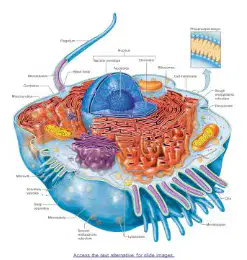
Which part of the composite cell contains genetic material and directs cell activities?
Cytoplasm
Nucleus
Cell membrane
Mitochondria
What is the main function of signal transduction in the cell membrane?
To store energy
To permit the cell to receive and respond to messages
To produce proteins
To divide the cell
Which component of the cell membrane helps stabilize the membrane and makes it less permeable to water-soluble substances?
Phospholipids
Cholesterol
Carbohydrates
Proteins
What is the main function of membrane proteins classified as "receptors"?
Establish self
Respond to extracellular signals
Enable cells to stick to each other
Catalyze chemical reactions
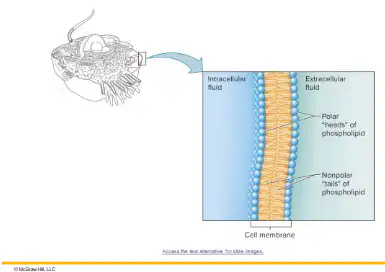
Which part of the phospholipid bilayer is hydrophilic?
The tails
The heads
The cholesterol molecules
The membrane proteins
Which of the following is a function of carbohydrates in the cell membrane?
Catalyze chemical reactions
Stabilize the membrane
Cell recognition and interaction
Transport small molecules
Mutations in which type of ion channel are associated with cystic fibrosis?
Sodium (Na+) channels
Potassium (K+) channels
Chloride (Cl-) channels
Calcium (Ca2+) channels
Which of the following best describes the function of cellular adhesion molecules (CAMs)?
Respond to extracellular signals
Enable cells to stick to each other
Catalyze chemical reactions
Transport small molecules and ions
How do selectins, a type of CAM, assist white blood cells?
By catalyzing chemical reactions
By providing friction to anchor them to capillary walls
By transporting ions across the membrane
By stabilizing the cell membrane
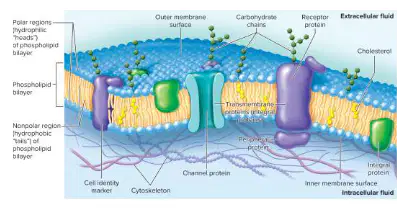
Why is the cell membrane described as having "fluid mosaic" properties?
Because it is made only of lipids
Because some lipids and proteins can move within the membrane
Because it is completely rigid
Because it contains only carbohydrates
Which of the following is NOT a function of membrane proteins?
Forming pores and channels
Acting as enzymes
Storing genetic information
Acting as receptors
A patient has a mutation in potassium (K+) channels. Which of the following symptoms might they experience?
Difficulty breathing and salty sweat
Disrupted heart rhythm and impaired hearing
Increased cell recognition
Enhanced cell adhesion
What is the main function of ribosomes in the cell?
Store genetic information
Provide structural support and enzyme activity to link amino acids in protein synthesis
Conduct lipid synthesis
Refine and package proteins
Which of the following best describes the cytoplasm?
Only the fluid portion inside the nucleus
The network of membranes and organelles suspended in cytosol
The outer membrane of the cell
Only the organelles inside the cell
What distinguishes rough endoplasmic reticulum (RER) from smooth endoplasmic reticulum (SER)?
RER contains ribosomes and conducts protein synthesis, while SER does not have ribosomes and conducts lipid synthesis
RER stores genetic material, while SER stores proteins
RER is found outside the cell, while SER is found inside the nucleus
RER is responsible for cell division, while SER is responsible for energy production
Which organelle is responsible for refining, packaging, and delivering proteins made on the rough ER?
Ribosome
Golgi Apparatus
Vesicle
Cytoskeleton
What is an example of organelle interaction mentioned in the material?
Photosynthesis in chloroplasts
Milk secretion involving rough and smooth ER, Golgi apparatus, and transport vesicles
DNA replication in the nucleus
Cellular respiration in mitochondria
Why is the cytoskeleton important in the cytoplasm?
It stores genetic information
It is a supporting framework of protein rods and tubules
It produces energy for the cell
It synthesizes proteins
How do vesicles function within the cell?
They synthesize proteins
They store or transport substances
They provide energy for the cell
They replicate DNA
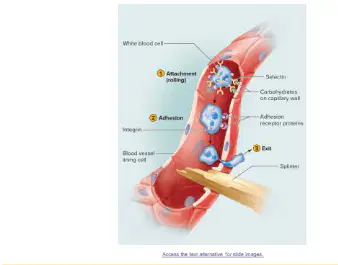
Which structure is depicted in Figure 3.7 and what is its primary function?
Mitochondria; energy production
Cellular Adhesion Molecules (CAMs); mediating cell-to-cell interactions
Ribosomes; protein synthesis
Nucleus; storing genetic material
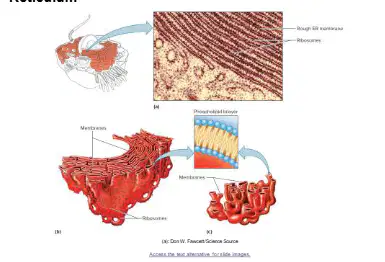
What does Figure 3.8 illustrate about the relationship between ribosomes and the endoplasmic reticulum?
Ribosomes are only found in the nucleus
Ribosomes are attached to the rough ER, facilitating protein synthesis
Ribosomes are responsible for lipid synthesis on the smooth ER
Ribosomes transport substances across the cell membrane
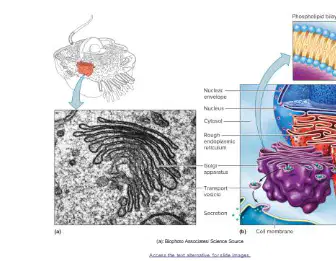
According to Figure 3.9, what is the role of the Golgi apparatus in relation to vesicles?
The Golgi apparatus breaks down vesicles
The Golgi apparatus refines, packages, and delivers proteins to vesicles for transport
The Golgi apparatus synthesizes DNA for vesicles
The Golgi apparatus stores energy for vesicles
Which organelle is known as the "powerhouse of the cell" because it is the site of ATP synthesis?
Mitochondria
Lysosomes
Peroxisomes
Nucleus
What is the primary function of lysosomes in a cell?
Digest proteins, carbohydrates, nucleic acids, bacteria, debris, and worn out cell parts
Produce ATP through cellular respiration
Support the nuclear envelope
Maintain cell shape
Which of the following best describes the function of peroxisomes?
Contain enzymes that digest lipids, alcohol, and hydrogen peroxide
Produce ribosomes for protein synthesis
Store genetic information
Transport proteins throughout the cell
Which cytoskeletal structure has the smallest diameter and is composed of actin?
Microfilaments
Microtubules
Intermediate filaments
Centrioles
What is the main role of microtubules in the cytoskeleton?
Maintain cell shape and help move organelles
Digest cellular debris
Produce ATP
Store calcium ions
Intermediate filaments are primarily responsible for which of the following?
Supporting the nuclear envelope
Producing energy
Digesting worn out cell parts
Synthesizing proteins
A scientist observes a cell structure that is a small membranous sac containing digestive enzymes. Which organelle is being observed?
Lysosome
Mitochondrion
Peroxisome
Ribosome
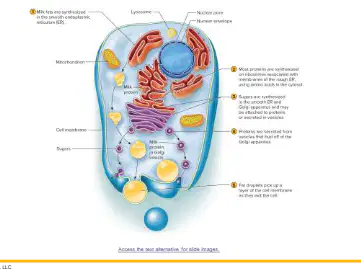
Which process is illustrated by the interaction of organelles in the milk secretion diagram?
Coordination of organelles to produce and secrete milk components
Photosynthesis in plant cells
DNA replication in the nucleus
Cell division by mitosis
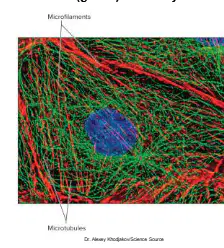
What does the micrograph with red and green filaments primarily illustrate?
The organization of microfilaments and microtubules in the cytoskeleton
The process of protein synthesis
The structure of the cell membrane
The replication of DNA
Which of the following statements best explains the importance of the cytoskeleton in eukaryotic cells?
It provides structural support, enables cellular movement, and organizes organelles within the cell.
It stores genetic information for the cell.
It produces energy through cellular respiration.
It digests cellular waste and debris.
What is the main function of centrioles during cell division?
They produce spindle fibers that distribute chromosomes to daughter cells.
They synthesize proteins for the cell.
They store genetic information.
They generate energy for the cell.
Where are centrosomes typically located within a cell?
In the cytoplasm, near the nucleus
Inside the mitochondria
On the cell membrane
In the endoplasmic reticulum
Which of the following best describes the structure of centrioles?
Cylindrical and composed of microtubules
Spherical and composed of actin
Flat and composed of lipids
Irregular and composed of DNA
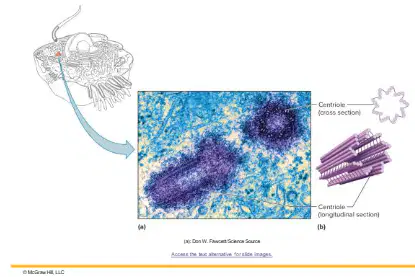
Which cellular structure is shown in Figure 3.15 and what is its primary role?
Centrosome; organizes microtubules and aids in cell division
Nucleus; stores genetic material
Mitochondrion; produces energy
Ribosome; synthesizes proteins
Which of the following statements about cilia is correct?
Cilia are mobile extensions of the cell membrane that beat back and forth in a coordinated manner.
Cilia are immobile and only found in plant cells.
Cilia are responsible for energy production in the cell.
Cilia store genetic information.
What is the main difference between cilia and flagella in human cells?
Flagella are much longer than cilia and each human cell has only one flagellum.
Cilia are longer than flagella and each cell has many flagella.
Flagella are found only in plant cells.
Cilia are responsible for cell division, while flagella are not.
What is the function of cilia in the respiratory tract?
Propel mucus toward the uterus
Absorb nutrients from food
Store fat for energy
Produce spindle fibers
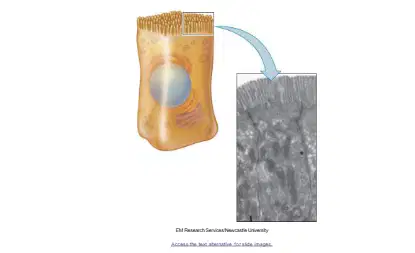
Which of the following best describes microvilli?
Tiny extensions of the cell membrane that increase surface area for absorption
Large organelles that store water
Structures that produce energy for the cell
Extensions that help the cell move
What are inclusions in the context of cytoplasmic structures?
Chemicals not necessary for survival, present only in some types of cells
Essential organelles for cell survival
Structures that produce proteins
Extensions that help the cell divide
Which of the following is an example of an inclusion found in cells?
Melanin granules in epidermal cells
Ribosomes in the cytoplasm
Mitochondria in muscle cells
Nuclei in red blood cells
Which disease is caused by a mutant gene in the DNA of mitochondria, resulting in the inability to extract maximum energy from nutrients?
Melas
Krabbe Disease
Adrenoleukodystrophy (ADL)
Cystic Fibrosis
What is the primary function of the nuclear envelope in a cell?
Surrounds the nucleus with a double-layered membrane and separates nucleoplasm from cytoplasm
Produces ribosomes for protein synthesis
Stores genetic information in chromosomes
Synthesizes myelin for nerve cells
Which structure within the nucleus is responsible for the production of ribosomes?
Nucleolus
Chromatin
Nuclear envelope
Mitochondria
What is the main cause of Krabbe Disease at the organelle level?
Inability to produce one lysosomal enzyme
Fatty acid buildup in peroxisomes
Mutant gene in mitochondrial DNA
Lack of protein in the nuclear envelope
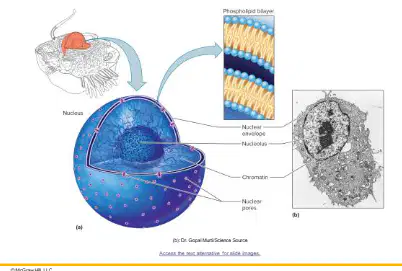
Which part of the cell nucleus is responsible for storing information for protein synthesis?
Chromatin
Nucleolus
Nuclear envelope
Mitochondria
Which of the following is NOT a physical (passive) mechanism for movement across cell membranes?
Active transport
Diffusion
Osmosis
Facilitated diffusion
What happens when a sugar cube dissolves in water, according to the concept of diffusion?
Sugar molecules move from a region of higher concentration to a region of lower concentration
Water molecules move from a region of lower concentration to a region of higher concentration
Sugar molecules are actively transported into the water
Water molecules are converted into sugar molecules
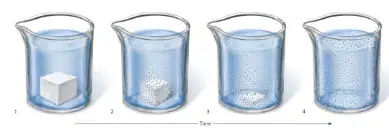
What does the process illustrated in the beakers demonstrate?
Diffusion
Osmosis
Filtration
Active transport
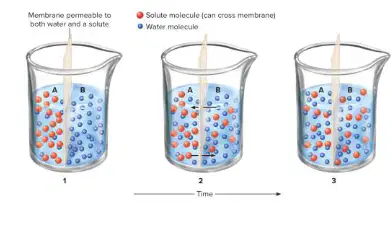
What is the final result when both water and solute can diffuse across a membrane?
Concentrations of water and solute become equal in both compartments
Only water moves to the other side
Only solute moves to the other side
No movement occurs
Which of the following best describes the movement of atoms, molecules, or ions during diffusion?
From a region of higher concentration to a region of lower concentration
From a region of lower concentration to a region of higher concentration
Randomly in all directions with no net movement
Only through active transport mechanisms
Which of the following best describes facilitated diffusion?
Movement of water across a selectively permeable membrane
Diffusion across the cell membrane through membrane proteins, such as ion channels or transporters
Active transport requiring ATP
Movement of gases only across the membrane
Which substances are typically transported by facilitated diffusion?
Lipid-soluble substances
Water-soluble substances like Na+, K+, Cl-, glucose, and amino acids
Only oxygen and carbon dioxide
Only large proteins
What is the main difference between osmosis and simple diffusion?
Osmosis involves the movement of solutes, while diffusion involves water
Osmosis involves the movement of water, while diffusion involves solutes
Both involve the movement of water only
Both require ATP to occur
Which statement about osmosis is correct?
Osmosis requires ATP to move water across the membrane
Water moves from a region of lower solute concentration to higher solute concentration
Water moves from a region of higher solute concentration to lower solute concentration
Osmosis only occurs in plant cells
What is the function of aquaporins in the cell membrane?
They transport ions across the membrane
They allow water to move through the membrane
They synthesize ATP
They break down proteins
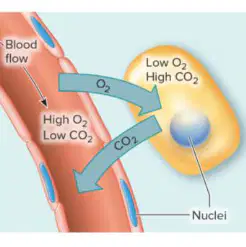
Based on the diagram, what is the direction of oxygen and carbon dioxide movement between blood and cells?
Oxygen moves from cells to blood; carbon dioxide moves from blood to cells
Oxygen and carbon dioxide both move from blood to cells
Oxygen moves from blood to cells; carbon dioxide moves from cells to blood
Both gases move in both directions equally
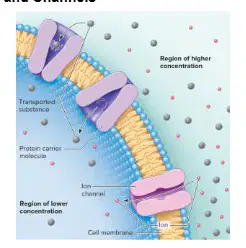
Why are carrier molecules or channels necessary for facilitated diffusion?
They provide energy for transport
They allow lipid-soluble substances to pass through
They help water-soluble substances cross the selectively permeable membrane
They block all substances from entering the cell
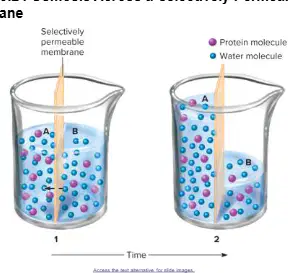
What happens to water movement when a cell is placed in a hypertonic solution?
Water moves into the cell, causing it to swell
Water moves out of the cell, causing it to shrink
There is no net movement of water
Water moves equally in both directions
Which of the following best defines isotonic solution?
Solution with higher osmotic pressure than the cell
Solution with lower osmotic pressure than the cell
Solution with the same osmotic pressure as the cell; no net gain or loss of water
Solution that causes the cell to burst
How does osmotic pressure change as the concentration of impermeant solutes increases in a solution?
Osmotic pressure decreases
Osmotic pressure remains the same
Osmotic pressure increases
Osmotic pressure fluctuates randomly
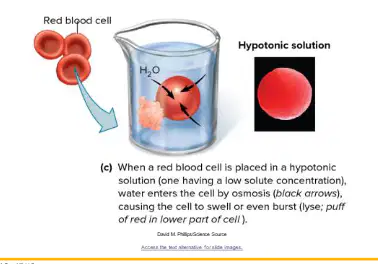
What happens to a red blood cell when it is placed in a hypotonic solution?
The cell shrinks due to water loss.
The cell remains unchanged.
The cell swells as water enters by osmosis.
The cell divides into two.
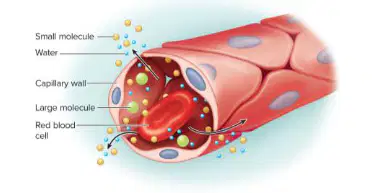
Which of the following best describes the process of filtration in biological systems?
Movement of molecules against a concentration gradient using ATP.
Movement of molecules through membranes by exerting pressure.
Movement of water only through a membrane.
Movement of molecules by carrier proteins only.
Which of the following is NOT an active mechanism for moving substances across the cell membrane?
Filtration
Active transport
Endocytosis
Exocytosis
Which statement about active transport is correct?
It is a passive process that does not require ATP.
It moves substances from high to low concentration.
It uses carrier molecules called "pumps" and requires ATP.
It only transports water molecules.
In secondary active transport, what is used to transport another substance across a cell membrane?
ATP directly
A Na+ gradient
Simple diffusion
Filtration pressure
Why are large plasma proteins and blood cells not filtered out of capillaries during filtration?
They are too small to be retained.
They are actively transported out.
They are too large to pass through the membrane.
They dissolve in water and pass through easily.
Which of the following processes requires cellular energy in the form of ATP?
Filtration
Osmosis
Active transport
Simple diffusion
Which process involves the movement of a substance into the cell inside a vesicle?
Exocytosis
Endocytosis
Diffusion
Osmosis
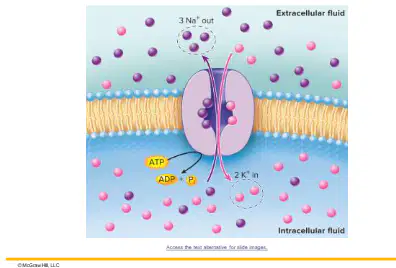
What is the main function of the Na+-K+ ATPase pump?
To transport glucose into the cell
To move sodium out of the cell and potassium into the cell using ATP
To allow water to move freely across the membrane
To engulf solid particles
Which type of endocytosis involves the membrane engulfing droplets of liquid?
Phagocytosis
Pinocytosis
Receptor-mediated endocytosis
Exocytosis
What distinguishes receptor-mediated endocytosis from other types of endocytosis?
It engulfs solid particles
It engulfs droplets of liquid
It involves specific substances binding to receptor proteins on the membrane
It releases substances from the cell
Which process is described as the release of substances or particles from the cell by vesicles fusing with the cell membrane?
Endocytosis
Pinocytosis
Exocytosis
Phagocytosis
Transcytosis is best described as:
The engulfing of solid particles by the membrane
The movement of water across a membrane
The transport of substances across barriers formed by tightly connected cells
The release of neurotransmitters from nerve cells
Which of the following is an example of exocytosis?
Transport of HIV across the lining of the anus or vagina
Release of neurotransmitters from nerve cells
Engulfing of bacteria by white blood cells
Movement of glucose into the cell
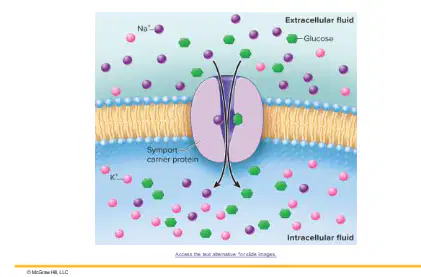
How does secondary active transport differ from primary active transport?
Secondary active transport uses ATP directly, while primary does not
Primary active transport uses ATP directly, while secondary uses the energy from an ion gradient
Both use ATP directly
Neither uses ATP
Which type of endocytosis is responsible for engulfing solid particles?
Pinocytosis
Phagocytosis
Receptor-mediated endocytosis
Exocytosis
What is the main role of vesicles in exocytosis?
To engulf bacteria
To transport substances into the cell
To fuse with the cell membrane and release contents outside the cell
To bind to receptor proteins
What is the main function of mitosis in the cell cycle?
Growth of the cell
Division of the nucleus
Replication of DNA
Division of the cytoplasm
During which phase of interphase is DNA replicated?
G₁ phase
G₂ phase
S phase
M phase
Which of the following best describes cytokinesis?
Division of the nucleus
Growth of the cell
Division of the cytoplasm
Replication of DNA
Which phase of mitosis involves chromosomes aligning at the cell's equator?
Prophase
Metaphase
Anaphase
Telophase
What happens during prophase of mitosis?
Chromosomes align at the center of the cell
Chromosomes condense, centrioles move to opposite sides, and the nuclear envelope disperses
Chromosomes separate and move to opposite directions
Nuclear envelope reforms around chromosomes
Why is interphase important in the cell cycle?
It is when the cell divides into two daughter cells
It is when the cell grows and prepares for division by replicating DNA and duplicating organelles
It is when chromosomes condense and spindle fibers form
It is when the nuclear envelope reforms
Which of the following is NOT a phase of mitosis?
Prophase
Metaphase
Cytokinesis
Telophase
A scientist observes a cell with chromosomes moving toward opposite centrioles as spindle fibers shorten. Which phase of mitosis is being observed?
Prophase
Metaphase
Anaphase
Telophase
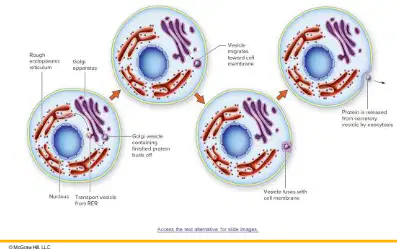
Which process is illustrated by vesicles fusing with the plasma membrane to release their contents outside the cell?
Endocytosis
Exocytosis
Phagocytosis
Pinocytosis
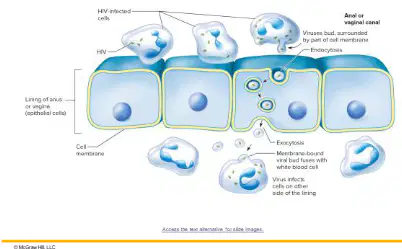
What is the main purpose of transcytosis in cells?
To divide the nucleus
To move substances across a cell using vesicles
To replicate DNA
To condense chromosomes
Which stage of the cell cycle involves the division of the cytoplasm?
Interphase
Mitosis
Cytokinesis
S phase
Which stage of mitosis involves chromosomes condensing into chromosomes, centrioles moving to opposite sides of the cytoplasm, and the nuclear envelope and nucleolus dispersing?
Metaphase
Anaphase
Prophase
Telophase
During which stage of mitosis do spindle fibers attach to the centromeres of the sister chromatids and chromosomes align midway between the centrioles?
Prophase
Metaphase
Anaphase
Telophase
The study of the structure/morphology of the human body parts and its part (derived from Greek for cutting up)
Anatomy
Physiology
The study of the functions of the human body and its part (derived from Greek for "relationship to nature"
Anatomy
Physiology
Clinical Application High frequency sound waves that provide images of soft internal structures; used to obtain sonogram of fetus in uterus
Ultrasound
Magnetic Resonance Scan (MR)
The sum of all chemical reactions in a living system, energy production and nutrient cycling
Excretion
Circulation
Metabolism
repiration
making energy, most organisms do it by taking in oxygen and giving off carbon dioxide
digestion
excertion
respiration
moving chemicals and cells through the body fluids
Circulation
Digestive
Excretion
metabloism
removing waste products
excretion
digestion
metabolism
What is the most abundant substances in body
water
food
oxygen

