
 Worksheets
Unit 2 Biology (Cell Biology)
Total questions: 122
Worksheet time: 1hrs 25mins
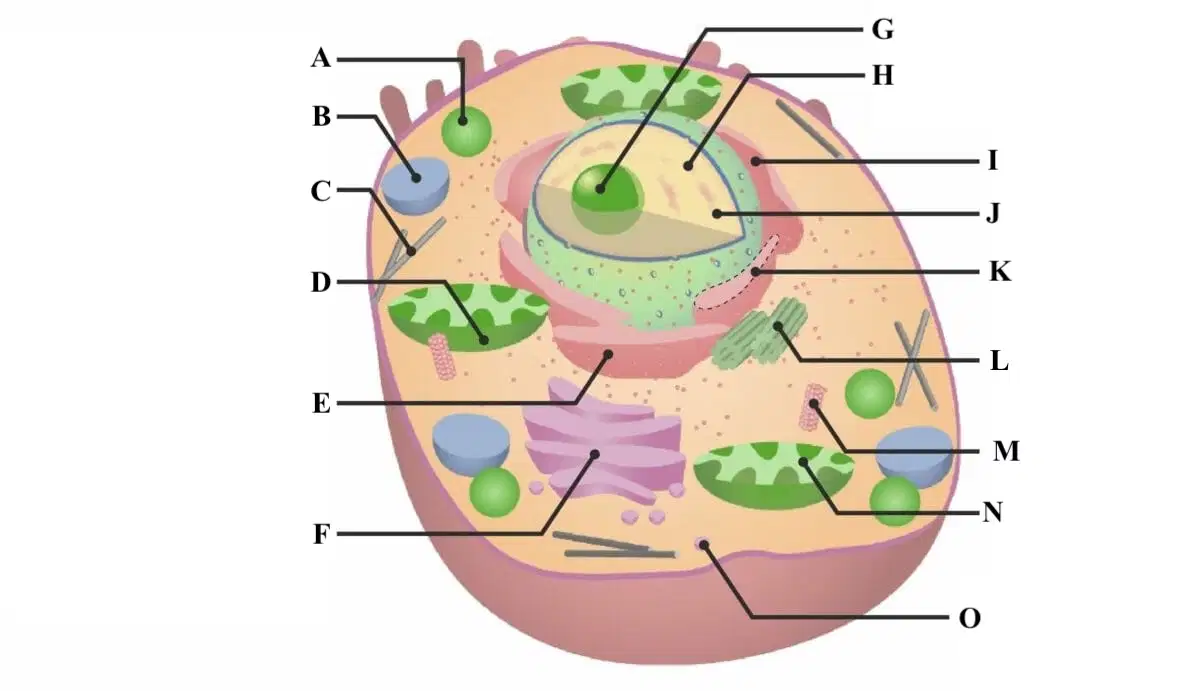
Which organelle contains chromatin?
A
D
G
H
Which organelle modifies and secretes proteins?
F
K
O
G
Which organelle is responsible for aerobic cellular respiration?
D
E
B
K
Which organelle is responsible lipid and steroid synthesis?
E
B
I
F
Which organelle is responsible for packaging and prepping proteins to be sent to the Golgi Apparatus?
E
B
I
F
Which organelle is responsible for packaging and prepping proteins and lipids to be secreted out of the cell?
E
B
I
F
Which organelle is responsible for the movement of chromosomes during cell division?
A
L
B
C
In a plant cell, DNA may be found ___.
only in the nucleus and chloroplasts
only in the nucleus
in the nucleus, chloroplasts, mitochondria, and peroxisomes
in the nucleus, mitochondria, and the chloroplasts
Grana, thylakoids, and the stroma are all components found in what organelle?
mitochondria
golgi body
lysosomes
chloroplast
What factor limits the size of most cells?
nuclear envelope to nucleus ratio
surface volume to density ratio
surface area to volume ratio
number of chloroplasts
Fibrous proteins and polysaccharides form an external layer around the cell called ______ that supports, anchors and separates animal cells.
plasma membrane
capsule
extracellular matrix
cell wall
Which of the following are not found on or in a prokaryotic cell?
mitochondria
cell membrane
ribosome
flagella
You have a partial inventory of the components found inside an unlabeled biological sample. The inventory contains the following items: enzymes, DNA, ribosomes, plasma membrane, and mitochondria. Based on this information, the cells could be from____.
plant cells & animal cells
plant cells, but not animal cells
any organism
animal cells, but not plant cells
Plasmodesmata in plant cells are similar to what structure found in animal cells?
tight junctions
gap junctions
desmosomes
peroxisomes
Which of the following is the most common pathway taken by a newly synthesized protein that will be secreted by a cell?
rough ER → lysosome → transport vesicle → plasma membrane
Golgi → rough ER → lysosome → transport vesicle → plasma membrane
rough ER → Golgi → transport vesicle → nucleus
rough ER → Golgi → transport vesicle → plasma membrane
Which organelle is the primary site of ATP synthesis in eukaryotic cells?
Golgi apparatus
mitochondrion
lysosome
peroxisome
Which of the following organelles have all of the following components: thylakoids, DNA, and ribosomes.
nuclei
lysosomes
chloroplasts
mitochondria
Which of the following relationships between cell structures and their respective functions is correct?
lysosomes: formation of ATP
cell wall: support and protection
ribosomes: secretion of biomolecules
chloroplasts: sites of cellular respiration
Which of the following types of molecules are major structural components of the cell membrane?
nucleic acids
proteins
carbohydrates
phospholipids
Cyanide binds to at least one molecule involved in producing ATP. If a cell is exposed to cyanide, most of the cyanide will be found within the ______
lysosome
chloroplast
ribosome
mitochondria
Organelle responsible for breaking down H2O2, which is toxic to the cell
nuclear pore
peroxisome
lysosome
vesicle
nuclear envelope
Organelle that allows material to enter and exit the nucleus
nuclear pore
peroxisome
lysosome
vesicle
nuclear envelope
Organelle that contains digestive enzymes
nuclear pore
peroxisome
lysosome
vesicle
nuclear envelope
Organelle that is responsible for moving a modified protein to the cell membrane for secretion
nuclear pore
peroxisome
lysosome
vesicle
nuclear envelope
Ions can travel directly from the cytoplasm of one animal cell to the cytoplasm of an adjacent cell through ________.
gap junctions
plasmodesmata
desmosomes
tight junctions
A defect in which of the following intercellular junctions would allow partially digested material to leak passively between the cells of the small intestine into the abdominal cavity?
desmosomes
tight junctions
gap junctions
plasmodesmata
The mitochondrion, like the nucleus, has two or more membrane layers. How is the innermost layer different from that of a nucleus?
The space between the two layers of the nuclear membrane is larger
The two membranes serve the same function since they are comprised of all the same components
The inner mitochondrial membrane is highly folded
The inner membrane of the mitochondria is separated into thylakoids
If an individual has abnormal microtubules, due to an inherited condition, which of the following symptoms would be expected?
poor sperm movement causing infertility
defects in muscle contraction
fragile and brittle fingernails and hair
all these symptoms could be expected within this individual
A scientist is performing experiments with lysosomal enzymes that perform best at a pH of 4.5. She performs the test with one enzyme and uses a pH of 7.4 for the reaction, but she observes no enzyme activity. What is the best explanation for this result?
The increase of H+ concentration at pH 7.4 denatures the enzyme
The decrease of H+ concentration at pH 7.4 denatures the enzyme
The H+ concentration at pH 7.4 did not change or denature the enzyme
These enzymes are sexist
Which organelle often takes up much of the volume of a plant cell?
golgi apparatus
central vacuole
lysosome
chloroplast
Tay-Sachs disease is a human genetic abnormality that results in brain cells accumulating and becoming clogged with very large, complex, undigested lipids stored in vesicles. Which cellular organelle is most likely defective in this condition?
the rough endoplasmic reticulum
the Golgi apparatus
the smooth endoplasmic reticulum
the lysosome
The liver is involved in detoxification of many poisons and drugs. Which of the following structures is primarily involved in this process and, therefore, abundant in liver cells?
smooth endoplasmic reticulum
rough endoplasmic reticulum
nuclear envelope
Golgi apparatus
A patient has had a serious accident and lost a lot of blood. In a rushed attempt to replenish bodily fluids, pure distilled water, equal to the volume of blood lost, is transferred directly into one of his veins. Remembering that cells have approximately 1% solute, what will be a likely result of this transfusion?
The patient's red blood cells will swell (and maybe undergo hemolysis) because the blood fluid is now hypotonic compared to the inside of the cells.
The patient's red blood cells will shrivel (crenate) because the blood fluid is now isotonic compared to the inside of the cells.
It is not predicted to have any unfavorable effects.
The patient's red blood cells will swell (and maybe undergo plasmolysis) because the blood fluid is now hypertonic compared to the inside of the cells.
Which of the following factors would tend to increase membrane fluidity?
a lower temperature
a greater proportion of saturated phospholipids
a relatively high protein content in the membrane
a greater proportion of unsaturated phospholipids
The electrochemical gradient across the plasma membrane of most of the cells in the human body is established and maintained by which of the following?
simple diffusion of H+
osmosis
facilitated diffusion via glucose carrier proteins
active transport via the Na+ and K+ pump
A defect in which of the following molecules would dramatically reduce the rate of diffusion of water across the cell membrane?
ATP
Ion Channel
Sodium-Potassium Pump
Aquaporin
Secretion of proteins is accomplished by what process?
phagocytosis
pinocytosis
exocytosis
osmosis
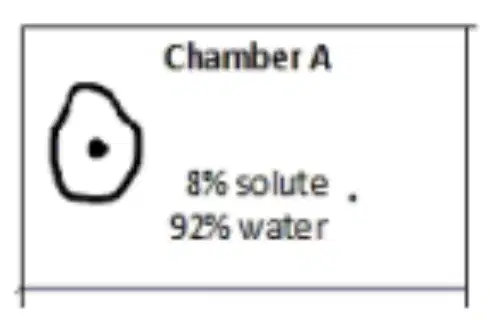
This animal cell solution at homeostasis is 1% solute and 99% water. Compare the solution in Chamber A to the animal cell. The solution is considered ________ to the cell.
hypertonic
hypotonic
neitherisotonic
This animal cell solution at homeostasis is 1% solute and 99% water. If you put this animal cell into the solution in chamber A with 8% solute and 92% water, in which direction would osmosis take place?
into the cell
out of the cell
neither
Which of the following is a correct statement about diffusion?
It’s an active process in which molecules move from a lower concentration region to a higher concentration region
It’s a passive process in which molecules move from a higher concentration region to a lower concentration region
A carrier protein must always be present for it to occur
it requires an expenditure of energy by the cell
Which of the following changes would produce a faster rate of osmosis?
increase in temperature
decrease in concentration gradient
decrease in temperature
elimination of concentration gradient
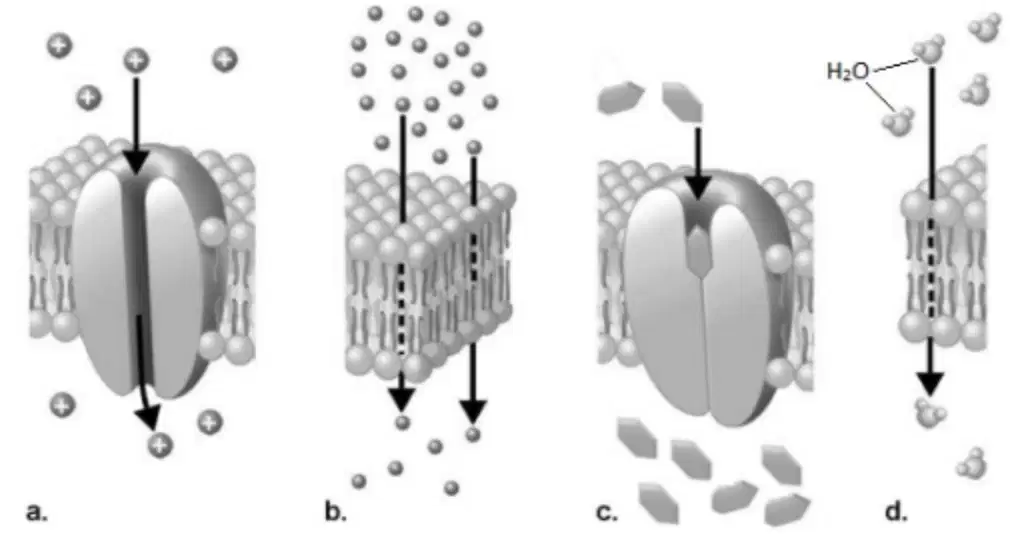
Which illustration best represents facilitated diffusion?
a
b
c
d
Which illustration best represents simple diffusion?
a
b
c
d
Which illustration best represents active transport?
a
b
c
d
Which illustration best represents osmosis?
a
b
c
d

The diagram below represents a portion of a cell membrane.
The arrow indicates that the cell membrane is carrying out the process of __________.
respiration
diffusion
facilitated difusion
active transport
Glucose normally diffuses very slowly through phospholipid bilayers on its own. The cells lining of the small intestine, however, rapidly move large quantities of glucose from the glucose-rich food (an area of high glucose concentration) into their glucose-poor cytoplasm (an area of low glucose concentration). Based on these observations, which transport mechanism is MOST likely used by the intestinal cells to absorb glucose?
simple diffusion
facilitated diffusion
active transport
exocytosis

Which letter represents the polar (hydrophilic) region of phospholipid?
A
B
C
D
E
Which letter represents the nonpolar (hydrophobic) region of phospholipid?
A
B
C
D
E
Which letter represents the integral membrane protein
A
B
C
D
E
Which letter represents the peripheral membrane protein?
A
B
C
D
E
Which of the following would be BEST able to cross the plasma membrane on its own by simple diffusion?
K+ ion
hemoglobin
O2
starch
Which of the following processes includes all the others?
osmosis
diffusion of a solute across a membrane
passive transport
transport of an ion down its electrochemical gradient
A bacterium engulfed by a white blood cell through phagocytosis will be digested by enzymes contained in ________.
vacuoles
lysosomes
secretory vesicles
Golgi vesicles
White blood cells engulf bacteria using ________.
pinocytosis
phagocytosis
osmosis
receptor-mediated exocytosis
What organelle maintains turgor pressure inside plant cells?
cell wall
chloroplast
central vacole
golgi apparatus
Which of the following is a correct statement about diffusion?
It’s an active process in which molecules move from a lower concentration region to a higher concentration region
It’s a passive process in which molecules move from a higher concentration region to a lower concentration region
A carrier protein must always be present for it to occur
it requires an expenditure of energy by the cell
The diagram below represents a portion of a cell membrane.
The arrow indicates that the cell membrane is carrying out the process of __________.
respiration
diffusion
facilitated difusion
active transport

A diagram of a cell is shown. The cell membrane is permeable to both carbon dioxide and oxygen.
Initially the oxygen and carbon dioxide will likely move in which direction?
Oxygen will enter the cell, and carbon dioxide will exit the cell.
Oxygen will exit the cell, and carbon dioxide will enter the cell.
Both oxygen and carbon dioxide will enter the cell.
Both oxygen and carbon dioxide will exit the cell.

What type of transport is shown in the diagram?
Ion pump
Facilitated diffusion
Endocytosis
Exocytosis
The rate of diffusion through a semipermeable membrane will be lowest when which of the following is (are) true?
I. Concentration gradients are steep
II. Temperatures are low
III. Solutes are small molecules
I only
II only
I and III only
II and III
I, II, and III
When a patient is admitted to the hospital and needs to be placed on intravenous (IV) fluids, its important that these fluids are at an isotonic (equal in concentration) concentration to their own body's fluids.
If the saline (salt) concentration of the body's fluids is 0.9
percent, what should be the concentration of IV saline solution administered to a patient?
0.9%
greater than 0.9%
less than 0.9%

The SARS-CoV2 virus binds to the ACE-2 receptor on the outside of a cell. Once it binds, it is brought into the cell inside a vesicle. What kind of transport does this describe?
Receptor-mediated endocytosis
Exocytosis
Facilitated diffusion
Pinocytosis
Proton pump inhibitors (PPI) irreversibly block the functioning of proton pumps in the cell membrane that use ATP to move H+ into the extracellular fluid from the cytoplasm. Which of the following would you expect to observe in a cell that has been treated with PPI?
An increase in the activity of secondary active transporters that are powered by an H+ concentration gradient.
Which of the following is an example of primary active transport?
ATP synthase uses an H+ concentration gradient to produce ATP
The sodium-potassium pump moves uses the hydrolysis of ATP to move Na and K across the membrane against their gradients
Aquaporins allow increased movement of water across the cell membrane down its concentration gradient.
Glucose co-transporter moves glucose against its concentration gradient using the movement of Na+ ions along their gradient.
Which of the following is an example of active transport.
The movement of H+ ions through channels along their concentration gradient
The movement of water out of the cell in a hypertonic environment
Amoebae move by crawling over a surface (cell crawling), which involves ________.
assembly of microtubule extensions that vesicles can follow in the direction of movement
reinforcement of the pseudopod with intermediate filaments
growth of actin filaments to form bulges in the plasma membrane.
localized contractions driven by myosin and microtubules
A characteristic 9 + 2 arrangement of microtubules, consisting of nine doublets of microtubules surrounding a pair of single microtubules is associated with ________.
eukaryotic flagella and motile cilia
centrioles and basal bodies
eukaryotic flagella, motile cilia, and nonmotile cilia
bacterial flagella
You have a partial inventory of the components found inside an unlabeled biological sample. The inventory contains the following items: enzymes, DNA, ribosomes, plasma membrane, and mitochondria. Based on this information, the cells could be from____.
plant cells & animal cells
plant cells, but not animal cells
any organism
animal cells, but not plant cells
Where are ribosomes assembled?
nucleus
nucleolus
mitochondria
DNA
White blood cells and amoebas engulf bacteria through what process?
exocytosis
osmosis
pinocytosis
phagocytosis
Zn2+ (zinc), an inorganic metal ion, is normally present in the active site of the enzyme carboxypeptidase. The Zn2+ most likely functions as a:
noncompetitive inhibitor of the enzyme
competitive inhibitor of the enzyme
coenzyme derived from a vitamin
cofactor necessary for enzyme activity
A red blood cell placed into a hypotonic solution will potentially undergo which of the following processes?
plasmolysis
crenation
hemolysis
nothing
Which of the following relationships between cell structures and their respective functions is correct?
ribosomes: secretion of lipids
cell wall: support, protection
chloroplasts: chief sites of cellular respiration
lysosomes: formation of ATP
What are the membrane structures that function in active transport?
carbohydrates
cholesterol
cytoskeleton filaments
integral proteins
Which of the following are NOT found on/in any prokaryotic cell?
capsule
nucleic acids
membrane-bound organelles
cell walls
Which of the following is a correct statement about diffusion?
A carrier protein must be present for it to occur.
It requires an expenditure of energy by the cell.
It is a passive process in which molecules move from a region of higher concentration to one of lower concentration.
It is an active process in which molecules move from a region of lower concentration to one of higher concentration.
The electrochemical gradient across the plasma membrane of most of the cells in the human body is established and maintained by the Na+-K+ pump moving ions AGAINST THEIR CONCENTRATION GRADIENTS. This is an example of which of the following?
osmosis
simple diffusion
active transport
passive transport
Secretion of proteins is accomplished by what process?
exocytosis
pinocytosis
phagocytosis
osmosis
Which of the following types of molecules are the major structural components of the plasma membrane?
phospholipids and proteins
proteins and cellulose
phospholipids and cellulose
nucleic acids and proteins
Animal cells have all of the following components EXCEPT
plasma membrane
cell walls
mitochondria
ribosomes
All organisms are composed of at least one cell. This is a central part of the
Fluid-Mosaic Model
Laws of Thermodynamics
Cell Theory
Theory of Endosymbiosis
In addition to a plasma membrane, a eukaryotic cell has organelles, such as mitochondria, that also have membranes. In which way would these membranes differ?
The proportion of phosphate within the phospholipids will vary.
Only certain membranes contain phospholipids.
Only certain membranes are selectively permeable.
The proportions of proteins, lipids, and carbohydrates will vary.

Which characteristic of a phospholipid, shown here, increases the fluidity of the membrane?
cholesterol
its head
saturated fatty acid tail
double bonds in the fatty acid tail
How would an organism maintain membrane fluidity in an environment where temperatures fluctuated from very high to very low?
Greater proportion of unsaturated phospholipids in membranes.
Greater proportion of saturated phospholipids in membranes.
Greater proportion of carbohydrates in membranes.
Greater proportion of proteins in membranes.

Identify the principal driving movement in diffusion, such as depicted here.
concentration gradient
membrane surface area
particle size
temperature
Which of the following is an example of passive transport across a membrane?
the movement of H+ into a thylakoid disc during photosynthesis
the uptake of glucose in the intestine
the uptake of mineral ions into root hair cells of plants
the movement of water from the descending loop of a nephron into the interstitium
Water moves via osmosis across plasma cell membranes in which direction?
from an area with a high concentration of other solutes to a lower one
from an area with a high concentration of water to one of lower concentration
from an area with a low concentration of water to one of higher concentration.
throughout the cytoplasm
What problem is faced by organisms that live in fresh water?
They will have higher concentrations of body solutes.
Without compensating mechanisms, their bodies tend to take in too much water.
They have no way of controlling their tonicity.
Their bodies tend to lose too much water to their environment.
Why must active transport of molecules across plasma membranes function continuously?
Diffusion cannot occur in certain cells.
Diffusion is constantly moving solutes in opposite directions.
Facilitated diffusion works in the same direction as active transport.
Not all membranes are amphiphilic.
Which explanation identifies how the following affect the rate of diffusion: molecular size, temperature, solution density, and the distance that must be traveled?
Larger molecules move faster than lighter molecules. Temperature affects the molecular movement. Density is directly proportional to the molecular movement. Greater distance slows the diffusion.
Larger molecules move slower than lighter molecules. Increasing or decreasing temperature increases or decreases the energy in the medium, affecting molecular movement. Density is inversely proportional to molecular movement. Greater distance slows the diffusion.
Larger molecules move slower than lighter molecules. Temperature does not affect the rate of diffusion. Density is inversely proportional to molecular movement. Greater distance speeds up the diffusion.
Larger molecules move slower than lighter molecules. Increasing or decreasing temperature increases or decreases the energy in the medium, affecting molecular movement. Density is inversely proportional to the molecular movement. Greater distance speeds up the diffusion.
Describe the difference between rough ER and smooth ER.
Rough ER compartmentalizes cell; Smooth ER functions in detox and lipid synthesis
Rough ER functions in ribosome synthesis; Smooth ER functions in lipid synthesis
Rough ER functions in detox and lipid synthesis; Smooth ER compartmentalizes cell
Rough ER functions in lipid synthesis; Smooth ER functions in ribosome synthesis
What is the difference between endocytosis and exocytosis?
Endocytosis involves cytoplasm of a neighboring cell entering
Endocytosis involves phagocytosis or pinocytosis to bring materials in cell
Exocytosis involves cytoplasm of a neighboring cell exiting
Exocytosis involves phagocytosis or pinocytosis to remove material from cell
Why is a eukaryotic cell able to be larger than a prokaryotic cell?
Membrane-bound organelles compartmentalize intracellular processes
Prokaryotic cells have a nucleus which decreases the volume of the cell
Eukaryotic cells have a nucleus which decreases the volume of the cell
Absence of membrane-bound organelles allows for enzymatic reactions.


What is the primary function of the Rough Endoplasmic Reticulum?
The Rough ER is primarily involved in the synthesis of proteins.
The Rough ER is responsible for lipid synthesis.
The Rough ER plays a key role in energy production.
The Rough ER is involved in the detoxification of drugs.
What is the relationship between the nucleus and protein synthesis?
The nucleus is where mRNA is synthesized, which is essential for protein synthesis.
The nucleus is responsible for the degradation of proteins after synthesis.
The nucleus produces ribosomes that directly synthesize proteins.
The nucleus stores proteins until they are needed by the cell.
What is the difference between passive and active transport?
Passive transport requires energy to move substances against their gradient, while active transport does not require energy and moves substances down their concentration gradient.
Passive transport does not require energy and moves substances down their concentration gradient, while active transport requires energy to move substances against their gradient.
Both passive and active transport require energy to move substances.
Passive transport moves substances against their gradient, while active transport moves substances down their concentration gradient.
Explain the term 'amphiphilic'.
Molecules that are only hydrophilic and do not interact with water.
Molecules that have both hydrophilic (water-attracting) and hydrophobic (water-repelling) parts.
Molecules that repel both water and oil.
Molecules that are only hydrophobic and do not interact with water.
What is the role of ribosomes in the cell?
Ribosomes are responsible for synthesizing proteins by translating messenger RNA (mRNA).
Ribosomes are involved in the breakdown of cellular waste.
Ribosomes are responsible for energy production in the cell.
Ribosomes help in the replication of DNA.
You are a doctor. A patient comes in dehydrated. What type of solution would be best to place into their IV?
A hypotonic solution to allow the cells to rehydrate.
A slightly hypertonic solution to allow the cells to rehydrate.
An isotonic solution to increase fluid in the body without causing harm to the cells.
An isotonic solution to decrease fluid in the body without causing harm to the cells.

The Endosymbiotic Theory explains
the origin of prokaryotes
how bacteria lives
the origin of eukaryotes
how species develop

Two students are reading an article about the evidence of the endosymbiotic theory. As they are reading, they have drawn images of what they believe to be occurring on index cards. The two students are engaging in a discussion on how the index cards should be ordered to accurately show the evolution of eukaryotic cells.
Student A claims the order should be B, E, D, A, C. Their reasoning is that since the small circles without lines in the index cards represent chloroplasts, photosynthesizing organisms evolved before aerobic organisms.
Student B claims the order should be B, A, C, E, D. Their reasoning is that since the small ovals with lines in the index cards represent mitochondria, respiratory organisms evolved before photosynthesizing organisms
Use the diagram to answer the question. Which statement below is accurate about the discussion above?
student A has a correct ordering of index cards but incorrect reasoning.
student B has a correct ordering of index cards and correct reasoning.
Student A has a correct ordering of index cards and correct reasoning.
Student B has a correct ordering of index cards but incorrect reasoning.
Which of the following is evidence to support the endosymbiotic theory?
Mitochondria and chloroplasts have their own DNA, which is similar to prokaryotic DNA.
Fossil evidence shows that the first forms of life were prokaryotic cells.
All eukaryotic cells have a double-layered membrane composed of phosplipids and proteins.
Prokaryotes have the same number and types of enzymes as eukaryotes.

This a picture of an animal and plant cell placed in a solution. Describe the solution?
Isotonic
Hypotonic
Hypertonic
Which organelle uses digestive enzymes to break down old cellular components and/or invading bacteria/virsus and recycles those components to other organelles for use in building new macromolecules?
Gap junction
Nucleus
Golgi Body
Lysosome
Cystic fibrosis is a genetic condition that is associated with defects in the CFTR protein found in the membrane. After being synthesized, where does it go to be modified, packaged, and sorted?
Golgi Bodies
Rough ER
Smooth ER
Lysosome

Aria is studying how nutrients enter cells and is curious about which part of the cell membrane is responsible for getting large or charged (polar) molecules across. Which of the following should she focus on?
E
B
C
D
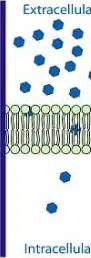
In the diagram above, indicate which side of the membrane shows the higher concentration of molecules.
The extracellular space shows the higher concentration of molecules.
The intracellular space shows the higher concentration of molecules.
Both sides have equal concentrations of molecules.
Neither side has any molecules.
An animal cell lacking in carbohydrates on the external surface of its plasma membrane would likely be impaired in which function?
transporting ions against an electrochemical gradient
cell-cell recognition
attaching the plasma membrane to the cytoskeleton
establishing a diffusion barrier to charged molecules
Which of the following membrane activities requires energy from ATP?
Facilitated diffusion of chloride ions through a chloride channel.
Movement of Na+ ions from lower concentration in a mammalian cell to a higher concentration in the extracellular fluid.
Movement of glucose molecules into a bacteria cell from a medium containing a higher concentration of glucose than inside the cell.
Movement of carbon dioxide out of a paramecium.
Which of the following factors would tend to increase membrane fluidity?
a greater proportion of unsaturated phospholipids
a greater proportion of saturated phospholipids
a lower temperature
a relatively high protein content in the membrane
White blood cells engulf bacteria using _______________.
phagocytosis
pinocytosis
osmosis
receptor-mediated exocytosis
Which substance would most easily pass through the cell membrane?
Oxygen
Glucose
Sodium ions
Water

