Wayground logo

Free Printable Worksheets

Font size

S
M
L
XL
Worksheets

8th STAAR Review

Total questions: 91

Worksheet time: 1hrs 10mins

Name
Class
Date
1.
What is the highest elevation on this map?
a)
Over 320 meters
b)
Over 450 meters
c)
Over 220 meters
d)
Over 380 meters
2.
Which side of Holland Hill is the steepest?
a)
North
b)
South
c)
East 
d)
West
3.
Which topographic map matches formation C?
a)
1
b)
2
c)
3
d)
4
4.

Match the topographic map to its profile.

a)
b)
c)
d)
5.

How much energy does trophic level 2 store from trophic level 1? (and so on..)

a)

1%

b)

10%

c)

50%

d)

100%

6.

Arrows in a food web show the flow of

a)

energy

b)

protein

c)

nutrients

d)

glucose

7.

What are the two REACTANTS in photosynthesis?

a)

Carbon dioxide and oxygen

b)

Water and sunlight

c)

Water and carbon dioxide

d)

Glucose and sunlight

8.

What are the PRODUCTS in photosynthesis?

a)

Sunlight and water

b)

Carbon dioxide and water

c)

Glucose and carbon dioxide

d)

Glucose and oxygen

9.
What organism consumes both rabbits and birds?
a)

The Snail

b)
The Wolf
c)
The Plant
d)
The Mushroom
10.
What level consumer could you consider the deer?  
a)
Primary
b)
Secondary
c)
Tertiary
d)
Quarternary
11.

Who are the primary consumers in this food web?  

a)
The lizard and the Hawk
b)
The Grasshopper and the Mouse
c)
The rabbit and the Hawk
d)
The lizard and the snake
12.
The image illustrates what type of boundary?
a)
Divergent
b)
Convergent
c)
Transform
d)
Emergent
13.
The image illustrates what type of boundary?
a)
Divergent
b)
Convergent
c)
Transform
d)
Emergent
14.
The image illustrates what type of boundary?
a)
Divergent
b)
Convergent
c)
Transform
d)
Emergent
15.
Which of the following actions causes the deposition of sand at a delta?
a)
river water slowing as it enters the ocean
b)
salt water & fresh water mixing together
c)
ocean waves transporting sand toward land
d)
ocean water slowing as it reaches the coast
16.
What would be expected to remove the most sand from a barrier island during a storm?
a)
waves depositing debris on a island
b)
currents moving sand along the island
c)
large waves crashing across the island
d)
strong winds blowing across the island
17.
What causes a valley to form first?
a)
earthquake
b)
running water
c)
landslide
d)
erosion by wind
18.
What would a beach look like that has been affected by storms and rough waves?
a)
there's a sea stack
b)
the beach is rocky
c)
there were sandbars
d)
the beach was sandy
19.
What force is responsible for erosion and deposition in landslides?
a)
gravity
b)
ice
c)
wind
d)
temperature
20.
What forms as wind slows?
a)
mudflows
b)
rockfalls
c)
dunes
d)
glaciers
21.

Unwanted waste or chemicals that flow into streams, rivers, lakes, ponds, or oceans.

a)

Water pollution

b)

Land pollution

c)

Air pollution

22.

My mother’s car is leaking oil. Last night it rained heavily and washed the oil down into the storm drain. What kind of pollution resulted?

a)

Air pollution

b)

Water pollution

c)

Land pollution

d)

Plastic pollution

23.

A factory that burns fossil fuels for energy has smoke coming out from the top of its building. What type of pollution is this example of?

a)

Air pollution

b)

Water pollution

c)

Land pollution

d)

Plastic pollution

24.

Basic unit of all forms of life

a)

Cell

b)

Nucleus

c)

Prokaryote

d)

Eukaryote

25.

Thin, flexible barrier that surrounds all cells; regulates what enters and leaves the cell

a)

Cell Wall

b)

Cell Membrane

c)

Nucleus

d)

Golgi apparatus

26.

Structure that contains the cell's genetic material in the form of DNA

a)

Vacuole

b)

Nucleolus

c)

Nucleus

d)

Ribosome

27.

Organism whose cells contain a nucleus

a)

Prokaryote

b)

Eukaryote

c)

Golgi apparatus

d)

Chloroplast

28.

Unicellular organism that lacks a nucleus

a)

Eukaryote

b)

Prokaryote

c)

Vacuole

d)

Lysosome

29.
The organelle that allows things in and out of the cell.  Also protects the cell.
a)
nucleus
b)
cell membrane
c)
ER
d)
ribosomes
30.
The organelle that is the control center of the cell.
a)
nucleus
b)
cell membrane
c)
ER
d)
ribosomes
31.
The jelly-like fluid that supports the organelles in place. 
a)
nucleus
b)
cell membrane
c)
chloroplast
d)
cytoplasm
32.

What two organelles are NOT in an animal cell?

a)

Cell Membrane and Mitochondria

b)

Nucleus and Ribosomes

c)

Cell Wall and Chloroplasts

d)

Golgi Body and Lysosomes

33.

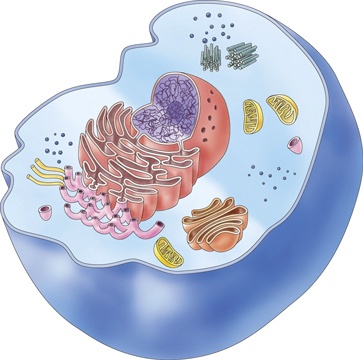
Name this organelle

a)

Ribosomes

b)

Vacuole

c)

Nucleus

d)

Chloroplast

34.

Creates energy for ALL cells, the powerhouse of the cell

a)

Nucleolus

b)

Vacuole

c)

Cytoplasm

d)

Mitochondria

35.

How many vacuoles does a PLANT cell have?

a)

1

b)

2

c)

3

d)

4+

36.

How many elements are in this chemical formula?

H2SO4H_2SO_4  

a)

1

b)

2

c)

3

d)

4

37.

How many atoms of Carbon are in this formula? C6 H12O6C_{6\ }H_{12}O_6  

a)

6

b)

1

c)

12

38.

How many more atoms of Oxygen than than Magnesium are in this formula? (subtraction) MgSO4MgSO_4  

a)

4

b)

3

c)

2

d)

6

39.

Which of the following elements is least likely to form a compound?

a)

Hydrogen

b)

Sodium

c)

Argon

d)

Potassium

40.

What is the total number of atoms in this chemical formula? C8H3NaBr12C_8H_3NaBr_{12}  

a)

18

b)

12

c)

25

d)

24

41.

How many elements are in this chemical formula? NaHCO3NaHCO_3  

a)

1

b)

2

c)

3

d)

4

42.

A lamp that plugs into a wall socket draws energy, which flows through a thin wire in the bulb, causing it to heat up until it glows. What energy transformations are taking place?

a)

Chemical → light → electrical

b)

Mechanical → sound → light

c)

Thermal → solar → electrical

d)

Electrical → thermal → light

43.

An electric pencil sharpener uses electricity to make its motor spin. The pencil sharpener also makes noise and heats up. Which observation of the pencil sharpener demonstrates the law of conservation of energy?

a)

The amount of electrical energy used equals the total amount of mechanical, sound, and thermal energy produced.

b)

The amount of energy used by the electric pencil sharpener is greater than an electric lamp.

c)

The electric pencil sharpener only uses energy when it is being used to sharpen a pencil.

d)

The electric pencil sharpener is easier to use than the older version that was cranked by hand.

44.

Turning the handle makes a current that causes the light bulb to glow. What are the energy transformations that happen in this hand generator?

a)

Thermal → solar → light

b)

Mechanical → electrical → light

c)

Electrical → mechanical → light

d)

Solar → light → electrical

45.

In which of the following scenarios would this energy transformation be observed?

chemical → light → heat

a)

Plucking a guitar string

b)

Lighting a match

c)

Turning on a fan

d)

Starting a car

46.

Which of the following is a form of potential energy?

a)

sound energy

b)

chemical energy

c)

mechanical energy

d)

thermal (heat) energy

47.

A baseball is hit into the air with a bat. When does baseball have the greatest gravitational potential energy?

a)

when it hits the ground

b)

when it reaches its highest point

c)

when it leaves the bat

d)

when the mechanical and kinetic energies of the baseball are equal

48.

___ is energy stored by things that stretch or compress.

a)

Gravitational potential

b)

Elastic kinetic energy

c)

Chemical kinetic energy

d)

Elastic potential energy

49.

Which energy transformation occurs in a toaster?

a)

electrical → thermal

b)

chemical → thermal

c)

nuclear → electrical

d)

thermal → electrical

50.
If differences in air pressure produce winds, what can you conclude about temperature and air pressure based on the figure?
a)
As warm air rises, it creates an area of lower pressure, and cooler air flows in as wind
b)
Warm air is denser than cold air is, creating an area of high pressure the produces wind.
c)
Winds flow from areas of low pressure to areas high pressure when temperature is warmer
d)
Air pressure decreases at night because temperature is lower, producing land and sea breezes
51.

What does heat do when convection currents are moving?

a)

Sinks

b)

Rises

c)

Stays in place

52.

Which picture shows material that is more dense?

a)

The picture of the left

b)

The picture on the right

53.

What causes convection current in the Earth?

a)

The uneven heating on each layer inside the Earth.

b)

The crusts outer layer.

c)

The temperatures we feel outside.

54.
Energy for convection on the Earth comes from...
a)
The sun
b)
The moon
c)
Solar winds
d)
The ocean
55.

In what position will it be winter in the southern hemisphere

a)

1

b)

2

c)

3

d)

4

56.

At what position will it be summer in the Southern hemisphere.

a)

1

b)

2

c)

3

d)

4

57.

At what position will it be spring in the southern hemisphere

a)

1

b)

2

c)

3

d)

4

58.
A[n] ___________ tide occurs when the sun, Earth, and the moon are nearly in a line. 
a)
spring
b)
high
c)
low
d)
neap
59.
A[n] ______________ tide occurs when the sun is at right angles to the line between Earth and the moon. 
a)
high
b)
neap
c)
low
d)
spring
60.
a)
spring tide
b)
neap tide
61.
a)
neap tide
b)
spring tide
62.

Identify what type of change happening in the picture below...

a)

Chemical Reaction

b)

Physical Change

c)

Change in State

d)

Change in appearance only

63.

Identify what type of change happening in the picture below...

a)

Chemical Change

b)

Physical Change

c)

Endothermic Reaction

d)

Exothermic Reaction

64.

Identify what type of change happening in the picture below...

a)

Chemical Change

b)

Physical Change

c)

Endothermic Reaction

d)

Exothermic Reaction

65.

Which of the following could indicate that a chemical change took place?

a)

Change in color

b)

Production of Energy

c)

Formation of Gas

d)

All are correct

66.
The atomic number tells you what?
a)
number of electrons
b)
number of protons
c)
number of neutrons
d)
both electrons and protons in an atom.
67.
Calcium is most like which of the following?
a)
Barium
b)
Potassium
c)
Cesium
d)
Nitrogen
68.
Beryllium is in group number______.
a)
Group 2
b)
Group 3
c)
Group 4
d)
Group 7
69.
What is the name of the group that never reacts--ever ever they are stable with a full outermost ring!!!
a)
noble gases
b)
transition
c)
halogens
d)
borons
70.
Which element is found in period 3 group 2?
a)
Sodium (Na)
b)
Magnesium (Mg)
c)
Yttrium (Y)
d)
Boron (B)
71.

a=Δυta=\frac{\Delta\upsilon}{t}  

An object at rest begins to move to a final speed of 30 m/s in 5 seconds. Calculate the object's acceleration.

a)

6 m/s2

b)

-6 m/s2

c)

150 m/s2

d)

0.17 m/s2

72.

a=Δvta=\frac{\Delta v}{t}  

An objects traveling at 10 m/s comes to a complete stop in 2 seconds. What is the objects acceleration?

a)

-5 m/s2

b)

5 m/s2

c)

0.2 m/s2

d)

200 m/s2

73.

A mouse-trap powered car can travel 20 meters in 15 seconds. What is the speed of the car?

a)

2 m/s

b)

1.3 m/s

c)

1

d)

.13 m/s

74.

The path around the park is 0.5 miles long. If you walk for 2 hours and complete 10 laps, what is your average speed? (First you must know the total disatance).

a)

2 m/hr

b)

5 mi/hr

c)

2.5 mi/hr

d)

2 mi/hr

75.
Hurricanes form near areas close to the equator. Why? 
a)
Solar heating is greatest near the equator.
b)
The Moon's plane of orbit is close to the equator.
c)
Earth's volcanic activity is clustered around the equator.
d)
the rate of rotation of Earth's surface is less at the equator.
76.
Which storm forms over water?
a)
tornado
b)
hurricane
c)
thunderstorm
77.
What happens if a hurricane moves over land or cold ocean water?
a)
it will get stronger
b)
it will get weaker
c)
it will upgrade its category
d)
it will morph into a typhoon
78.

How many valence electrons does this element have?

a)

12

b)

8

c)

2

d)

10

79.

What is the atomic mass for this element? (Round to the nearest WHOLE number.) (This information for this element can be found on the periodic table!)

a)

11

b)

19

c)

24

d)

23

80.

What element does this Bohr model represent?

a)

Carbon

b)

Boron

c)

Neon

d)

Nitrogen

81.

Is this the correct Bohr model for silicon (Si)?

a)

Yes

b)

No

82.

Is this the correct Bohr model for carbon (C)?

a)

Yes

b)

No

83.
Using this dichotomous key, identity the name of the circled fish.
a)
band-tail puffer
b)
spotted goat fish
c)
peacock flounder
d)
trumpet fish
84.
Based on this diagram which type of stars would belong to spectral class M and have the lowest luminosity?
a)
Main Sequence Stars
b)
Giants
c)
Super Giants
d)
White Dwarfs
85.
Analyze this HR Diagram. Which group of stars is considered to have lower than average luminosity as well as a higher than average temperature?
a)
Giants
b)
Main Sequence
c)
White Dwarfs
d)
Super Giants
86.
Which of these observations of Proxima Centuri's Star is most likely accurate?
a)
Proxima Centuri's Star is less bright than the sun and has a surface temperature below 3,400 K
b)
Proxima Centuri's Star is less bright than the sun and has a surface temperature above 3,400 K
c)
Proxima Centuri's Star is brighter than the sun and has a surface temperature below 4,000 K
d)
Proxima Centuri's Star is brighter than the sun and has a surface temperature above 4,000 K
87.
Which city can expect to see an increase in temperatures over the next 24 hours?
a)
Billings, Montana
b)
Atlanta, Georgia
c)
Minneapolis, Minnesota
d)
Miami, Florida
88.
Insecticides are sprayed over a large area in an effort to reduce the number of grasshoppers that are eating the corn plants. How will this change affect this food chain? 
a)
The number of grasshoppers will increase
b)
The number of lizards will increase
c)
The number of lizards and hawks will decrease
d)
The number of grasshoppers, lizards, and hawks will decrease
89.
Scientists gathered the following data on lizard populations for several years. The results are shown in the table. Which environmental factor most likely contributes to the change in lizard population? 
a)
increase in available water and food
b)
increase in shelter
c)
increase in predators
d)
increase in light
90.
In the 1850s, Thomas Austin released approximately twenty-four rabbits from Europe into the Australian countryside. By 1900, tens of millions of rabbits were found all over the Australian continent. The warm Australian climate, abundant farmland, and crops provided the perfect habitat for the rabbits. The rabbits caused extensive damage to all vegetation, and the lack of plants increased soil erosion. Why were the rabbits so successful? 
a)
the rabbits competed with local herbivores for food
b)
the rabbits did not have natural predators
c)
erosion of soil benefited the rabbits
d)
diseases helped decrease rabbit populations
91.
This figure shows three warblers with different niches in a spruce tree habitat.  The warblers are feeding in different areas of the tree which allows them to avoid _
a)
competing with one another for food
b)
establishing a strict territory from one another
c)
creating a symbiotic relationship with one another
d)
caring for their young by supplying food