
 Worksheets
Ecology
Total questions: 155
Worksheet time: 2hrs 23mins
This helps plants maintain shape, storage, digestion and waste. This organelle can become very enlarged when plants store water.
Lysosome
Vacuole
Golgi Apparatus
Cell membrane

Nucleus

mitochondria

chloroplast

chloroplasts and cytoplasm
chloroplasts and cell wall
cell wall and cell membrane
mitochondria and nucleus

Name a primary consumer (herbivore):
Hawk
Tree
bees
bird

The eagle depends on which organisms for its energy needs:
deer and snake
trees and grasses
snake, mouse, frog
mouse and grasshopper

Which of the following are herbivores:
(a) (b) (c)

The energy sources of the seal are:
plankton
penguin, krill and squid
krill, seagull, whale

Identify a food chain seen in this food web, in correct order:
grasses
grasshopper
frog
snake
hawk

Name the top predator in this food web:
wildcat
snake
jackal
lion

Who receives the LEAST energy in this food web:
eagle
mouse
grasshopper
trees and grasses

Name a predator-prey relationship in this food web:
mouse and grass
deer and frog
snake and mouse
trees and grass

Arrows represent ______________
flow of organisms
what eats what
flow of energy
percent of energy
What is the ultimate source of energy?
food
plants
sun
sugar
What percentage of energy is transferred from one trophic level to the next?
1%
10%
90%
100%
What is the primary consumer?
grass
grasshopper
mouse
snake
red hawk
What is the producer?
grass
grasshopper
mouse
snake
red hawk
What is the tertiary consumer?
grass
grasshopper
mouse
snake
red hawk
What is the secondary consumer?
grass
grasshopper
mouse
snake
red hawk
What is the decomposer?
sun
grasshopper
water
snake
mushrooms
Energy that is not passed from one trophic level to the next is usually lost as?
sugar & undigested food
waste & heat
food & sugar
heat & sugar

Which organism is NOT a producer?
grass
tree
grasshopper
shrub
Where does the rabbit get its energy from?
snake
shrub
cricket
robin
Which organism is a primary consumer in the above diagram?
deer
snake
hawk
shrew
Which organism is a secondary consumer in the above diagram?
deer
rabbit
squirrel
shrew
Which organism gives its energy to 4 organisms?
grass
fungi
shrub
grasshopper
Which organism gets its energy from 3 organisms?
mountain lion
hawk
squirrel
snake

Which of the following statements is true of this Waterbird Food Web?
The bald eagle preys upon the wading birds
Small Planktivorous Fish are omnivores
Wading Birds are herbivores
Sea Ducks are predators to Tundra

Which organism is a decomposer?
Grasshopper
Cranefly
Ant
Mayfly
The skylark meadow pipit is a predator to how many organisms?
4
5
6
7

If the yellow perch population were to increase what would happen to the algae?
The algae population would increase
The algae population would decrease
The algae would be unaffected
It would cause a forest fire

Which of these organisms is a producer?
Cotton bush
red-legged grasshopper
eastern bluebird
black rat snake

Which of these organisms is a tertiary consumer?
The Orca
The sea otter
The sea urchin
The Kelp
What effect does bird extinction have on an ecosystem?
deer and other primary consumers lose food sources.
producers decrease because of lost food sources
humans populations increase without bird populations.
Insect populations increase without birds eating them
How can humans alter an environment to lower animal survival?
Build a dam
Plant trees
Introduce new fish into a pond
Both Build a dam & Introduce new fish into a pond


Using the food web, which of the following is a primary consumer?
butterfy
snake
fox
frog

Which of the following is producer/autotroph?
rabbit
frog
tree
worm

Using the food web what would happen if the eagle became extinct?
The frog population would decrease.
The frog population would increase.
The butterfly population would increase.
The snake population would decrease.

Which two animals below are primary consumers
moth and ant
mushroom and moth
ant and hawk
spider and mouse
In a food web the arrow always points to
the consumer
the prey
producer
autotroph

In the diagram, which organism provides nutrients for the
largest number of other organisms?
Seal
Herring
Snapper
Bluefish
Examples of ecosystems:
a pond, a river, a park
savanna, grassland, tundra
Example of Biotic Factors are:
an oak tree, a tulipan, a whale
mountains, sunlight, soil
Abiotic Factors are also known as:
Nonliving things.
Living things.
None of these answers.
Desert, Rain Forest and Tundra are examples of:
Biomes
Ecosystems
Environments
What does biodiversity mean?
a lot of rain
rich soil
many kinds of plants and animals
great climate differences
What is permafrost?
soil that has thawed
soils that is always frozen
a plant in the tundra
muddy soil
How does the temperature of ocean water change as it gets deeper?
It gets warmer
It gets colder
It stays the same
It gets colder and then warmer
Which describes the deep-water zone?
It gets a lot of sunlight
It get no sunlight
No fish live there
Cattails and rushes grow there
Which biome receives the most rain?
tropical rain forest
temperate rain forest
taiga
tundra
Which biomes would be found nearest to the equator?
tropical rain forests and savannas
tundras and taigas
tropical rain forests and taigas
tundras and savannas
Karen is studying an area that has many trees and goes through all four seasons. The trees lose their leaves as the seasons progress. Which biome is she studying?
deciduous forest
grassland
desert
tropical rain forest
Nuri lives in an area where there is little rain and not many plants. The daytime temperatures can be much higher than nighttime temperatures.
Where does Nuri live?
deciduous forest
grassland
desert
tropical rain forest
Tropical rain forests tend to have soils that are nutrient poor, and most of the nutrients are found in the top few inches of the soil.
Which adaptation is most likely found in tropical trees?
deep root systems
shallow root systems
needles
pine cones
A lion has pointed teeth to help it tear meat off of the bone.
Behavioral Adaptation
Physical/Structural Adaptation
A black bear hibernates during the winter months.
Behavioral Adaptation
Physical/Structural Adaptation
A penguin is white on its belly and black on its back so it harder to see underwater from above and below.
Behavioral Adaptation
Physical/Structural Adaptation


When species do not have the traits necessary to survive, what can happen to them?
fossils
extinction
evolution
adaptation
This is a behavior an animal is born with
migration
instinct
physical adaptation
camouflage
The things animals do to survive.
Behavioral Adaptations
Structural Adaptations
Mimicry is
an animal’s color and pattern that helps it blend in with its surroundings.
animal body parts or physical features.
when an animal looks like another animal or plant.
movement of one group of one type of animal from one region to another and back again.


The ears of this fox are an example of...
A behavioral adaptation
A physical adaptation
The tundra is a vast plain with frigid temperatures and plenty of snow. Which of the following adaptations does not help the polar bear survive in the tundra.
Layers of fat for insulation
webbed toes for swimming
white fur for camouflage
total herbivorous diet
A female Atlantic green turtle is born with the need to travel to Ascension Island in the South Atlantic Ocean to lay eggs in the sand. This behavior is best described as --
Hibernation
Instinct
Mutation
Variation

When a cheetah teaches its cub to hunt, this is called a __________.
learned (acquired) behavior
predator
physical characteristic
migration
Different birds have different beak structures. This is an example of:
mimicry
variation
instincts
Which is the simplest level of organization within the environment?
organism
population
community
Which of the following is the highest level of organization within the environment?
population
organism
ecosystem
biosphere
Similar organisms that can reproduce with each other are considered to be members of the same _______________.
community
species
biosphere
ecosystem
All the alligators in the same area are an example of a(n) _______________.
organism
community
population
group
All the tiger sharks in the ocean.
All the oak trees in a forest.
All the cows on a farm.
The plants and animals in the same area.
Reorder the following from least to greatest (from left to right).
organism
population
community
ecosystem
biome

Which of the following describes #2?
An ecosystem is the interaction between biotic and biotic factors.
A community is a group of different populations in the same area.
An organism is one living thing.
A population is a group of the same organisms.
Which of the following describes #4?
An ecosystem is the interaction between biotic and biotic factors.
A community is a group of different populations in the same area.
An organism is one living thing.
A population is a group of the same organisms.
Which of the following describes #1?
An ecosystem is the interaction between biotic and biotic factors.
A community is a group of different populations in the same area.
An organism is one living thing.
A population is a group of the same organisms.
Which of the following describes #3?
An ecosystem is the interaction between biotic and biotic factors.
A community is a group of different populations in the same area.
An organism is one living thing.
A population is a group of the same organisms.
This biome is near the equator.
Temperate deciduous forest
Grassland
Rainforest
Desert
This biome generally has 4 seasons.
Boreal forest (Taiga)
Arctic tundra
Desert
Temperate deciduous forest
All bacteria are
prokaryotes
eukaryotes
DNA is located in the nucleus of
prokaryotes
eukaryotes
These do not have a nucleus
prokaryotes
eukaryotes
Eukaryotes have
a real "true" nucleus
no membrane bound organelles
no nucleus
Eukaryotic cells are
the smallest of cells
those without DNA inside of a nucleus
more complex than prokaryotic cells
found only making up multicellular organisms
Eukaryotic cells are
found in plants, animals, and fungi
cells with no membrane bound organelles
less organized than prokaryotic cells
not in possession of a nucleus
Both prokaryotes and eukaryotes
have a nucleus
have DNA
do not have DNA
have DNA in the form of chromosomes

What kingdom do I belong to? I am unicellular, ancient and found in extreme places like hot springs and deep ocean vents.
Fungi
Archaebacteria
Plant

What kingdom am I? I am multi-cellular, eukaryotic and a heterotroph. Most members of my kingdom also move.
Plant
Fungi
Protist
Animal

What kingdom am I? I am an autotroph, multi-cellular and typically green.
Plant
Animal
Protist
Eubacteria

What kingdom am I? I am prokaryotic, unicellular and can be found all around you, even in you!
Eubacteria
Fungi
Plant

What kingdom am I? When you think of eukaryotic, mostly multi-cellular decomposers, you should think of me!
Plant
Fungi
Animal
Protist

What kingdom am I? I am eukaryotic but often only one cell big. I commonly live in wet environments like ponds/lakes.
Plant
Protist
Animal

True or False: animals are single-celled organisms
True
False

True or False: Animals are multi-cellular organisms that eat other organisms for food.
True
False

True or False: Plants are autotrophs meaning they make food through photosynthesis.
True
False

Are YOU unicellular or multicellular?
Unicellular
(single celled)
Multicellular
(many celled)
Living things are based on a universal genetic
code. What molecule is responsible for that code?
RNA
Lipid
Protein
DNA
Protista
be seen with the human eye
move
reproduce
make their own food
What kingdom has organisms that feed off dead or decaying organisms?
Plantae (Plant)
Fungi
multicellular
unicellular
heterotroph
autotroph
Prokaryotes do not have a nucleus.
True
False
orchid
bacteria
spider
mushroom

Which vocabulary word is represented in the picture?
Biome
Desert
Habitat
Marine
An aquatic biome with a high amount of salt. It covers most of the surface of the earth. Which one is it?
Ponds
Estuary
Marine
Fresh water
This biome is made-up of deciduous trees; it experiences four seasons annually. Pennsylvania is found in this biome. Which one is it?
Tundra
Temperate Deciduous Forest
Taiga
Tropical RainForest
All of the organisms living in a particular area (plants and animals) is known as what?
community
ecosystem
biome
Terrestial
Another name for land is...
terrestial
aquatic
deciduous
taiga
Another name for water is...
terrestial
aquatic
latitude
alpine
A living or once-living organism in its environment is known as what?
freshwater
A nonliving element in an ecosystem is known as what?
population
Soil, dirt, rocks, precipitation, air, water, sunlight are examples of the non-living parts of the environment known as what?
aquatic
biotic
abiotic
terrestrial
A forest (or biome) that is characterized by trees that shed their leaves in the fall is known as what?
tropical rain forest
temperate deciduous forest
estuary
taiga
An area of land that has similar biotic and abiotic conditions is a...
biome
biosphere
community
population

Trees that lose their leaves during one given season each year are...
deciduous.
coniferous.
dangerous.
humus.
____________________ is the average weather in a place over many years.
Weather
Climate
Tsunamies
Overcast
This climate zone experiences long cold winters and has very little precipitation.
Tropical
Temperate
Polar
Dry
Highlands
What climate zone experiences four distinct seasons and average year-round precipitation?
Tropical
Temperate
Polar
HIghland
Dry
What climate zone is warm year round and receives high amounts of rain?
Tropical
Temperate
Polar
Highland
Dry
What factor of climate is dependent on how high you live above sea level?
Topography
Oceans
Wind
Elevation
Latitude

The hot zones are located between...
The artics
The tropics
The latitudes
My legs

The Temperate zones are located between...
The tropics and the Equator
The Equator and the tropics
The tropics and the artics
The artics and the Equator

The Cold zone is located in...
The Equator and the tropics.
The tropics and the artics.
The artic and antartic circles.
The distance from sea

The seasons are caused by___________?
The tilt of the Earth on its axis
Tropical Storms
Changes in the moon
The Earth's rotation
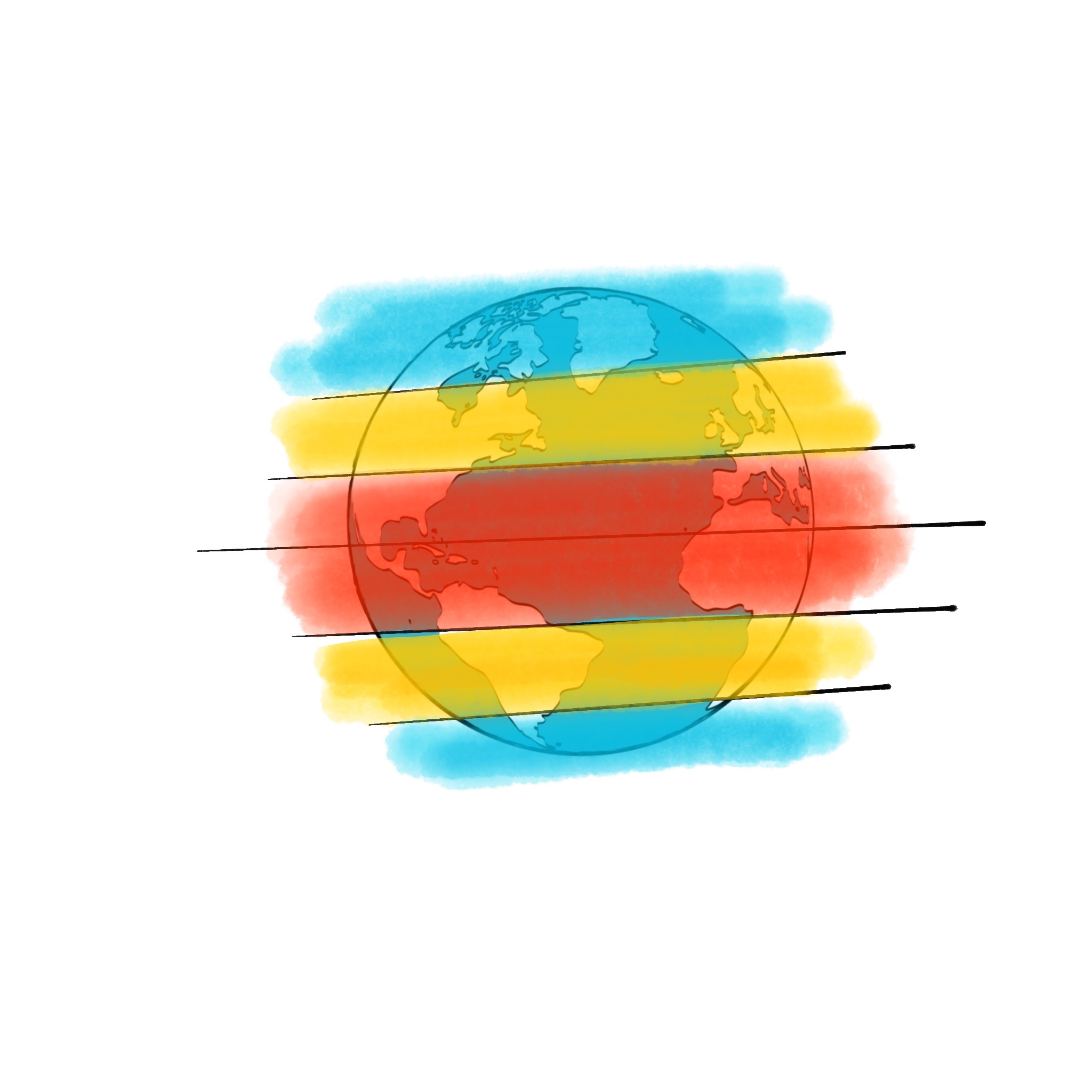
Look at the picture, which climate zone is in red?
Temperate zone
Polar zone
Tropical zone

Look at the picture, which climate zone is in yellow?
Temperate zone
Polar zone
Tropical zone
What is the name of the imaginary line that ‘divides’ the world in half?
equator
Latitude
Longitude
triangle

