
 Worksheets
Intro To Humanities: Exam 2 Review Part 2
Total questions: 71
Worksheet time: 36mins
The Broadway musical Hamilton: An American Musical (2015) was written and composed by _____________________. He also played the part of Alexander Hamilton in the first months of the musical's performance.
Jean-Jacques Rousseau
Wolfgang Amadeus Mozart
Jacques Louis David
Olaudah Equiano
Lin-Manuel Miranda
Which of the following statement about Alexander Hamilton is NOT true?
He was president of the United States.
He is on the $10 bill.
He worked as an aid to George Washington.
He died in a duel with Aaron Burr.
He was the first Secretary of the Treasury.
Which of the following statement about Alexander Hamilton is NOT true?
He was born in the Caribbean.
His father was from Scotland.
He was an immigrant.
He was born out of wedlock.
He was a member of the ancien régime.
Hamilton: An American Musical (2015) is a pastiche (or a collage of art forms from a variety of time periods and genres) that blends 18th century culture, Broadway musical theatre, and this contemporary genre of dance and music:
Hamilton "both depicts and embodies the dynamism and synthesis at the heartof America’s founding. It does so primarily through an artistic medium, hip-hop, in which synthesis is anessential creative device. Hip-hop artists sample musical refrains, lyrics, and dialogue in their work, engagingin an ongoing discourse with musicians of the past while creating something new in the process." Why Hamilton Matters by Tara Helfman, February 2016Links to an external site.
heavy metal
hip-hop
anime
hiplet
opera
Hamilton: An American Musical (2015) set a Broadway box office record for the most money grossed in a single week in New York City in 2016. That same year, the show broke another record when it was nominated for 16 ________________________. It won 11 of those awards, including Best Musical.
Academy Awards
MTV Video Music Awards
Golden Raspberry Awards
Grammy Awards
Tony Awards
The casting in the Broadway musical, Hamilton was ________________________, meaning that performers were selected in part based on the color of their skin.
"The casting of Hamilton speaks to this dynamism. The 'dead white men' of the founding generation are portrayed as complex, imperfect individuals by a largely non-white cast. Color-blind casting this is not. Race is conspicuous and salient, serving to underscore the paradoxes of a nation founded on ideals of liberty and equality but in which both were denied to vast segments of the population. But at the same time, the casting highlights the durability of those founding ideals." Why Hamilton Matters by Tara Helfman, February 2016
color-blind
heliocentric
color-conspicuous
social contract
natural state
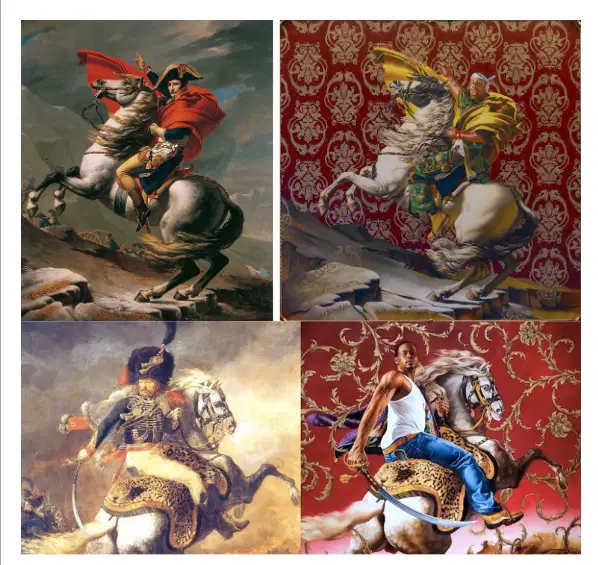
The images above (top right and bottom right) were painted by the artist Kehinde Wiley in the early 2000s. They are from are from a series of paintings inspired by the history of __________ portraiture, a sub-genre of portraiture that features a figure on a horse. This sub-genre is particularly infused with the lineage of male power. From classical Rome to post-revolutionary France, political and military leaders on horseback have evoked and perpetuated social norms of masculine might and control (for example, this equestrian portrait of the Roman Emperor Marcus Aurelius).
In these paintings, Wiley replaced traditional white subjects depicted in large-format paintings with young African American men in street clothes. Wiley was born in Los Angeles in 1977. He attracted attention from both the media and the art world almost immediately after earning his Masters of Fine Arts from Yale University in 2001. Wiley is currently based in New York City and is best known for his highly naturalistic paintings of African Americans.
Similar to Hamilton: An American Musical (2015), Kehinde Wiley's work is a form of pastiche (or a collage of art forms from a variety of time periods and genres) that blends 18th century portraiture traditions with with 21st century subject matter.
grisaille
impasto
vanitas
afro art
equestrian
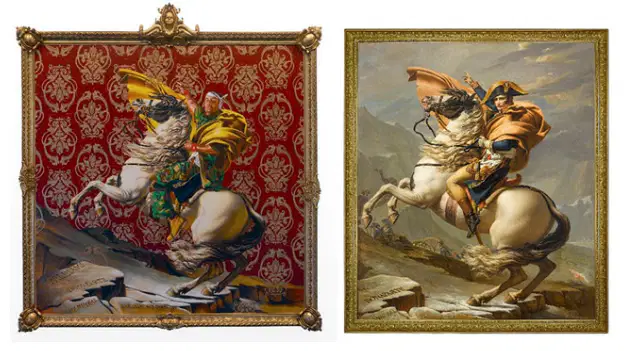
LEFT: Kehinde Wiley, Napoleon Leading the Army over the Alps, 2005
RIGHT: Jaques Louis David, Napoleon Crossing the Alps (1801-1805)
Kehinde Wiley was born in Los Angeles in 1977. He attracted attention from both the media and the art world almost immediately after earning his Masters of Fine Arts from Yale University in 2001. Wiley is currently based in New York City and is best known for his highly naturalistic paintings of African Americans. .....
Through his demonstration of extraordinary painting skill and his use of famous portraits, Wiley could be seen as wryly placing himself in line with the history of great master painters. Here, for example, he has signed and dated the painting just as David did, painting his name and the date in Roman numerals onto the band around the horse’s chest. Wiley makes another reference to lineage in the foreground where he retains the original painting’s rocky surface and the carved names of illustrious leaders who led troops over the Alps: NAPOLEON, HANNIBAL, and KAROLUS MAGNUS (Charlemagne). But Wiley also includes the name WILLIAMS—another insistence on including ordinary people of color who are often left out of systems of representation and glorification. Not only is Williams a common African-American surname, it hints at the imposition of Anglo names on black people who were brought by force from Africa and stripped of their own histories." Khan Academy
Which of the following statements about the painting above is NOT TRUE:
The background is also infused with tiny paintings of sperm—Wiley’s way of poking fun at the highly charged masculinity and propagation of gendered identity that are involved in the Western tradition of portraiture.
Kehinde Wiley painted the background of this image to match the naturalistic setting of Jacques Louis David's painting.
This painting is a clear spin-off of Jacques-Louis David’s painting of 1800-01, which commemorates Napoleon’s victorious military campaign against the Austrians.
Wiley includes the name WILLIAMS to the other names listed on the rock to represent the people of color who are often left out of systems of representation and glorification.
Kehinde Wiley has signed and dated the painting just as Jacques Louis David did, painting his name and the date in Roman numerals onto the band around the horse’s chest.
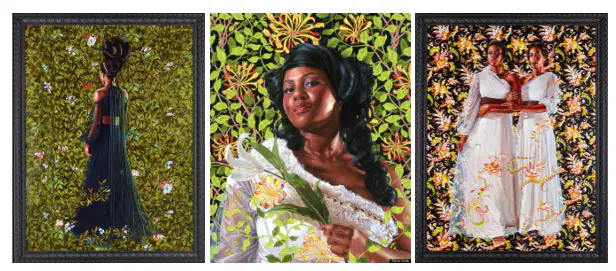
The images above are from a series of portraits by the artist Kehinde Wiley called Economy of Grace. Wiley was born in Los Angeles in 1977. He attracted attention from both the media and the art world almost immediately after earning his Masters of Fine Arts from Yale University in 2001. Wiley is currently based in New York City and is best known for his highly naturalistic paintings of African Americans.
"This group of paintings represents a significant departure from Wiley’s previous subject matter by depicting African-American women, his first-ever series dedicated to female subjects. The models for the paintings were cast on the streets of New York City. Chosen by Wiley at the Louvre, Their poses are based on historical portraits of society women by Jacques-Louis David, Thomas Gainsborough and John Singer Sargent, among others. For the first time, custom-made couture gowns were created specifically for each of the models by Riccardo Tisci of Givenchy. The resulting paintings to be shown in An Economy of Grace are a celebration of black women, creating a rightful place for them within art history, which has to date been an almost exclusively white domain." Kehinde Wiley - Economy of GraceLinks to an external site.
Which of the following statements about the paintings above is NOT TRUE:
The models for the paintings were cast on the streets of New York City.
The painted are intended to be a celebration of black women, creating a rightful place for them within art history, which has to date been an almost exclusively white domain.
This was Kehinde Wiley's first-ever series dedicated exclusively to male subjects.
Custom-made couture gowns were created specifically for each of the models by the high-end design house, Givenchy.
Their poses are based on historical portraits of society women at The Louvre painted by artists such as Jacques-Louis David.
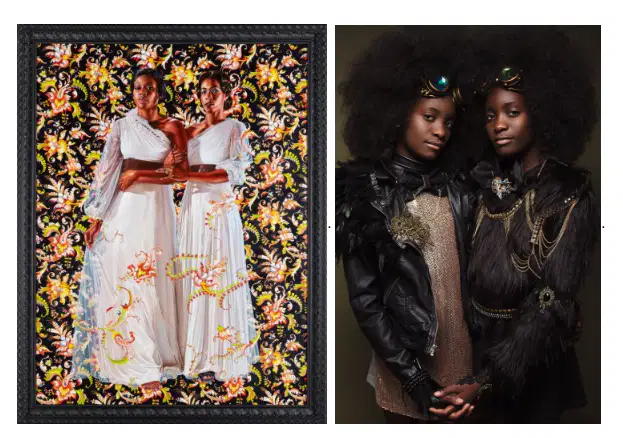
The image on the left is The Two Sisters, and was painted by Kehinde Wiley in 2012 as part of his Economy of Grace series. The exhibition represented a significant departure from Wiley’s previous subject matter by depicting African-American women, his first-ever series dedicated to female subjects. The models for the paintings were cast on the streets of New York City. Their poses are based on historical portraits of society women by Jacques-Louis David, Thomas Gainsborough and John Singer Sargent, among others.
The image on the right is part of he AfroArt series created by the Atlanta-based Creative Soul PhotographyLinks to an external site. studio of a married couple named Regis and Kahran Bethencourt. The photographers draw inspiration from classic portraiture as well as more contemporary art movements, such as the Harlem Renaissance of the early 20th century. According to their website, "The series is a recognition and celebration of the versatility of black hair and its innate beauty. The purpose of this series is to illustrate the story of our royal past, celebrate the glory of the here and now, and even dare to forecast the future. With this series, we aim to empower children of color to embrace their natural curls and the skin that they’re in."
Afro Art is a celebration of the beauty of black girls and the afro, which is worn as a symbol of pride. The politics of black hair is deeply rooted in history. In the 1960s, the afro hair style emerged during the civil rights movement as a symbol of rebellion, pride, and empowerment. Afro Art continues to influence culture in the 21st century.
Although both images depict female subjects, one was created from the perspective of a male artist and the other was created from the perspective of a woman and a man (a married couple). All of the artists are African American. These images raise interesting questions related to the male gaze, the female gaze, and the white gaze.
Which one of the following statements about the portraits above is TRUE:
Both images were created by female artists.
Both images depict natural hair styles.
Both images draw inspiration from classical portraiture.
Both images depict international-known political figures.
Both images were created in New York City.

In 2017, __________________________ was chosen by Barack Obama to paint his official portrait for the National Portrait Gallery in Washington, DC.
The artist was born in Los Angeles in 1977. He attracted attention from both the media and the art world almost immediately after earning his Masters of Fine Arts from Yale University in 2001. The artist is currently based in New York City and is best known for his highly naturalistic paintings of African Americans.
Forty-fourth president, 2009–2017 @ National Portrait Gallery Links to an external site.
"This portrait does not include an underlying art historical reference, but some of the flowers in the background carry special meaning for Obama. The chrysanthemums, for example, reference the official flower of Chicago. The jasmine evokes Hawaii, where he spent the majority of his childhood, and the African blue lilies stand in for his late Kenyan father."
Jacques Louis David
Jean-Michel Basquiat
Amy Sherald
Kehinde Wiley
Lin-Manuel Miranda
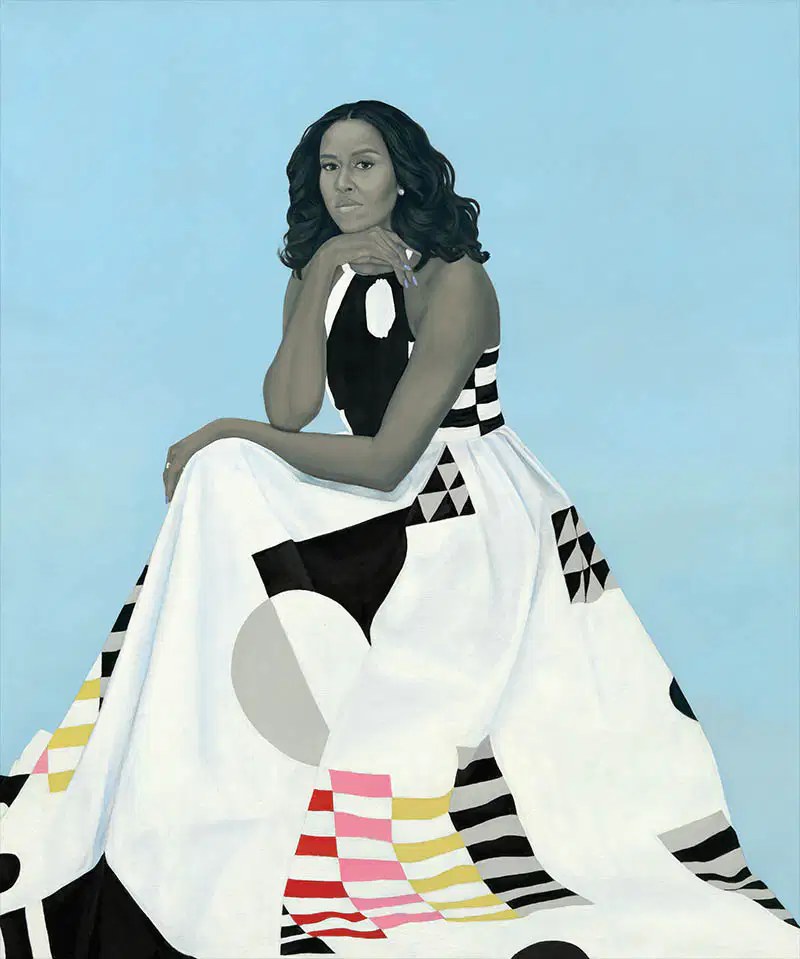
In 2017, Amy Sherald was chosen by Michelle Obama to paint her official portrait for the National Portrait Gallery in Washington, DC. Michelle Obama is the former first lady of the United States and the wife of the 44th president, Barack Obama.
The portrait was painted using the artist Amy Sherald’s signature grayscale technique, also called grisaille. The subject's unnaturally colored skin asks us to consider both her race and her humanity. While the use of gray in lieu of more natural skin tones reduces the reference to her race, the blunt removal also draws attention to her skin color, highlighting her racial identity. The gray tones, in particular, reference nineteenth-century photographic traditions, wherein the emerging photographic medium allowed free African Americans to celebrate themselves and craft their own unique (and positive) identities. Whereas the grand portraiture traditions of painting and sculpture were largely out of reach, photography was an accessible medium. Instead of representing a particular time or place, Sherald strives to make Michelle Obama timeless and therefore eternally relevant for viewers.
Dominating the composition is Mrs. Obama’s monumental dress. Designed by Michelle Smith, for her label Milly, and selected for the portrait by Mrs. Obama, Sherald, and Mrs. Obama’s stylist, the dress is symbolic, referencing the former first lady’s modernity and approachability. While the dress was originally designed by Smith with modern art, such as Pop and Op art, in mind, Sherald recognized its visual affinities with the quilts of Gee’s Bend, Alabama. The quilts of Gee’s Bend, a remote black community of the descendants of former slaves, are bold and improvisational, and reference the independence and resourcefulness of the African American experience.
Which of the following statements about the portrait above is NOT TRUE:
Michelle Obama painted this self portrait for the National Portrait Gallery in Washington, DC.
The gray skin tone is a reference to nineteenth-century photographic traditions that allowed free African Americans to celebrate themselves and craft their own unique (and positive) identities.
The portrait was painted using the artist Amy Sherald’s signature grayscale technique, also called grisaille.
The dress is symbolic of the former first lady’s modernity and approachability
The dress references the quilts of Gee’s Bend, Alabama, a remote black community of the descendants of former slaves.
_________________ is an American painter who was born in Columbus, Georgia in 1973.
She focuses on African American cultural history and the representation of the African American body. She uses a grayscale to paint skin tones as a way of challenging the concept of color as race. This grayscale technique, also called grisaille, is connected to the artist’s early personal experiences. The artist remembers looking at family photo albums as a child and getting to know her grandmother Jewel through a black-and-white photograph. She was captivated by her grandmother’s beauty, self-possession, and confident, direct gaze in the photograph. When she looked for painted portraits of people who looked like her in art history books in local libraries, she realized that her family’s story was absent in the history of painted portraiture. She was also discouraged when she did not find people who looked like her in the public spaces of museums. Her larger project of painting portraits of African Americans seeks to make up for this absence by addressing the history of representation. She has notably described her paintings as a “meditation on photography.” Her subjects are often set in whimsical, nondescript settings with occasional surreal details that add a bit of satire. The dreamlike backgrounds create what the artist refers to as “the amorphous personal space of my own existence within the context of black identity and my search for ways to clarify and ground it.”
Frida Kahlo
Kathleen Hanna
Mary Cassatt
Amy Sherald
Artemisia Gentileschi
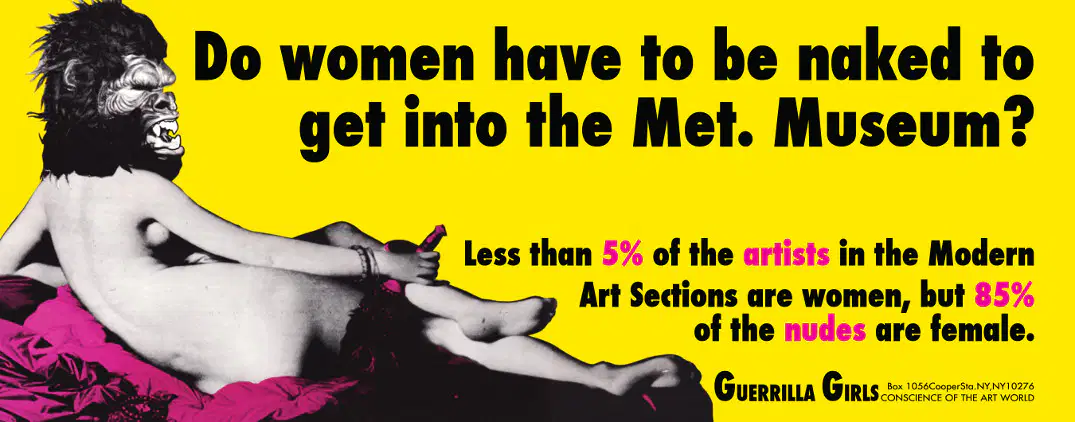
This is one of thirty posters published in a portfolio entitled Guerrilla Girls Talk Back by the group of anonymous American female artists who call themselves the Guerrilla Girls.
Since their inception in 1984 the Guerrilla Girls have been working to expose sexual and racial discrimination in the art world, particularly in New York, and in the wider cultural arena. The group’s members protect their identities by wearing gorilla masks in public and by assuming pseudonyms taken from such deceased famous female figures as the writer Gertrude Stein (1874-1946) and the artist Frida Kahlo (1907-54). They formed in response to the International Survey of Painting and Sculpture held in 1984 at the Museum of Modern Art, New York. The exhibition included the work of 169 artists, less than 10% of whom were women. Although female artists had played a central role in experimental American art of the 1970s, with the economic boom of the early 1980s in which artwork prices rose steeply, their presence in museum and gallery exhibitions diminished dramatically. Dubbing themselves the ‘conscience of the art world’, in 1985 the Guerrilla Girls began a poster campaign that targeted museums, dealers, curators, critics and artists who they felt were actively responsible for, or complicit in, the exclusion of women and non-white artists from mainstream exhibitions and publications.
This print is based on the 1989 poster that asks ‘Do women have to be naked to get into the Met. Museum?’ above a reclining naked woman who wears a gorilla mask. The image is based on the famous painting by Jean-Auguste-Dominique Ingres (1780-1867) entitled La Grande Odalisque 1814 (Musée du Louvre, Paris) and accompanied by the facts: ‘less than 5% of the artists in the Modern Art Sections are women, but 85% of the nudes are female’. Tate ModernLinks to an external site.
Which of the following statements about the portrait above is NOT TRUE:
Although female artists had played a central role in experimental American art of the 1970s, their presence in museum and gallery exhibitions diminished dramatically in the 1980s.
The image is based on the 1814 painting by Jean-Auguste-Dominique Ingres entitled La Grande Odalisque which is in Musée du Louvre, Paris.
The group’s members protect their identities by wearing gorilla masks in public and by assuming pseudonyms taken from such deceased famous female figures.
Since their inception in 1984 the Guerrilla Girls have been working to expose sexual and racial discrimination in the art world, particularly in New York, and in the wider cultural arena.
Less than 5% of the artists in the Modern Art Sections are men, but 85% of the nudes are male.

A Sculpture for Mary Wollstonecraft is a public sculpture by the British artist Maggi Hambling. The sculpture was unveiled on November 10, 2020 in London.....
The artist has defended her choice be asserting that the statue is not intended to depict Wollstonecraft herself. Rather, it represents the birth of a movement. The nude woman is intended to represent all women and transcend traditional models of memorials in which individual people are put onto pedestals.
Which of the following statements is NOT TRUE:
Mary Wollstonecraft suggested that both men and women should be treated as rational beings in a social order founded on reason.
According to the The Wollstonecraft Society, who launched a ten-year campaign to raise the funds for the memorial, more than 90% of London’s monuments celebrate women.
The sculpture commemorates Mary Wollstonecraft, an 18th century feminist philosopher and key thinker of the Enlightenment.
Mary Wollstonecraft was largely absent from the historical narrative for many years after her death, her work took on greater significance during the women's right's movements of the 20th century.
In the face of controversy, the artist defends her choice by asserting that the figure represents the birth of a moment. She is meant to represent all women and transcend traditional models of memorials in which indiviual people are put onto pedestals.

The National Native American Veterans Memorial was unveiled on Veteran's Day 2020 in Washington DC just a block away from the Capitol......
The legislation from Congress did not allow for any federal funding to be used for the construction of the memorial. Funding for the memorial came from individuals, organizations, and Native Nations.
Which of the following statements about the monument above is NOT TRUE:
The memorial is a tribute to the American Indian, Alaska Natives and Native Hawaiian people who have served in every conflict since the Revolution.
The funding for the memorial was granted by Congress.
The lower rings of the memorial’s lances are already festooned with offerings. The memorial is not meant to be a static offering to the dead, but rather a "living" work of art that is multi-sensory, interactive, and transformative.
The memorial was to provide a healing, contemplative space for all native veterans and their families.
The memorial honors not an event or a person, but a group of people.
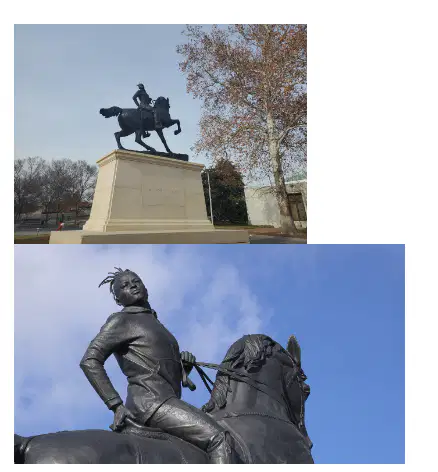
The monument above was created by the artist Kehinde Wiley, who was born in Los Angeles in 1977 and is currently based in New York City. He is best known for his highly naturalistic paintings of Africian Americans.....
Which of the following statements about the sculpture above is NOT TRUE:
Rumors of war was unveiled in December 2019 in its permanent home in Times Square in New York City.
Rumors of War takes its inspiration from the statue of Confederate Army General James Ewell Brown “J.E.B.” Stuart created by Frederick Moynihan in 1907.
Rumors of War takes its name from a biblical phrase found in Matthew 24:6, addresses the violence that continues not just in the Middle East but every day on the streets of this nation.
Rumors of War commemorates African American youth lost to the social and political battles being waged throughout our nation.
Rumors of War depicts a young African American dressed in urban streetwear. The artist describes him as "both no man and everyman."
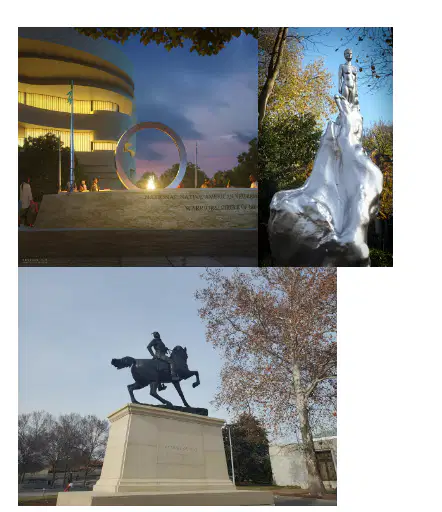
Shown above are:
The National Native American Veterans Memorial was unveiled on Veteran's Day 2020 in Washington DC just a block away from the Capitol. It is a tribute to the American Indian, Alaska Natives and Native Hawaiian people who have served in every conflict since the Revolution. The memorial was intended to be a living work of art that provides a healing, contemplative space for all native veterans and their families.
A Sculpture for Mary Wollstonecraft (2020) by Maggi Hambling in London. The sculpture represents the birth of the feminist movement. The nude woman is intended to represent all women and transcend traditional models of memorials in which individual people are put onto pedestals.
Rumors of War (2019) by Kehinde Wiley at the Virginia Museum of Fine Art in Richmond, Virginia. The bronze sculpture commemorates African American youth lost to the social and political battles being waged throughout our nation. It depicts "both every man and no man."
What do all of these monuments have in common?
All of these memorials celebrate the birth of the feminist movement.
All of these memorials were made during the civil rights movement of the 1960s.
All of these memorials are located in Washington DC.
All of these memorials pay tribute to an idea rather than a specific person.
All of these memorials were funded by the government.
______________________________, the 43rd United States President started painting as a post-presidency pastime. The former president began painting soon after leaving office, but kept the hobby largely hidden from the public until 2013, when his sister Dorothy Bush Koch's email account was hacked and several images of his paintings were leaked online. Since then, he has publicly exhibited his works, and they have even received positive attention from critics.
In his 2014 exhibit, The Art of Leadership: A President's Personal DiplomacyLinks to an external site., Bush explores the relationships he forged with world leaders to shape international policy and advance American interests abroad. The exhibit featured thirty never-before-exhibited portraits painted by President Bush. Portraits are accompanied by artifacts, photographs, and personal reflections to help illustrate the stories of relationships formed on the world stage.
The Art of Leadership: A President's Personal Diplomacy educates and informs visitors about the important role leadership plays in global diplomacy, and provides an insider’s view into President Bush’s unique relationships with other world leaders.
John McCain
Barack Obama
Alexander Hamilton
George W. Bush
George Washington
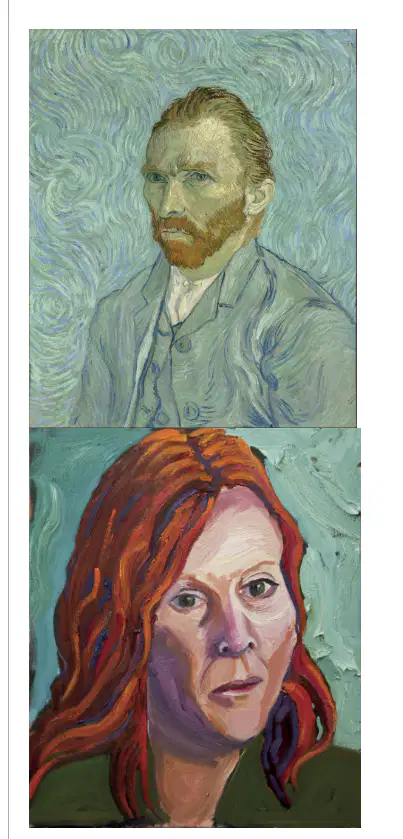
The work of George W. Bush (on the right) could be compared to the work of the 19th century Post-Impressionist painter, ___________________ (on the left).
Both artists use bold colors, expressive brush strokes, and the impasto painting technique in which the paint is applied so thickly so that it stands out from a surface
The former president started painting as a post-presidency pastime. He created a set of paintings in the evenings as a way to commemorate some of the veterans he has met since leaving office in 2009. This book is his first art book.
Paul Gauguin
Vincent Van Gogh
Georges Seurat
Pablo Picasso
Paul Cézanne
Portraits of Courage: A Commander in Chief's Tribute to America's Warriors (2017) is a vibrant collection of oil paintings and stories by George W. Bush, the 43rd United States President honor the sacrifice and courage of America's Military Veterans.
The former president started painting as a post-presidency pastime. He created a set of paintings in the evenings as a way to commemorate some of the veterans he has met since leaving office in 2009. This book is his first art book.
Who is George W. Bush honoring with his Portraits of Courage portrait series?
Native American veterans
American immigrants
America's founding fathers
America's military veterans
his unique relationships with other world leader
"George W. Bush, the 43rd president of the United States and a hobbyist painter, is publishing his second book of paintings. Titled Out of Many, One: Portraits of America’s Immigrants, the book will showcase a series of 43 portraits painted in oil depicting American immigrants. But blowback has been swift on social media, with critics accusing the former president of hypocrisy with the new series, since his administration created US Immigration and Customs Enforcement, more commonly known as ICE, which has cracked down harshly on undocumented immigration under Trump.
“While I recognize that immigration can be an emotional issue, I reject the premise that it is a partisan issue. It is perhaps the most American of issues, and it should be one that unites us,” Bush writes in his book’s introduction. “My hope is that this book will help focus our collective attention on the positive impacts that immigrants are making on our country.” Critics online however have pointed out that the sweeping authority given to ICE by Bush enabled the hardline immigration policy pushed by Trump today.
The former president began painting soon after leaving office, but kept the hobby largely hidden from the public until 2013, when his sister Dorothy Bush Koch's email account was hacked and several images of his paintings were leaked online. Since then, he has publicly exhibited his works, and they have even received positive attention from critics. Out of Many, One will be published on 2 March 2021 by Crown. The book will accompany an upcoming exhibition at the George W. Bush Presidential Center in Dallas, and a portion of the proceeds will be given to organizations that help immigrants resettle in the US." by Wallace Ludel, The Art Newspaper, August 11, 2020Links to an external site.
Which of the following statements is NOT TRUE:
George W. Bush hopes that this book will help focus our collective attention on the positive impacts that immigrants are making on our country.
George W. Bush began painting soon after leaving office, but kept the hobby largely hidden from the public until 2013, when his sister Dorothy Bush Koch's email account was hacked and several images of his paintings were leaked online.
George W. Bush has publicly exhibited his art works, and they have even received positive attention from critics.
George W. Bush created these portraits to help promote harsher penalties for undocumented immigrants.
George W. Bush rejects the premise that immigration is a partisan issue. He asserts that it is perhaps the most American of issues, and it should be one that unites us.
Making a work of cinema is a collaborative effort and depends on the work of many individual. According to the ___________________ theory, it is the person who controls the mise-en-scene that is the true author of the film. This is often the same person as the director.
Bechdel
cinéma vérité
auteaur
male gaze
pastiche
An editing technique that breaks the continuity of time by quickly moving forward from one part of the action to another. It creates an illusion of moving forward quickly in time.
subjective viewpoint
dissolve
tracking shot
mise-en-scene
jump cut
An editing technique in cinema that includes a rapid succession of images in a short period of time. It can be used to compress time or draw a visual metaphor.
high-key lighting
montage
dissolve
cinéma vérité
subjective viewpoint
In cinema, this camera viewpoint is roughly analogous to the third-person narrative in literature.
establishing shot
subjective
objective
direct address
long shot
In cinema, this camera viewpoint is roughly analogous to the third-person narrative in literature.
establishing shot
subjective
objective
direct address
long shot
In filmmaking, a transition device where a scene fades out into black and the next scene fades in.
crosscutting
pan
parallel development
dissolve
jump cut
In filmmaking, the camera rotates horizontally while keeping it fixed vertically.
pan
jump cut
pastiche
cinéma vérité
zoom
A filmmaking technique in which natural or outdoor lighting is used and the camera is hand-held, while the film appears unsteady.
travesty
high-key lighting
direct address
diagetic sound
cinéma vérité
An editing technique that involves alternating between two different sets of action. Those actions might be occurring simultaneously or at different times.
crosscutting
cinéma vérité
montage
mise-en-scene
diagetic sound
An editing technique that allows two or more simultaneous sets of action to unfold within a single film sequence.
camera angle
structural rhythm
tracking shot
long shot
parallel development
A filmmaking method in which the actor looks or speaks directly into the camera. This is also called, "breaking the fourth wall."
mise-en-scene
direct address
female gaze
auteur theory
cinéma vérité
The visual elements of a work of cinema or theatrical production. The auteur uses these elements to tell a story or convey meaning. These visual elements could be anything that can be seen by the viewer, such as props, costumes, actors, setting, color, and lighting. The term literally means to "set the stage".
subjective viewpoint
direct address
mise-en-scene
cinéma vérité
objective viewpoint
A work of cinema or theatre that deliberately distorts or falsifies a historical narrative.
cinéma vérité
travesty
Bechdel Test
mise-en-scene
auteur theory
The elements of mise en scène can be used to create themes (or central ideas embedded within the film) and ______________ (or recurring visual elements that reinforce the themes).
non-diagetic sound
tracking shots
long shots
cinéma vérité
motifs
Which of the following is concerned with whether a work of cinema contains at least two female characters who speak to each other about something other than a man.
travesty
Bechdel Test
cinéma vérité
auteur theory
mise-en-scene
A technique used in art in which elements from a variety of time periods and genres are blended together like a collage.
theme
pastiche
travesty
cinéma vérité
motif
This term describes a noise which does have a source on-screen. They are noises which have not been edited in.
non-diagetic sound
cinéma vérité
high-key lighting
diagetic sound
direct address
This term describes a noise which does not have a source on-screen. These noises have been added in during the editing process.
non-diagetic sound
cinéma vérité
high-key lighting
direct address
diagetic sound
A type of shot in cinema where the focal length is adjusted during the shot, making the subject either larger or smaller. The camera itself does not move (as opposed to a tracking shot).
camera angle
pan
zoom
establishing shot
bridging shot
A type of shot in cinema where the camera itself moves in relation to the subject being filmed.
long shot
zoom
tracking shot
cinéma vérité
pan
The act of depicting women and the world from a masculine, heterosexual perspective in a way that depicts women as sexual objects on display for the pleasure of the male viewer.
cinéma vérité
pastiche
the male gaze
Bechdel Test
auteur theory
The act of depicting the world from the perspective of a woman. Since women make up such a small percentage of directors and cinematographers, a more complete understanding of this perspective is yet to be revealed.
camera angle
direct address
female gaze
objective viewpoint
male gaze
The _______________marks the specific location at which the camera is placed to take a shot. Different placements can have different effects on the viewer and how they perceive the action.
camera angle
tracking shot
dissolve
theme
travesty
In filmmaking, the _____________________ is created by whatever appears or occurs within the shot of a moving picture. It can change within a scene (film) and from scene to scene. For example, it might be energetic and upbeat in one scene, and slow and somber in another.
structural rhythm
high-key lighting
travesty
direct address
cinéma vérité
This shot sets up the context for a scene by showing the relationship between its important figures and objects. It helps to set the stage for the action this is about to take place.
jump cut
close-up shot
bridging shot
establishing shot
long shot
This type of shot shows the entire subject, although they aren't necessarily filling up the frame. Sometimes the scenery dominates the frame. This type of shot can act as an establishing shot, and sets the scene and the character's place in that scene.
tracking shot
close-up shot
bridging shot
zoom
long shot
This type of shot is used to cover a jump in time or place or some other discontinuity. Examples are a clock face showing advancing time, falling calendar pages, railroad wheels, newspaper headlines and seasonal changes.
bridging shot
establishing shot
structural rhythm
crosscutting
long shot
A ________________ (or tightly-framed shot) is a shot taken of a subject or object at close range intended to show greater detail to the viewer. It is a method for drawing attention to something that holds great importance to the character or the story.
close-up
pan
cinéma vérité
jump cut
long shot
A basic rule of composition in film production. Divide the frame visually into nine equal parts. The intersections of the lines are control points. Important subjects are placed strategically along these lines.
parallel development
rule of thirds
objective viewpoint
subjective viewpoint
subjective viewpoint
This term refers to the frame and how the elements of the mis-en-scene are arranged within that frame. However the auteur chooses to arrange these elements can have a significant impact on how the viewer perceives the film.
diagetic sound
parallel development
cinéma vérité
pan
composition
A style of lighting used in cinema that is often used to suggest a positive, upbeat mood or a some sort of fantasy world.
diagetic sound
mise-en-scene
high-key lighting
non-diagetic sound
cinéma vérité
The oral speech between characters. There are many factors that could potentially impact the overall impact of the film such as accents, slang, and the desirability of the speech.
dialogue
auteur theory
theme
diagetic sound
montage
The viewpoint in filmmaking in which the scene unfolds through the eyes of the character. It helps to the viewer to feel more immersed in the action of the film and empathize with the character.
long shot
female gaze
subjective
bridging shot
objective
Which of the following is NOT a film directed by Sofia Coppola.
Lost in Translation (2003)
The Bling Ring (2013)
Being John Malkovich (1999)
The Beguiled (2017)
The Virgin Suicides (1999)
Coppola's nomination for Best Director for ____________________________ made her the first American woman in history to be nominated for an Academy Award in that category, and the third woman overall.
The Beguiled (2017)
The Virgin Suicides (1999)
Lost in Translation (2003)
Marie Antoinette (2006)
Somewhere (2010)
Sofia Coppola was born in 1971. She is the daughter of ______________________, an American film director, producer, screenwriter, film composer, and vintner. He was a central figure in the New Hollywood filmmaking movement of the 1960s and 1970s. He is widely considered to be one of the greatest filmmakers of all time. He is perhaps most famous for his Godfather movies. In the article Portrait of a Lady: Sofia Coppola, Pam Cook argues that the privilege that comes from being the daughter of such an affluent Hollywood director gives Sofia Coppola special insight into the life of Marie Antoinette.
Stanley Kubrick
Ron Howard
George Lucas
Francis Ford Coppola
Steven Spielberg
Sofia Coppola was married to director ___________________, who directed Being John Malkovich and Adaptation). Sofia is currently with Thomas Mars of the French band Phoenix, who is featured on the soundtrack of Lost in Translation and Marie Antoinette.
Christopher Nolan
Spike Jonze
Quentin Tarantino
Paul Thomas Anderson
Steven Soderbergh
Although Marie Antoinette is set in France, the accents of the actors are mostly ______________________________.
German
Russian
French
American
Italian
Marie Antoinette was filmed on location at ________________________.
The crew was allowed unprecedented access to rooms including the grand Hall of Mirrors and Marie Antoinette's bedroom. The lavish palace and gardens, capable of housing 20,000, were commissioned by Louis XIV, and by the 18th century had become hugely expensive to maintain -- one of the problems facing Louis XVI and Marie Antoinette.
Portrait of a Lady: Sofia Coppola, Pam Cook
The Florence Cathedral
The Vatican
The Palace of Versailles
Buckingham Palace
The Parthenon
Below is an excerpt from Portrait of a Lady: Sofia Coppola by Pam Cook. What cinema concept is being discussed in this excerpt?
________________, a common device in theatre and literature, irreverently wrests its source material from its historical context, producing blatantly fake fabrications that challenge accepted notions of authenticity and value. It brazenly mixes high and low culture, and does not disguise its impulse to sweep away tradition. In the case of historical fictions, _______________ collapses boundaries of time and place through pastiche, emphasizing that history is in the eye of the beholder, whether group or individual. ________________ is playful, but it can have a serious purpose: to demonstrate that the past is always viewed through the filter of the present, and represents the vested interests of those who reinvent it. Precedents for _______________________ in cinema range from 1940s Gainsborough costume melodramas to Baz Luhrmann's 'Red Curtain' trilogy (Strictly Ballroom, Romeo + Juliet, Moulin Rouge); they are often regarded with suspicion by critics who object to the liberties taken and are embarrassed by the disregard for hallowed values.
cinéma vérité
travesty
auteur theory
pastiche
direct address
In the article Portrait of a Lady: Sofia Coppola, Pam Cook discusses the term "pastiche". What is a synonym for that word?
package
pastry
original
collage
colorful
According to Pam Cook in her article, Portrait of a Lady: Sofia Coppola what art form is one of the key vehicles for travesty and pastiche because it consciously disrespects boundaries of time, place and culture, yet at the same time is intimately tied to history?
cinema
classical music
oil painting
sculpture
fashion
In the article Portrait of a Lady: Sofia Coppola, Pam Cook says, "Although we witness Marie Antoinette's progress towards maturity, we are not invited to decide whether she is good or bad. Rather, we are encouraged to respond __________________________ to her situation."
with a critical eye
on an emotional level
with indifference
with historical accuracy
What cinematic term is being discussed in this passage from Pam Cook's Portrait of a Lady: Sofia Coppola?
Production designer K.K. Barrett (who also designed Lost in Translation) embellished the place with furniture, food and draperies that respect the original settings while reinterpreting them, bringing ostentation and conspicuous consumption to the fore and instilling a bright, youthful whimsicality. The resulting visual overload is both seductive and decadent, invoking Marie Antoinette's candy-coloured perspective while at the same time commenting on her addiction to taste and fashion. Costume designer Milena Canonero is similarly inventive, giving Marie Antoinette's status as an 18th century style icon a contemporary twist by simplifying her outrageous dresses and hairstyles (the young dauphine's 'big hair' became her trademark) without losing their original value as culture-shock
Bechdel Test
mise-en-scene
cinéma vérité
parallel development
establishing shot
In the article Portrait of a Lady: Sofia Coppola, Pam Cook describes Coppola's claim that her goal was to to create:
an impression of Marie Antoinette's world
an exposé about a corrupt monarchy
a compelling documentary about Marie Antoinette
a traditional historic epic
In her film Marie Antoinette, Sofia Coppola switches between objective ________________ and subjective __________________ to help viewers experience empathy as well as estrangement. The viewer is meant to have ambivalent (or mixed) feelings toward Marie Antoinette.
camera movement
dialogue
viewpoint
camera angle
shot
Coppola has based her film on the 2001 biography Marie Antoinette: The Journey by _______________, According to Pam Cook in her article, Portrait of a Lady: Sofia Coppola, this biography counters many of the misconceptions surrounding Marie Antoinette, including the "let them eat cake" myth.
<The author> draws a picture of a teenager out of her depth in the French court and its political intrigues, faced with a sexless marriage and under pressure to produce a royal heir, who gradually grew to maturity only to face barbaric retribution at the hands of the revolutionary tribunal. Coppola claims that she was drawn to the idea of Marie Antoinette as a naive and warm-hearted character caught up in circumstances beyond her control. Rather than a sweeping historical epic, she wanted to paint an intimate portrait that gave an impression of the world in which her heroine was cast adrift from the young woman's own perspective.
Ronald Chernow
Élisabeth Vigée Le Brun
Kara Cooney
Antonia Fraser
Rose Bertin
In her article, Portrait of a Lady: Sofia Coppola, Pam Cook describes Sofia Coppola's portrayal of Marie Antoinette as:
sympatheic
hostile
bizarre
unfair
illogical
In the article Portrait of a Lady: Sofia Coppola, Pam Cook compared Coppola's "pop culture aura" to which artist?
Jackson Pollock
Jacques Louis David
Andy Warhol
Katsushika Hokusai
Marcel Duchamp

