
 Worksheets
Semester 2 - General Review
Total questions: 97
Worksheet time: 3hrs 58mins
1 mole of Li
1 mole of Au
1 mole of Si
None, all are equal
If 55.6 grams of calcium carbonate react in excess sodium hydroxide, how many grams of Na2CO3 are made?
Reaction: CaCO3 + NaOH → Ca(OH)2 + Na2CO3
147.34 gram
52.45 gram
55.9 gram
194.24 gram
Fe2O3(s) + 3H2(g) → 2Fe(s) + 3H2O(l)
How many moles of iron can be made from 6 moles H2?
How many moles of hydrogen are needed to react with 2 moles of nitrogen?
6 mol H
2 mol H
3 mol H
1 mol H
12.00 moles of NaClO3 will produce how many grams of O2?
What mass of O2 will be needed to burn 36.1 g of B2H6?
How many grams of aluminum sulfate would be formed if 250g H2SO4 completely reacted with aluminum?
How many moles of HCl are consumed in the production of 7.5 moles of MgCl₂?
CaC₂(s) + H₂O(l) --> C₂H₂(g) + Ca(OH)₂(aq)
how many grams of Ca(OH)₂ would be formed with 3.20 moles of CaC₂?
4NH3+6NO --> 5N2 + 6H2O
The ______________ yield is the maximum amount of product possible in a reaction. This determines the amount of product that should be produced in a perfect setting
Percent
actual
stoichiometry
theoretical
Actual yield = 62g
Calculate the percent yield.
24 grams of CH4 was added to the above reaction. Calculate the theoretical yield of CO2.
Solid or liquid that is being dissolved? (a)
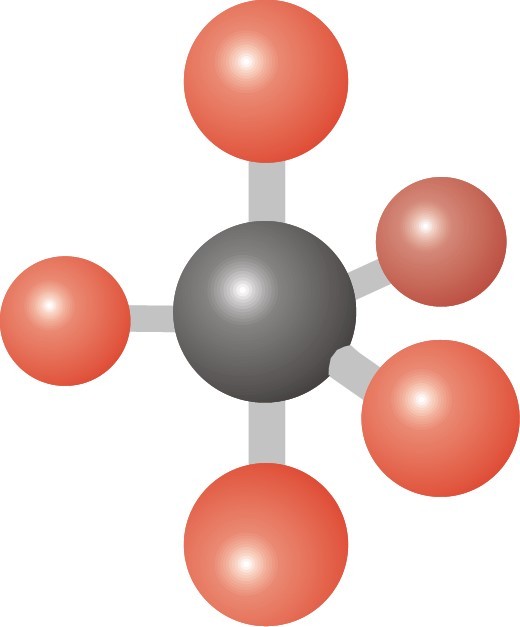
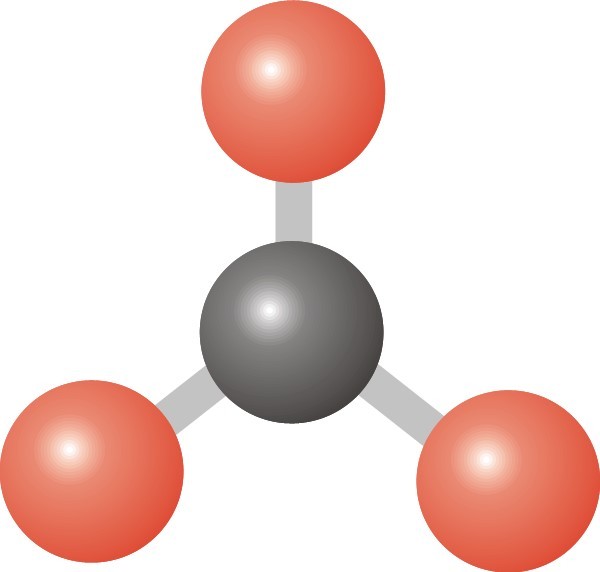
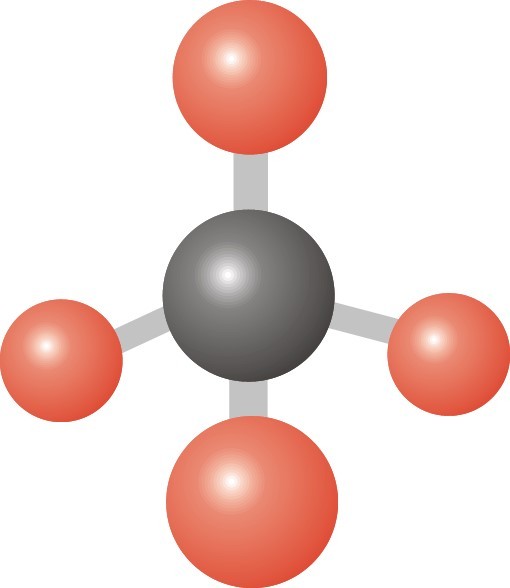
What molecular geometry would PH3 have?
Trigonal Pyramidal
Trigonal Bipyramidal
Bent
Linear
Which substance would have the weakest intermolecular forces of attraction?
CH4
NaCl
H2O
MgF2

Intermolecular forces for: NH3
Dispersion Force
Dipole dipole
Hydrogen bonding
Which substance has the weakest intermolecular forces?
Substance A, boiling point of 75 °C
Substance B, boiling point of 105 °C
Substance C, boiling point of 25 °C
Substance d, boiling point of 45 °C

Intermolecular forces for: CO2
Dispersion Force
Dipole dipole
Hydrogen bonding
What is the molarity of a 0.5L sample of a solution that contains 60.0 g of sodium hydroxide (NaOH)
0.8 M
1.5M
3.0M
6.0M
Which of the following types of solutions has more room to dissolve solute?
supersaturated
saturated
unsaturated
What is the molality of a solution in which 3.0 moles of NaCl is dissolved in 1.5 Kg of water?
2.0 M
0.22 m
135 m
2.0m

What is the molarity of a solution containing 4 moles of KCl in 2.5 L of solution?
1.6 M
0.63 M
10 M
2.6 M
What is the meaning of standard solution?
A solution of which its concentration does not accurately known.
Measurement that shows the quantity of solute in one unit of volume of solution
A solution of which its concentration is accurately known.
Concentration that shows the number of mol of solute
In dilution method, ___________increase but the_____________ remains constant.
volume of solvent
concentration
mass
number of moles of solute
If I have 340 mL of a 0.5 M NaBr solution, what will the concentration be if I add 560 mL more water to it?
.188 M
3.78 M
.389 M
1.76 M
How many mL of 10.8M HCl are required to make 100.0 mL of 3.00M acid?
27.8 mL
.278 mL
2.8 mL
278 mL
If I have 340 mL of a 0.5 M NaBr solution, what will the concentration be if I add 560 mL more water to it?
.188 M
3.78 M
.389 M
1.76 M
PbCl2 + AgNO3 → Pb(NO3)2 + AgCl
Combination/Synthesis
Single Displacement
Double Displacement
NH3 + HCl → NH4Cl
Combination/Synthesis
Single Displacement
Double Displacement
element displacing another element in a compound
burning of a substance
Al(OH)3 → Al2O3 + H2O
Combination/Synthesis
Single Displacement

What type of reaction is taking place in this picture?
Combination/Synthesis
Single Displacement
Double Displacement
Combination/Synthesis
What reaction has the following general formula:
AB + CD --> CB + AD
Combination/Synthesis
Decomposition
Single Displacement
Double Displacement
Combustion
When solutions of MgCO3 and Fe2(SO4)3 are combined, what precipitate(s) forms?
MgSO4
neither form a precipitate
MgSO4 and Fe2(CO3)3
Fe2(CO3)3
Identify the spectator ion(s) in the equation: 2Ag+(aq) + 2NO3–(aq) + 2Na+(aq) + S2–(aq) --> Ag2S(s) + 2Na+(aq) + 2NO3–(aq)
2Ag+(aq) + 2NO3–(aq)
2Na+(aq) + 2NO3–
2Na+(aq) + S2–(aq)
Ag2S(s) + 2Na+(aq
Which of the following best describes a precipitate?
an insoluble solid
a soluble solid
a soluble gas
an insoluble liquid
AB (aq) + CD (aq) → AD (aq) + CB(s)
Which substance is the precipitate in the reaction above?
AB
CD
AD
CB
Use the Solubility Rules to determine if the following compound is soluble in water:
Li2S
Soluble
Insoluble
Based on the activity series, will this reaction occur?
Ni (s) + HCl (aq) →
Yes
No
Based on the activity series, will this reaction occur?
Au (s) + HCl (aq) →
Yes
No
Based on the activity series, will this reaction occur?
Sr (s) + HCl (aq) →
Yes
No
The pH scale is an inverse function. This means the ___________ the concentration of hydrogen ions, the ___________ the pH is. (select all that apply)
higher, lower
lower, higher
higher, higher
lower, lower
Substances with a pH of 7 are
Acidic
Basic
Neutral
Saturated
If we add EQUAL amounts of equally strong Acid and Base to a solution, we call this
Supersaturated
Dangerous
Neutralization
Dilution

Choose the substance that is more acidic using the scale
Milk
Soap
Coffee
Stomach acid
What would be the two new compounds that would be formed in this reaction?
HCl + NaOH -> ______? + ______?
NaCl
ClOH
HNa
H2O
HBr is an example of a(n)
Acid
Base
Neutral
Ca(OH)2 is an example of a(n)
Acid
Base
Neutral
This substance releases OH- into solution
Acid
Base
Neutral
Which solution releases H+ in solution?
Base
Acid
Buffer
Water
A type of chemical that forms solutions that taste sour, due to high concentrations of positive hydrogen ions
acid
base
salt
pH
Zn(OH)2 + HNO3 ---> H2O + Zn(NO3)2
Complete the following reaction:
HCl + Mg(OH)2 -->
MgCl2 + H2O
Mg +H2O
MgCl2 + H2
MgCl2 + H2O + CO2
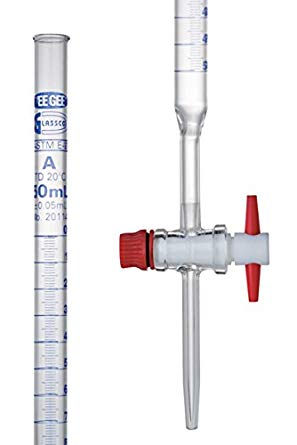
What is this piece of apparatus called
Pipette
Burette
Janette
Cuvette
Which of these titres are concordant?
12.7cm3
12.3cm3
12.4cm3
12.0cm3
30cm3 of NaOH is neutralised by 12.3cm3 of 0.2mol/l HCl. What is the concentration of the NaOH.
82 mol/l
0.82 mol/l
0.49 mol/l
0.082 mol/l
HClO4 + KOH → KClO4 + H2O
Suppose 100 mL of perchloric acid is neutralized by exactly 50,0 mL of 1.0 M of Potassium hydroxide. What is the concentration of the perchloric acid?
H2SO4 + 2NaOH → Na2SO4 + 2H2O
Suppose 50 mL of NaOH with unknown concentration is placed in a flask with bromthymol blue indicator. A solution of 0.20 M H2SO4 is dripped into the NaOH solution. After exactly 25.0 mL of H2SO4 is added, the indicator changes from blue to yellow. What is the concentration of the KOH?

Which factors increase the rate of a reaction?
increasing temperature
increasing concentration
increasing total surface area
All of these
List three factors that affect the rate of a reaction
temperature
concentration
surface area
volume

At what time the volume of product reach 35 cm3
0
100
20
60

The graph below shows how the concentration of a reactant in four different reactions changes over time. Which reaction is the slowest?
A, blue
B, red
C, green
D, purple
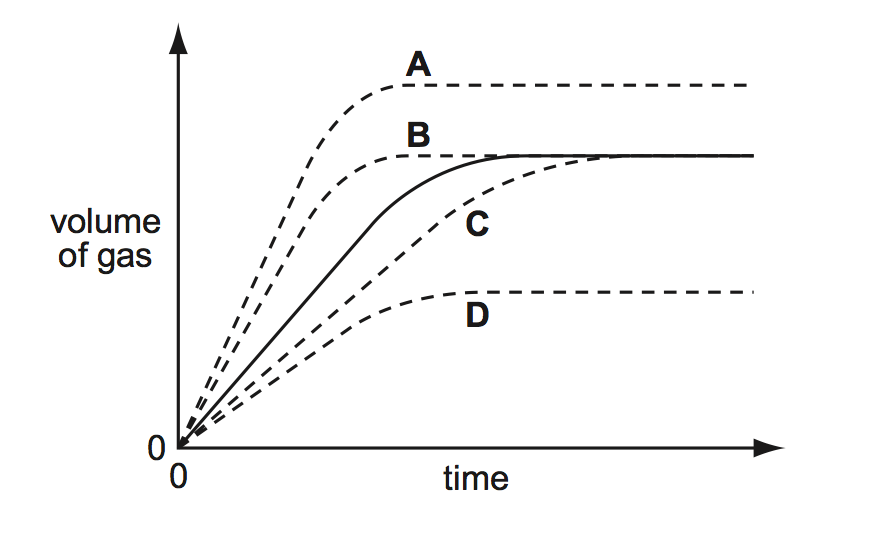
In an experiment, a 2 g lump of zinc and 2 g of powdered zinc are added separately to equal volumes of dilute sulfuric acid.The solid line on the graph shows the volume of gas given off when the 2 g lump is used.
Which dotted line is obtained when the zinc is powdered?
A
B
C
D

