
 Worksheets
EOY Review
Total questions: 97
Worksheet time: 2hrs 38mins
Carries oxygen and nutrients to all parts of the body.
Integumentary
Nervous
Circulatory
Respiratory
Allows movement in the body
Integumentary
Nervous
Skeletal
Muscular
Supports and provides structure for the body
Skeletal
Muscular
Circulatory
Respiratory
Main Organs: Skin
Integumentary
Nervous
Skeletal
Muscular

This is the brain or control center of the cell.
Cytoplasm
Nucleus
Cell membrane

Which cell is shaped like a box?
Plant Cell Only
Animal Cell Only
Both

Every living thing has genetic information stored in the form of
Ribosomes
DNA
Chloroplast
Mitochondria

Traits that are passed from parents to offspring are always
Recessive
Inherited
Dominant
Heterozygous

The passage of genetic instructions from one generation to the next is known as
Alleles
Ancestry
Heredity
Variation

The genetic difference between individuals in the same species is
Interesting
Harmful
Variation
Genetics
Which of the following describes what is meant by Natural Selection?
An organism will survive no matter what its adaptations may be
An organism with adaptations that do not allow it to reproduce as effectively as others will survive.
An organism with adaptations that allow it to obtain resources and reproduce more effectively than others will survive.
No organisms will survive.
Before the industrial revolution the birds were eating more black moths. After the industrial revolution the birds started eating more white moths. Why
The birds thought the white moths tasted better.
There were not any black moths to eat
The white moths stood out on the dark trees so the birds could see them easier.

What is most likely to happen to moth populations in the picture shown?
Light moths--hunted easily, dark moths--population increase
Dark moths--hunted easily, dark moths--population increase
Light moths--hunted easily, light moths--population increase
Lights moths will change their color to match dark moths.
Selective breeding is...
a process to create an organism with desired traits from parents with those desired traits
natural method of producing offspring with desired traits
creating a new species
making organisms reproduce during times of stress

Change over time
Natural Selection
Evolution
Selective Breeding
Homeostasis
Natural selection
organisms better adapted to their environment tend to survive and produce more offspring
process used by humans to develop new organisms with desirable characteristics
Selective breeding
organisms better adapted to their environment tend to survive and produce more offspring
process used by humans to develop new organisms with desirable characteristics

What definition BEST describes a watershed?
An area where water infiltrates the soil
An area where aquatic plants and animals thrive
An area where snow melts and changes into liquid water
An area that collects precipitation and drains it to the lowest point
Which statement about water pollution is TRUE?
Pollution only affects surface water.
Pollution cannot be dissolved in water.
Pollution affects both surface and groundwater.
Pollution cannot travel through soil to groundwater.

A neighborhood in a small Texas town had to be evacuated because the houses were sinking due to a problem in the aquifer. What is the most likely cause of this problem?
Heavy rains caused oversaturation of soil foundations.
Overbuilding in the area polluted the ground water.
Runoff from fertilized land created a dead zone.
Excessive removal of water weakened the ground.

The use of pesticides and fertilizers is carefully monitored because of the effect they can have on the environment. Which of the following is a possible negative effect of the use of these chemical on the environment?
These chemicals are expensive to produce.
Runoff carries these chemicals into lakes and streams.
Storage space for these chemicals is limited.
Theses chemicals cannot be purchased in large bulk.

Aquifer is an area of permeable rock on the land surface that holds groundwater.
True
False
All water below the surface of land is called__________.
water table
watershed
groundwater
runoff
The process where water or irrigation runs over land and seeps into the ground, or flows into streams or oceans.
water cycle
runoff
precipitation
evaporation

Rapid growth of algae in a pond is often the result of -
loss of habitat due to commercial building.
flooding that causes water levels to rise.
excess nutrients from fertilizer runoff.
clogged river tributaries entering a lake.

Identify the change:
Glass breaking
Physical
Chemical
Identify the change:
Wood burning
Physical
Chemical
Boiling Water
Physical Change
Chemical Change
Ice cream melting
Physical Change
Chemical Change
Dissolving Sugar
Physical Change
Chemical Change
A Candle Burning
Physical Change
Chemical Change
Nail Rusting
Physical Change
Chemical Change
A producer is something that:
Eats plants
Makes its own food
Eats animals
Eats plants and animals
Producers are always at the __________ of a food chain
Beginning
Middle
End
Producers are not part of the food chain
What do the arrows show in this food chain:
plant → grasshopper → bird → snake → owl.
The arrow points from the organism being eaten to the organism that eats it.
The arrow points from the organism that eats it to the organism that is being eaten.
The arrow points from biggest animal to smallest animal.
The arrow points from the consumers to the producers.
What is the producer in this food chain?
phytoplankton → krill → fish → shark
Phytoplankton
Krill
Fish
Shark
As you move through a food chain, the amount of energy stored....
Increases
Decreases
Stays the same
It depends on the ecosystem
Arrows in a food web show the flow of
energy
protein
nutrients
glucose
What do decomposers eat?
Dead things
Living things
An heterotroph is another word for a ________, meaning it needs to ________
Consumer, eat other organisms
Consumer, go through photosynthesis
Producer, make its own food
Producer, survive without water

Mushroom (Fungus)
Decomposer
Producer
Consumer

Trees
Decomposers
Consumers
Producers

Falcon
Decomposer
Consumer
Producer

What are the two REACTANTS in photosynthesis?
Carbon dioxide and oxygen
Water and sunlight
Water and carbon dioxide
Glucose and sunlight

What are the PRODUCTS in photosynthesis?
Sunlight and water
Carbon dioxide and water
Glucose and carbon dioxide
Glucose and oxygen
What does an ecosystem NEED to survive?
Sunlight
Oxygen
Carbon Dioxide
All of the above

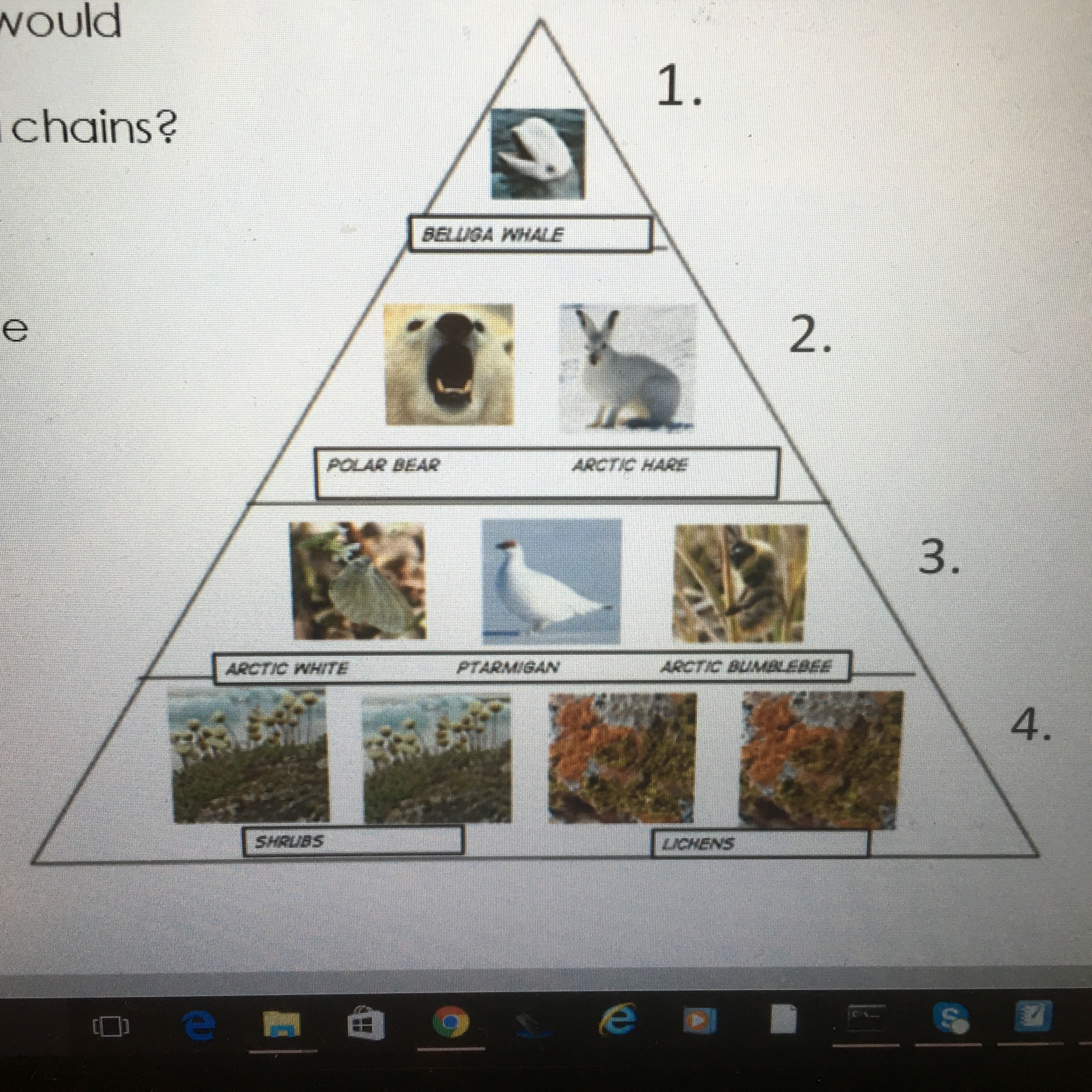
In this energy pyramid, which organisms have the most energy available?
Producers
Carnivores
Herbivores
Top Predator

In this energy pyramid, which organism has the least amount of energy available?
Producers
Herbivores
Carnivores
Top Predator


During the process of photosynthesis —
radiant energy is converted into chemical energy
heat energy is transferred into potential energy
radiant energy is changed into potential energy
thermal energy is exchanged for kinetic energy
Complex interactions must occur before solar energy is converted into a form of energy humans need to work and perform many life processes. Choose the sequence that best shows this path of energy.
radiant energy → chemical energy → mechanical energy
radiant energy → mechanical energy → chemical energy
heat energy → light energy → photosynthesis
mechanical energy → chemical energy → radiant energy
What part of a watershed is most responsible for movement of pollution?
precipitation
condensation
runoff
evaporation
What does it mean for a planet to be found within the “habitable zone” of a solar system?
A habitable planet is the correct distance from a star making the water cycle possible.
A habitable planet is the correct distance from a star making the temperature conditions possible for supporting life.
A habitable planet is too far away from a star making the temperature conditions too cold for liquid water to exist.
A habitable planet is a planet where life has been discovered by scientists.

What type of asexual reproduction is it?
vegetative propagation
sporulation
budding
binary fission

What type of asexual reproduction is it?
budding
regeneration
sporulation
binary fission
The same or identical
Asexual Reproduction
Sexual Reproduction
Diverse
Uniform
Being different
Asexual Reproduction
Sexual Reproduction
Diverse
Uniform
Combining of egg and sperm
Asexual Reproduction
Sexual Reproduction
Diverse
Uniform
Involves only one parent
Asexual Reproduction
Sexual Reproduction
Diverse
Uniform
After a volcano destroys the land, ________________ succession takes place.
Secondary
Primary
Tertiary
Important
The first species to live in a land, after destruction, are:
Oregon Trail species
Primary consumers
Pioneer species
A pattern of change after existing ecosystem is destroyed, such as clearing for farming.
Evolution
Secondary Succession
Primary Succession
A new island is formed after a volcano erupts.
What is the order that things would grow?
Tree, grass, moss
Lichen, Grass, Shrub, Tree
Lichen, Shrub, Moss, Tree
Shrub, grass, moss, tree
The first plants to grow on bare rock are:
Pioneer species
large trees
succession community
After an area was cleared for farmland 100 years ago, it has completely regrown large trees. This is an example of:
Evolution
Ecology
Primary Succession
Secondary Succession
What type of organism would typically grow on bare rock?
Moss and lichen
Grass
Oak trees
Shrubs
Would an oak tree be one of the first or last species to grow?
First
Last

Which of the following organisms is M. erminea?
A
B
C
D
E

A
B
C
D

A
B
C
D
Which statement was NOT included in cell theory?
All living things are composed of cells.
Living cells come only from other living cells.
Each cell contains a cell membrane, cytoplasm, nucleus, mitochondria, and endoplasmic reticulum.
Cells are the smallest structure of living things that can perform the functions necessary for life.
Which instrument is credited for helping scientists develop cell theory?


Robert Hooke, Anton van Leeuwenhoek, Theodor Schwann, Rudolf Virchow, and Matthias Schliden were all responsible for what theory?
The Theory of Gravity
The Theory of Relativity
The Cell Theory
The Theory of Continental Drift
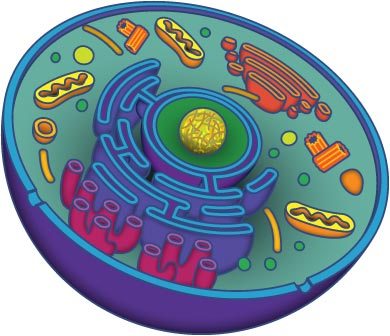
All living things are made up of...
cells
tissues
organ
organ systems
What is the basic structural and functional unit of all living things?
atom
cell
bacteria
animalcules
All cells -----
come from other dead cells
come from other living cells
crystallize out of the air

