Worksheets
Geosphere Review (Rocks, Earth's Layers, Pl. Tectonics, Rel Age)
Total questions: 100
Worksheet time: 2hrs 3mins
How are the materials of the Earths core different from those of the crust (in general)?
They are harder
They are more dense
They are older
They are darker in color
Which area of the Earth is least dense ?
Outer core
inner core
mantle
crust
Which things increase as depth increases into the Earth?
time
Pressure
temperature
density
What is the thinnest layer of the Earth?
Mantle
inner core
outer core
crust
Which layer of the Earth has the most VOLUME?
crust
mantle
inner core
outer core
How do scientists know the Earth has layers?
Drilling into the mantle
Volcanoes
Seismic waves data
ocean waves

What process is the pictures showing?
comprehension
mantle
Earth's layers
convection
melting

What processes causes tectonic plates move?
mountain building
earthquakes
convection currents
water cycle
subduction zones

What phenomena takes place that results in the formation of new crust at mid-ocean ridges?
Earthquakes
Inner Core turbulence
plate tectonics
erosion of mountain ridges
magma rising to the surface

What evidence exists that proves that Earth has layers?
They can be seen from special locations on the Earth
observations of earthquakes and buildings swaying
seismic data from earthquakes on the other side of the Earth
tsunami data from other countries and the impact on the land
rock samples from deep layers
The heat from the interior of the Earth is very, very slowly being lost. Where is it losing this thermal energy?
Earth's surface
Earth's oceans
Earth's moon
Earth's poles
Earth's equator
The breaking down of rocks by factors such as wind and water.
erosion
deposition
weathering
compaction
The movement of sediments by wind and water.
erosion
deposition
weathering
cementation
The laying down of sediment at a location.
erosion
weathering
compaction
deposition
Layers of sediment being squeezed and pressed together.
weathering
compaction
deposition
cementation
___ occurs when sediments crystalize and join together.
cementation
erosion
weathering
compaction
Rock made up of sediments, such as sand, silt, and pieces of shell.
igneous
sedimentary
metamorphic
Rock made from lava or magma cooling and hardening.
igneous
sedimentary
metamorphic
Made from existing rock exposed to extreme heat and pressure.
igneous
sedimentary
metamorphic
Rocks being constantly broken down and reformed is the ____
fossil cycle
pebble cycle
rock cycle
evolution cycle
The thickest layer of the Earth where convection currents occur.
crust
core
mantle
The lithosphere is the rocky upper layer containing Earth's ....
crust and upper mantle
crust and core
upper mantle and outer core
outer core and inner core
The lithosphere contains tectonic plates that glide over the ____ .
mesosphere
atmosphere
asthenosphere
Convection currents are the force that moves earth's tectonic plates.
true
false

Which is MORE DENSE, continental crust or oceanic crust?
Oceanic crust
Continental crust

Which is THICKER, continental crust or oceanic crust?
continental crust
oceanic crust
Tectonic plates are located in earth's __.
core
lithosphere
mantle
asthenosphere
Earth's magnetic field is caused by the iron ___.
mantle
crust
core
The earth's lithosphere is broken up into plates that continuously move.
Theory of Continental Drift
Theory of Plate Tectonics
Theory of Moving Continents
Theory of Superposition
The Law of Superposition states that ____ rock is located above older rock.
younger
older
the same age
Sedimentary rock cannot become metamorphic rock.
true
false
Mountain ranges can be produced when tectonic plates collide and push areas of Earth’s crust to higher elevations. What is the correct term for this process?
deposition
subsidence
erosion
uplift
What is the relationship between magma and lava?
They are both molten rock found at different depths below Earth’s surface.
Lava is magma that has reached Earth’s surface.
They are both types of solid material that spew out of a volcano.
Magma is lava that has reached Earth’s surface.
The Rocky Mountains formed when the Pacific plate collided with the North American plate. Which of the following terms describes this process?
ridge push
transform boundary
divergent boundary
convergent boundary
What happens at a convergent tectonic plate boundary?
Two tectonic plates collide with one another, causing subduction and/or mountain building.
One tectonic plate pulls apart into two new plates, forming a rift or ridge.
Two tectonic plates slide horizontally past each other along Earth’s surface, forming long fault lines.
Two tectonic plates pull away from one another, decreasing rock deformation.
Which statement describes one way in which a divergent boundary is different from a transform boundary?
At a divergent boundary, tectonic plates collide with each other.
Plates slide past each other at a divergent boundary.
At a transform boundary, tectonic plates move away from each other.
Plates grind past each other at a transform boundary.
Mainly igneous rocks have been found in a specific area on land. Which natural event most likely took place in the area to form the rocks?
landslide
flooding river
earthquake
volcanic eruption
Which type of stress causes deformation that leads to earthquakes at converging plate boundaries?
tension
shear stress
stretching
compression

The flow chart below shows how a metamorphic rock can change into a sedimentary rock. Which term should replace the question mark?
cooling
deposition
melting
weathering
How is the outer core of Earth different from the inner core?
The outer core is solid, and the inner core is liquid.
The outer core is made of nickel, and the inner core is made of iron.
The outer core is liquid, and the inner core is solid.
The outer core is made of iron, and the inner core is made of nickel.
Florida is not close to the edge of a tectonic plate. Therefore, which one of the following features does not exist in or beneath Florida?
crust
tectonic plate
mantle
tectonic plate boundary
Rocks and sediment change their form as they move through the rock cycle. Which change involves melting?
lava to rock
rock to magma
magma to lava
rock to sediment
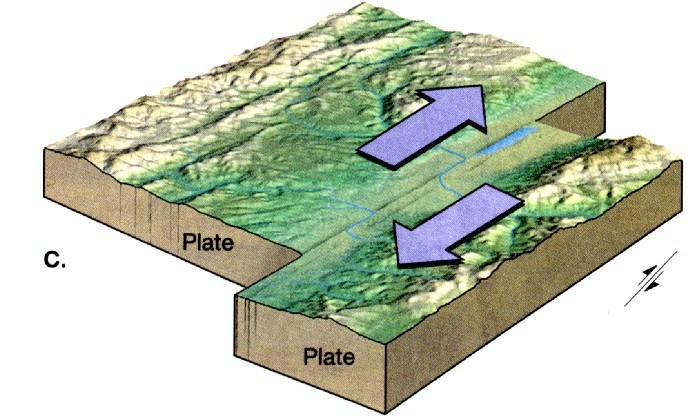
The San Andreas Fault in California is a strike-slip fault (transform). Which of these statements best describes a strike-slip fault?
One fault block moves up relative to the other.
Two fault blocks move in the same direction.
One fault block moves down relative to the other.
Two fault blocks move past each other horizontally.
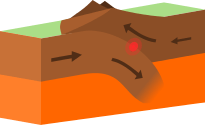
Volcanoes often form at convergent plate boundaries. Which set of arrows represents a convergent plate boundary?


Which of these answers best describes compression caused by tectonic plate movement?
stress that slides rocks past one another
stress that stretches rocks
stress that squeezes rocks
stress that pulls rocks apart
The rock cycle describes how rocks change. What two conditions must be present for either igneous rock or sedimentary rock to change into metamorphic rock?
heat and pressure
earthquakes
water
volcanoes
How does sedimentary rock usually form?
in large crystals
in swirling bands
in vertical layers
in horizontal layers
Fossils of the same plants and animal species have been found on continents that are separated by the Atlantic Ocean. Which of the following statements does this observation support?
These animals and plants crossed the Atlantic Ocean.
The continents that are now separated by the Atlantic Ocean once formed a single landmass.
The Atlantic Ocean was once a large body of freshwater.
The continents that are now separated by the Atlantic Ocean have the same kinds of organisms today as they did millions of years ago.
A scientific ____________ is a broad explanation for events that is widely accepted as true.
law
observation
theory
method
The densest layer of the Earth is the
crust
mantle
lithosphere
inner core
Convection currents in this layer cause the movement of Earth's plates
crust
upper mantle
lower mantle
inner core
The breaking down of materials due to water, wind, ice and gravity
weathering
erosion
deposition
compaction
Metamorphic rock can be found at _____ boundaries
divergent
insurgent
transform
convergent
A rock undergoes extreme heat and pressure, it has become a _______ rock
sedimentary
igneous
metamorphic
mighty morphin
Rock formed by the process of weathering, erosion, deposition, compaction and cementation.
sedimentary
igneous
metamorphic
granite
Limestone caves can develop when limestone is weathered. Which of the following best explains how limestone can be weathered?
moss and plants grew on limestone and broke it down
water flowing through the rock dissolved the limestone
wind blowing across the surface eroded limestone
animals burrowed through the limestone
The type of rock you're most likely to find fossils in is
metamorphic
sedimentary
igneous
Dwayne the Rock
The rock cycle is driven in part by _________________.
The Earth's mantle
The Earth's core
The Earth's tectonic plates
The Earth's rock cycle
The __________________ are chains of undersea mountains.
Mid-Ocean Ridges
Ocean Trench
Divergent boundary
Transform boundary
______________________ continually adds materials to the ocean floor creating ocean floor.
Sea-floor spreading
Ocean trenches
Divergent mid-ocean ridges
Convergent mid-ocean ridges
Oceans plates sink back into the mantle at _______________ zones, keeping the crust the same size.
Mid-ocean ridges
Ocean trenches
Subduction
Transforming
_____________________ are undersea that are the deepest part of the ocean.
Divergent trenches
Ocean trenches
Transform trenches
Mid-ocean trenches
This plate boundary moves land apart, creating an ocean trench or a valley on land : ________________________
Divergent boundary
Transform boundary
Convergent boundary
Mid-Ocean voundary
This tectonic plate boundary creates mountain ranges: ____________________
Divergent boundary
Convergent boundary
Transform boundary
Mid-oceanic boundary
This tectonic plate slips past each other nor creating or destroying land formations: _____________
Divergent boundary
Transform boundary
Convergent boundary
Mid-Ocean boundary
The outermost layer of rock on Earth, especially the part of the earth above the mantle is called ________________
Crust
Rock Cycle
Plate tectonics
Subduction zones
The region of the earth's interior between the crust and the core is called the ________________.
Crust
Mantle
Both the crust and the mantle
Both the mantle and the core
Which tectonic plate boundary SLIDES past each other...
Divergent
Convergent
Transform
Continental
Which tectonic plate moves TOWARDS each other...
Divergent
Convergent
Transform
Continental
Which tectonic plate moves AWAY from each other...
Divergent
Continental
Transform
Covergent
An ocean trench is the same as a __________ on land.
Mountain
Valley
Earthquake
Volcano
Which of these is NOT causes by the moving of tectonic plates?
Valleys
Mountains
Earthquakes
Hurricanes

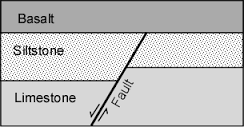
How do these rock formations support the idea that Earth has changed due to natural processes?
It has changed because of Erosion
It has changed because of Plate Tectonics
It has changed because of gravitational pulls of the Earth
It has changed because of different rock layers.
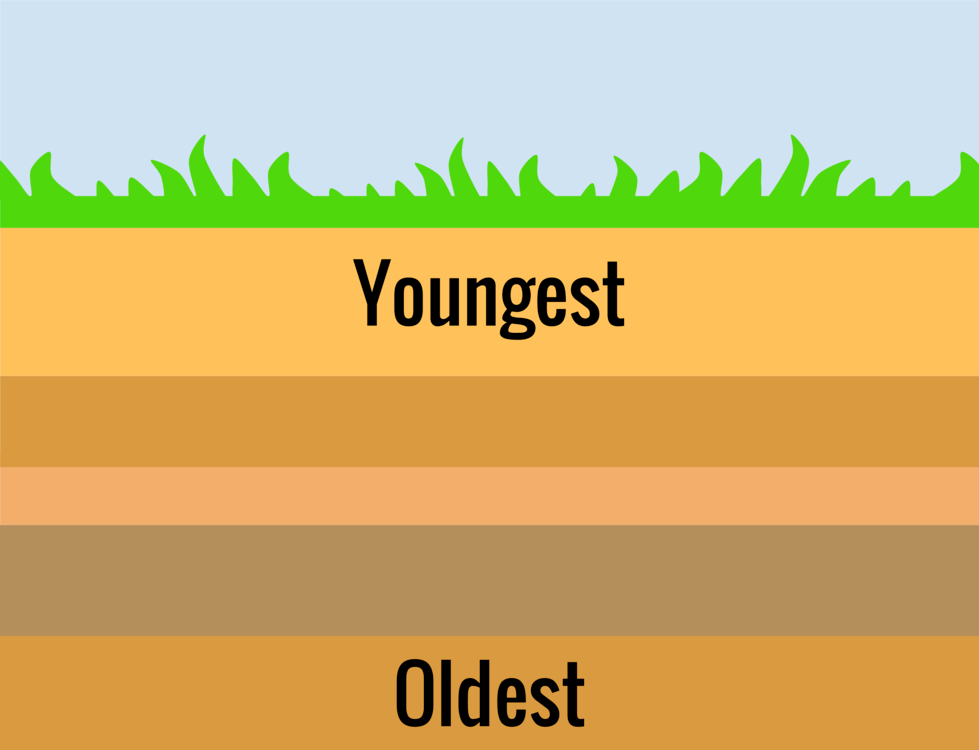
The Law of Superposition states that
the older layers of rock are at the bottom
the older layer of rock are at the top
the younger layer of rock is at the bottom
the younger layer of rock is in the middle

Which statement is correct
Layer 2 is younger than layer 4
Layer 1 is younger than layer 4
Layer 2 is older than layer 1
Layer 3 is younger than layer 1
What geologic principle(or law) is best displayed here?
Superposition
Original horizontality
Cross-cutting relationships
Inclusions

The youngest material of the ocean floor is found at mid-ocean _________.
ridges
trenches
basins
rifts





Which piece of evidence below was NOT used by Wegener to support the Theory of Continental Drift?
Human remains have been found in Europe and North America.
Matching plant and animal fossils found on different continents.
Matching rock formations found across oceans on different continents.
Africa shows evidence of glacial activity.

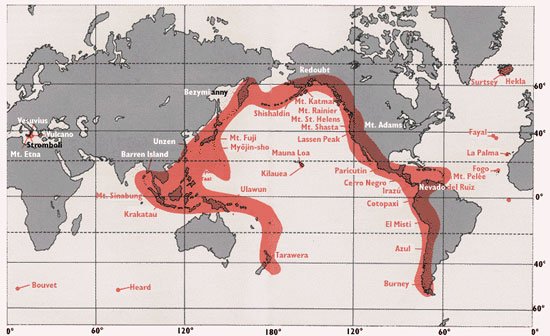
Which statement best describes the Ring of Fire?
Active hot spots are found along its boundaries.
Inactive hot spots are found along its boundaries.
It is a tectonically active area that includes many volcanoes
It is a tectonically inactive area that includes many dormant volcanoes.
All organisms contain the element_________, so it is used to find the ages of fossils.
carbon-14
carbon-12
carbon
carbon age