
 Worksheets
Unit 6 GMA Review
Total questions: 70
Worksheet time: 1hrs 18mins
Excess nitrogen fertilizers sometimes drain into waterways that flow into the Galveston Bay. This nitrogen may cause algae blooms, which reduce dissolved oxygen in the water. How does nitrogen negatively affect the Galveston Bay?
fish births increase
fish populations decrease
sediment on the bottom of the bay
Organisms that make their own food are called __________________.
producers
consumers
decomposers
Where does all the energy originate from in a food web?
All energy comes from the Sun.
All energy comes from the Moon.
All energy comes from your Face.
All energy comes from the Sun.

In this food web, which organism has the greatest number of food sources?
Snake
Hawk
Shrew
Mouse
A certain type of mite is a parasite of honeybees. Which statement best describes the relationship between the mites and the bees?
The mites harm the bees by feeding on their blood.
The mites get honey in return for helping the bees stay healthy.
The mites help the bees find food but get nothing in return.
The mites live in the hive of the bees but do not interact with the bees.


The population size that the environment can sustain.
Carrying Capacity
Limited resources
Mutation
Polygenic Trait
A type of relationship when one species uses another species as a food source; this usually ends in the death of the organism
Symbiosis
Predation
Competition
Parasitism
Biological interaction between two species that use the same resource.
Symbiosis
Predation
Competition
Parasitism
Biological interaction when one organism uses a host organism to obtain nutrients
Symbiosis
Predation
Competition
Parasitism
The variety of living organisms in an ecosystem
Coevolution
Biodiversity
Producer
Consumer
Organization of the environment have a specific order. Which shows the correct order?
Organism, community, population, ecosystem, biome, biosphere
Organism, population, biome, ecosystem, population, biosphere
Organism, biome, community, ecosystem, population, bioshpere
Organism, population, community, ecosystem, biome, biosphere


Aphids are tiny insects that live on and eat the leaves of plants, removing vital nutrients from the plants.
Predation
Parasitism
Commensalism
Mutualism

If a scientist in New Zealand was studying how a group of herbivores interacted with a group of omnivores, and all of their abiotic surroundings, what level of ecology would she be studying?
Community
Population
Species
Ecosystem
Biome
Honey guide birds alert and direct badgers to bee hives. The badgers then expose the hives and feed on the honey first. Then, the honey guide birds eat as well.
symbiosis
parasitism
mutualism
commensalism
Tapeworms reside in human intestine and take nutrients from the human
symbiosis
parasitism
mutualism
commensalism

Vines grow on a tree. The vines get light but the tree is not affected. What kind of relationship is this?
Competition
Mutualism
Commensalism
Parasitism
The number of pythons found throughout Everglades National Park has increased in recent years. These huge snakes are not native to Florida and are believed to have been released into the wild by pet owners. Wildlife biologists have initiated attempts to capture and remove these pythons. Which statement best explains the biologists’ reason for removing these pythons from the Everglades?
The pythons could upset the territorial boundaries of native organisms.
The pythons could adapt to overcome diseases common to native snakes.
The pythons could prey on native organisms and cause native populations to decline.
The pythons could begin to interbreed with native snakes and produce a more successful species.

Predator population lags behind prey population because......
Increase in predators leads to decrease in prey
Increase in predators leads to increase in prey
Increase in predators leads to decrease in producers
Increase in producers leads to increase in prey

What ecological interaction describes the relationship between rabbits and deer?

___ states that two species cannot exist together if they compete for the same resources. One will either die out or migrate, or they will adapt to separate resources.
Hardy-Weinberg Principle
Limiting Nutrient Principle
Competitive Exclusion Principle
Tolerance Principle
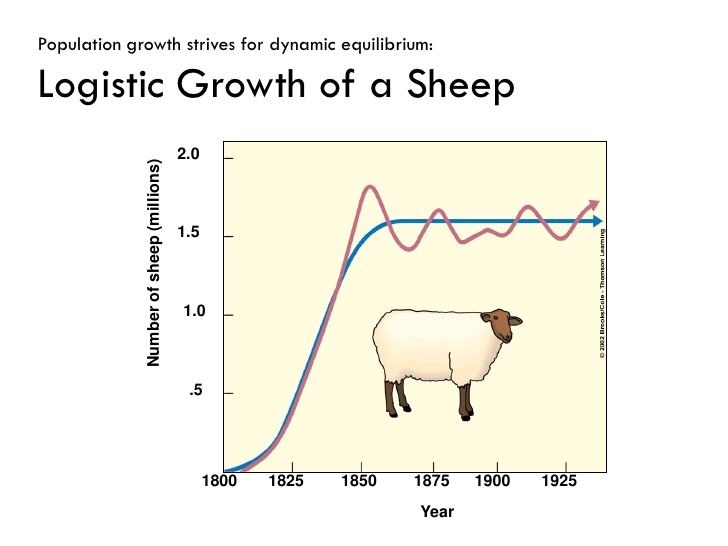


What does the term carrying capacity describe?
The maximum number of birth rates for a population.
The ability of a population to accept new immigrants.
The ratio of birth rates to death rates in a population.
The population size that the environment can sustain.
Food, water, sunlight, shelter, and space are that keep populations from growing exponentially are called...
food chains
ecosystems
communities
limiting factors
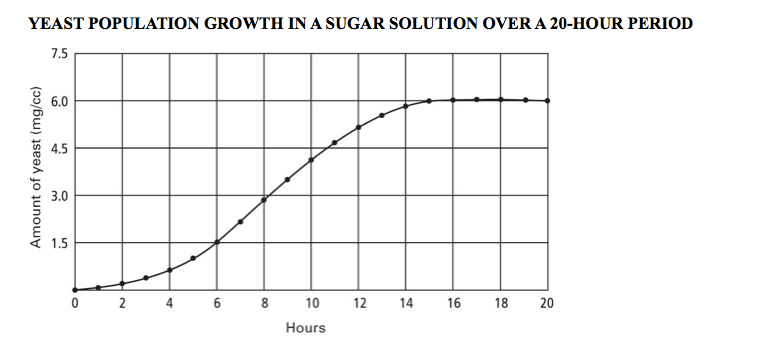
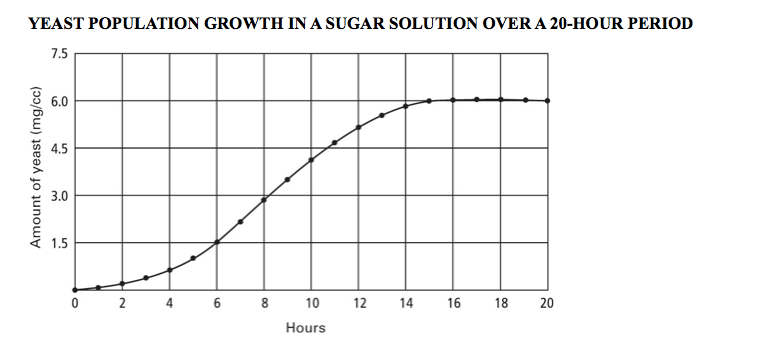
When does the yeast population shown in the graph reach its carrying capacity?
15 hours
10 hours
6 hours
At the start

A student studies the data for the population size of birds in an area over time. The student claims that the birds never exceeded their carrying capacity and displays this graph in support of the claim. Which two statements below are true about the student's claim?
The claim is neither supported nor refuted by the data
The claim is true because the birds experienced periods of exponential growth
The claim is false because the population decreases every time overshoot occurs
The claim is true because the birds are at a stable equilibrium with the environment
The claim is false because the population fluctuates above and below the carrying capacity
Which of these best explains why mosquito populations show an exponential increase followed by a die off on a seasonal basis with a regular pattern?
Mosquito hosts are declining on a seasonal basis due to changes in climate because of global warming.
Mosquitoes are limited by temperature, with reproduction levels high in the spring and summer and low in the fall and winter.
Mosquitoes have a seasonal outbreak of disease that kills more than fifty percent of the populations late in the summer season.
Mosquitoes have an imbalance of males and females in their sex ratio, creating fewer offspring after each successive growing season.
The Great Lakes region is a major source of fresh water and home to a diverse group of plants and animals. Which of these factors could disturb the stability of the ecosystem?
A decrease in fishing throughout the Great Lakes region.
A slowdown of clear cutting and construction in the area.
Normal snowfall in winter, ensuring that water levels remain normal.
The disappearance of a keystone species due to an increase in water temperature.
A species of rabbit lives in a meadow where grass plants are readily available during summer months. The rabbits do not stray far from the meadow because the plants supply food and protection from predators. One summer, a fire destroys the plants in the meadow. As a result of the absence of plants in the meadow, the rabbit population will probably
decrease in size.
increase and flourish.
increase reproduction.
switch to a different type of food.
A laboratory investigation examined the growth rate of fruit flies in culture jars over time. The fruit flies were grown in an artificial medium containing nutrients and moisture. They were enclosed in a culture jar of a defined size. Initially, there were ten fruit flies in the experiment. The population reached 75 over the course of four weeks. However, after eight weeks, the population size leveled off and then decreased. Survival of fruit fly larvae declined after eight weeks. Which 3 hypotheses are supported by the information in this scenario?
The older fruit flies were unable to reproduce.
The carrying capacity was exceeded by the fly population.
Food was abundant for the first four weeks of the experiment.
The fruit flies were unable to survive in a laboratory setting.
The carrying capacity decreased when no new food was added to the culture jars.

Global mean sea level has risen about 8–9 inches since 1880, with about a third of that coming in just the last two and a half decades. The rising water level is mostly due to a combination of meltwater from glaciers and ice sheets and the thermal expansion of seawater as it warms. Changes in the sea level are also impacting the coastal ecosystems. Select 3 of the ways sea level rise can impact the stability of coastal communities.
Contamination of aquifers
Loss of shoreline habitat
Increases in saltwater species
Increased nesting sites for sea turtles
Changes in pH incompatible with plant life
A graph showing the species diversity for a community in response to different levels of disturbance is shown above. Choose 2 statements that support the graph.
All invasive species have a low impact on the diversity of a community.
Intense fires promote more species diversity than fires of low or intermediate intensity.
Extreme drought and high temperatures will have a small impact on species diversity in the community.
A storm of intermediate strength may promote more species diversity than low and high intensity storms.
Selective cutting involving removal of some but not all trees may promote a higher species diversity in a forest community.
The mouse population of an area decreased last year. Which abiotic factor would explain the population decrease?
a decrease in rainfall
a fatal bacterial disease
an increase in owl populations
competition among the mice for food
In 2010, an area in the Gulf of Mexico was the site of the worst oil spill in United States history. The Deepwater Horizon oil rig caught fire, sank, and spilled over 200 million gallons of oil into the surrounding waters. Prior to this event, the leaking of oil into the Prince William Sound from the Exxon Valdez off the coast of Alaska in 1989 was the worst oil spill in US history. In order to assess the damage done to the local ecosystems in the Gulf of Mexico, how would biologists best organize the data?
Biologists would compare the migration patterns of shore birds from 2010, 2011, and 2012.
Biologists would compare the average water temperatures of the Gulf coast before and after the oil spill.
Biologists would track the number of species and their relative abundance in the Gulf coast region in 2009, 2010, and 2011.
Biologists would compare the biodiversity of the gulf coastal regions in 2011 to the biodiversity of the Alaskan coastal regions in 1990, after each of the oil spill events.

Biologists in Louisiana have become concerned about cadmium levels in the water near New Orleans and the probability that frogs will die out. They performed an experiment on bullfrog tadpoles to determine how toxic cadmium is to bullfrogs. Suppose a small river with a population of 10,000 frogs becomes polluted with cadmium to a level of 3 mg per gallon per day. About how many bullfrogs would be expected to die?
about 3000
about 7000
about 8000
about 1500
Forests throughout the U.S. are under increasing development pressure. Habitat fragmentation occurs when the natural habitat is interrupted and partially removed. This occurs when houses, lawns, driveways, and other infrastructure are constructed. This can have consequences for the forest biodiversity. Losing forested land impacts life on Earth in many ways as well as having consequences for Earth's climate. Evaluate the potential solutions below and select those that can reduce the impacts of habitat fragmentation. Select ALL that apply
Replant trees in gaps to eliminate the space between fragmented landscapes.
Use carefully controlled burns as a management tool to maintain plant communities.
Put land in a conservation easement to ensure that it will not be fragmented in the future.
Reduce the rate of conversion of forestland to alternative uses through zoning and comprehensive planning.
Create corridors of trees along fencerows or streams as natural pathways for wildlife connecting forest fragments.
European frog's-bit is a free-floating plant with clustered heart-shaped leaves. Resembling small water lilies, frog's bit has white flowers with three petals and yellow centers that bloom in the summer. European Frog's-bit is native to Europe but was introduced to North America in the 1930s as an ornamental pond plant. It is one of eleven invasive aquatic species identified in Maine law as illegal to import, sell, and transport. What is a way to prevent its spread in Maine lakes and ponds?
treating infestations with aquatic herbicides
Banning the sale and distribution of the plant
Limit boaters to only one local waterway to prevent the spread of invasive species from one environment to another.
Educational outreach and watercraft inspections at boat ramps to keep infestation from migrating from one water body to another.
80% of Australia’s land area is managed by farmers, indigenous communities, and other private land managers. As a result, effectively protecting Australia's environmental resources requires managing environmental assets on private land, and engaging landowners in this effort. Australian dairy farmers have taken the lead in environmental self-assessments and restoration and preservation of the land and water resources. Efforts have been made in the last several decades to preserve and restore Australian lands by dairy farmers. Efforts have included all but one the following techniques. Identify the technique that does not help with restoration or preservation.
Irrigating pasture land during times of water stress and drought.
Planting trees, shrubs and grasses to increase river bank stability.
Fertilizer use on an as-needed basis to reduce nitrous oxide emissions.
Diverting murky run-off from farms into settling ponds to let nature clean it.

The graph illustrates what has happened over an 8 year period, when non-native Nile perch were introduced to Lake Malawi in Africa. Environmental factors remained the same during this period (i.e., temperature, pH, water levels, etc.) Based on the data, what recommendation would you make to African biologists?
Remove or reduce the Nile perch as quickly as possible, as it is clearly out-competing the pike cichlid.
Remove the remaining pike cichlids, as they are competing with the Nile perch.
Reduce both fish populations, or they will starve one another out.
There is no competition between these species of fish.

This chart shows the annual catch statistics for the red grouper for the state of North Carolina during the 1990’s. Red grouper begin their lives as females, and the largest fish change sexes to become male during mating season. Only large females' mate with these males and lay eggs. You are a fisheries biologist for the state of North Carolina. You are charged with protecting the fish population, while also keeping professional fishermen from losing their jobs. Based on the chart above, what would you conclude and what would your solution be?
There is a serious problem with overfishing of red grouper, so there must be a problem with other fish as well. All fishing for any species should be banned.
There is not a very serious problem. The smaller size and population are probably just due to some bad years. Do nothing and monitor the situation.
There is a problem with overfishing. Ban fishing for large fish so their size and population can recover, but allow the fishermen to take smaller fish.
There is a problem with overfishing of red grouper, but the fishermen need to stay in business. Bring in another species of grouper from Australia, so that there are more fish to catch.

This food web shows the flow of energy through a coastal Maine ecosystem. Assuming the phytoplankton has 100,000 joules of chemical energy, what can you infer about the amount of energy available to the other trophic levels? Choose 3.
Herbivores would have 10,000 J of energy available.
Wading birds would have 1000 J of energy available.
The invertebrates have 9,000 J of energy available.
Secondary consumers have 10% of the energy of the producers available.
The tertiary consumers have 0.1% of the energy from the phytoplankton available.

Analyze the pyramid representing the energy flow through an ecosystem. Select the 3 phrases that accurately describe the flow of energy in this ecosystem according to the image here.
Top carnivores obtain the maximum energy from the ecosystem.
Herbivores have more energy available to them than carnivores.
The primary consumers will only have 10% of the energy made by the producers.
Soil organisms recycle nutrients but not energy back into the ecosystem.
Of the energy that is available to the producer level, only ten percent is available to the tertiary consumers.

This picture shows a food web for a forest ecosystem. Evaluate each of the choices and select ALL of those that include ONLY secondary consumers.
hawks, owls, foxes
rabbits, foxes, spiders
spiders, predaceous insects, foxes
insectivorous birds, hawks, spiders
herbivorous insects, mice, squirrels
Consider the Canyonlands food web. Evaluate each of the statements provided and select 3 that apply.
The Fennec Fox is an omnivore.
The Northern Whiptail is an herbivore.
Rock squirrels are the only consumers of Yucca.
Producers include Utah Juniper, Yucca, and Pinyon Pine
The Rock Squirrel, Spiny Lizard, and Fennec Fox are all primary consumers.

Examine the model of the carbon cycle. Select ALL of the processes that return carbon compounds to the atmosphere.
photosynthesis
decay of organisms
animal respiration
animal waste products
auto & factory emmissions

According to the table, what is the optimum temperature for the production of glucose in plants?
10 degrees Celsius
30 degrees Celsius
20 degrees Celsius
35 degrees Celsius
A population of green iguanas lived on a tropical island. Originally, most of the iguanas had feet without webbing between their toes and a long round tail. A few iguanas had webbed feet and a short, flat tail. As the years passed, the island became smaller and smaller because of flooding. Even the land areas were dotted with ponds and pools. The iguanas had a hard time finding the food they normally ate. To survive, the iguanas had to swim from island to island to find food. How would you expect the iguanas to look many years after the island flooded and food became harder to find?
The iguanas will look the same but there will be less of them.
There would be more iguanas with webbed feet and flat tails.
There would be fewer iguanas with webbed feet.
The iguanas would no longer be green.
Wildfires are frequent In the Great Basin shrub steppe. Every time there is a fire outbreak, much of the natural vegetation is destroyed. What is the MOST LIKELY impact of fire on this ecosystem?
A drastic reduction in the animal population due to migration or death by starvation.
No impact, because the plants have only been temporarily removed from the ecosystem.
There would be no rainfall because there are no trees or shrubs in the region.
Non-native plants and animals would migrate into the region.

In a drought, sufficient water is not available for the uptake of water into trees. This directly affects the process of _____________________. Without this process, ample oxygen is not placed into the atmosphere for living things to undergo _______________________.
oxygen, carbon dioxide
carbon dioxide, oxygen
photosynthesis, respiration
respiration, photosynthesis

A team of scientists examining the effects of drought conditions on fish populations assembled the data shown. The data are collected from automated stations that monitor water levels in a stream. The scientists suspect that one of the automated stations may be malfunctioning. Based on the data shown, which monitoring station is most likely malfunctioning and reporting erroneous data?
Station A
Station B
Station C
Station D

