wayground logo

Free Printable Worksheets

Font size

S
M
L
XL
Worksheets

first six weeks review

Total questions: 125

Worksheet time: 6hrs 42mins

Name
Class
Date
1.

a)

A

b)

B

c)

C

d)

D

2.

a)

A

b)

B

c)

C

d)

D

3.

a)

A

b)

B

c)

C

d)

D

4.

a)

A

b)

B

c)

C

d)

D

5.

a)

F

b)

G

c)

H

d)

J

6.

a)

F

b)

G

c)

H

d)

J

7.

a)

F

b)

G

c)

H

d)

J

8.

sand

a)

less dense than water

b)

more dense than water

9.

rubber band

a)

less dense than water

b)

more dense than water

10.

sugar cube

a)

less dense than water

b)

more dense than water

11.

a)

A

b)

B

c)

C

d)

D

12.

a)

A

b)

B

c)

C

d)

D

13.

a)

A

b)

B

c)

C

d)

D

14.

a)

A

b)

B

c)

C

d)

D

15.
floating or sinking when compared to water.
a)
volume
b)
solution
c)
relative density
d)
mixture
16.
The water is ______ dense than the boat
a)
more
b)
less
17.
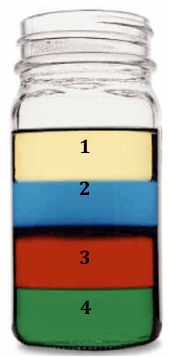
If you poured 3 liquids that do not mix how could you tell which one is the most dense?
a)
The liquid on top
b)
The liquid in the middle
c)
The liquid at the bottom
18.

A bobber floats on the water because it is....

a)

more dense than the water

b)

less dense than the water

c)

the same density as the water

d)

to show you when you have a bite

19.

Rocks sink because they are

a)

the same density as the water

b)

less dense than the water

c)

more dense than the water

d)

because they're round

20.

Why does the egg not sink or float?

a)

it is more dense than the water

b)

it is less dense than the water

c)

it has the same density as the water

d)

it is light

21.
Put the liquids in order from most dense to least dense?
a)
4, 3, 2, 1
b)
1, 2, 3, 4
c)
3, 4, 2, 1, 
d)
4, 3, 1, 2
22.
What two types of measurements make up DENSITY
a)
Mass and Volume
b)
Temperature and Mass
c)
Grams and Centimeters
d)
Volume and Weight
23.
Look at this image.  Which object has the LOWEST density in water? How
a)
The Ping Pong Ball because it floats to the top 
b)
The bolt because it has sunk to the bottom
c)
The soda cap because it is not just full of air like the Ping Pong ball
24.
What is this tool to get mass?
a)
triple beam balance
b)
ruler
c)
thermometer
d)
graduate cylinder
25.
What is this tool to get volume?
a)
triple beam balance
b)
ruler
c)
thermometer
d)
graduate cylinder
26.

Characteristic that can be observed or measured without changing the substance, such as color, melting point, or conductivity

a)

Physical Property

b)

Milliliter (ml)

c)

Cubic centimeter, cm3

d)

Mass

27.

Density

a)

A metric unit of measurement used to measure small volumes of solid substances

b)

A physical property relating the amount of matter in a substance to the volume of the substance; a property used to identify and classify substances

c)

Has mass and takes up space; occurs as elements, compounds and mixtures

d)

Any form of matter that is uniform throughout and has consistent properties
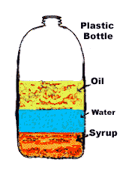
28.
Put the liquids in order from most dense to least dense?
a)
4, 3, 2, 1
b)
1, 2, 3, 4
c)
3, 4, 2, 1, 
d)
4, 3, 1, 2
29.
Which liquid is the least dense?
a)
oil
b)
water
c)
syrup 
d)
plastic bottle
30.

Warm air is _____ dense than cool air.

a)

more

b)

less

c)

the same

31.

What happens to air molecules when they are cooled?

a)

They spread apart

b)

they become compacted

c)

they stay the same

d)

they move quickly

32.

has mass and takes up space.

a)

gram

b)

volume

c)

displacement

d)

matter

33.

If I cut a block of gold in half, what happens to its density?

a)

Density is cut in half.

b)

Density stays the same.

c)

Density doubles.

d)

Density cannot be determined.

34.

a)

A

b)

B

c)

C

d)

D

35.

a)

A

b)

B

c)

C

d)

D

36.

a)

A

b)

B

c)

C

d)

D

37.

a)

A

b)

B

c)

C

d)

D

38.

sand

a)

less dense than water

b)

more dense than water

39.

a)

A

b)

B

c)

C

d)

D

40.

a)

A

b)

B

c)

C

d)

D

41.
floating or sinking when compared to water.
a)
volume
b)
solution
c)
relative density
d)
mixture
42.
The water is ______ dense than the boat
a)
more
b)
less
43.
If you poured 3 liquids that do not mix how could you tell which one is the most dense?
a)
The liquid on top
b)
The liquid in the middle
c)
The liquid at the bottom
44.
Which of these grouping of elements could have the characteristic of luster (shiny)?
a)
Metal
b)
Nonmetal
c)
metalloids
d)
Both metals and metalloids
45.
Which of these is a property of metals?
a)
It's malleable
b)
It can't conduct electricity
c)
They are used in food
d)
It's very brittle
46.
Brittle
a)
Metal
b)
Nonmetal
47.
Good conductor of heat
a)
Metal
b)
Nonmetal
48.
Which element is a metalloid?
a)
Titanium
b)
Selenium
c)
Potassium
d)
Polonium
49.
All of the following would classify an element as a metal except?
a)
Dull
b)
Luster
c)
Malleable
d)
Hard
50.
Iron is a good conductor, malleable and magnetic. What type of element is Iron? 
a)
Metal
b)
Nonmetal
c)
Metalloid
d)
Pretty
51.
A student is given a sample of an unknown substance. He is asked to determine if it is classified as a metal, a metalloid, or a nonmetal. He discovered that the unknown element conducted some heat and electricity, had a shiny luster, and broke easily. This element is most likely a 
a)
metal
b)
nonmetal
c)
metalloid
d)
cannot be determined
52.
Which table below correctly lists the properties of metals and nonmetals? *
a)
A
b)
B
c)
C
d)
D
53.
Which of the following is a property of a non-metal?
a)
Conducts electricity and heats well
b)
Can be hammered into thin sheets
c)
Is brittle and breaks easily
d)
Has a shiny, metallic luster
54.
All of the following are properties used to classify elements as metals, non-metals, and metalloids EXCEPT —
a)
texture
b)
conductivity
c)
luster
d)
malleability
55.
A student tested the conductivity of four elements using an incomplete electrical circuit. When the element is placed in the circuit, the bulb lights up brightly, lights up dimly, or does not light up at all based on the element’s ability to conduct electricity. The table below shows the results of her investigation. Based on the results of the conductivity test, which element is classified as a metal? 
a)
Hydrogen
b)
Arsenic
c)
Krypton
d)
Copper
56.
Which of the following correctly lists the three main groups of elements from greatest conductivity to least conductivity?
a)
Nonmetals -metalloids-metals
b)
metals-nonmetals-metalloids
c)
metalloids-metals-nonmetals
d)
metals-metalloids-nonmetals
57.
The word “luster” refers to which property of matter?
a)
The ability to conduct electrical or thermal energy
b)
Capable of being drawn out into thin wires
c)
The way a surface appears when it reflects light
d)
Suitable for being shaped by beating or rolling
58.
The table shows the properties of four elements. Which element in the table is classified as a metal?
a)
Manganese
b)
Sulfur
c)
Silicon
d)
Neon
59.
Silicon is a semiconductor and has properties of both metals and nonmetals. What type of element is Silicon? 
a)
Metal
b)
Nonmetal
c)
Metalloid
d)
Pretty
60.
John was observing the physical properties of elements in order to classify them as either a metal, nonmetal, or metalloid. The first element was dull, brittle, and did not conduct heat. What would its classification be? 
a)
metal 
b)
nonmetal 
c)
metalloid
61.
´Elizabeth was examining elements and their physical properties. She described an element is her science journal as having no shine, an insulator, and  very brittle. What would this element be a metal, nonmetal, or metalloid?
a)
metal 
b)
nonmetal 
c)
metalloid
62.
If a material can easily be drawn into the shape of a wire, it is
a)
Ductile
b)
Magnetic
c)
Malleable
d)
Reactive
63.

Which of the following are all examples of METALS?

a)

glass, gold, copper, silver

b)

copper, gold, bronze, plastic

c)

wood, iron, aluminium, steel

d)

copper, silver, iron, gold

64.

Are metals good insulators?

a)

No

b)

Yes

65.

What does "malleable" mean?

a)

Can be made into a shape.

b)

Brittle

c)

Ductile

d)

Shiny

66.

Which words best describe NON-METALS?

a)

ductile, shiny, brittle

b)

malleable, dull, brittle, ductile

c)

brittle, dull, insulators

67.

What are properties?

a)

They give us an idea of what the object can do.

b)

They describe the object.

c)

They tell us what an object cannot do.

68.

Some students conducted a laboratory investigation to learn more about the physical properties of different elements. They observed four samples and recorded their observations in the table below. Which Sample is a Non Metal?

a)

Sample 1

b)

Sample 2

c)

Sample 3

d)

Sample 4

69.
Describe what luster means
a)
How an object reflects light
b)
How soft an object is
c)
If an object floats
d)
If an object can be dug out of the earth.
70.
When an object shatters when struck by a hammer.
a)
luster
b)
malleable
c)
brittleness
d)
ductile
71.
When an object changes shape when struck by a hammer.
a)
luster
b)
malleable
c)
brittleness
d)
ductile
72.

Sulfur is considered:

a)

malleable

b)

brittle

c)

ductile

d)

a good conductor

73.

Which elements are to the right of the zig zag?

a)

metals

b)

nonmetals

c)

metalloids

74.

Which elements are to the LEFT of the zigzag?

a)

metals

b)

nonmetals

c)

metalloids

75.

Which elements are colored red?

a)

nonmetals

b)

metals

c)

metalloids

76.
At higher temperatures
a)
particles in an object have less energy
b)
particles in an object move faster
c)
a gas contracts
77.
A gas
a)
has a definite shape but no definite volume
b)
has a definite volume but no definite shape
c)
has fast-moving particles
78.

Freezing

a)

Solid to gas

b)

Liquid to solid

c)

Gas to solid

79.

Boiling

a)

liquid to gas

b)

gas to solid

c)

gas to liquid

80.
Which state of matter has a definite shape?
a)
solid
b)
liquid
c)
gas
81.

The state of matter that has no definite size or shape is

a)

Solid

b)

Liquid

c)

Gas

82.

Particles in a ______________________ move quickly and are far apart.

a)

gas

b)

solid

c)

liquid

83.

The slower the particles in a substance move,

a)

the colder it is.

b)

the warmer it is.

c)

the more energy it has.

84.
The temperature of a substance increases as___.
a)
the substance expands
b)
the average kinetic energy of its particles increases
c)
the substance's volume increases
d)
the substance's mass increases
85.

Particles move relative to each other, but remain in contact with each other.

a)

solid

b)

liquid

c)

gas

86.

Basic state of matter with the greatest amount of energy.

a)

solid

b)

liquid

c)

gas

87.

What happens to particles when their temperature increases?

a)

The particles move slower

b)

The particles move faster

c)

The particles lose mass

d)

The particles gain mass

88.

The amount of space something takes up is its...

a)

Mass

b)

Volume

c)

Thermal Energy

d)

Temperature

89.

The energy of MOTION is...

a)

chemical energy

b)

radiant energy

c)

potential energy

d)

kinetic energy

90.

What is used to measure (but not precise), heat, and mix large amounts of liquids?

a)

beaker

b)

flask

c)

test tube

d)

graduated cylinder

91.

What equipment allows you to see small objects?

a)

beaker

b)

compound light microscope

c)

flask

d)

test tube

92.

What equipment allows you to measure liquid's volume and measures in milliliters?

a)

test tube

b)

beaker

c)

flask

d)

graduated cylinder

93.

Which equipment holds, measures, and mixes liquids (not a precise measurement), and measures in milliliters?

a)

flask

b)

test tube

c)

beaker

d)

graduated cylinder

94.

Which equipment measures temperature in liquid or gas, and measures in degrees Celsius?

a)

hot plate

b)

beaker

c)

thermometer

d)

bunsen burner

95.

Which equipment heats liquids and some stir liquids?

a)

beaker

b)

graduated cylinder

c)

flask

d)

hot plate

96.

Which equipment holds specimens so that you can look at them closely under the microscope?

a)

hot plate

b)

slide

c)

test tube

d)

dropper

97.

Which equipment holds liquids and allows reactions in a small space?

a)

test tube

b)

hot plate

c)

dropper

d)

beaker

98.

Which equipment heats objects with an open flame?

a)

hot plate

b)

thermometer

c)

bunsen burner

d)

beaker

99.

Which equipment allows you to drop a small amount of liquid?

a)

dropper

b)

test tube

c)

graduated cylinder

d)

flask

100.

What does it mean when you see this lab safety symbol?

a)

wear safety goggles

b)

working with fire

c)

working with electricity

d)

working with chemicals

e)

working with sharp objects

101.

What does it mean when you see this safety symbol?

a)

wear goggles

b)

working with electricity

c)

working with glassware or chemicals

d)

working with sharp objects

e)

working with fire

102.

What does it mean when you see this lab safety symbol?

a)

wear goggles

b)

working with fire

c)

working with sharp objects

d)

working with chemicals

e)

working with sharp objects

103.

What does it mean when you see this lab safety symbol?

a)

working with glassware/chemicals

b)

wear goggles

c)

working with sharp objects

d)

working with electricity

e)

working with chemicals

104.

What does it mean when you see this lab safety symbol?

a)

working with sharp objects

b)

working with electricity

c)

working with glassware/chemicals

d)

wear goggles

e)

working with chemicals

105.

What does it mean when you see this lab safety symbol?

a)

wear goggles

b)

working with fire

c)

working with electricity

d)

working with sharp objects

106.
Example: a scientist and his/her occupation... 
Why do archaeologists create maps for their dig sites?
a)
to photograph artifacts
b)
to calculate the exact age of artifacts
c)
to record where the artifacts were found
d)
to discover artifacts
107.
What is a conclusion that is based on an observation?
a)
a control
b)
an inference
c)
a hypothesis
d)
a variable
108.
A scientist publishes the result of an experiment.  Which science skill is this?
a)
observing
b)
inferring
c)
communicating (report)
d)
hypothesizing
109.
What is a series of carefully planned steps used to test a hypothesis?
a)
a constant
b)
an observation
c)
a conclusion
d)
an experiment
110.
Why should an experiment be repeated?
a)
to form a hypothesis
b)
to see if what you assumed was correct
c)
to change controls
d)
to identify the problem
111.
In regard to archaeology, what would be the first step commonly used of the scientific method?
a)
digging for artifacts
b)
drawing conclusions
c)
controling variables
d)
recognizing a problem
112.
What is the term for a variable changed by the experimenter?
a)
independent variable
b)
dependent variable
c)
constant
d)
control
113.
What is the term for a statement that can be tested?
a)
independent variable
b)
dependent variable
c)
inference
d)
hypotheisis
114.
Name the term for a step-by-step approach to problem solving.
a)
inference 
b)
observation
c)
scientific method
d)
science
115.
Which of the following can be used to test a hypothesis?
a)
experiment
b)
theory
c)
law
d)
variable
116.
Which step might be included when defining the problem?
a)
Listing criteria and constraints
b)
Research
c)
Testing a prototype
d)
Brainstorming
117.
Which step might be included when developing solutions?
a)
Listing criteria and constraints
b)
Drawing models
c)
Testing a prototype
d)
Defining the problem
118.
Which step might be included when optimizing a design solution?
a)
Drawing models
b)
Testing a prototype
c)
Analyzing data
d)
All of the above
119.
What is the main job of engineers?
a)
Working on a computer
b)
Using math
c)
Using science
d)
Solving problems
120.
What could be used to help decide on the best design solution?
a)
Criteria
b)
Constraints
c)
Cost
d)
All of the above
121.
What would a limited amount of time to complete a project be considered?
a)
Criteria
b)
Constraint
c)
Cost
d)
All of the above
122.
What is needed as a requirement of success for a design solution?
a)
Criteria
b)
Constraint
c)
Cost
d)
All of the above
123.
What type of engineer might help design a bridge?
a)
Mechanical engineer
b)
Chemical engineer
c)
Civil engineer
d)
Aerospace engineer
124.
What type of engineer might help design a new fuel for cars?
a)
Mechanical engineer
b)
Chemical engineer
c)
Civil engineer
d)
Aerospace engineer
125.
What type of engineer might help design an airplane wing?
a)
Mechanical engineer
b)
Chemical engineer
c)
Civil engineer
d)
Aerospace engineer