
 Worksheets
AP Physics 1 review
Total questions: 130
Worksheet time: 2hrs 57mins

The diagram shows all of the forces acting a ball. Which way is the ball moving?
up
down
there is not enough information
The slope of a velocity-time graph is equal to...
displacement
change in velocity
acceleration
net force
A ball is tossed upward, at an angle of 45 degrees above the horizontal. Which position-vs-time diagram could represent the horizontal component of the ball's motion?


A ball is released from rest, and free-falls with no air resistance. Which graph could represent the ball's velocity-vs-time?
A ball is released from rest, and free-falls with no air resistance. Which graph could represent the ball's acceleration-vs-time?

Two boxes sit on a frictionless surface. An external applied force of 24 N pushes the blue box as shown. What is the magnitude of the force that the blue box exerts on the red box?
4 N
8 N
16 N
24 N

A 2 kg box is initially at rest when it is pushed along a frictionless surface. The graph shows the net force on the box as a function of time. For the first 4 seconds, how much work is done on the box?
16 J
32 J
48 J
64 J
Not enough information to answer.
The period of a pendulum with a length L is 4 seconds. What is the period of a pendulum with length 4L?
2 seconds
4 seconds
8 seconds
16 seconds
The period of a pendulum is 4 s. If the mass of the pendulum bob is doubled, what will the new period of the pendulum be?
2 s
4 s
8 s
16 s
A toy car drives around a circular track at a constant speed of 2 m/s. The radius of the track is 8 m. What is the magnitude of the car's acceleration?
Zero
0.25 m/s/s
0.50 m/s/s
2.0 m/s/s

A small planet P orbits a large star S. The star S exerts a gravitational force F on Planet P. Which statement is true?
Planet P exerts a gravitational force equal to F on Star S.
Planet P exerts a gravitational force smaller than F on Star S.
Planet P exerts a gravitational force greater than F on Star S.
A small planet P orbits a large star S. The planet moves from point A to point B. What is true about the angular momentum of planet P about Star S?
The angular momentum of the planet is greater at point A.
The angular momentum of the planet is greater at point B.
The angular momentum of the planet is the same at both points A & B.
How can you find displacement from a velocity-vs-time graph?
Displacement will be equal to the area under the graph.
Displacement will be equal to the slope of the graph.
Displacement will be equal to the y-intercept of the graph.
Displacement will be equal to the height of the graph at t = 0.

Jogging Jake runs along a train flatcar that moves at the velocities shown. From greatest to least, rank the relative velocities of Jake as seen by an observer on the ground. (Call the direction to the right positive.)
A > B > C > D
B > C > A > D
C > A > B > D
D > C > A > B

Shown below are three separate pairs of point charges, pairs A, B, and C. Assume the pairs interact only with each other. Rank the magnitudes of the force between the pairs, from largest to smallest.
C > B > A
B > A > C
A > B > C
C > A > B

The roller coaster ride starts with the car at rest at point A. Rank from the greatest to least the car's speed at each point.
A > B > C > E > D
A > E > C > B > D
D > E > A > B > C
D > B > C > E > A
The roller coaster ride starts with the car at rest at point A. Rank from the greatest to least the car's kinetic energy at each point.
A > B > C > E > D
A > E > C > B > D
D > E > A > B > C
D > B > C > E > A


A car can go from 0 m/s to 60 m/s in 10 seconds. What is the acceleration of the car?
6 m/s2
60 m/s2
180 m/s2
10 m/s2
A runner has an average velocity of 4 m/s and travels for 12 seconds along the track. What is the distance traveled by the runner during this time?
48 m
12 m
3 m
24 m

750 seconds
35 seconds
0.3 seconds
3.3 seconds
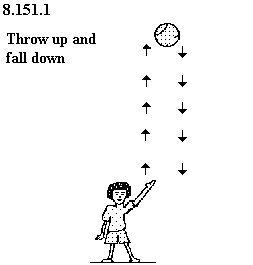
A ball is thrown upwards and caught when it comes back down at the same height. In the absence of air resistance, the speed of the ball when caught would be
less than the speed it had when thrown upwards.
more than the speed it had when thrown upwards.
the same as the speed it had when thrown upwards.
need more information to determine.
In a lab experiment, a ball is rolled down a ramp so that it leaves the edge of the table with a horizontal velocity v. If the table has a height h above the ground, how far away from the edge of the table, a distance x, does the ball land? You may neglect air resistance in this problem.
g2v2
v⋅g2h
g2vh
g2h

What location on the coaster has the greatest potential energy?
W
X
Y
Z


Which of the following correctly ranks the displacement Δx for the three segments of the object's motion?


A student is asked to determine the work done on a block of wood when the block is pulled horizontally using an attached spring. The student is supplied with a spring scale, a stopwatch, and a meterstick. Which of the following graphical analysis techniques will allow the student to determine the work done on the block by the string?
Graphing the force as a function of time and calculating the slope
Graphing the force as a function of time and calculating the area under the curve
Graphing the force as a function of distance and calculating the slope
Graphing the force as a function of distance and calculating the area under the curve
Block A and Block B move toward each other on a level frictionless track. Block A has mass m and velocity +v. Block B has mass 2m and velocity -v. The blocks collide, and during the collision the magnitude of the net force exerted on block A is F. What is the magnitude of the net force exerted on block B, and why does it have that value?
2F, because the mass of block B is twice that of block A and the blocks have the same acceleration during the collision
F/2, because the mass of block B is twice that of block A and the blocks have the same acceleration during the collision
F, because the blocks have the same speed immediately before the collision
F, because the net force is equal to the mutual contact force between the blocks
The magnitude of the gravitational field on the surface of a particular planet is 2g. The planet's mass is half the mass of Earth. What is the planet's radius in terms of the radius RE of Earth?
4RE
2RE
2RE
2RE

A 0.5kg sphere traveling at velocity v1 collides with another 0.5kg sphere at rest. After the collision, the first sphere comes to rest and the other sphere travels at velocity v2. Which of the spheres in the image experiences the greater change in speed?
Black
White
Same
Not Enough Info
How much momentum is lost in an inelastic collision?
Momentum is conserved in all collisions
All the momentum is lost
Half of the momentum is lost
On fourth of the momentum is always lost
An open box and its contents have a combined mass of 5.0 kg. A horizontal force of 15 N is required to push the box at a constant speed of 1.5 m/s across a level surface. How long was the force applied for?
0.25 s
0.33 s
0.5 s
1 s
Which situation will produce the greatest change of momentum for a 1.0 kg cart?
accelerating it from rest to 3 m/s
accelerating it from 2 m/s to 4 m/s
applying a net force of 5 N for 2 s
applying a net force of 10 N for 0.5 s

What force should be applied to compress a spring by 0.5m if its spring constant is k = 1500 N/m?
1880 N
750 N
1500 N
3000 N
A block of wood with mass 1kg is clamped onto a wall with a force of 10N to the right. What is the minimum vertical force needed to keep the block from sliding down? μs=0.15
11.5 N
1.5 N
10.0 N
8.5 N
A block with mass m is hung from a spring with negligible mass and set into vertical oscillation. The maximum distance the spring can stretch is x. A spring is considered to be at equilibrium when there is no net force. At equilibrium, what must be true about the energy of the system involving the mass, spring, and the Earth?
Has only kinetic energy
Has kinetic and gravitational potential energy
Has kinetic, spring potential, and gravitational potential energy
Has only gravitational potential energy
A block with mass m is hung from a spring with negligible mass and set into vertical oscillation. The maximum distance the spring can stretch is x. A spring is considered to be at equilibrium when there is no net force. At equilibrium, what must be true about the energy of the system involving the mass, spring, and the Earth?
Has only kinetic energy
Has kinetic and gravitational potential energy
Has kinetic, spring potential, and gravitational potential energy
Has only gravitational potential energy

The restoration force of a spring oscillator is proportional to __
x
x^2
square root of x
No relation to displacement (x)

1 pendulum and 1 spring oscillator have the same period. If both masses are doubled, the new period of the pendulum is ___ the new period of the spring system.
Less than
Greater than
Equal to
Depends on amplitude

An object undergoes periodic motion. Its position vs time data is shown below. Where is the equilibrium point on the graph?
15 m
0.06 m
4 m
2 m

A centrifuge is used in medical laboratories. It has a rotor that rotates at an angular speed of X rpm in the positive direction when switched on. When switched off, it completes Y revolutions before coming to rest.
A. Derive an expression for the angular acceleration (α) of the centrifuge in terms of X, Y, and π.
B. Derive an expression for the time (t) it takes for the centrifuge to come to a stop in terms of X, α, and π.
The machine applies an average frictional torque of τ to stop the rotor in t seconds when it is switched off.
C. An engineer uses a computer model to graph the frictional torque applied to the rotor with respect to time over an interval of t seconds. What does the area under the plotted curve represent?
D. Consider mass, radius, and angular speed of the rotor. For each of these quantities, determine if changing it has an effect on τ. If it does, how must the quantity change in order to reduce τ? Substantiate all your reasoning.
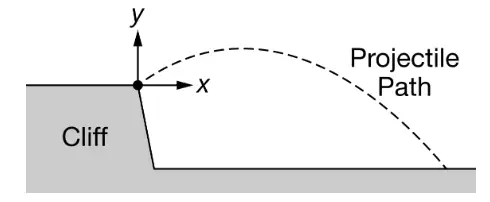
A projectile launched from a cliff at time t = 0 s follows the path indicated by the dashed line in the above figure. The axes indicate the positive horizontal and vertical directions. Which of the following graphs could represent the projectile’s motion?


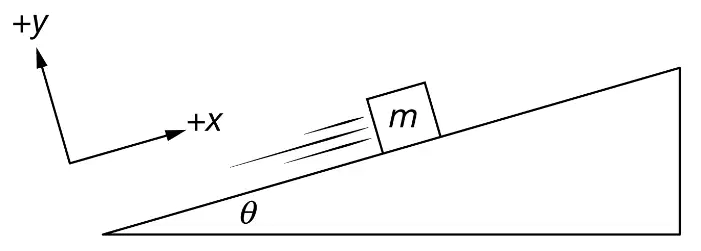
A box of mass m slides up a ramp with initial velocity +v0 . The kinetic friction force on the box has magnitude f . Which of the following is a correct equation that could be used to determine the acceleration a of the box?
−f=ma
mgsinθ−f=ma
f−mgsinθ=ma
−f−mgsinθ=ma
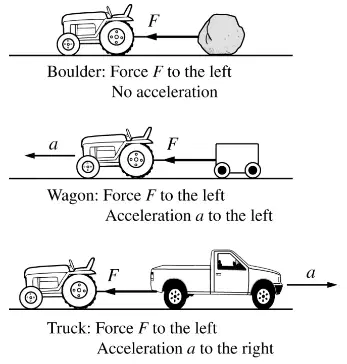
Each of the figures above shows a tractor attached to an object. The tractor exerts the same constant force F on each object in every case. Which of the following is a true statement about an object and the relative magnitude of the force exerted by the object on the tractor?
The magnitude of the force exerted by the truck on the tractor is greatest, because the resulting motion is in the direction opposite the tractor’s pull.
The magnitude of the force exerted by the boulder on the tractor is least, because no motion results.
The magnitude of the force exerted by the wagon on the tractor is least, because the resulting motion is in the direction of the tractor’s pull.
The magnitude of the force exerted by each object on the tractor is equal, because the tractor exerts an equal force on each object.
An astronaut with mass MA is within a satellite that orbits Earth at a height H above its surface. Earth has a mass ME and radius RE . Which of the following is a correct expression for the gravitational force exerted on the astronaut by Earth?
Fg=G H2MEMA
Fg=G RE2MEMA
Fg=G (RE+H)2MEMA
Fg = 0
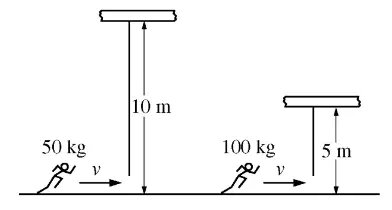
A 50 kg athlete running at speed v grabs a light rope that hangs from a 10-meter-high platform and swings to a maximum of 1.8 m above the ground. Later, a 100 kg athlete, running at the same speed, grabs a similar rope hanging from a 5-meter-high platform. What is the maximum height to which the 100 kg athlete swings?
0.9 m
1.8 m
2.5 m
3.6 m
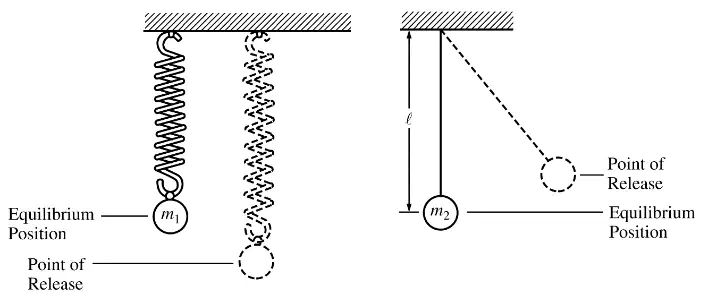
A sphere of mass m1, which is attached to a spring, is displaced downward from its equilibrium position as shown above left and released from rest. A sphere of mass m2, which is suspended from a string of length l is displaced to the right as shown above right and released from rest so that it swings as a simple pendulum with small amplitude. Assume that both spheres undergo simple harmonic motion. Which of the following is true for both spheres?
The maximum kinetic energy is attained as the sphere passes through its equilibrium position.
The maximum kinetic energy is attained as the sphere reaches its point of release.
The minimum gravitational potential energy is attained as the sphere passes through its equilibrium position.
The maximum gravitational potential energy is attained when the sphere reaches its point of release.
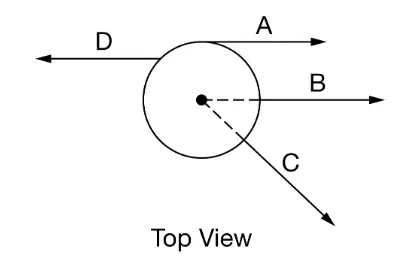
A horizontal disk is free to rotate about an axle at its center. The labeled arrows in the figure represent forces of equal magnitude that are exerted on the edge of the disk in the directions shown. Which of the following correctly ranks the magnitude τ of the torque about the axle exerted by each force?
τA=τB=τC=τD
τA>τD>(τB=τC)
(τA=τB=τD)>τC
(τB=τC)>τD>τA

The diagram above shows a top view of a child of mass M on a circular platform of mass 5M that is rotating counterclockwise. Assume the platform rotates without friction. Which of the following describes an action by the child that will result in an increase in the total angular momentum of the child-platform system?
The child moves toward the center of the platform.
The child moves away from the center of the platform.
The child moves along a circle concentric with the platform (dashed line shown) opposite the direction of the platform’s rotation.
None of the actions described will change the total angular momentum of the child-platform system.

Two solid spheres of radius R experience a gravitational force F1. If two larger spheres of radius 3R made of the same material, what is the magnitude of the gravitational force they would exert on each other?
F1
3F1
9F1
81F1
A car takes 4 s to come to rest while traveling 20 m at constant acceleration. Can the speed of the car immediately before the brakes were applied be determined without first determining the car's acceleration?
Yes, by dividing the distance (20 m) by the time (4s).
Yes, by determining the average speed while braking and doubling it.
No, because the acceleration is need to use standard kinematics equations.
No, because the fundamental relationship that defines velocity contains acceleration.
While traveling in an elliptical orbit around the Sun, Mars gains speed when it is closest to the Sun. Which of the following best explains this phenomenon?
As Mars gets closer to the Sun, the Mars-Sun system loses potential energy and gains kinetic energy.
A component of the gravitational force is perpendicular to the direction of motion and causes a gain in speed.
Torque exerted on Mars by the Sun during this segment increases the Mars-Sun system's angular momentum.
The centripetal force exerted on Mars is greater than the gravitational force during this segment of the orbit.

A marble moves across the floor for a marble moving in one dimension. Which describes the motion of the marble?
Rolling along the floor and bouncing off a wall.
Rolling down one side of a bowl and then rolling up the other side.
Rolling up a ramp and then rolling back down.
Falling and then bouncing elastically off a hard floor.
A race car goes around a flat, unbanked circular track and gradually increases speed as it completes one full trip around the track. Which of the following can explain why the car gains speed?
Energy stored in the fuel is converted to mechanical energy.
A component of the frictional force exerted by the ground on the tires is directed toward the center of the circle.
A component of the frictional force exerted by the ground on the tires is in the direction of motion.
The car's velocity and acceleration are perpendicular.

A child of mass M is on a platform of mass 2M that is rotating, frictionlessly, counterclockwise. Which describes an action that will increase the angular speed of the platform-child system and gives the correct reason why?
The child walks inward, increasing the total angular momentum.
The child walks inward, decreasing the rotational inertia.
The child walks outward, increasing the total angular momentum.
The child walks outward, decreasing the rotational inertia.

The figure shows the forces on a block sliding on a surface. The coefficient of the block and surface is 0.20. The acceleration of the block is most nearly
1.0 m/s2 right
1.0 m/s2 left
2.0 m/s2 right
2.0 m/s2 left

Students are asked to use the set up shown to determine the mass of block B. They plan to measure the time it takes A to reach the floor. Assuming a light string and a light pulley, what other measurements must they make to determine B's mass?
Only the mass of A
Only the distance A falls to reach the floor
Only the mass of A and the distance it falls to reach the floor
The mass of A, the distance A falls, and the radius of the pulley

A student finds a standing wave with one antinode is formed with a frequency fo. If the length of string is halved, at what frequency will a standing wave with one antinode now be formed on the string?
fo/2
fo
2fo
There is no frequency at which the standing wave will be formed
V=πr2h solve for π
π=Vr2h
π=Vr2h
π=Vhr2
π=r2hV
According to Newton’s second law of motion, if force remains the same but mass increases, then acceleration will
increase
decreases
remain constant


A soccer ball is kicked with a 36 degree angle and a velocity of 23 m/s. Find the horizontal component of the balls velocity.
13.5 m/s
14.1 m/s
18.6 m/s
33.1 m/s

Find the magnitude of the resultant vector.
17 m
149 m
3 m
12.2 m
A projectile is launched and reaches its peak in 1.2 seconds. What was the initial vertical velocity of the projectile?
8.13 m/s
9.48 m/s
10.75 m/s
11.76 m/s


Which of the following is the best expression for the Normal Force?
FN = mg cos(ϴ)
FN = mg sin(ϴ)
FN = mg sin(180-ϴ)
FN = mg cos(90-ϴ)

The slope of a velocity-time graph is equal to...
displacement
change in velocity
acceleration
net force
A 2 kg blue cart is moving with a velocity of +3 m/s. It collides to a 4 kg red cart which is initially at rest. The carts stick together after the collision. What is the final velocity of the blue cart?
-2 m/s
-1 m/s
+1 m/s
+2 m/s
A toy car drives around a circular track at a constant speed of 2 m/s. The radius of the track is 8 m. What is the magnitude of the car's acceleration?
Zero
0.25 m/s/s
0.50 m/s/s
2.0 m/s/s
Consider a ball thrown up from the surface of the earth into the air at an angle of 30° above the horizontal. Air friction is negligible. Just after the ball is released, its acceleration is:
0 m/s2
Upwards at 9.8 m/s2
Downwards at 9.8 m/s2
Upwards at 4.9 m/s2
None of these
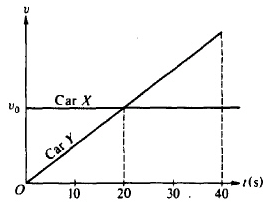
At time t = 0, car X traveling with speed v0 passes car Y which is just starting to move. Both cars then travel on two parallel lanes of the same straight road. The graphs of speed v versus time t for both cars are shown above. Which of the following is true at time t = 20 seconds?
Car X is accelerating faster than car Y.
Car Y is passing car X.
Car Y is in front of car X.
Car Y is behind car X
A ball is tossed straight up and later returns to the point from which it was launched. If the ball is subject to air resistance as well as gravity, which of the following statements is correct?
The speed at which the ball returns to the point of launch is less than its speed when it was initially launched.
The net work done by air resistance on the ball during its flight is zero.
The time for the ball to fall is the same as the time for the ball to rise.
The force of air resistance is directed down-ward both when the ball is rising and when it is falling.
The net work done by gravity on the ball during its flight is greater than zero.

A spring is compressed by a force F against a wall as shown. Which of the following describes the sign of work done by the spring as it is being compressed?
The spring does positive work since it is gaining potential energy.
The spring does zero work since all the work is done by force F.
The spring does negative work since it applies a force against the direction of its compressing motion.
The spring works part-time at Chik Fil-A.
In which of the following situations is kinetic energy decreasing?
A lit tinsel llama is dropped from a building.
A satellite is moving in a circular orbit around the moon.
A baseball is headed upward after being thrown up in the air.
An elevator is moving upward at a constant velocity.
A baguette is dropped off the top of the Eiffel Tower. What is true concerning of the mechanical energy of the ball as it falls?
The potential energy of the baguette is conserved as it falls.
The sum of the kinetic and potential energies of the baguette is a constant.
The kinetic energy of the baguette is conserved as it falls.
A) The total energy of the object increases as it falls since it gains speed.
Bill and Ted both push a crate of mass m crate across a floor with friction at constant speed. Bill pushes the crate d meters in 100 seconds. Ted takes 200 seconds to push the crate the same distance. Which of the following is true?
More power is developed when Ted pushes the crate.
More power is developed when Bill pushes the crate.
An equal, non-zero amount of power is developed in both cases.
Power is not developed in either case since the crate travels at constant velocity in both cases
A car of mass m is traveling at a speed of when the driver applies the brakes. The car moves a distance of d before it stops completely. What is the magnitude of the braking force required?
v22d
2dmv2
d2v2
dmv
A penguin of mass M is lifted upwards a vertical distance of H at a constant speed of v. Which of the following gives a correct expression for the power developed by the penguin as it is raised upward at constant speed?
Mgv
vmg
vmgh
mgh

The system shown consists of two objects of unequal masses, M1 and M2, and pulley with negligible mass and friction. Which of the following is true about the changes in the gravitational potential energy and kinetic energy of the system soon after the objects are released from rest?
ΔU = 0 and ΔK>0
ΔU>0 and ΔK>0
ΔU<0 and ΔK>0
ΔU=0 and ΔK=0
Jared holds a book still two feet above his desk. He then lowers the book at a constant speed and places it on the desk. Which of the following describes the change in total mechanical-energy of the book?
The total mechanical energy is unchanged since there is no net work done as the book is lowered.
The total mechanical energy decreases because Jared does positive work on the book.
The total mechanical energy is unchanged because no work is done on the book while it is lowered.
The total mechanical energy decreases, because Jared does negative work on the book.

