
Font size
 Worksheets
2nd Semester Final Review
Total questions: 108
Worksheet time: 2hrs 52mins

mixture has a temperature of 20°C. About how many grams of the sodium nitrate dissolved?

the best job of communicating the general features of the graph?


In the following, what is the unknown variable:
What is the volume of a balloon if it contains 3.2 moles of helium at a temperature of 20⁰C and 1.2 atm?
P
V
n
T
What is the correct value for T in the following problem:
What pressure is required to contain 0.023 moles of nitrogen gas in a 4.2 L container at a temperature of 20⁰C?
T = 0.23 K
T = 293 K
T = 4.2⁰C
T = 20⁰C
In the ideal gas law, P = (a) , V = (b) , n = (c) ,
R = (d) , and T = (e)
Under which conditions of temperature and pressure does carbon dioxide behave most like an ideal gas?
A) Low temperature and low pressure
B) Low temperature and high pressure
C) High temperature and low pressure
D) High temperature and high pressure
A real gas differs from an ideal gas because the molecules of a real gas have
A) Some volume and no attraction for each other
B) Some volume and some attraction for each other
C) No volume and no attraction for each other
D) No volume and come attraction for each other
Match the following units to their names.
Pressure
mmHg
Volume
L
Temperature
K
Moles
mol
A real gas and ideal gas are similar at (a) pressures because the real gas particles (b) and have (c) collisions, like an ideal gas.
A gas tank carrying 55L of Cl2 has a pressure of 2.6atm and a temperature of 289K. How many moles of chlorine gas are in the tank?
6.03 mol
0.55 mol
1.45 mol
0.75 mol
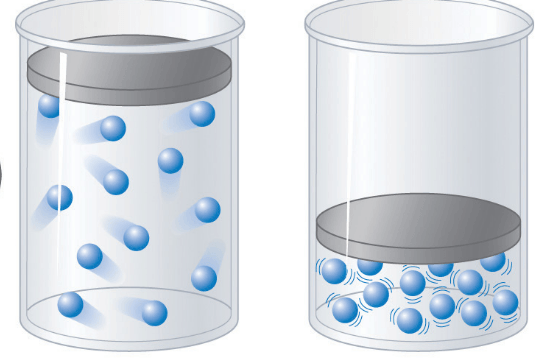
Click the area of lowest pressure
When Volume increases then Pressure must...
Increase
Decrease
When Pressure increases then the Volume must...
Increase
decrease
Which measurement can be identified by the unit K (Kelvin)?
Temperature
Volume
Pressure
Mass
According to Charles Law, if Temperature of a gas increases Volume will also....
Increases
Decreases
Stays the same
If a balloon is placed in the freezer for several hours, then taken out and placed in a warm room, what would you expect to happen to the volume in the balloon?
Volume would increase
Volume would decrease
Volume would not be effected
Volume would briefly increase then decrease
Your tire heats up as you drive it. This will result in...
Pressure increasing
Volume decreasing
Pressure decreasing
Temperature decreasing
Two flasks are kept at the same temperature. Flask 1 has a pressure of 1.2atm, Flask 2 has a pressure of 1.5atm. Which of the following statements is true?
Flask 1 has a smaller volume
Flask 1 has a larger volume that Flask 2
Flask 2 has a smaller volume
Flask 1 has a higher temperature than Flask 2
You blow up an inflatable for the pool. Everything seems great, but there is a hole in the inflatable and soon it is empty. This is an example of...
Diffusion
Effusion
Partial Pressure
Dalton's Law
3 perfumes are sprayed across the room from you: Vanilla (112 g/mol), Fruity (145 g/mol) and Floral (125 g/mol). In what order would you smell the perfumes (first to last)?
Vanilla, floral, fruity
Floral, fruity, vanilla
Fruity, floral, vanilla
Vanilla, fruity, floral
Select the temperature that would increase the kinetic energy of the particles the most.
55oC
341K
70oC
366K
Select all that apply: If you doubled the pressure of a gas...
The volume would decrease by half.
The volume would double.
The temperature would decrease by half.
The temperature would double.

Which energy diagram line represents the catalyzed reaction?
The black line
The red line
It can not be determined

D represents
Potential Energy of Products
Potential Energy of Reactants
Change in Enthalpy
Activation Energy
A represents
Potential Energy of Products
Potential Energy of Reactants
Change in Enthalpy
Activation Energy
B represents
Potential Energy of Products
Potential Energy of Reactants
Change in Enthalpy
Activation Energy

Which of the following is true?
The reaction rate of the diagram on the left would be greater because there are more collisions that will happen because of greater surface area.
The reaction rate of the diagram on the right would be greater because there are more collisions that will happen because of lesser surface area.
The reaction rate of the diagram on the right would be greater because there are more collisions that will happen because of greater surface area.
The reaction rate of the diagram on the left would be greater because there are more collisions that will happen because of lesser surface area.
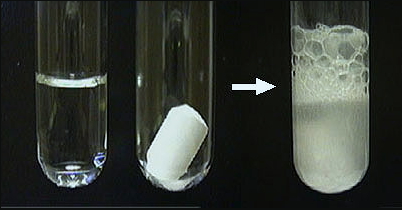
How could we make this reaction happen more quickly?
Decrease the concentration of the acid
crush the chalk to increase the surface area
Put the test tube in an ice bath

When balancing an equation, you can NEVER change the...
Coefficients
Subscripts

The small number after an element is called a...
Reactants
Products
Coefficient
Subscript
The molecules and atoms on the right side of the arrow are called...
Reactants
Products
Coefficient
Subscript
The molecules and atoms on the left side of the arrow are called...
Reactants
Products
Coefficient
Subscript
The large number in front of a molecule is called then....
Reactants
Products
Coefficient
Subscript

This reaction is an example of....
Synthesis
Decomposition
Combustion
Single Replacement
Double Replacement

This reaction is an example of....
Synthesis
Decomposition
Combustion
Single Replacement
Double Replacement

This reaction is an example of....
Synthesis
Decomposition
Combustion
Single Replacement
Double Replacement

This reaction is an example of....
Synthesis
Decomposition
Combustion
Single Replacement
Double Replacement
Baking a cake is a...
Chemical change
Physical change
Mixing salt and water is a...
Chemical change
Physical change
According to the collision theory, more collisions correspond to a:
Faster reaction rate
Slower reaction rate
Constant reaction rate
None of the above

How do we make a dilution?
Add more solute
Remove solute
Remove solvent
Add more solvent
As we dilute a solution.....
The volume increases and the molarity (M) increases
The volume increases and the molarity (M) decreases
The volume decreases and the molarity (M) increases
The volume decreases and the molarity (M) decreases
How many moles of solute are present in 50.0 mL of 0.20M KNO3?
10.0 moles solute
0.05 moles solute
1.00 moles solute
0.01 moles solute
How many mL of stock solution of 2M NaCl do you need to prepare 100 mL of 0.150M NaCl?
7.5 mL
15 mL
1333 mL
200 mL
How many mL of 1.0M KBr solution would you need to prepare 250 mL of a 0.2M dilution?
175 mL
250 mL
50 mL
5 mL
What would the molarity of a solution be if you took 10 mL of a 13M stock solution and made a 300 mL solution?
390M
230M
0.43M
0.26M
You are adding a chlorine solution to a swimming pool. The stock solution of chlorine is 1000M. Your swimming pool (75,000 L) needs to be at a concentration of 0.1M. How much of the stock solution should you add?
7500 L
.75 L
750 L
7.5 L
Balance this equation (a) N2 + (b) H2 --> (c) NH3
Balance this equation. _CF4 + _Br2 → _CBr4 + _F2
3,1,2,1
1,2,1,2
2,2,2,2
12CO2 +H2O --> C6H12O6 + O2
CO2 + 9H2O --> C6H12O6 + O2
CO2 + H2O --> 3C6H12O6 + O2
6CO2 + 6H2O --> C6H12O6 + 6O2

Balance this equation:
(a) Fe + (b) O2 --> (c) Fe2O3
180.18 g/mol
180.12 g/mol
180.24 g/mol
180.06 g/mol
Fe2O3(s) + 3H2(g) → 2Fe(s) + 3H2O(l)
How many moles of iron can be made from 6 moles H2?
How many moles of water can be produced if 8 moles H2 are used?
What mass of O2 will be needed to burn 36.1 g of B2H6?
12.00 moles of NaClO3 will produce how many grams of O2?
What is the mass of one mole of silver?
32.06 g
107.87 g
14.01 g
22.99 g
48.86 g of cobalt is equal to how many moles of cobalt?
2879 moles
8.291 moles
.8291 moles
.829 moles
What is the mass of 4.98 x 1024 atoms of Zn?
541 g
8.27 g
.122 g
4.59 x 1046 g
In an endothermic reaction, energy is _________.
absorbed
released
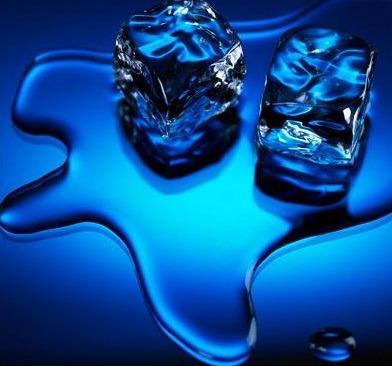
____ reactions usually feel cold.
endothermic
exothermic
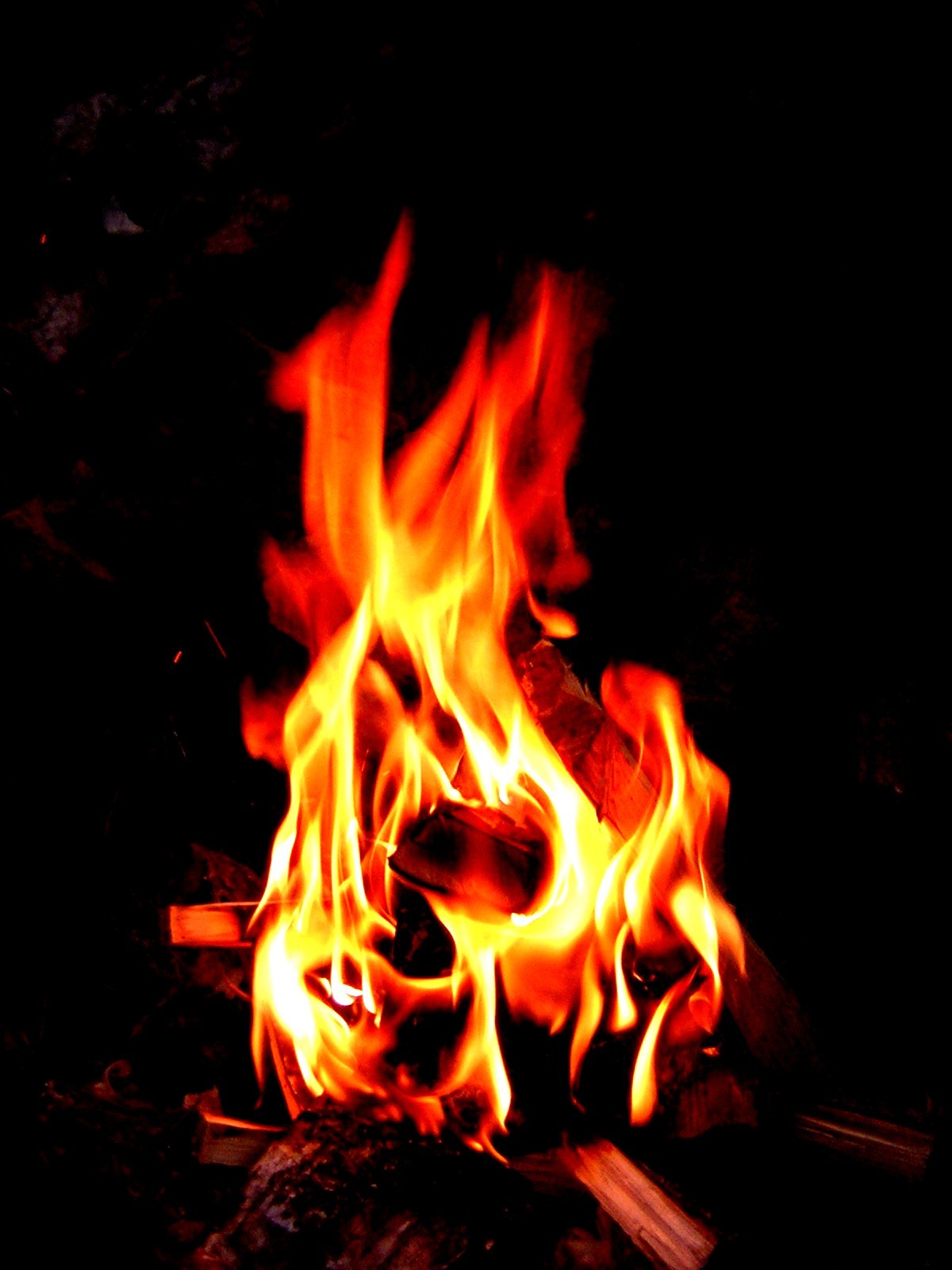
_____ reactions usually feel hot!
endothermic
exothermic
Solid --> liquid --> gas is what type of reaction?
endothermic
exothermic
catalytic
inhibited
gas --> liquid --> solid is what type of reaction?
endothermic
exothermic
catalytic
inhibited
Endo means in or _______.
absorbed
released
Exo means out or ________.
absorbed
released

Ice cubes in your glass of soda melt.
endothermic
exothermic

You freeze juice to make ice pops.
exothermic
endothermic

What is the Heat of Reaction ΔH for this reaction?
-200 KJ
200 KJ
400 KJ
-300 KJ
How much activation energy is needed for this reaction?
300 KJ
500 KJ
400 KJ
100 KJ
What type of reaction is this?
Exothermic
Endothermic
Energy Producing
No way to tell
What kind of equation is this: 2KI + MgCl2 + 200KJ ----> 2KCl + MgI2
Endothermic
Exothermic

How can you tell this reaction is exothermic: MgO + CaS ----> CaO + MgS + 200 KJ
Energy is written on the reactants side
Energy is being released
Energy is being absorbed
if more heat energy is released in making bonds in the products than is taken in when breaking bonds in the reactants
Exothermic
Endothermic
Exotermic
Endotermic

The potential energy diagram of a reaction is shown. Which statement below is correct relating to this reaction?
#1 represents the enthalpy change for this exothermic reaction.
#2 represents the enthalpy change for this endothermic reaction.
#3 represents the enthalpy change for this endothermic reaction.
#4 represents the enthalpy change for this exothermic reaction.

The diagram represents two solids and the temperature of each. What occurs when the two solids are placed in contact with each other?
Heat energy flows from solid A to solid B. Solid A decreases in temperature
Heat energy flows from solid A to solid B. Solid A increases in temperature
Heat energy flows from solid B to solid A. Solid B decreases in temperature.
Heat energy flows from solid B to solid A. Solid B increases in temperature.
Ice cream melting is an example of an __________ process.
endothermic
exothermic
When heat flows from system to the surroundings that is an example of an ________________ process.
exothermic
endothermic
Heat flows from _______ to _________.
warm to cool
cool to warm
Which of the following is true?
Energy transfers from hot to cold.
Energy transfers from system to surroundings.
Energy transfers from surroundings to the system.
Energy transfers from cold to hot.
When a bond is being formed, energy must be....
absorbed
released
When a bond is being broken, energy must be....
absorbed
released

