
Font size
 Worksheets
Y6. Elements, Compounds and Mixtures - Pre-test Revision
Total questions: 129
Worksheet time: 2hrs 54mins

This is an example of a(n)...
Element
Compound
Mixture
Molecule
Solid particles are able to...
Move around
Move in random directions
Vibrate in a fixed position
Be compressed
liquid particles are able to
move around
move in random directions
vibrate in a fixed position
be compressed
Gas particles move in random direction and at...
steady speeds
random speeds
faster speeds
slower speeds
Which state of matter is able to be compressed?
Liquids
Solids
Texas
Gases
Which state of matter is able change to the shape of the container but not be compressed?
Solids
Gases
Liquids
Sublimation
Which two statements correctly describe the properties of a solid?
The particles are close together
The particles have an irregular structure
The particles are held together with strong bonds
The particles have no bonds between them
Which two statements correctly describe the properties of a liquid?
The particles are held to together by strong bonds
The particles have a random structure
The particles can not flow and move
The particles are held to together by weaker bonds
Which two statements correctly describe the properties of a gas?
The particles have no bonds between them
The particles have weak bonds between them
The particles move in random directions at steady speeds
The particles move in random directions at random speeds
When we add more energy to a solid to particles will do what?
Vibrate more
Vibrate less
Move apart
Flow around each other
The reason that liquids can take the shape of the container that they are in is because...
The particles have a random structure
The particles have space between them
The particles can move around each other
The particles are closer together so take up less space
Why can gases be compressed?
The have lots of space between the particles so can be pushed closer together
The particles can flow and move
The particles have lots of energy
The particles have no bonds
Metals are shiny, good conductors, malleable, and ductile.
True
False

Copper is a good conductor of electricity. It is metal or non-metal?
Metal
Non-metal

Gold is lustrous (shiny). It is metal or non-metal?
Metal
Non-metal

Aluminium is really easy to bend and shape without breaking. It is metal or non-metal?
Metal
Non-metal

Steel can be stretched into wire. It is metal or non-metal?
Metal
Non-metal

Bronze metal is used for ringing bells (it is sonorous). It is metal or non-metal?
Metal
Non-metal
Have a high melting point
Metals
Non-Metals
Metals are good conductors of heat, true or false?
True
False
A distinct cluster of two or more atoms bonded together
molecule
lattice
element
Lego
Which could be a correct symbol for a chemical element?
Ca
n
CO
Alu

What is oxygen (O2)?
Atom
Element
Compound
Molecule

What is water (H2O)?
Atom
Element
Compound
Mixture

What is air?
Molecule
Element
Compound
Mixture
What element has the chemical symbol "C"?
Chlorine
Oxygen
Hydrogen
Carbon
What element has the chemical symbol "He"?
Hydrogen
Oxygen
Hydrogen
Helium

Iron is a...
Metal
Non-metal
Metalloid
Gas

What is this compound called?
H2O
O2
CO2
C2O
What element has the chemical symbol "Mg"?
Magnesium
Potassium
Sodium
Carbon
Which of these is needed for filtration?
Wire gauze
Burner
Funnel
Round-bottom flask

In a coffee machine, the ground coffee is separated from the coffee solution by using..
sand paper
filter paper
toilet paper
tissue paper

This is used to pour lab materials into an object with a small opening
scoop
funnel
bunsen burner
goggles

This is called_______________________?
Conical Flask
Test Tube
Safety Gloves
Thermometer
I am left behind in the filter paper ]. What Am I?
Filtrate
Solution
Residue
The part of the mixture that passes through the filter paper is called the
residue
filtrate
suspension
Th components of filtration are separated based on
boiling point
solubility
particle size
Filtration involves a Bunsen burner
True
False
Filtration is generally used to separate...
liquid from liquid
solid from liquid
liquid from gas
gas from gas

Identify the method of separation
Sedimentation
Decantation
Filtration
Distillation
How to separate coffee beans and coffee liquid?
Distillation
Filtration
Evaporation
Sieving
What is filtration used for?
It's used for drinking
It's used for separating water and impurity
all of the above
none of the above

The part of the mixture that passes through the filter paper is called the
residue
filtrate
suspension
mixture

I am left behind in the filter paper. What Am I?
Filtrate
Solution
Residue
Mixture

How will you separate sand from water?
Sieving
Filtration
Evaporation and crystallisation
Hand picking

What separation technique do the images show?
Evaporation
Magnets
Filtration
Distillation

What does the particle diagram represent?
Compound
Mixture
Element
An example of insoluble solid is
sand
suger
The beaker is placed...
under the filter funnel
beside the filter funner
The insoluble solid remains in the ______ because the tiny holes in the filter paper do not allow insoluble solid through
filter paper
beaker
In filtration, the clear liquid which passes through the filter paper is called
residue
liquid
filterate
distillate
Sam kept some water out side in the sun next day he saw nothing in the glass what happen to the water?
It disappeared
It evaporated
Magic

Sara heats a salt solution. What is the name of the process happening at X?
boiling
evaporation
freezing

Ali pours water into a glass dish. He leaves the dish in a warm place for 8 days. After 8 days, there is less water in the dish. Why does the dish contain less water?
The water evaporated
The water froze
The water condensed

Element
Compound
Homogeneous Mixture
Heterogeneous Mixture
H2 is an example of a(n)...
Element
Compound
Molecule
Heterogeneous Mixture

Element
Compound
Homogeneous Mixture
Heterogeneous Mixture
A molecule is created when the same _________ is bonded together. For example: C10
Element
Compound
Homogeneous Mixture
Heterogeneous Mixture

Element
Compound
Homogeneous Mixture
Heterogeneous Mixture
2 or more different elements that are bonded together is called...
A. element
B. compound
C. mixture
D. solution

What is CO2 and example of?
element
molecule
compound
The chemical formula: N2 would represent what type of substance?
Element
Compound
Mixture
Molecule
Copper - Cu
Element
Compound
Homogeneous Mixture
Heterogeneous Mixture
Chalk - CaCO3
Element
Compound
Homogeneous Mixture
Heterogeneous Mixture
Sugar (sucrose) ----C6H22O11
Element
Compound
Homogeneous Mixture
Heterogeneous Mixture


What is the picture displayed?
compound
element
molecule
How many elements are in C6H12O6?
1
2
3
6


How do you remove the water to leave solid copper sulfate crystals?
Filter
Evaporate
Distill
How do you separate an excess insoluble reactant from a solution?
Filtration
Precipitation
Crystalisation
Evaporation
What is the symbol for Copper?
C
co
Cu
CU
Which laboratory apparatus is a beaker?


copper is an example of a(n)
Element
Electron
Neutron
Carbon
___ are pure substances that cannot be broken down into simpler substances by ordinary chemical means.
Minerals
Compounds
Crystals
Elements
Among the following which mineral is found in electronics we use like wires and circuit boards?
Carbonate
Salt
Iron
Copper
Potash
How many elements are in this chemical formula?
HCl
1
2
3
4
How many atoms of Carbon are in this formula? C6 H12O6
6
1
12
What is the total number of atoms in this formula? H2O2
2
4
3
How many atoms does Nitrogen (N) have in the following molecule? AgNO3
1
2
3
4
Fe(C5H5)3 How many atoms of hydrogen? (Answer with number only)
(a)
How many elements are in this chemical formula?
HCl
1
2
3
4
What is the total number of atoms in this chemical formula? C8H3NaBr12
18
12
25
24
Which chemical formula correctly displays 1 atom of nickel and 2 atoms of Fluorine?
niF2
NIF2
Ni1F2
NiF2
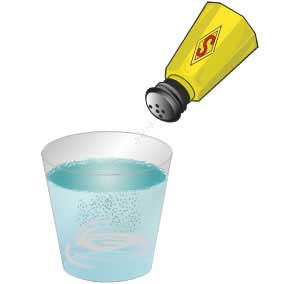

Water is the univeral ____.
solute
solvent
solution

solvent
solute
If I dissolve carbon dioxide in water, what is the solvent?
Carbon Dioxide
There is no solvent
Oxygen
Water
Fish breathe oxygen, which is dissolved in water. Is the oxygen the fish breathe considered to be the solute or solvent?
Solute
Solvent

solvent
solute
Solutes dissolve quicker if you stir them.
true
false
Solutes dissolve quicker in _________ water.
cold
warm
If I dissolve carbon dioxide in water, what is the solvent?
Carbon Dioxide
There is no solvent
Oxygen
Water
Group of atoms bonded together
Mixture
Compouns
Atom
Molecules

What is the picture displayed?
atom
element molecule
compound molecule

Are these molecules also compounds?
YES
NO
Which of the following is NOT a compound?
HCl
Cl2
NaCl
CO2

Element
compound molecules
elemental molecules
Mixture

