wayground logo

Free Printable Worksheets

Font size

S
M
L
XL
Worksheets

Unit #3 Test: Ecology REVIEW!

Total questions: 95

Worksheet time: 2hrs 38mins

Name
Class
Date
1.
Which one is NOT an example of a decomposer?
a)
mushroom
b)
leaves
c)
mold
d)
worm
2.
Examples of a producer
a)
frog
b)
algae
c)
worm
d)
mouse
3.
Example of a decomposer
a)
fungus
b)
mouse
c)
plants
d)
frogs
4.
What is a producer?
a)
an organism that gets energy from eating other organisms
b)
an organisms that uses sunlight to make its own food
c)
an organism that gets energy from eating dead organisms, non-living material or waste
d)
an organism that uses chemical energy to make its own food
5.
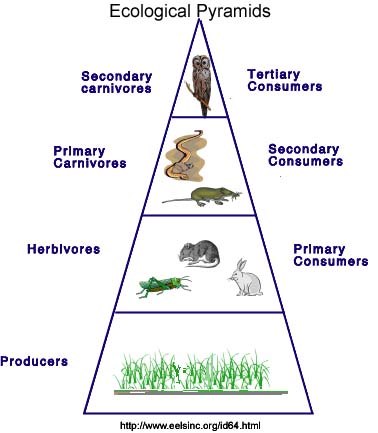
In the energy pyramid here, which organisms have the most energy available?
a)
Producers
b)
Carnivores
c)
Herbivores
d)
Top Predator
6.
In the energy pyramid below, which organism has the least amount of energy available?
a)
Producers
b)
Herbivores
c)
Carnivores
d)
Top Predator
7.
Which organism recieves the least amount of energy from the producer?
a)
Owl
b)
Grasshopper
c)
Lilypad
d)
Mouse
8.
The largest group of organisms found in a food web would be:
a)
Primary Consumers
b)
Producers
c)
Decomposers
d)
Tertiary Consumers
9.

How does the energy flow in an energy pyramids?

a)

up the pyramid

b)

down the pyramid

10.
Biodiversity is 
a)
the variety of species within an ecosystem
b)
a large number of the same species in an ecosystem
c)
an abundant amount of the same primary consumers 
d)
the ability to have an abundant source from the same species
11.
Which of the following terms describes an area where an organism lives?
a)
community
b)
habitat
c)
area
12.
Which is represented by all of the bullfrogs living around a pond?
a)
community
b)
habitat
c)
population
13.
Which is an example of a parasitic relationship?
a)
a bee pollinates a flower
b)
a tapeworm takes nutrients from a dog
c)
an orchid lives in a tree but does not harm the tree
14.
In which type of relationship do both species benefit?
a)
parasitism
b)
mutualism
c)
commensalism
15.
Barnacles grow on whales.  Whales give the barnacles a place to live but the barnacles do not help or harm the whale.  Which type of relationship is this?
a)
commensalism
b)
mutualism
c)
parasitiesm
16.
An organism that needs to eat other organisms to obtain energy is known as a:
a)
Autotroph
b)
Producer
c)
Consumer
d)
Mutualist
17.
Consumer that eats plants
a)
heterotroph
b)
herbivore
c)
producer
d)
community
18.
What does a food web represent?
a)
All connections of energy flow throughout all organisms in a habitat.
b)
The specific ways that mutualism is carried out.
c)
A single pathway or energy flow between organisms. 
d)
How carnivores get their food. 
19.
The nonliving aspects of an ecosystem.
a)
Abiotic factors
b)
Biotic factors
20.
A collection of organisms that make up a community as well as all of the nonliving aspects of the environment.
a)
Population
b)
Community
c)
Habitat
d)
Ecosystem
21.
Different populations living and interacting with each other in the same area
a)
Biome
b)
Ecosystem
c)
Community
d)
Niche
22.

What happens when different species try to occupy the same niche?

a)

The species compete with each other

b)

The species cooperate with each other

c)

The species coexist with each other

d)

All of the above

23.

What is a niche?

a)

The habitat that an organism lives in

b)

An organism’s “role” in an ecosystem

c)

A type of consumer

d)

The relationship between a producer and consumer
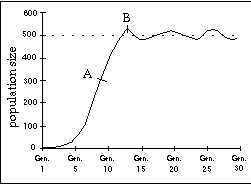
24.

What is the carrying capacity of the graph?

a)

around 500

b)

more than 800

c)

less than 300

d)

around 700

25.
Which of the following would INCREASE the carrying capacity of an ecosystem?
a)
increase in predators
b)
disease
c)
increase in available food
d)
drought
26.

When death rate is equal to birth rate...

a)

population increases

b)

population decreases

c)

population stays the same.

d)

population rapidly increases then becomes stable

27.

When birth rate is high and death rate is low...

a)

population increases

b)

population decreases

c)

population stays the same

d)

all of these

28.

Match the following

a)
1.

Predation

b)
2.

Symbiosis

c)
3.

Commensalism

d)
4.

Parasitism

29.

A scientist was studying a population of fish in a pond over a period of 10 years. He observed that

the population increased each year for 3 years, and then remained nearly constant for the rest of

the study. The best explanation for this observation is that the population had

a)

stopped reproducing

b)

reached carrying capacity

c)

mutated into a different species

d)

run out of food and all died

30.
2 factors which increase population size
a)
Birth Rate, Immigration
b)
Death Rate, Immigration
c)
Birth Rate, Emigration
d)
Death Rate, Emigration
31.

Look at the carrying capacity graphic.


Why does the month of June have the largest seasonal carrying capacity?

a)

Longer summer days causes vegetation to wilt, leading to animal starvation

b)

An increase in humidity allows predators extra moisture for hunting

c)

Warm weather supplies ample food and shelter for life

d)

The breeding stock is not interested in mating during hot, humid days.

32.
What is ecological succession?
a)
A slow change in an environment
b)
A change that takes days in an environment
c)
No change
d)
Abiotic change
33.
A pioneer species is...
a)
a large organism
b)
the first organisms to adapt to a new environment 
c)
The best organism 
d)
Abiotic organisms 
34.
What is the difference between primary and secondary succession?
a)
Primary succession already has soil.
b)
Primary has soil and secondary does not
c)
soil is present in both
d)
primary has no soil and secondary has soil
35.
A large tree forest is an example of ...
a)
a small community
b)
a abiotic community
c)
a climax community
d)
a pioneer species 
36.

After a volcanic eruption the lava cools and becomes rock. Which succession must take place in order for vegetation (plants) to return?

a)

Primary Succession

b)

Secondary Succession

37.

During a forest fire most vegetation (plants) burn. Which ecological succession will take place after a forest fire?

a)

Primary

b)

Secondary

38.

We rely on fossil fuels for electricity and transportation.

a)

True

b)

False

39.

Adding carbon dioxide to atmosphere has what effect on the globe?

a)

It decreases atmospheric temperatures

b)

It increases atmospheric temperatures

c)

It has no impact

40.

What does the term carrying capacity describe?

a)

The maximum number of birth rates for a population.

b)

The ability of a population to accept new immigrants.

c)

The ratio of birth rates to death rates in a population.

d)

The population size that the environment can sustain.
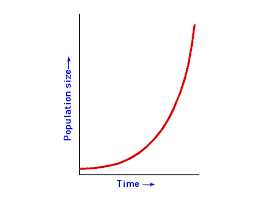
41.

What type of growth is shown in the diagram? (a)  

Choose from the below words
exponential growth
logistic growth 
predator-prey cycle
boom-bust curve
42.
What is deforestation?
a)
Clearing Earth's forests on a massive scale
b)
Eating too much vegetables
c)
Going to a forest and pulling weeds
d)
Clearing the five trees in my backyard
43.
How is acid rain formed?
a)
Carbon monoxide and carbon dioxide mix with water in the ocean.
b)
Carbon dioxide and oxygen mix with water in the air.
c)
Sulfur dioxide and carbon monoxide mix with lake water.
d)
Sulfur dioxide and nitrogen oxide mix with water in the air.
44.

What is a pesticide?

a)

Chemicals derived from natural and organic sources only

b)

Any substance used to control pest organisms in any situation

c)

Only those chemicals registered for pest control

45.

The thinning of the ozone layer is also known as the (a)  

Choose from the below words
ozone hole
ozone gap
ozone space
ozone void
46.
An endangered species is
a)
One whose numbers are so small that it is at risk of extinction
b)
One whose not been spotted after many years.
c)
One whose numbers are abundant.
47.
The major cause of extinction is ____________________.
a)
habitat fragmentation
b)
habitat destruction
c)
pollution
d)
poaching
48.
Scientists think people have directly caused the extinction of some species through ______________.
a)
habitat destruction
b)
poaching
c)
pollution
d)
All of these
49.
what is the leading cause of deforestation?
a)
Diseases 
b)
Housing market
c)
Agriculture and Farming
d)
Paper mill
50.
Where is pollution found on the earth?


a)
only in the air 
b)
only on the land 
c)
only in the water 
d)
on land, in the air, and in the water 
51.
Which way can people best reduce land pollution caused by large amounts of waste dumped in landfills?  
a)
They can use a water filter to use fewer water bottles.
b)
They can recycle their plastic, glass, paper, and cardboard items and only throw away non-recyclable items.
c)
They can watch less television, reducing electricity use and allowing their electronics to last much longer.
d)
They can refill large plastic containers, like those used for laundry detergent, instead of throwing them away.
52.
What do we call it when an ecosystem is able to maintain its structure and be stable over time?
a)
It is dependable.
b)
It is sustainable.
c)
It is independent.
d)
It is adaptable.
53.
Which of the following results when levels of COin the atmosphere increase due to fossil fuel burning?
a)
ecological succession 
b)
acid rain 
c)
ozone depletion
d)
global warming
54.
Which of the following is NOT a method of energy conservation?
a)
taking public transportation to work (bus, subway)
b)
riding your bike to work
c)
walking to work 
d)
driving alone in your car to work
55.

What effects does over-hunting have on an ecosystem?

a)

It increase the population of the hunted species

b)

It disrupts the food chain

c)

It feeds humans

d)

It improves the ecosystem

56.

How does agriculture effect climate change?

a)

Increases climate change by polluting water

b)

Decreases climate change by planting crops

c)

Increases climate change by producing methane and carbon dioxide

d)

Decreases climate change by clearing forests

57.

What types of materials take a long time to degrade in landfills?

a)

Plastic products

b)

Paper products

c)

Aluminum products

d)

Wood products

58.
What are Nonrenewable resources? 
a)
Resources that can be replaced in a short amount of time  
b)
Resources that are used faster than they can be replaced 
c)
Resources America does not use
59.
Name Two examples of Nonrenewable resources?
a)
Coal and Oil
b)
Biomass and Wind Turbines
c)
Tidal and Geothermal
60.
Name two examples of Renewable energy?
a)
Coal and Nuclear
b)
Oil and Gas
c)
Solar Panels and Hydroelectric
61.

What is global warming

a)

the normal temperature fluctuations of Earth's climate cycle

b)

the melting of the polar ice caps

c)

the trend of increasing temperatures on Earth

d)

the changes in Earth's biosphere that affect the atmosphere

62.

When introduced to a new habitat, non-native plants often threaten the native plants. Why is this?

a)

Non-native plants eat the native plants.

b)

Non-native plants are eaten by more native animals.

c)

Non-native plants cause native animals to relocate.

d)

Non-native plants compete with the native plants for resources.

63.

Which of the following is the correct order of ecological succession?

a)

grass - shrubs - lichens - trees

b)

lichens - shrubs - grasses - trees

c)

lichens - grasses - shrubs - trees

d)

grasses - lichens - shrubs - trees

64.

What is the term that describes a steady and stable community?

a)

peak community

b)

turf community

c)

climax community

d)

disturbed community

65.

Which is faster: Primary or Secondary Succession?

a)

Primary Succession

b)

Secondary Succession

c)

Both Take The Same Amount of Time

66.

Which of the following is NOT a pioneer species?

a)

Shrubs

b)

Lichen

c)

Mosses

d)

Fungi

67.

All of the organisms of one species living in the same area.

a)

Individual

b)

Population

c)

Community

d)

Ecosystem

68.

Which of the following is an abiotic factor?

a)

Grass

b)

Spider

c)

Turtle

d)

Rock

69.

Leveling off of the population after the maximum number the environment can support has been reached.

a)

Exponential

b)

Carrying capacity

c)

Linear

d)

Negative

70.

Which of the following would likely be a limiting factor to a population?

a)

Abundance of food

b)

Living near a water source

c)

Presence of a natural predator

d)

Multiple sources for shelter

71.

What happens if a population grows past its carrying capacity?

a)

The population keeps growing

b)

The population starts to die off

c)

The entire species will go extinct

d)

The carrying capacity just increases

72.
What is another name for evaporation of water through the leaves of plants?
a)
Transpiration
b)
Condensation
c)
Precipitation
d)
Percolation
73.
Rain, sleet, snow, and hail are all forms of _____.
a)
Percolation
b)
Evaporation
c)
Condensation
d)
Precipitation
74.
Which of the following best explains why nitrogen fixation must take place?
a)
Atmospheric nitrogen is unusable to plants and animals
b)
Nitrogen must be returned to the atmosphere
c)
Animals must breathe in nitrogen
d)
Nitrogen gets "stuck" in the soil and must be untrapped
75.
What is the overall purpose of photosynthesis?
a)
To use energy from the sun to produce food for the plant
b)
To use energy from the sun to produce oxygen for animals to breathe
c)
To break down food in order to produce energy (ATP)
d)
To break down food in order to produce carbon dioxide
76.
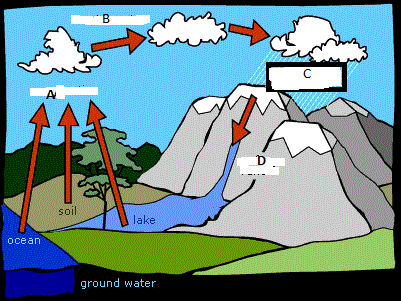
What is A?
a)
Evaporation
b)
Condensation
c)
Precipitation
d)
Runoff
77.
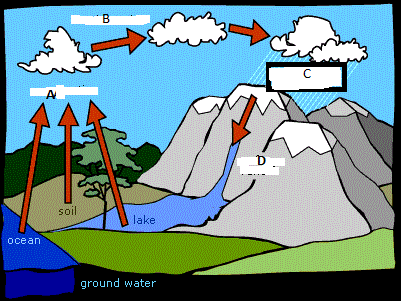
What is B?
a)
Evaporation
b)
Condensation
c)
Precipitation
d)
Runoff
78.
The continuous process by which water moves from Earth's surface to the atmosphere and back
a)
Nitrogen Cycle
b)
Carbon Oxygen Cycle
c)
WaterCycle
d)
Nitrogen Fixation
79.
What gas is released by plants from the process of photosynthesis?
a)
air
b)
carbon dioxide
c)
oxygen
d)
hydrogen
80.
How animals get the nitrogen they need
a)
from the air they breathe
b)
from the water they drink
c)
from the food they eat
d)
from the Sun
81.
Organism that breaks down dead plants & animals and releases nitrogen back into atmosphere
a)
bacteria
b)
plants
c)
animals
d)
producers
82.

What is the process that converts nitrogen into a form that can be used by plants and animals?

a)
Combustion
b)
Photosynthesis
c)
Decomposition
d)
Nitrogen Fixation
83.

How does phosphorus travel through an ecosystem?

a)

From the soil to producers and then from producers to consumers.

b)

From the air directly into consumers and then from consumers to producers.

c)

Phosphorus cannot travel through an ecosystem.

d)

From the soil to producers and that is as far as phosphorus may travel.

84.

As CO2 concentration increases in this graph, how is average global temperature affected?

a)

As CO2 concentration increases, average global temperature increases.

b)

As CO2 concentration increases, average global temperature decreases.

c)

As CO2 concentration increases, global temperature stays the same.

d)

CO2 concentration and average global temperature have no relationship.

85.

Which of the following explains the long term portion of the phosphorus cycle?

a)

Phosphorus is stored in rocks, and it is slowly recycled back into the ecosystem through weathering and erosion.

b)

Phosphorus is constantly cycled through the food chain starting at the producer level and working its way to the apex predator.

c)

Phosphorus does not have a long term portion.

d)

Phosphorus cannot be recycled and reused because it is a nonrenewable resource.

86.

If a farmer uses an excessive amount of fertilizer and this fertilizer washes into a nearby lake in runoff, what is likely to happen in this area?

a)

The plant life will grow exponentially, and many of the fish living in this area will die.

b)

The plant life will be destroyed, and many of the fish in this area will die due to a lack of food.

c)

The fish in this area will multiply exponentially, and they will destroy the plant life.

d)

Fertilizer will not affect the area because it only affects the growth of plants that grow on land.

87.
When humans burn fossil fuels, most of the carbon quickly enters the                       as carbon dioxide.
a)
Water
b)
Atmosphere
c)
Sun
d)
Air
88.
Which one of these does not add CO2 to the atmosphere?
a)
cooking with gas
b)
planting trees
c)
burning wood
d)
riding in a bus
89.

What converts nitrogen gas into a usable form for plants and animals?

a)

bacteria

b)

rain

c)

fungi

d)

car exhaust

90.

The process in which nitrogen circulates and is recycled is called

a)

The nitrogen cycle

b)

The carbon cycle

c)

The water cycle

d)

The phosphorus cycle

91.

Organisms that need nitrogen to survive.

a)

only plants

b)

only animals

c)

only bacteria

d)

all living things

92.
Identify the cycle pictured.
a)
The Water cycle
b)
The Carbon cycle
c)
The Nitrogen cycle
d)
The Phosphorus cycle
93.
What makes up 78% of the air we breathe?
a)
oxygen
b)
free nitrogen
c)
fixed nitrogen
d)
carbon
94.

In general, algal blooms occur when

a)

toxins accumulate in shellfish.

b)

nutrients decrease in the water.

c)

nutrients increase in the water.

95.

An algal bloom is the rapid growth of a population of

a)

fungi

b)

protozoans

c)

algae