
 Worksheets
Spring Semester Final Reivew
Total questions: 95
Worksheet time: 48mins
Name
Class
Date
1.
Test Code
4 lines
2.
The bending of a wave around a barrier.
a)
Reflection
b)
Refraction
c)
Diffraction
d)
Medium
e)
Rarefaction
3.
Occurs when a wave changes direction as it moves from one medium to another.
a)
Reflection
b)
Refraction
c)
Diffraction
d)
Medium
e)
Rarefaction
4.
When a wave strikes a barrier and bounces off.
a)
Reflection
b)
Refraction
c)
Diffraction
d)
Medium
e)
Rarefaction
5.
The number of crests that pass a point per unit of time (e.g. per second).
a)
Hertz
b)
m/s
c)
Decibels
d)
Frequency
e)
Wavelength
6.
Using sound waves in order to locate objects (specifically underwater).
a)
Sonar
b)
Radar
c)
Ultrasounds
d)
Resonance
e)
Acoustics
7.
Soundwaves that are at a frequency that is higher than human hearing.
a)
Sonar
b)
Radar
c)
Ultrasonic
d)
Resonance
e)
Acoustics
8.
The phenomenon in which the motion of an object affects the frequency of a wave as it moves towards and away from a moving object.
a)
Wave interfrerence
b)
Standing Waves
c)
Doppler Effect
d)
Pitch
e)
Decibels
9.
Which of these is NOT a longitudinal (compression) wave?
a)
A
b)
B
c)
C
d)
D
10.
Sounds can travel through all but which of the following?
a)
Solids
b)
Liquids
c)
Gasses
d)
Empty Space
11.
All types of waves transfer _______________
a)
Matter
b)
Molecules
c)
Heat
d)
Energy
12.
For a sound with a low pitch, what else is true?
a)
Low Amplitude
b)
Low Frequency
c)
Low Wavelength
d)
Low Wave velocity
13.
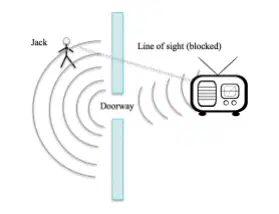
Jack hearing a radio around the corner from another room is an example of what?
a)
Refraction
b)
Diffraction
c)
Resonance
d)
Interference
14.
Which of the following has medical uses?
a)
Acoustics
b)
Doppler Radar
c)
Ultrasonic waves
d)
Sonar
15.
After a sound wave has passed through matter, the matter is usually ___ .
a)
Still moving
b)
Left unchanged
c)
Permanently changed
d)
Moved out of position
16.
Which letter is Amplitude?
a)
B
b)
A
c)
C
d)
D
e)
E
17.
Which letter is wavelength?
a)
A
b)
B
c)
C
d)
D
e)
E
18.
How many waves in the picture?
a)
1
b)
2
c)
3
d)
4
19.
In a ___ wave, the matter in the medium moves back and forth at right angles to the direction the wave travels.
a)
Sound
b)
Transverse
c)
Compressional
d)
Refractional
20.
Which of the following explains how bats find food and avoid obstacles in the dark?
a)
Infrared Vision
b)
Echolocation
c)
Reverberation
d)
Resonation
21.
Tesla envisioned switching from DC to _____.
a)
AC
b)
TC
c)
NC
d)
VC
22.
Alternating current needs high _____________ to send electricity over large distances.
a)
current
b)
resistance
c)
power lines
d)
voltage
23.
What was the "new device" that Tesla created to step down voltage?
a)
television
b)
battery
c)
transformer
d)
solar panel
24.
The flow of electrons in a circuit.
a)
voltage
b)
resistance
c)
insulator
d)
current
25.
The accumulation of excess electric charge (electrons) on an object.
a)
current
b)
voltage
c)
static electricity
d)
resistance
26.
The "push" of electrons through a circuit.
a)
voltage
b)
resistance
c)
current
d)
static electricity
27.
A light bulb filament is a good _____________.
a)
insulator
b)
conductor
c)
resistor
d)
voltage source
28.
Copper metal is a good ____________
a)
insulator
b)
conductor
c)
resistor
d)
voltage source
29.
The vinyl coating on a wire is a good _____________.
a)
insulator
b)
conductor
c)
resistor
d)
voltage source
30.
A device that interrupts electrical current in our homes. This device contains a metal that melts because of excess current. This device cannot be reused.
a)
battery
b)
fuse
c)
resistor
d)
circuit breaker
31.
A device that interrupts electrical current in our homes. This device contains a metal that bends because of excess current. This device can be reused.
a)
battery
b)
fuse
c)
resistor
d)
circuit breaker
32.
A path for electrons to follow.
a)
circuit
b)
resistor
c)
insulator
d)
battery
33.
Which of the following would make a good conductor?
a)
copper
b)
fiberglass
c)
wood
d)
rubber
34.
Which of the following would make a good insulator?
a)
copper
b)
plastic
c)
carbon
d)
aluminum
35.
Which of the following would make a good resistor?
a)
aluminum
b)
copper
c)
tungsten
d)
silver
36.
Tendency for a material to oppose (not stop) the flow of electrons.
a)
insulate
b)
voltage
c)
resistance
d)
amps
37.
A car battery is an example of a ____________.
a)
wet cell
b)
dry cell
38.
A "D" cell battery is an example of a _____________.
a)
wet cell
b)
dry cell
39.

The circuit on the left is a ____________ circuit.
a)
parallel
b)
series
40.
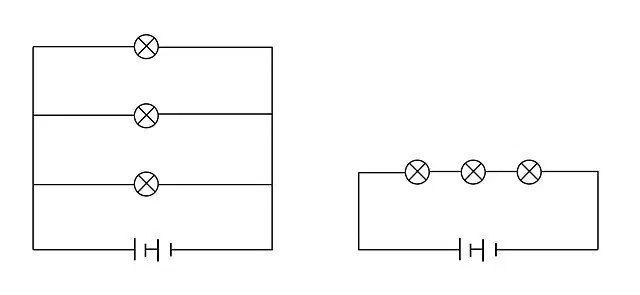
The circuit on the right is a ____________ circuit.
a)
parallel
b)
series
41.
A grouping of atoms that have their magnetic fields aligned.
a)
Magnetic domains
b)
Electrical field
c)
Photons
d)
Radiant energy
42.
The ends of a magnetic object, where the magnetic force is strongest.
a)
Poles
b)
Radiant energy
c)
Magnetic domain
d)
Photovoltaic cells
43.
Energy carried by an electromagnetic wave.
a)
Color
b)
Magnetism
c)
Radiant
d)
Compression
44.
A magnet that retains its magnetic properties in the absence of an inducing field or current.
a)
Electrical
b)
Permanent
c)
Temporary
d)
Intermittent
45.
Magnetism is generated by moving _________.
a)
Arms
b)
Electrons
c)
Neutrons
d)
Elements
46.
What is responsible for the Magnetic Field around Earth?
a)
The Earth's crust
b)
The Earth's molten iron core
c)
The Earth's mantle
d)
The Sun
47.
The earth's magnetic field protects us from ____________.
a)
The heat of the sun
b)
Tsunamis
c)
Earthquakes
d)
Solar radiation
48.
In un-magnetized materials the domains are __________ aligned.
a)
Super
b)
Slightly
c)
Randomly
d)
Always
49.
How can a wire become magnetic?
a)
Point it north
b)
Add a resistor
c)
Heat it up
d)
Run a current through it
50.
Which of the following make good magnets. Choose all that apply.
a)
Iron
b)
Carbon
c)
Gold
d)
Nickel
51.
Iron nail, wire, battery
a)
Computer
b)
Galvanometer
c)
Electromagnet
d)
Electric motor
52.
Changes electrical energy into mechanical energy.
a)
Galvanometer
b)
Motor
c)
Battery
d)
Generator
53.
Current that flows in one direction through a wire.
a)
Alternating
b)
Variable
c)
Direct
d)
Oscillating
54.
A device that increases or decreases the voltage of alternating current.
a)
Computer
b)
Transformer
c)
Galvanometer
d)
Electromagnet
55.
How can a magnet lose its magnetic properties? Choose all that apply.
a)
Applying acid
b)
Dropping
c)
Freezing
d)
Heating
56.
How can you increase the strength of an electromagnet? Choose all that apply.
a)
Increase the temperature
b)
More wire turns
c)
More voltage
d)
You cannot increase the strength of an electromagnet
57.
In a transformer, the secondary coil has less wire turns than the primary coil. This will ______________.
a)
Step down the voltage
b)
Not change the voltage
c)
Step up the voltage
58.
Which has the LONGEST wavelength and, therefore, the lowest frequency/energy?
a)
Gamma Rays
b)
Radio Waves
c)
Visible Light
d)
Infrared rays
59.
Put the visible light colors in order from longest wavelength to shortest wavelength.
a)
Violet, Indigo, Blue, Green, Orange, Yellow, Red
b)
Red, Yellow, Green, Orange, Violet, Blue, Indigo
c)
Red, Orange, Yellow, Green, Blue, Indigo, Violet
d)
Violet, Blue, Orange, Yellow, Green, Orange, Red
60.
Select the correct order of waves on the Electromagnetic Spectrum (going from longest wavelength to smallest).
a)
Radio, Micro, Infra, Visible, Ultra, X-ray, Gamma
b)
Gamma, X-ray, Ultra, Vis, Infra, Micro, Radio
c)
Vis, Micro, Infra, Ultra, X-ray, Gamma, Radio
d)
Micro, Radio, Vis, Infra, Ultra, X-ray, Gamma
61.
If the wavelength of an electromagnetic wave is longer, what is true about the energy?
a)
Energy is higher
b)
Energy is lower
c)
Energy is not related to WL
d)
Energy is cancelled out
62.
Which of the following electromagnetic waves is given off as heat?
a)
ultraviolet light
b)
infrared rays
c)
gamma rays
d)
radio waves
63.
Which EM wave is used for TV remote controls?
a)
Visible Light
b)
X - Rays
c)
UV Light
d)
Infrared
64.
Which EM wave is used for cell phones?
a)
Microwaves
b)
Infrared
c)
Radio
d)
UV
65.
The color with the lowest energy.
a)
Blue
b)
Orange
c)
Red
d)
violet
66.
Which of the following ranks the states of matter in order of increasing space between particles?
a)
gas, liquid, solid
b)
gas, solid, liquid
c)
liquid, solid, gas
d)
solid, liquid, gas
67.
Which of the following ranks the states of matter in order of increasing kinetic energy of particles?
a)
gas, liquid, solid
b)
solid, liquid, gas
c)
liquid, solid, gas
d)
solid, gas, liquid
68.
What is the difference between liquids and gases?
a)
Gases take the shape of a container while liquids do not
b)
Liquids are clear and gases are not
c)
Gases and liquids both take the shape of their container
d)
A gasses volume can change, while a liquid's volume is constant
69.

Which of the pictures in the model below most correctly depicts a liquid?
a)
A
b)
B
c)
C
d)
None of them are liquid
70.
A proton has a mass that is _________.
a)
Nearly 0 amu
b)
1 amu
c)
The same as an electron
d)
2 amu
71.
A letter or pair of letters used as a shorthand method of writing the name of an element is called the __________.
a)
Descriptor
b)
Chemical symbol
c)
Stoichiometry
d)
Atomic number
72.
The sum of the protons and neutrons of an atom is called the ____.
a)
Isotopes
b)
Electrons
c)
Mass number
d)
Chemical symbol
73.
Atoms of the same element that have different numbers of neutrons are called ____.
a)
Isotopes
b)
Electrons
c)
Mass number
d)
Chemical symbol
74.
The positively charged center of the atom is called the ____.
a)
Eletrons
b)
Nucleus
c)
Electron cloud
d)
Atom
75.
What is the most common element in the universe?
a)
Hydrogen
b)
Helium
c)
Oxygen
d)
Carbon
76.
Electrons have a ____ charge.
a)
Positive
b)
Neutral
c)
Negative
d)
Alternating
77.
Neutrons have a ____ charge.
a)
Positive
b)
Neutral
c)
Negative
d)
Alternating
78.
In the periodic table, elements that are arranged in a vertical column are called a ____.
a)
Group
b)
Period
c)
Series
d)
Transition
79.
In the periodic table, elements that are arranged in a horizontal row are called a ____.
a)
Group
b)
Period
c)
Series
d)
Transition
80.
An atom has 26 protons, 26 electrons and 30 neutrons. What is the atomic mass of the atom?
a)
26
b)
30
c)
56
d)
82
81.
Which of the letters above represents a liquid that is absorbing heat.
a)
A
b)
B
c)
C
d)
D
e)
E
82.
Which of the letters above represents a solid that is increasing in temperature?
a)
A
b)
B
c)
C
d)
D
e)
E
83.
Which of the letters above represents a gas that is increasing in temperature?
a)
A
b)
B
c)
C
d)
D
e)
E
84.
Which of the letters above represents the heat of vaporization?
a)
A
b)
B
c)
C
d)
D
e)
E
85.
Which of the letters above represents heat of fusion?
a)
A
b)
B
c)
C
d)
D
e)
E
86.
GOLD
a)
Al
b)
Ag
c)
Ar
d)
Au
87.
COPPER
a)
C
b)
Ca
c)
Cu
d)
Cl
88.
The Modern Periodic Table of Elements is arranged by
a)
atomic mass
b)
atomic number
c)
valence electrons
d)
number of isotopes
89.
Which one of these is not a noble gas?
a)
Helium
b)
Radon
c)
Iodine
d)
Krypton
90.
__________ would have some characteristics of metals and some characteristics of nonmetals.
a)
Gold
b)
Sodium
c)
Silicon
d)
Argon
91.
Which element that starts with a "B" is an Alkaline Earth Metal?
a)
Barium
b)
Boron
c)
Bread
d)
Bromine
92.
What statement is true about ALL of the elements in Group 18?
a)
They ALL have 6 valence electrons.
b)
They ALL are gases at room temperature.
c)
They ALL react easily with other elements.
d)
They ALL form +2 charges.
93.
Which statement is true about the alkaline earth metal family?
a)
They have 2 valence electrons.
b)
They are found on the right side of the periodic table.
c)
They form -2 charges.
d)
They tend to gain valence electrons.
94.
Which group has the most reactive nonmetals?
a)
alkali metals
b)
noble gases
c)
alkali earth metals
d)
halogens
95.
Which of these describe alkali metals?
a)
Soft, Brittle and Smelly
b)
Silver, Soft, and Reactive
c)
Dark Grey - Black, Liquid, Heavy
d)
Yellow, Crumbly, Non-Reactive
100 %

