wayground logo

Free Printable Worksheets

Font size

S
M
L
XL
Worksheets

Semester 2 Final Review

Total questions: 131

Worksheet time: 2hrs 46mins

Name
Class
Date
1.

Name that symbol.

a)

Cold Front

b)

Warm Front

c)

Stationary Front

d)

Occluded Front

2.
This layer is directly below the crust.
a)
Crust
b)
Mantle
c)
Outer Core
d)
Inner Core
3.
This layer is directly below the mantle.
a)
Crust
b)
Mantle
c)
Outer Core
d)
Inner Core
4.
This layer is the innermost layer of the Earth.
a)
Crust
b)
Mantle
c)
Outer Core
d)
Inner Core
5.
This layer is the thinnest layer and is made of solid rock.
a)
Crust
b)
Mantle
c)
Outer Core
d)
Inner Core
6.

Who is the scientist who proposed Continental Drift Theory?

a)
Albert Einstein
b)
Alfred Wegener
c)
Isaac Newton
d)
John Dalton
7.

Alfred Wegener named his single supercontinent ____________, which means "all Earth" in ancient Greek.

a)

Pandora

b)

Gandowandaland

c)

Pangea

d)

Percia

8.

Most geologists think that the movement of Earth's tectonic plates is caused by

a)

the rotation of the Earth.

b)

the Earth's magnetic field.

c)

subduction.

d)

convection currents.

9.
Associated with transform boundaries.
a)
Volcanoes
b)
mountains
c)
trenches
d)
earthquakes
10.
A location where two tectonic plates collide is known as a _________ boundary.
a)
Convergent
b)
Divergent
c)
Transform
d)
Spreading
11.

Subduction means.....

a)

one plate goes under another plate

b)

two plates slide past each other

c)

two plate collide and form folded mountains

12.

Sea-floor spreading explains how.....

a)

new crust is created at a divergent boundary

b)

volcanoes are formed on continents

c)

deep sea trenches are formed

13.
A divergent boundary occurs when plates ....
a)
Pull apart
b)
Come together
c)
Slide past each other
d)
subducting
14.
Where weather occurs.
a)
stratosphere
b)
thermosphere
c)
troposphere
d)
mesosphere
15.
What is the function of the ozone layer?
a)
to allow UV rays to get to Earth
b)
to block UV rays from getting to Earth
c)
To keep oxygen in
d)
to allow meteors to get to Earth
16.

Most of the atmosphere is composed of the following gas

a)

nitrogen

b)

oxygen

c)

carbon dioxide

d)

argon

e)

flatulence

17.
The color of a mineral in powder form is called the mineral's 
a)
hardness
b)
specific gravity
c)
luster
d)
streak
18.
How light reflects off of a mineral is called the mineral's 
a)
luster
b)
streak
c)
cleavage
d)
fracture
19.
A naturally occurring, inorganic solid with a crystal structure and a definite chemical composition is referring to
a)
density
b)
streak
c)
mineral
d)
non silicate mineral
20.
A mineral's resistance to being scratched is called?
a)
streak
b)
luster
c)
hardness
d)
heft
21.
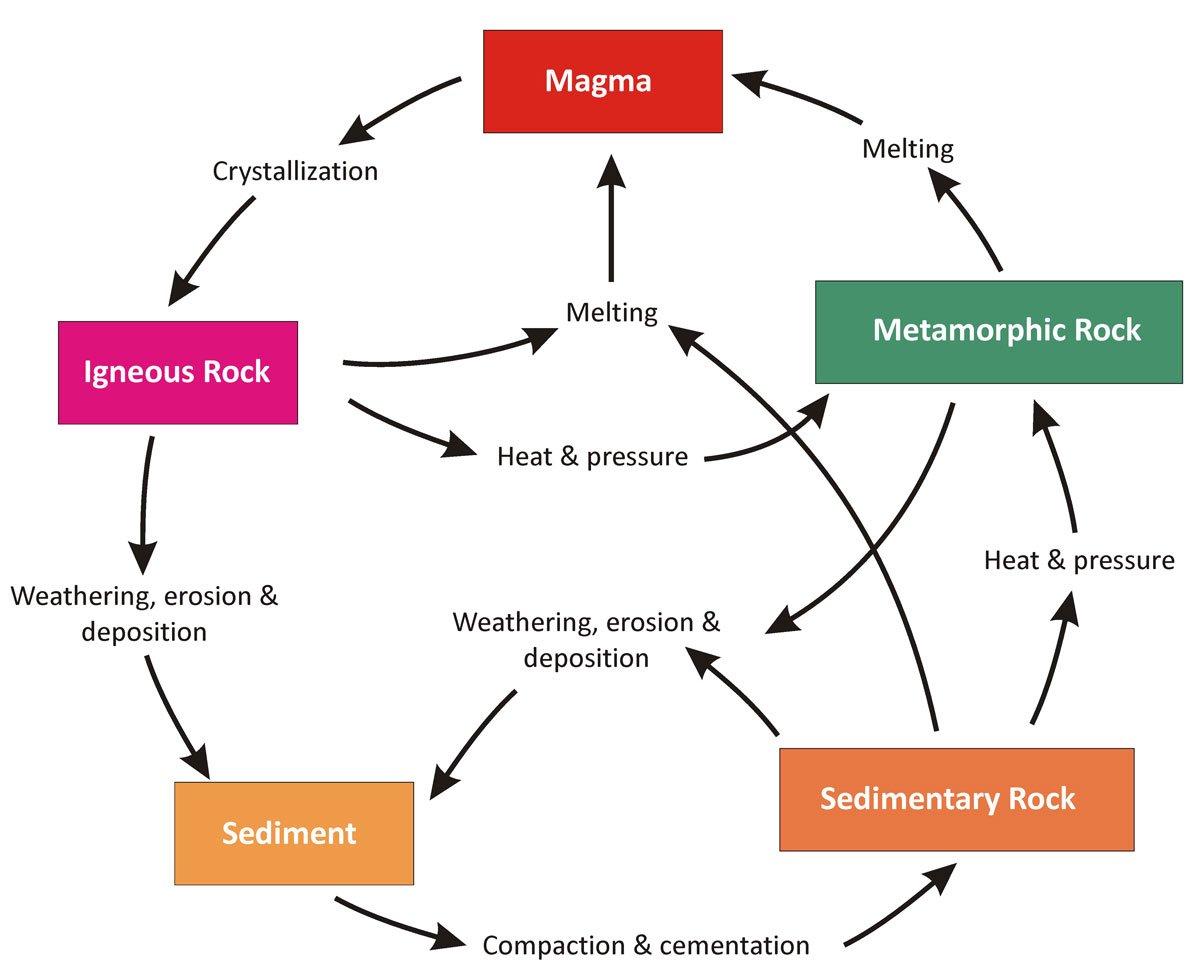
Formed by heat and pressure
a)
Sedimentary
b)
Metamorphic
c)
Extrusive Igneous
d)
Intrusive Igneous
22.
Formed by weathering & erosion
a)
magma
b)
sediments
c)
sedimentary rock
d)
intrusive igneous
23.
Formed by melting
a)
magma
b)
sediments
c)
sedimentary rock
d)
intrusive igneous
24.

Intrusive & extrusive are 2 types of...

a)

sedimentary

b)

metamorphic

c)

Igneous

25.

Foliated & non-foliated are 2 types of...

a)

Sedimentary

b)

Metamorphic

c)

Igneous

26.

Clastic & non-clastic are 2 types of.....

a)

Sedimentary

b)

Igneous

c)

Metamorphic

27.
The process when rocks break into smaller pieces due to exposure to natural elements is called
a)
erosion
b)
weathering
c)
sediments
28.
What are the 3 major types of rocks?
a)
Igneous, Metamorphic, Sedimentary
b)
Metamorphic, Igneous, Cementation
c)
magma, lava, crystals
29.

This usually takes place when a river enters an area of shallow water and the river current slows down.

a)

erosion

b)

weathering

c)

deposition

d)

sublimation

30.
States that younger rocks lie above older rocks if the layers have not been disturbed
a)
Law of crosscutting
b)
Law of superposition
c)
Relative Dating
d)
Unconformity
31.
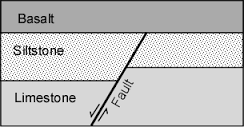
How does the law of crosscutting explain the age of a fault?
a)
The fault is younger than the rocks above it.
b)
The fault is younger than the rocks it cuts through.
c)
The fault is older than the rocks above it.
d)
The fault is older than the rocks it cuts through.
32.
What are the relative ages of the features in order from oldest to youngest?
a)
Limestone, Basalt, Fault, Siltstone
b)
Siltstone, Fault, Basalt, Limestone
c)
Limestone, Fault, Basalt, Siltstone
d)
Limestone, Siltstone, Fault, Basalt
33.
Which of the following is the oldest?
a)
Layer L
b)
Intrusion D
c)
Intrusion H
d)
Layer E
34.

What is an example of kinetic energy?

a)

A bird sitting in a tree

b)

A bouncy ball on the table

c)

A car driving on the highway

d)

A book on shelf

35.

Energy cannot be created or destroyed.

a)

True

b)

False

36.

What is an example of sound energy?

a)

A thermometer heating up

b)

Solar panels generating electricity

c)

A guitar string being plucked

d)

A machine in an assembly line

37.

Which of the following show a change from kinetic energy to potential energy?

a)

A sled sliding up a hill

b)

A ball that is thrown into the air

c)

A car driving down a hill

d)

A rubber band being stretched

38.

What transformation occurs in a toaster?

a)

Electrical to radiant

b)

Electrical to thermal

c)

Thermal to mechanical

d)

Solar to electrical

39.

What type of energy transformation occurs when a piece of wood burns?

a)

Electrical energy is released as radiant energy

b)

Stored chemical energy is released as thermal energy

c)

Mechanical energy is stored as chemical energy

d)

No transformation occurs

40.
Energy due to motion is ____________ energy. 
a)
Potential 
b)
Energy
c)
Kinetic
d)
Friction
41.
The faster an object moves, the ________ kinetic energy it has. 
a)
more
b)
less
c)
none of the above
d)
all of the above 
42.
What kind of energy is in a rock at the edge of a cliff?
a)
Potential
b)
Kinetic
43.
What kind of energy is in a stretched rubber band?
a)
Potential
b)
Kinetic
44.

Which Apple has the greatest Gravitational Potential Energy?

a)

Apple A

b)

Apple B

c)

Apple C

d)

Apple D

45.
How much kinetic energy does a moving 6 kg object have if it moves with a velocity of 3 m/s?
a)
27 J
b)
18 J
c)
9 J
d)
2 J
46.

The equation E = 1⁄2 mass x velocity2 is used to find which energy store?

a)

Kinetic Energy

b)

Gravitational Potential Energy

47.

The equation E = mass x gravity x height is used to find which energy store?

a)

Kinetic Energy

b)

Gravitational Potential Energy

48.

What is the correct unit for energy?

a)

meters (m)

b)

kilogram meters per second (kg m/s)

c)

Newtons (N)

d)

Joules (J)

49.

What is the unit for FORCE?

a)

N (Newtons)

b)

lbs (pounds)

c)

g (grams)

d)

m/s (meters per second)

50.
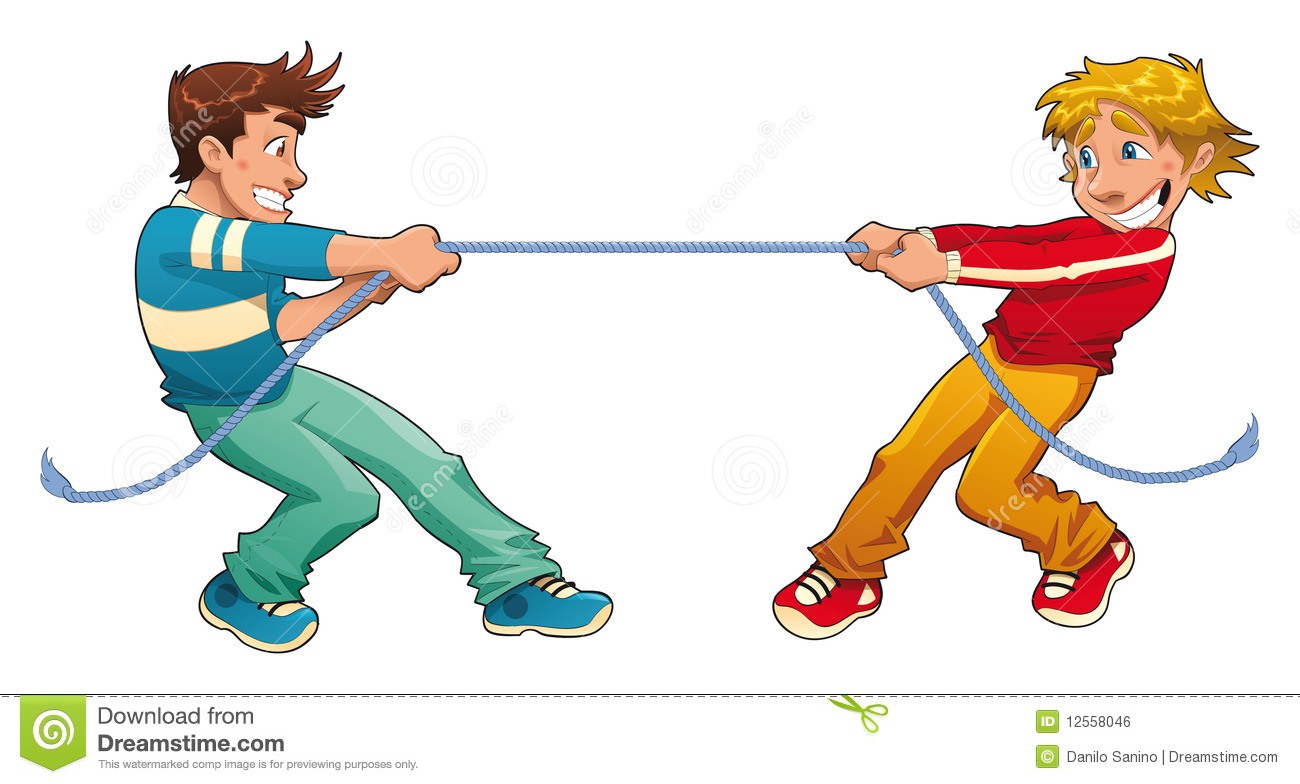
If these boys are pulling with the same amount of force.  What will happen?
a)
The boy in blue will win.
b)
They will not move at all.
c)
The boy in red will win.
d)
Both will fall down.
51.

What is any push or pull called?

a)

Force

b)

Energy

c)

Speed

d)

Acceleration

52.

In a tug of war game, the net force is 50 N to the left. The winning team pulled with a force of 200 N to the left. How much force did the losing team pull with?

a)

50 N Right

b)

100 N Right

c)

150 N Right

d)

250 N Left

53.

What is the Net Force acting on the box in this picture?

a)

10 N to the Left

b)

10 N to the Right

c)

60 N to the Left

d)

60 N to the Right

54.

What is the Net Force acting on the box in this picture?

a)

30 N to the Right

b)

30 N to the Left

c)

70 N to the Right

d)

70 N to the Left

55.

___________ forces always cause an object's motion to change.

a)

balanced

b)

unbalanced

c)

contact

d)

non-contact

56.
With unbalanced forces, the object will move in the direction of the _______ force.
a)
larger 
b)
smaller 
c)
equal 
d)

None of these answers are correct

57.

What explains why objects resist changes in their state of motion?

a)

gravity

b)

inertia

c)

force

d)

friction

58.

The force that prevents a ball rolling on the ground from continuing on it's path forever is...

a)

Friction

b)

Gravity

c)

Inertia

59.
An empty truck and a fully loaded truck are next to each other at a traffic light. When the light turns green, the lighter truck increases speed more quickly. Which of these best explains this situations
a)
Newton's first law
b)
Newton's second law
c)
Newton's third law
d)
Conservation of momentum
60.

An inflated balloon released from rest moves horizontally.

The law that best explains this event is

a)

Newton's 1st Law

b)

Newton's 2nd Law

c)

Newton's 3rd Law

d)

Law of Gravity

61.
What is the formula for force?
a)
F=M/A
b)
F=A/M
c)
F=M*A
d)
F=M*F
62.

Isaac Newton stated for every action there is an

_________ and _________ reaction.

a)

equal and same

b)

equal and opposite

c)

unequal and same

d)

unequal and opposite

63.

The sum of all movements from start to the end of motion is best described as____.

a)

distance

b)

displacement

c)

motion

d)

donkey

64.

The change in an objects position from the final position to initial position.

a)

displacement

b)

distance

c)

motion

d)

reference point

65.

A man walks 5 miles forwards, 6 miles backwards and then 2 miles forwards. What is his displacement?

a)

1 mile forward

b)

13 miles

c)

3 miles forward

d)

1 mile

66.
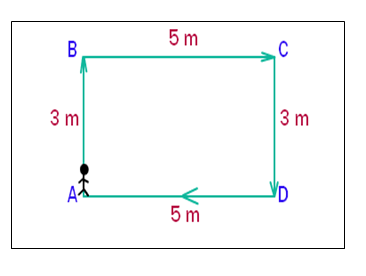
Sara walks from Point A to Point B. Which is true?
a)
Distance and displacement are EQUAL
b)
Distance is less than displacement
67.
Bill runs 400 meters to Andy's house, turns around, and runs 400 meters back home.  What is Bill's distance?
a)
0 meters
b)
400 meters
c)
800 meters
d)
1600 meters
68.

Bill runs 400 meters to Andy's house, turns around, and runs 400 meters back home.  What is Bill's displacement?

a)
0 meters
b)
400 meters
c)
800 meters
d)
1600 meters
69.

A cross-country skier moves 10 meters eastward, then 14 meters westward, and finally 6 meters eastward.

What is the magnitude and direction of the displacement?

a)

30 meters east

b)

16 meters east

c)

2 meters west

d)

2 meters east

70.

Danny decided to go and run a mile around the track (4 laps).  However, after running just one lap, he collapsed in the same spot he started.  

What was the displacement?

a)

0 mi

b)

1/4 mi

c)

1/4 mi east

d)

unknown

71.

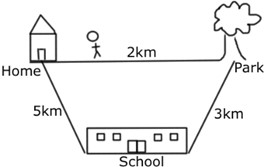
Jerry walked from home to school, then from the school to the park. What is his total distance?

a)

2 km

b)

5 km

c)

8 km

d)

10 km

72.

Vector quantities

a)

only need a number

b)

Need a number and direction

c)

Need arrows

73.

A dog walks 12 meters to the east and then turns around and walks 16 meters back to the west.

What is the displacement of the dog?

a)

28 meters

b)

4 meters

c)

4 meters west

d)

4 meters east

74.

Jerry walked from home to school, then from the school to the park. What is his total displacement?

a)

2 km east

b)

5 km

c)

8 km

d)

2 km

75.

the unit of acceleration is

a)

(m/s2)

b)

jouls

c)

m

d)

s

76.

A negative acceleration means that your object is  

a)

constant

b)

speeding up

c)

at rest

d)

slowing down

77.

A positive acceleration means that your object is

a)

at rest

b)

speeding up

c)

moving

d)

slowing down

78.

Acceleration: is the rate of change in

a)

velocity

b)

speed

c)

displacement

d)

direction

79.

A bus starts from rest and accelerates to 14 m/s in 4 s. What is the average acceleration of the bus?

a)

3.5 m/s2

b)

5.9 m/s2

c)

10.5 m/s2

d)

24 m/s2

80.

Which of the following objects is accelerating?

a)

A car driving in a northwest at a constant speed of 35 mph.

b)

A car driving southwest at a constant speed of 35 mph.

c)

A car driving in a circle at a constant speed of 35 mph.

Back

d)

A car driving south at a constant speed of 45 mph.

81.
A car accelerates from a standstill to 70 m/s in 10 seconds.  What is the acceleration?
a)
0.7m/s2
b)
7m/s2
c)
14m/s2
d)
none of the above
82.
A box sliding down an inclined plane attains a velocity of 27 m/s in 3 seconds from rest.  Find the acceleration.
a)
30 m/s
b)
24 m/s2
c)
9 m/s2
d)
81 km/hr
83.
A dog runs with an initial speed of 7.5 m/s on a waxed floor.  It slides to a stop in 15 seconds.  What is the acceleration?
a)
-7.5 m/s
b)
-7.5 m/s2
c)
-0.5 m/s2
d)
7.5 mi//hr
84.

___ refers to how fast an object is moving.

a)

Speed

b)

Velocity

c)

Acceleration

d)

Motion

85.

Which two factors does speed depend on?

a)

distance and direction

b)

direction and time

c)

distance and time

d)

distance, time and direction

86.

Which is an example of velocity?

a)

A car driving 55 miles per hour south.

b)

A bicyclist traveling 10 meters per hour.

c)

A roller coaster is traveling 10 meters per second.

d)

A rocket blasting off at 2,500 meters per second.

87.

Which is NOT an example of Acceleration?

a)

An object speeds up

b)

An object slows down

c)

An object changes direction

d)

An object is in constant motion.

88.

Speed or Velocity?:

A train is travelling North 220 km/hr

a)

Speed

b)

Velocity

c)

Neither

d)

Both

89.

Speed or Velocity?:

A turtle is crawling 34 cm/min.

a)

Speed

b)

Velocity

c)

Neither

d)

Both

90.

Acceleration is a speeding up, slowing down or a change in direction. Is the following acceleration and if so, which one?


A swimmer has 10 meters left in the race and he is neck-in-neck with his competitor. He has a surge of adrenaline and pulls ahead to win.

a)

Yes, this is acceleration since the swimmer starts to speed up to pull ahead.

b)

Yes, this is acceleration since the swimmer uses the wall to change directions.

c)

No, this is not acceleration since there is no speeding up, slowing down, or change in direction.

91.

True or False: You are standing at the bus stop and not moving at all. Since you are not moving, your acceleration would be 0 (zero). Support with how you know.

a)

True since you are not speeding up, slowing down or changing directions.

b)

True since you are traveling no distance in a certain amount of time.

c)

False since you are speeding up, slowing down and/or changing directions.

d)

False since you were going to get on a moving bus.

92.

Olympic runner, Usain Bolt is able to increase his speed faster than any runner in his heat.

a)

Speed

b)

Velocity

c)

Acceleration

93.

The subway car begins to slow down as it makes its way to the train station.

a)

Speed

b)

Velocity

c)

Acceleration

94.
65 miles per hour North is an example of an objects what?
a)
Speed
b)
Velocity
c)
Average Speed
d)
Constant Speed
95.

Name that symbol.

a)

Cold Front

b)

Warm Front

c)

Stationary Front

d)

Occluded Front

96.
This layer is directly below the crust.
a)
Crust
b)
Mantle
c)
Outer Core
d)
Inner Core
97.
This layer is directly below the mantle.
a)
Crust
b)
Mantle
c)
Outer Core
d)
Inner Core
98.
This layer is the innermost layer of the Earth.
a)
Crust
b)
Mantle
c)
Outer Core
d)
Inner Core
99.
This layer is the thinnest layer and is made of solid rock.
a)
Crust
b)
Mantle
c)
Outer Core
d)
Inner Core
100.

Who is the scientist who proposed Continental Drift Theory?

a)
Albert Einstein
b)
Alfred Wegener
c)
Isaac Newton
d)
John Dalton
101.

Alfred Wegener named his single supercontinent ____________, which means "all Earth" in ancient Greek.

a)

Pandora

b)

Gandowandaland

c)

Pangea

d)

Percia

102.

Most geologists think that the movement of Earth's tectonic plates is caused by

a)

the rotation of the Earth.

b)

the Earth's magnetic field.

c)

subduction.

d)

convection currents.

103.
Associated with transform boundaries.
a)
Volcanoes
b)
mountains
c)
trenches
d)
earthquakes
104.
A location where two tectonic plates collide is known as a _________ boundary.
a)
Convergent
b)
Divergent
c)
Transform
d)
Spreading
105.

Subduction means.....

a)

one plate goes under another plate

b)

two plates slide past each other

c)

two plate collide and form folded mountains

106.

Sea-floor spreading explains how.....

a)

new crust is created at a divergent boundary

b)

volcanoes are formed on continents

c)

deep sea trenches are formed

107.
A divergent boundary occurs when plates ....
a)
Pull apart
b)
Come together
c)
Slide past each other
d)
subducting
108.
Where weather occurs.
a)
stratosphere
b)
thermosphere
c)
troposphere
d)
mesosphere
109.
What is the function of the ozone layer?
a)
to allow UV rays to get to Earth
b)
to block UV rays from getting to Earth
c)
To keep oxygen in
d)
to allow meteors to get to Earth
110.

Most of the atmosphere is composed of the following gas

a)

nitrogen

b)

oxygen

c)

carbon dioxide

d)

argon

e)

flatulence

111.
The color of a mineral in powder form is called the mineral's 
a)
hardness
b)
specific gravity
c)
luster
d)
streak
112.
How light reflects off of a mineral is called the mineral's 
a)
luster
b)
streak
c)
cleavage
d)
fracture
113.
A naturally occurring, inorganic solid with a crystal structure and a definite chemical composition is referring to
a)
density
b)
streak
c)
mineral
d)
non silicate mineral
114.
A mineral's resistance to being scratched is called?
a)
streak
b)
luster
c)
hardness
d)
heft
115.
Formed by heat and pressure
a)
Sedimentary
b)
Metamorphic
c)
Extrusive Igneous
d)
Intrusive Igneous
116.
Formed by weathering & erosion
a)
magma
b)
sediments
c)
sedimentary rock
d)
intrusive igneous
117.
Formed by melting
a)
magma
b)
sediments
c)
sedimentary rock
d)
intrusive igneous
118.

Intrusive & extrusive are 2 types of...

a)

sedimentary

b)

metamorphic

c)

Igneous

119.

Foliated & non-foliated are 2 types of...

a)

Sedimentary

b)

Metamorphic

c)

Igneous

120.

Clastic & non-clastic are 2 types of.....

a)

Sedimentary

b)

Igneous

c)

Metamorphic

121.
The process when rocks break into smaller pieces due to exposure to natural elements is called
a)
erosion
b)
weathering
c)
sediments
122.
What are the 3 major types of rocks?
a)
Igneous, Metamorphic, Sedimentary
b)
Metamorphic, Igneous, Cementation
c)
magma, lava, crystals
123.

This usually takes place when a river enters an area of shallow water and the river current slows down.

a)

erosion

b)

weathering

c)

deposition

d)

sublimation

124.
States that younger rocks lie above older rocks if the layers have not been disturbed
a)
Law of crosscutting
b)
Law of superposition
c)
Relative Dating
d)
Unconformity
125.
How does the law of crosscutting explain the age of a fault?
a)
The fault is younger than the rocks above it.
b)
The fault is younger than the rocks it cuts through.
c)
The fault is older than the rocks above it.
d)
The fault is older than the rocks it cuts through.
126.
What are the relative ages of the features in order from oldest to youngest?
a)
Limestone, Basalt, Fault, Siltstone
b)
Siltstone, Fault, Basalt, Limestone
c)
Limestone, Fault, Basalt, Siltstone
d)
Limestone, Siltstone, Fault, Basalt
127.
Which of the following is the oldest?
a)
Layer L
b)
Intrusion D
c)
Intrusion H
d)
Layer E
128.
Identify the type of front that is shown in the image.
a)
Occluded Front
b)
Cold Front
c)
Stationary Front
d)
Warm Front
129.
Identify the type of front that is shown in the image.
a)
Occluded Front
b)
Cold Front
c)
Stationary Front
d)
Warm Front
130.
Identify the type of front that is shown in the image.
a)
Occluded Front 
b)
Cold Front
c)
Stationary Front
d)
Warm Front
131.
Identify the type of front that is shown in the image.
a)
Occluded Front
b)
Cold Front
c)
Stationary Front
d)
Warm Front