
 Worksheets
Spring Final Exam Review
Total questions: 46
Worksheet time: 28mins
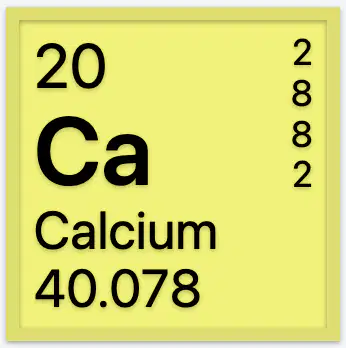
What is the mass number of the following element?
20 amu
2882 amu
Ca
40. amu
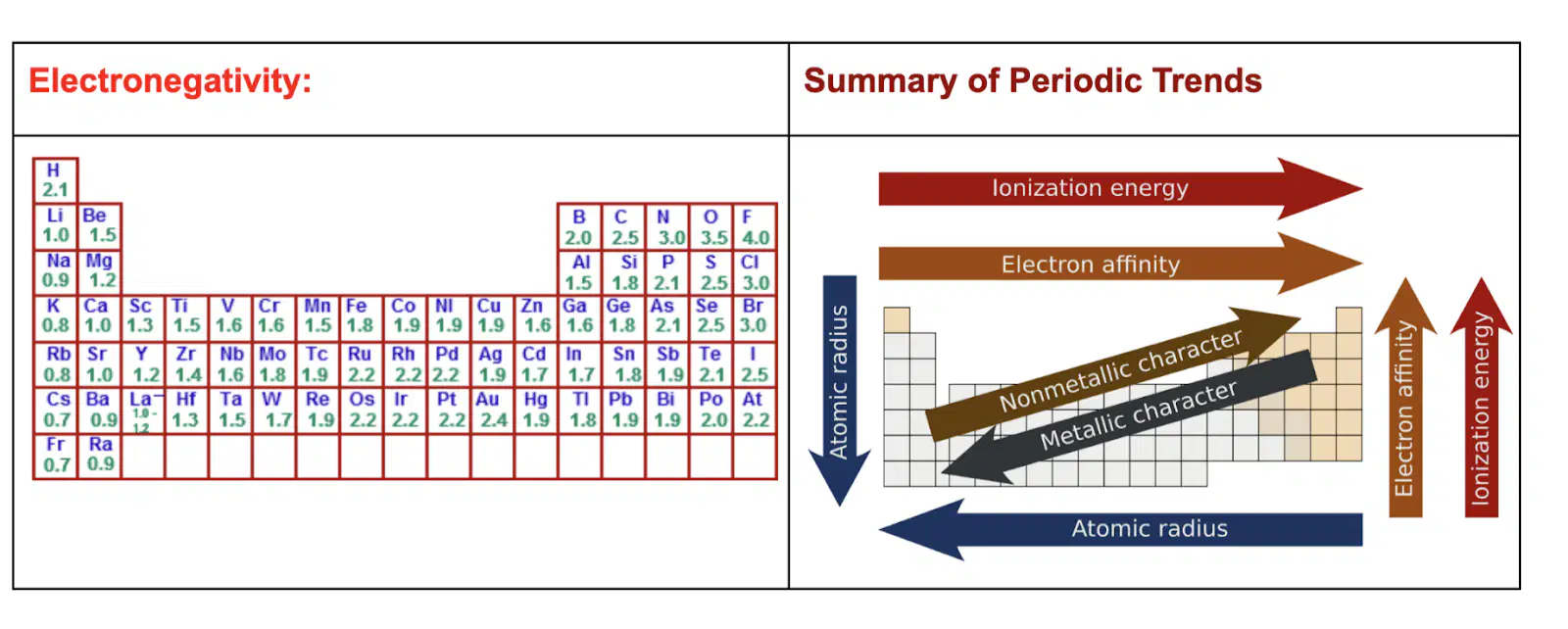
Going across a period from left to right, the size of the atomic radii...
stay the same
are unpredictable
increases
decreases
The number of neutrons in an atom of Bi-211 is
128
209
83
2
Malleable, shiny, and ductile describe
nonmetals
halogens
sulfur
alkali metals
Mendeleev's periodic table was organized based on
atomic number
atomic mass
valence electrons
x-ray results

The most electronegative element on the periodic table is
potassium
hydrogen
fluorine
oxygen
For Gold (Au), 79 represents
mass number
number of electrons
atomic number
avg atomic mass
In general, which properties are common to elements within a single group on the periodic table?
atomic number and atomic weight
chemical properties and ability to bond to other atoms
color and luster
boiling point and freezing point
Horizontal rows of the periodic table are called
periods
columns
groups
families
Which is an example of a nonmetal?
copper
phosphorus
mercury
cadmium
Valence electrons are
outer level electrons
found only in metals
the amount of electrons short of a full level
always "s" orbit electrons
What phase change occurs during condensation?
solid to liquid
liquid to gas
liquid to solid
gas to liquid
Changing a subscript in a correctly written chemical formula will
change the electron configuration of that element
change the charges on the other ions in the compound
change the formula so that it no longer represents the same compound
have no effect on the formula
The first part of the name of a binary ionic compound is the
cation
polyatomic ion
oxyanion
anion
The oxidation number for Mg in MgO is
+1
-1
-1
+2
Formula for silicon dioxide
SO2
SiO2
Si2O2
SiO
N2O4
Nitride oxide
Mononitrogen hexoxide
Dinitrogen tetroxide
Nitrogen oxide
CO
Monocarbon oxide
Carbon dioxide
Carbon monoxide
Chlorine oxide
Molar mass of carbon dioxide (CO2)
44.0 g/mol
28.0 g/mol
40 g/mol
12.0 g/mol
What is the mass of 0.240 mol glucose, C6H12O6 ?
750 g
.00133 g
180 g
43.2 g
What part is the cation in sodium oxide?
S
Na
Oxygen
moles
How many atoms are present in the compound (NH4)3N?
9
11
16
13
To balance a chemical equation, you should adjust the
coefficients
subscripts
formulas of the products
number of products
In a chemical equation, the symbol (aq) indicates that the substance is
water
dissolved in water
an acid
insoluble
In a reaction, the ions of two compounds exchange places in aqueous solution to form two new compounds. This reaction is called a
synthesis reaction
decomposition reaction
single displacement reaction
double displacement reaction
What type of chemical reactions is: CaO(s) + H2O(l) → Ca(OH)2(s)
synthesis
decomposition
single replacement
combustion
Balance this chemical equation: __ AgNO3 + __ CuCl2 → __ AgCl + __ Cu(NO3)2
2,2,1,2
1,2,1,2
1,3,1,2
2,1,2,1
Balance this chemical equation: ___ PbO2 → ___ PbO + ___ O2
2,2,1
3,3,1
4,2,2
1,1,1
What is generally found on the left side of the equation?
reactants
products
coefficients
subscripts
Balance the equation and choose the type of reaction: __ Cs + __ N2 --->__ Cs3N
2,2,2 synthesis
2,3,1 decomposition
3,2,3 single replacement
6,1,2 synthesis
Balance the following chemical equation: ___ BaCO3 -->___ BaO + ___ CO2
2,2,2
2,2,3
1,1,1
3,2,1
In the equation 6CO2 + 6H2O → C6H12O6 + 6O2, the mole ratio of water to oxygen is
2:1
1:1
3:2
6:8
For the reaction represented by the equation N2 + 3H2→ 2NH3, how many moles of nitrogen are required to produce 18 mol of NH3?
9
18
27
36
In the reaction represented by the equation 2Na + 2H2O → 2NaOH + H2, how many grams of hydrogen are produced if 120. g of Na and 80.0 g of H2O are available?
5.21 g H2
2.60 g H2
4.48 g H2
2.23 g H2
Reaction: 2As2O3 + 3C → 3CO2 + 4As
If 8.0 mol As2O3 reacts with excess carbon, the theoretical yield of the above reaction is
32 mol As
16 mol As
8 mol As
4 mol As
For the reaction 2H2 + O2 → 2H2O, how many moles of water can be produced from 6.0 mol of oxygen?
6.0 mol H2O
2.0 mol H2O
12 mol H2O
3.0 mol H2O
Given the reaction represented by the following unbalanced equation: N2O(g) + O2(g) → NO2(g) What is the mole ratio of NO2 to O2?
2:3
3:4
4:3
1:2
The volume of 1 mole of a gas at STP is
760 mL
22.4 L
100 mL
dependent on the type of gas
How many mL are in 3 L?
100
1000
3000
3
Convert 2000 grams to kg:
2 kg
20 kg
2000 kg
4000 kg
What word describes when water is attracted to other substances?
Cohesion
Adhesion
Capillary action
Surface tension
When water molecules stick easily to other water molecules, this is called what?
Cohesion
Adhesion
Solution
Polar molecule
The fact that ice floats on liquid water is due to the fact that water's solid form is _____________ than its liquid form.
Less polar
More polar
Less dense
More dense
O2(g) + 2 H2 (g) → 2 H2O (g) + Energy
endothermic
exothermic
6 CO2+ 6 H2O + Energy → C6H12O6 + 6 O2
endothermic reaction
exothermic reaction

