Wayground logo

Free Printable Worksheets

Font size

S
M
L
XL
Worksheets

SP23_EOC Review

Total questions: 115

Worksheet time: 1hrs 27mins

Name
Class
Date
1.
A species of snake was introduced to a tropical region. Scientists then noticed a steady decline in the presence of a field mice and an increase in the number of snakes. Which of these is the most likely explanation about why the population size of each animal changed?
a)
The snakes introduced to the region dominated the habitat, forcing the mice to find another place to live 
b)
The mice became prey to the introduced snakes, allowing the snake population to increase but decreasing the mice population 
c)
The snakes introduced to the region competed with the mice for food, allowing the snake population to increase but decreasing the mice population
d)
The people in the surrounding are set traps that killed the mice, allowing the snakes to live without any predators and therefore to increase in number
2.

Which of these best describes the initial change caused by a DNA mutation?

a)

a change in the sequence of base pairs

b)

a change in the production of enzymes

c)

a change in the number of nucleosomes within a cell

d)

a change in the number of hydrogen bonds between the bases

3.
What is the result of the fertilization of an egg?
a)
it restores the diploid number of chromosomes
b)
it deletes polypeptide chains in the chromosomes
c)
it gives offspring more chromosomes that the parents 
d)
it gives offspring fewer chromosomes than the parents 
4.
Which of these would lead to a lower rate of photosynthesis in a plant?
a)
an increase in the amount of oxygen in the air
b)
a decrease in the amount of oxygen in the air 
c)
an increase in the amount of carbon dioxide in the air
d)
a decrease in the amount of carbon dioxide in the air
5.
The loulu tree in Hawaii reproduces by a seed encased in a fruit Nonnative species, such as pigs and rats, eat the fruit as regular part of their diet, drastically reducing the regeneration rate of the loulu. What most likely would be the outocme for loulu trees in the next century without intervention?
a)
They would become extinct
b)
They would rebound and thrive
c)
They would remain at their current levels 
d)
They would evolve a new way to reproduce
6.
A forest fire destroys the majority of the trees in a state park. Whic effect will this most likely have a secondary consumers in that ecosystem?
a)
The amount of available energy will increase because there will be fewer predators in the forest
b)
The amount of available energy will increase because there will be less competition from producers
c)
The amount of available energy will decrease because fewer primary consumers are not reliant on primary consumers
d)
The amount of available energy will remain constant because secondary consumers are not reliant on primary consumers
7.
Which process allows for an organism to increase the number of body cells during development?
a)
budding 
b)
conjugation
c)
meiosis
d)
mitosis
8.
What is the role of hydrogen bonds in the structure of DNA?
a)
to code for proteins
b)
to synthesize proteins 
c)
to separate the strands 
d)
to connect the base pairs 
9.
The loss of habitat in a forest region has caused some plant species to become extinct, while others survive. The process by which some plant species survive and others do not in a changing environment is best explained by 
a)
natural selection
b)
law of segregation
c)
biological magnification
d)
alternation of generations
10.
Which structure is primarily responsible for directiong all processes of a plant cell?
a)
chloroplast
b)
lysosome
c)
mitochondria
d)
nucleus 
11.
A strand of DNA is exposed to intense heat. Which of these best describes what will happen to the strand of DNA?
a)
The chemical bonds of the DNA molecule will be broken
b)
More nitrogen base pairs will add on the the DNA molecule
c)
The chemical bonds of the DNA molecule will be strengthened 
d)
The nitrogen base pairs in the DNA molecule will switch places. 
12.
Polar bears swim across large expanses of ocean while hunting for seals, their main source of food. The bears use sea ice as a resting spots during their long swims. However, the sea ice is rapidly melting as a result of global warming. Which statement describes what most likely happen if global warming continues at its present rate?
a)
Polar bear and seal populations will both increase
b)
Polar bear populations will decrease, and seal populations will increase.
c)
Polar bear populations will increase, and seal populations will decrease.
d)
Polar bear populations will decrease, and seal populations will remain the same
13.
In a certain insect, round wings (R) are dominant to pointed wings (r). Which cross will produce the greates number of genotypic and phenotypic variations?
a)
rr X rr
b)
Rr X Rr
c)
Rr X RR
d)
RR X RR
14.
The papaya mealybug is a pest that poses a threat to many tropical plants. Which fate of the mealybug would result from the inability of the species to reproduce?
a)
The species would mutate
b)
The species would increase
c)
The species would become extinct
d)
The species would continue to thrive
15.
What is the main function of a selectively permeable membrane?
a)
storage of water
b)
storage of chemicals
c)
breaks down molecules within the cell
d)
regulates what enters and leaves the cell
16.
Which of these best explains the difference between the way animals and plants exchange gases with their environment?
a)
Animals use only photosynthesis, while plants use both photosynthesis and respiration
b)
Animals use only respiration, while plants use both photosynthesis and repiration
c)
Animals use both photosynthesis and respiration, while plants use only respiration
d)
Animals use both photosynthesis and respiration, while plants only use photosynthesis
17.
A reduction in which of these would lead to a decrease in all other populations?
a)
Coyote
b)
Grass
c)
Grasshoppers 
d)
Squirrel 
18.
A population of salamanders that lice in a river require clear, fresh water to survive. A flood causes tons of sediment to be suspended in the river. Which of these most likely will happen to the salamander population?
a)
The salamanders will adapt to life on land
b)
The salamanders will move to another river
c)
The salamanders will adapt to living in the muddy water
d)
The salamanders will decrease in number because of the water quality 
19.
The gopher snake uses its glottis to produce a hiss that sounds similar to a rattlesnake's rattle. What most likely reason a gopher snake would do this?
a)
to attract prey
b)
to attract a mate
c)
to confuse predators 
d)
to increase adrenaline flow
20.
Made of monomers of amino acids
a)
Carbohydrates 
b)
Lipids
c)
Proteins 
d)
Nucleic Acids
21.
Made of monomers of monosaccharides
a)
Carbohydrates
b)
Lipids
c)
Proteins
d)
Nucleic Acids
22.
Made of monomers of nucleotides
a)
Carbohydrates
b)
Lipids
c)
Proteins
d)
Nucleic Acids
23.
Made of glycerol and fatty acids
a)
Carbohydrates
b)
Lipids
c)
Proteins
d)
Nucleic Acids
24.
Include sugars (ex. glucose) and starches
a)
Carbohydrates
b)
Lipids
c)
Proteins
d)
Nucleic Acids
25.
Include waxes, oils, steroids (hormones)
a)
Carbohydrates
b)
Lipids
c)
Proteins
d)
Nucleic Acids
26.
Include waxes, oils, steroids (hormones)
a)
Carbohydrates
b)
Lipids
c)
Proteins
d)
Nucleic Acids
27.
Includes collagen, hemoglobin and insulin
a)
Carbohydrates
b)
Lipids
c)
Proteins
d)
Nucleic Acids
28.
Includes DNA and RNA
a)
Carbohydrates
b)
Lipids
c)
Proteins
d)
Nucleic Acids
29.
Speed up chemical reactions, protects against infections, and structural component of hair, skin, and muscles
a)
Carbohydrates
b)
Lipids
c)
Proteins
d)
Nucleic Acids
30.
What does every food chain start with? (Even if it's not drawn or written there!)
a)
producers
b)
sun
c)
consumer
d)
decomposers
31.
An organism that needs to eat other organisms to obtain energy is known as a:
a)
Autotroph
b)
Producer
c)
Consumer
d)
Mutualist
32.
relationship in which two species live closely together
a)
resource
b)
mutualism
c)
succession
d)
symbiosis
33.
Where an organism lives
a)
habitat
b)
niche 
c)
heterotrogh
d)
biosphere
34.
What is the term for each step in the transfer of energy and matter within a biological community?
a)
energy path
b)
food web
c)
trophic level
d)
food pyramid
35.
The nonliving aspects of an ecosystem.
a)
Abiotic factors
b)
Biotic factors
36.
The living portions of the ecosystem.
a)
Biotic factors
b)
Abiotic factors
37.
As you move upward, from level to level, in an energy pyramid, energy _____.
a)
increases
b)
decreases
c)
stays the same
d)
increases exponentially
38.
What are the Abiotic factors in this image? 
a)
water, sunlight, dirt, air
b)
birds and plants
c)
birds, water, dirt
d)
plants, water
39.
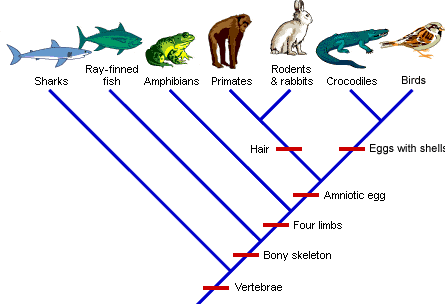
According to this cladogram, birds are LEAST related to: 
a)
Amphibians
b)
Sharks
c)
Ray Finned Fish
d)
Crocodiles
40.
An illustration and a dichotomous key are given. What is the correct classification for this organism?
a)
Class Insecta
b)
Order Amblygygi
c)
Order Araneae
d)
Order Scorpiones
41.
What are two main functions of fats within the body?
a)
energy storage and cellular transport
b)
energy storage and insulation
c)
building blocks for DNA and hormones
d)
storing cellular information and in the cell membrane
42.
Carbohydrates have which ratio of elements?
a)
1:3:1 ratio
b)
2:2:2 ratio
c)
1:2:1 ratio
d)
1:2:3 ratio
43.
Glycogen:
a)
Is the sugar storage molecule for animals
b)
is the sugar storage unit for plants
c)
is a disaccharide
d)
Is used as insulation in animals
44.
What genotype would go in box 1?
a)
BB
b)
Bb
c)
bb
d)
bB
45.
What genotype would go in box 2?
a)
BB
b)
Bb
c)
bb
d)
bB
46.
Colorblindness is a recessive x-linked disorder.
Which genotype represents a female who is colorblind?
a)
XNXn
b)
XnXn
c)
XNXN
d)
XnY
47.
Colorblindness is a recessive x-linked disorder.
Which genotype represents a male with normal vision?
a)
XNXN
b)
XnXn
c)
XNY
d)
XnY
48.
Which of the following genotypes belongs in the red box in the Punnett square?
a)
XBXb
b)
XbXb
c)
XBXB
d)
XbY
49.
A red flowered plant (RR) breeds with a White flowered plant (WW). The gene for petal color in these plants expresses incomplete dominance.  What percentage of the offspring will have pink (RW) flowers?
a)
0%
b)
25%
c)
50%
d)
100%
50.
Enzymes are capable of increasing the rate of a chemical reaction within a living cell.  Enzymes accomplish this through which of the following means?
a)
reducing the number of products   
b)
reducing the activation energy
c)
increasing the temperature of the cell
d)
increasing the concentration of reactants 
51.
How do enzymes speed up chemical reaction?
a)
Increasing activation energy
b)
Decreasing activation energy
c)
Increasing deactivation energy
d)
Decreasing deactivation energy
52.
What happens when enzymes are heated to a high temperature?
a)
The enzymes die.
b)
The shapes of the enzyme are altered or denatured
c)
The enzymes' amino acid sequence changes.
d)
The enzymes remain the same
53.
Structure (b) is a ____.
a)
chromosome
b)
chromatid
c)
centromere
54.
Which of these lists presents the stages of the cell cycle in the correct order?
a)
interphase, mitosis, cytokinesis
b)
cytokinesis, mitosis, interphase
c)
mitosis, interphase, cytokinesis
d)
interphase, cytokinesis, mitosis
55.
When you start with 1 cell, at the end of mitosis, how many identical cells will you have?
a)
1
b)
2
c)
3
d)
4
56.
After meiosis is complete, how many cells will there be?
a)
1
b)
2
c)
3
d)
4
57.
What causes genetic variation in meiosis?
a)
chromosomes lining up
b)
crossing over of chromosomes
c)
separation of chromosomes
d)
chromosomes pulling apart
58.
Which of these cells would be produced through meiosis?
a)
skin cells
b)
liver cells
c)
brain cells
d)
sperm cells
59.
What is the phase in this picture?
a)
prophase 
b)
anaphase 
c)
telophase 
d)
metaphase 
60.
What is the phase pictured here?
a)
anaphase 
b)
telophase 
c)
metaphase 
d)
prophase 
61.
Which phase is pictured here?
a)
anaphase 
b)
metaphase 
c)
prophase 
d)
telophase 
62.
Which phase is pictured here?
a)
metaphase 
b)
anaphase
c)
prophase 
d)
telophase 
63.
Mitosis is considered to be _______ reproduction
a)
sexual
b)
asexual
64.
The stages of mitosis in order:
a)
Metaphase, Anaphase, Prophase, Telophase
b)
Prophase, Anaphase, Metaphase, Telophase
c)
Prophase, Metaphase, Anaphase, Telophase
d)
Anaphase, Prophase, Telophase, Metaphase
65.
Which shows the correct complementary base pairing for DNA?
a)
C-A, T-G
b)
A-G, C-T
c)
C-G, U-A
d)
T-A, G-C
66.
Name this structure.
a)
double helix
b)
nucelotide
c)
twisted ladder
d)
hydrogen bond
67.
Which sequence of DNA bases would pair with this partial strand:
ATG TGA CAG
a)
ATG TGA CAG
b)
TAC ACT GTC
c)
GTA AGT GAC
d)
CAT TCA CTG
68.
Which process is used to make mRNA from the DNA in the nucleus?
a)
transcription
b)
translation
c)
replication 
69.
What does mRNA do?
a)
provides information from DNA to ribosomes
b)
transfers amino acids to the ribosomes
c)
makes up ribosomes
d)
builds proteins
70.
What does tRNA do?
a)
provides information from DNA to ribosomes
b)
transfers amino acids to the ribosomes
c)
makes up ribosomes
d)
builds proteins
71.

_______ is made during transcription and ________ is made during transLation.

a)

mRNA / a protein

b)

a protein / mRNA

c)

Ribosome / Nucleus

d)

mRNA / tRNA

72.
Choose the nucleotide sequence of the RNA strand that would be complementary to the following strand: 
GTA GTC AGG
a)
UAT UAG AUU
b)
ACG ACT GTA
c)
CAU CAG UCC
d)
CAT CAG TAT
73.
What is the location in the cell for translation?
a)
nucleus
b)
mitochondria
c)
ribosome
d)
chloroplast
74.
Based on these results, whose blood was found in the blood stain at the crime scene?
a)
Bob
b)
Sue
c)
John
d)
Lisa
75.
Osmosis is the movement of _____ across a membrane.
a)
food
b)
energy
c)
oxygen
d)
water
76.
In the given scenario, what will happen to the organism: salt is poured onto eggplant.
a)
Water will move out of the eggplant cells and the cells will shrink.
b)
Water will move out of the eggplant cells and the cells will swell.
c)
Water will move into the eggplant cells and the cells will swell.
77.
Ideally, your cells should be in a(n) _______ solution
a)
Hypertonic
b)
Hypotonic
c)
Isotonic
d)
Cola
78.
The cell below is in a _________ solution.
a)
Hypotonic
b)
Hypertonic
c)
Isotonic
79.

Sexual reproduction requires _____ parent(s) and asexual reproduction requires ___ parent(s)

a)

1,1

b)

2,2

c)

2,1

d)

1,2

80.
Primary consumers
a)
gain energy from producers.
b)
gain energy from other primary consumers.
c)
gain energy from secondary consumers.
d)
gain energy from decomposers.
81.
The cells produced via meiosis are called:
a)
sex cells
b)
somatic cells
c)
body cells
d)
skin cells
82.
Unlike mitosis, meiosis in male mammals results in the formation of
a)
one haploid gamete
b)
three diploid gametes
c)
four diploid gametes
d)
four haploid gametes
83.
If the Diploid number of Carrots is 18, the haploid number is
a)
18
b)
9
c)
27
d)
36
84.
If a body cell in a butterfly contains 24 chromosomes, a butterfly egg would contain
a)
3
b)
6
c)
12
d)
24
85.
The chromosomes that pair up during meiosis, are called __________ chromosomes.  
a)
homozygous 
b)
asexual
c)
homologous
d)
genes
86.
Identify the phase.
a)
Metaphase I
b)
Metaphase II
c)
Prophase I
d)
Anaphase II
87.
Name the growth phase of the cell cycle for both Mitosis and Meiosis.
a)
metaphase
b)
telophase
c)
interphase
d)
anaophase
88.
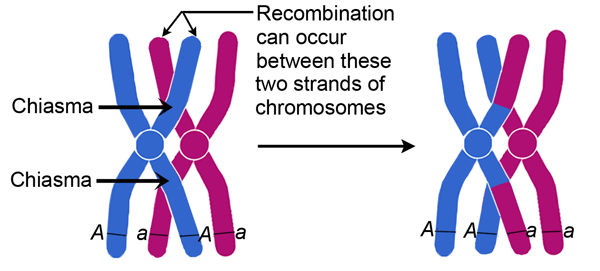
This image shows chromosomes during Prophase 1. Which of the following correctly describes the process shown?
a)
segregation of sister chromatids
b)
condensation and segregation of alleles
c)
mutationin which the DNA content of the gene is altered
d)
crossing - over in which alleles are exchanged
89.
Why do we need meiosis?
a)
To double the number of chromosomes going into sex cells
b)
To halve the number of chromosomes going into sex cells
c)
To triple the number of chromosomes going into sex cells
d)
To not change the number of chromosomes going into sex cells
90.
A human zygote should have _____ chromosomes inside.
a)
46
b)
23
c)
92
d)
64
91.
When an area of a chromatid is exchanged with the matching area on a chromatid of its homologous chromosome, _________________ occurs
a)
crossing over
b)
mutagenesis
c)
hybridization
d)
fertilization
92.
Human eggs and sperm are _____, and each has ____ chromosomes.
a)
diploid, 23
b)
diploid, 46
c)
haploid, 23
d)
haploid, 46
93.
How are your chromosomes inherited?
a)
most of your chromosomes from your mother
b)
most of your chromosomes from your father
c)
a random number of chromosomes from each parent
d)
half your chromosomes from your mother and half from your father.
94.
Meiosis makes sperm and egg cells. In humans, sperm and egg cells each have _____ chromosomes. Therefore a fertilized human egg cell (sperm and egg cell combined) would create a cell with _____ chromosomes.
a)
23, 46
b)
46, 23
c)
2, 4
d)
50, 100
95.
What causes genetic variation in meiosis?
a)
chromosomes lining up
b)
crossing over of chromosomes
c)
separation of chromosomes
d)
chromosomes pulling apart
96.

A human body (somatic) cell usually has how many chromosomes?

a)

14

b)

23

c)

46

97.

A species of snake was introduced to a tropical region. Scientists then noticed a steady decline in the presence of a field mice and an increase in the number of snakes. Which of these is the most likely explanation about why the population size of each animal changed?

a)

The snakes introduced to the region dominated the habitat, forcing the mice to find another place to live

b)

The mice became prey to the introduced snakes, allowing the snake population to increase but decreasing the mice population

c)

The snakes introduced to the region competed with the mice for food, allowing the snake population to increase but decreasing the mice population

d)

The people in the surrounding are set traps that killed the mice, allowing the snakes to live without any predators and therefore to increase in number

98.
Which of these best describes the initial change caused by a DNA mutation?
a)
a change in the swquence of base pairs 
b)
a change in the production of enzymes 
c)
a change in the number of nucleosomes within a cell
d)
a change in the number of hydrogen bonds between the bases 
99.
What is the result of the fertilization of an egg?
a)
it restores the diploid number of chromosomes
b)
it deletes polypeptide chains in the chromosomes
c)
it gives offspring more chromosomes that the parents 
d)
it gives offspring fewer chromosomes than the parents 
100.
Which of these would lead to a lower rate of photosynthesis in a plant?
a)
an increase in the amount of oxygen in the air
b)
a decrease in the amount of oxygen in the air 
c)
an increase in the amount of carbon dioxide in the air
d)
a decrease in the amount of carbon dioxide in the air
101.
The loulu tree in Hawaii reproduces by a seed encased in a fruit Nonnative species, such as pigs and rats, eat the fruit as regular part of their diet, drastically reducing the regeneration rate of the loulu. What most likely would be the outocme for loulu trees in the next century without intervention?
a)
They would become extinct
b)
They would rebound and thrive
c)
They would remain at their current levels 
d)
They would evolve a new way to reproduce
102.
A forest fire destroys the majority of the trees in a state park. Whic effect will this most likely have a secondary consumers in that ecosystem?
a)
The amount of available energy will increase because there will be fewer predators in the forest
b)
The amount of available energy will increase because there will be less competition from producers
c)
The amount of available energy will decrease because fewer primary consumers are not reliant on primary consumers
d)
The amount of available energy will remain constant because secondary consumers are not reliant on primary consumers
103.
Which process allows for an organism to increase the number of body cells during development?
a)
budding 
b)
conjugation
c)
meiosis
d)
mitosis
104.
What is the role of hydrogen bonds in the structure of DNA?
a)
to code for proteins
b)
to synthesize proteins 
c)
to separate the strands 
d)
to connect the base pairs 
105.
The loss of habitat in a forest region has caused some plant species to become extinct, while others survive. The process by which some plant species survive and others do not in a changing environment is best explained by 
a)
natural selection
b)
law of segregation
c)
biological magnification
d)
alternation of generations
106.
Which structure is primarily responsible for directiong all processes of a plant cell?
a)
chloroplast
b)
lysosome
c)
mitochondria
d)
nucleus 
107.
A strand of DNA is exposed to intense heat. Which of these best describes what will happen to the strand of DNA?
a)
The chemical bonds of the DNA molecule will be broken
b)
More nitrogen base pairs will add on the the DNA molecule
c)
The chemical bonds of the DNA molecule will be strengthened 
d)
The nitrogen base pairs in the DNA molecule will switch places. 
108.
Polar bears swim across large expanses of ocean while hunting for seals, their main source of food. The bears use sea ice as a resting spots during their long swims. However, the sea ice is rapidly melting as a result of global warming. Which statement describes what most likely happen if global warming continues at its present rate?
a)
Polar bear and seal populations will both increase
b)
Polar bear populations will decrease, and seal populations will increase.
c)
Polar bear populations will increase, and seal populations will decrease.
d)
Polar bear populations will decrease, and seal populations will remain the same
109.
In a certain insect, round wings (R) are dominant to pointed wings (r). Which cross will produce the greates number of genotypic and phenotypic variations?
a)
rr X rr
b)
Rr X Rr
c)
Rr X RR
d)
RR X RR
110.
The papaya mealybug is a pest that poses a threat to many tropical plants. Which fate of the mealybug would result from the inability of the species to reproduce?
a)
The species would mutate
b)
The species would increase
c)
The species would become extinct
d)
The species would continue to thrive
111.
What is the main function of a selectively permeable membrane?
a)
storage of water
b)
storage of chemicals
c)
breaks down molecules within the cell
d)
regulates what enters and leaves the cell
112.
Which of these best explains the difference between the way animals and plants exchange gases with their environment?
a)
Animals use only photosynthesis, while plants use both photosynthesis and respiration
b)
Animals use only respiration, while plants use both photosynthesis and repiration
c)
Animals use both photosynthesis and respiration, while plants use only respiration
d)
Animals use both photosynthesis and respiration, while plants only use photosynthesis
113.
A reduction in which of these would lead to a decrease in all other populations?
a)
Coyote
b)
Grass
c)
Grasshoppers 
d)
Squirrel 
114.
A population of salamanders that lice in a river require clear, fresh water to survive. A flood causes tons of sediment to be suspended in the river. Which of these most likely will happen to the salamander population?
a)
The salamanders will adapt to life on land
b)
The salamanders will move to another river
c)
The salamanders will adapt to living in the muddy water
d)
The salamanders will decrease in number because of the water quality 
115.
The gopher snake uses its glottis to produce a hiss that sounds similar to a rattlesnake's rattle. What most likely reason a gopher snake would do this?
a)
to attract prey
b)
to attract a mate
c)
to confuse predators 
d)
to increase adrenaline flow