
Font size
 Worksheets
Chapter 7 Cell Structure and Function Test
Total questions: 76
Worksheet time: 46mins
Who was one of the first people to identify and see cork cells?
Anton van Leeuwenhoek
Robert Hooke
Matthias Schleiden
Rudolf Virchow
The work of Schleiden and Schwann can be summarized by saying that
a. all plants are made of cells.
b. all animals are made of cells.
c. plants and animals have specialized cells.
c. plants and animals have specialized cells.
d. all plants and animals are made of cells.
Which of the following is NOT a principle of the cell theory?
a. Cells are the basic units of life.
b. All living things are made of cells.
c. Very few cells reproduce.
d. All cells are produced by existing cells.
The cell theory applies to
bacteria
plants and animals
multicellular organisms
all of the above
Electron microscopes can reveal details
a. 100 times larger than those visible in light microscopes.
b. the same size as those visible in light microscopes.
c. 100 times smaller than those visible in light microscopes.
d. 1000 times smaller than those visible in light microscopes.
Which type(s) of microscopes can produce three-dimensional images of cells?
a. transmission electron microscopes
b. scanning electron microscopes
c. both A and B
d. neither A nor B
Researchers use fluorescent labels and light microscopy to
a. produce movies of cells as they grow, divide, and develop.
b. scan cells with laser beams.
c. follow molecules moving through the cell.
d. build three-dimensional images of cells.
Prokaryotes lack
cytoplasm
a cell membrane
a nucleus
genetic material
Which of the following contain a nucleus?
prokaryotes
bacteria
eukaryotes
organelles
Eukaryotes usually contain
a nucleus
specialized organelles
genetic material
all of the above
Which of the following organisms are prokaryotes?
plants
animals
bacteria
all of the above
Which of the following is a function of the nucleus?
a. stores DNA
b. controls most of the cell’s processes
c. contains the information needed to make proteins
d. all of the above
Which of the following is NOT found in the nucleus?
cytoplasm
nucleolus
chromatin
DNA
Which of the following statements explains why the nucleus is important to cells?
a. Only eukaryotes have nuclei.
b. Only prokaryotes have nuclei.
c. The nucleus contains coded instructions for making proteins.
d. The nucleus is surrounded by a nuclear envelope.
Which of the following structures is found in the cytoplasm?
nucleolus
ribosome
chromatin
cell wall
Which organelle breaks down food into molecules the cell can use?
Golgi apparatus
lysosome
endoplasmic reticulum
mitochondrion
Which structure makes proteins using coded instructions that come from the nucleus?
Golgi apparatus
mitochondrion
vacuole
ribosome
Which organelle converts the chemical energy stored in food into compounds that are more convenient for the cell to use?
chloroplast
Golgi apparatus
endoplasmic reticulum
mitochondrion
Which organelles help provide cells with energy?
mitochondria and chloroplasts
rough endoplasmic reticulum
smooth endoplasmic reticulum
Golgi apparatus and ribosomes
Which sequence correctly traces the path of a protein in the cell?
a. rough endoplasmic reticulum, Golgi apparatus, released from the cell
b. ribosome, smooth endoplasmic reticulum, chloroplast
c. smooth endoplasmic reticulum, lysosome, Golgi apparatus
d. mitochondria, rough endoplasmic reticulum, cell membrane
Which organelle would you expect to find in plant cells but not animal cells?
mitochondrion
ribosome
chloroplast
smooth endoplasmic reticulum
Which of the following is a function of the cytoskeleton?
helps a cell keep its shape
contains DNA
surrounds the cell
helps make proteins
Which structures carry out cell movement?
cytoplasm and ribosomes
nucleolus and nucleus
microtubules and microfilaments
chromosomes
Which of the following is NOT a function of the cytoskeleton?
a. helps the cell maintain its shape
b. helps the cell move
c. prevents chromosomes from separating
d. helps organelles within the cell move
The main function of the cell wall is to
support and protect the cell
store DNA
direct the activities of the cell
help the cell move
Unlike the cell membrane, the cell wall is
found in all organisms
composed of a lipid bilayer
a flexible barrier
usually made of tough fibers
You will NOT find a cell wall in which of these kinds of organisms?
plants
animals
fungi
all of the above
Which of the following structures serves as the cell’s boundary from its environment?
mitochondrion
cell membrane
chloroplast
channel proteins
Which of the following is a function of the cell membrane?
a. breaks down lipids, carbohydrates, and proteins from foods
b. stores water, salt, proteins, and carbohydrates
c. keeps the cell wall in place
d. regulates which materials enter and leave the cell
The cell membrane contains channels and pumps that help move materials from one side to the other.
What are these channels and pumps made of?
carbohydrates
lipids
bilipids
proteins
Diffusion is the movement of molecules from
a. an area of low concentration to an area of high concentration.
b. an area of high concentration to an area of low concentration.
c. an area of equilibrium to an area of high concentration.
d. all of the above
Diffusion occurs because
a. molecules constantly move and collide with each other.
b. the concentration of a solution is never the same throughout a solution.
c. the concentration of a solution is always the same throughout a solution.
d. molecules never move or collide with each other.
When the concentration of molecules on both sides of a membrane is the same, the molecules will
a. move across the membrane to the outside of the cell.
b. stop moving across the membrane.
c. move across the membrane in both directions.
d. move across the membrane to the inside of the cell.
Which means of particle transport requires input of energy from the cell?
diffusion
osmosis
facilitated diffusion
active transport
The diffusion of water across a selectively permeable membrane is called
osmotic pressure
osmosis
facilitated diffusion
active transport
An animal cell that is surrounded by fresh water will burst because the osmotic pressure causes
water to move into the cell
water to move out of the cell
solutes to move into the cell
solutes to move out of the cell
Which term refers to cells having different jobs in an organism?
multicellular
cell specialization
levels of organization
unicellular
The cells of multicellular organisms are
a. smaller than those of unicellular organisms.
b. simpler than those of unicellular organisms.
c. specialized to perform different tasks.
d. not dependent on one another.
All of the following are examples of cell specialization EXCEPT
a. a pancreatic cell that produces protein-digesting enzymes.
b. muscle cells that control movement of materials in the body
c. a prokaryotic cell that carries out photosynthesis.
d. a red blood cell that carries oxygen.
Which of the following is an example of an organ?
heart
epithelial tissue
digestive system
nerve cell
All of the following are types of tissues EXCEPT
muscle
connective
digestive
nerve
A group of similar cells that perform a particular function is called a(an)
organ
organ system
tissue
division of labor
Which of the following is an organ of the digestive system?
stomach
nerve tissue
muscle cell
epithelial tissue
An organ system is a group of organs that
a. are made up of similar cells.
b. are made up of similar tissues.
c. work together to perform a specific function.
d. work together to perform all the functions in a multicellular organism.
Which list represents the levels of organization in a multicellular organism from the simplest level to the most complex level?
cell, tissue, organ system
organ system, organ, tissue, cell
tissue, organ, organ system
cell, tissue, organ, organ system
If a cell contains a nucleus, it must be a prokaryote.
T
F

The cell represented in Figure 7–1 is a eukaryote.
T
F
The assembly of ribosomes begins in a small dense structure called the chromatin.
T
F
Ribosomes stud the surface of rough endoplasmic reticulum.
T
F
Many membrane proteins are made by the smooth endoplasmic reticulum.
T
F
Ribosomes stud the surface of rough endoplasmic reticulum.
T
F
Many membrane proteins are made by the smooth endoplasmic reticulum.
T
F
Cilia and flagella are made of protein filaments called endoplasmic reticulum.
T
F
The main function of the cell wall is to provide support and protection.
T
F
Water, carbon dioxide, oxygen, and some other substances can pass through the cell wall.
T
F
The nuclear envelope regulates which substances enter and leave a cell.
T
F
Once equilibrium is reached, roughly equal numbers of molecules move in either direction across a semipermeable membrane, and there is no further change in concentration on either side of the membrane.
T
F
A red blood cell placed in pure water will shrink.
T
F
There is a division of labor among the cells of multicellular organisms.
T
F
Cell specialization means that the cells in an organism are uniquely suited to reproduce.
T
F
A typical organ is made up of many different kinds of cells and tissues.
T
F
According to the cell theory, all cells come from existing (a) .
In a eukaryote, the material between the cell membrane and the nucleus is called the
(a)

The material indicated in Figure 7–2 by the letter B is called the (a) .
During cell division, chromatin condenses to form (a) , which are
threadlike structures containing genetic material.
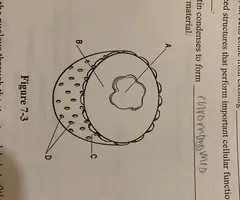
The structure labeled (a) in Figure 7–3 consists of DNA bound to protein.

RNA and other molecules leave the nucleus through the structure labeled (a) in Figure 7–3
Eukaryotes contain specialized structures that perform important cellular functions. These structures are called (a) .
Unlike smooth endoplasmic reticulum, rough endoplasmic reticulum has (a) attached to it.
Enzymes in the (a) attach carbohydrates and lipids to proteins.

The structure indicated in Figure 7–1 by the letter F is usually larger in (a) cells.
The cell takes in food and water and eliminates wastes through the (a)
Molecules tend to move from an area where they are more concentrated to an area where they are less concentrated. This process is called (a) .
Large molecules such as glucose that cannot cross the lipid bilayer can still move across the membrane with a concentration gradient by (a) .
The cells in a multicellular organism have specific jobs. This is called cell
(a)
The levels of organization in a multicellular organism are ____________________, tissues,
____________________, and organ systems.
(a)

