wayground logo

Free Printable Worksheets

Font size

S
M
L
XL
Worksheets

PS 2nd Sem. Exam

Total questions: 100

Worksheet time: 2hrs 0mins

Name
Class
Date
1.
A candle wick burning is an example of a _________________________
a)
physical reaction
b)
condensation
c)
neutrons
d)
chemical reaction
2.

You know that a chemical reaction has occurred if

a)

there is a precipitate (new solid)

b)

there is a color change.

c)

there is a temperature change.

d)

All of these answers are evidence.

3.

A(an) ______ is the number that appears before a formula in a chemical equation.

a)

subscript

b)

coefficient

c)

ratio

d)

denominator

4.

How is a chemical change different from a physical change?

a)

there is no difference

b)

a physical change creates a new substance

c)

a chemical change creates a new substance

5.
the starting materials in a chemical reaction
a)
Products
b)
Reactants
c)
Starters
d)
Enders
6.

In chemical reactions, what does the Law of Conservation of Matter mean?

a)

Matter is not created or destroyed.

b)

The total mass of the reactants is greater than the total mass of the products.

c)

The total mass of the reactants is less than the total mass of the products.

d)

Matter is not changed.

7.
The substances listed on the right side of a chemical equation are the
a)
Yields
b)
Reactants
c)
Products
d)
Precipitates
8.
The blue numbers in the image below represent ________
a)
I don't know, and don't want to try
b)
coefficients
c)
subscripts
d)
none of the answers are correct
9.
Balance this equation.
_Mg + _Cl--> _MgCl2
a)
1, 2,1
b)
already balanced
c)
2,1,1
d)
1,1,2
10.
How many atoms of aluminum are on each side of the following equation: 4Al + 3O--> 2AlO3
a)
2
b)
6
c)
1
d)
4
11.

What term is given to a reaction which transfers heat energy to the surroundings?

a)

Endothermic

b)

Reversible

c)

Exothermic

d)

Exotermic

12.

if less heat energy is released in making bonds in the products than is taken in when breaking bonds in the reactants

a)

Endothermic

b)

Exotermic

c)

Exothermic

d)

Entrothermic

13.
What does velocity have that speed doesn't?
a)
time
b)
a unit
c)
an equation
d)
direction
14.
A car moves 500 meters in 10 seconds. What is it's speed?
a)
500 m/s
b)
50 m/s
c)
5 m/s
d)
0.05 m/s
15.
The slope of a position vs time graph represents the:
a)
speed
b)
acceleration
c)
distance
d)
time
16.
The slope on a speed vs time graph represents the:
a)
speed
b)
acceleration
c)
distance
d)
time
17.
What is the force called that opposes motion?
a)
Net force
b)
Friction
c)
Gravity
d)
Normal force
18.
What is the kinetic energy of a 50 kg object moving at 2 m/s?
a)
25 J
b)
50 J
c)
100 J
d)
200 J
19.

In which scenario is gravitational potential energy the highest?

a)

standing on top of a mountain

b)

at the bottom of a swing path

c)

in a submarine at the bottom of the ocean

d)

standing on your desk

20.
Scott drives a Jeep 12 km east, then 4 km north, then finally 3 km west. He traveled a total distance of:
a)
5 km
b)
10 km
c)
13 km
d)
19 km
21.
Liza is swimming laps from one end of a 50 meter pool to the other. Going from one end to the other is considered one lap. If she swims four complete laps, which statement is TRUE?
a)
Her distance and displacement are both zero.
b)
Her distance is zero, but her displacement is 200 meters.
c)
Her distance is 200 meters, but her displacement is zero.
d)
Her distance and displacement are both 200 meters.
22.
Ivan walks 10 meters west to the water fountain, then runs 2 meters east to his class to avoid a lockout. His displacement would be:
a)
8 meters
b)
8 meters, east
c)
8 meters, west
d)
12 meters
23.
Distance and direction of an object's change in position from a starting point
a)
displacement
b)
distance
c)
motion
d)
reference point
24.

The formula for Speed is...

a)

Speed = distance/ time

b)

Speed = time/ distance

25.

If Harry drives 4 miles in 2 minutes, what was his speed?

a)

0.5 miles/min

b)

2 miles/min

c)

2 min/m

d)

0.5 min/m

26.

If Emma is running for 8 minutes at 2 miles/min, how far did she run?

a)

4 miles

b)

16 min

c)

16 miles

d)

0.5 min

27.

In order to find the Time, you must

a)

divide the distance by the speed (distance/speed)

b)

multiply the distance by the speed (distance/speed)

c)

Neither of the Above

28.

In each of the following cases, determine where the car has no acceleration?

a)

A car speeds up after a stoplight turns green.

b)

A car slows down as it approaches a red light

c)

A car with the cruise control set at 80 km/h going down a straight highway

d)

A car turning a curve at a constant speed

29.

The SI unit for acceleration is

a)

mph

b)

ft/sec

c)

m/s2

d)

m/s

30.
A negative acceleration means that your object is _____. 
a)
not accelerating
b)
not moving
c)
speeding up 
d)
slowing down 
31.

A positive acceleration means that your object is _____.

a)

not accelerating

b)

not moving

c)

speeding up

d)

slowing down

32.
A box sliding down an inclined plane attains a velocity of 27 m/s in 3 seconds from rest.  Find the acceleration.
a)
30 m/s
b)
24 m/s2
c)
9 m/s2
d)
81 km/hr
33.
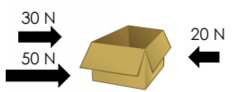
What is the net force?
a)
20 N 
b)
0 N 
c)
400 N 
d)
40 N 
34.

What is the unit to MEASURE force?

a)

Kilogram

b)

Meter

c)

Pounds

d)

Newton

35.

A ____________ is a push or a pull on an object.

a)

friction

b)

force

c)

magnet

d)

gravity

36.
What will cause an object to move?
a)
Applied forces
b)
Balanced forces
c)
Unbalanced forces
37.
When forces are _________ the object DOES NOT move.
a)
unbalanced
b)
balanced
c)
heavy
d)
light
38.
Calculate the Net Force. 
a)
60N, Left 
b)
40N, Right 
c)
0N
d)
60N, Right
39.

An object in motion will stay in motion and an object at rest will stay at rest unless acted upon by an outside force. Which law does this describe

a)

2nd law

b)

1st law

c)

3rd law

40.

If there is a big mass, it would need a stronger force to accelerate it. Which law does this describe?

a)

3rd law

b)

1st law

c)

2nd law

41.

Which one of Newton's laws are displayed

a)

2nd law

b)

1st law

c)

3rd law

42.

The ability to do work or cause change:

a)

work

b)

energy

c)

momentum

d)

power

43.

Energy in the form of motion.

a)

mechanical energy

b)

potential energy

c)

kinetic energy

d)

momentum

44.

Stored energy in the form of position or condition.

a)

potential energy

b)

kinetic energy

c)

momentum

d)

mechanical energy

45.

Where is the kinetic energy of pendulum at its highest?

a)

at the top of the swing

b)

at the bottom of the swing

c)

at 1/4 of the swing

d)

at 3/4 of the swing

46.
A weightlifter lifts two 300 newton weights 1.5 meters off the ground. How much work has he done?
a)
600 J 
b)
660 J
c)
900 J 
d)
1200 J 
47.
What color of stars are the coolest?
a)
Orange
b)
Red
c)
Blue
d)
White
48.
The estimated age of the universe is:
a)
12.3 million years 
b)
4.6 billion years
c)
27.8 billion years
d)
13.8 billion years
49.
The sun and other main sequence stars are made primarily of what element?
a)
Hydrogen
b)
Carbon
c)
Oxygen
d)
Neon
50.

Which statement best describes the difference between longitudinal and transverse?

a)

Longitudinal waves transfer energy perpendicular to the direction of motion and a transverse wave transfers energy parallel to the direction of motion

b)

Transverse waves transfer energy perpendicular to the direction of motion and a longitudinal wave transfers energy parallel to the direction of motion

c)

Both transverse waves and longitudinal waves transfer energy perpendicular to the direction of motion

d)

Both transverse waves and longitudinal waves transfer energy parallel to the direction of motion

51.

What type of wave behavior phenomenon is represented in the diagram shown?

a)

reflection

b)

refraction

c)

interference

d)

diffraction

52.

A light ray is incident on a mirror as shown in the diagram. Which ray best represents the reflected ray?

a)

A

b)

B

c)

C

d)

D

53.

Sound travels fastest in

a)

a vacuum

b)

solids

c)

liquids

d)

gases

54.

Light travels fastest in

a)

a vacuum

b)

solids

c)

liquids

d)

gases

55.

Which wave shown in the diagram has the highest frequency and shortest wavelength?

a)

A

b)

B

c)

C

d)

D

56.
Which would be a good conductor of electricity?
a)
Wood
b)
Rubber
c)
Plastic
d)
Metal
57.

A ray of light will reflect at the same angle it hits a surface. What is the name of this law?

a)

The Law of Reflection

b)

The Law of Diffraction

c)

The Law of Refraction

d)

The Law of Longitudinal Waves

58.

Objects that do not allow heat to flow are known as ____________.

a)

conductors

b)

plastics

c)

solids

d)

insulators

59.

The highest point on a transverse wave is the

a)

compression

b)

crest

c)

rest position

d)

trough

60.

The lowest point on a transverse wave is the

a)

compression

b)

crest

c)

rest position

d)

trough

61.

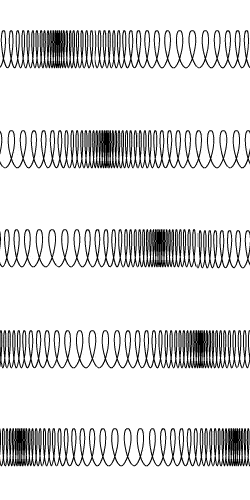
What type of wave is this?

a)

Longitudinal

b)

Transverse

c)

Electromagnetic

d)

x ray

62.
What materials would be good insulators for a handle on a pan or pot that would be used on the stove?
a)
wood or plastic
b)
metal or rubber
c)
wood or rubber
d)
copper or steel
63.
Conduction can only occur between two objects when –
a)
one object is less dense than the other.
b)
both objects are in physical contact with each other.
c)
one of the objects is made of a metal.
d)
both objects are exactly the same temperature.
64.
Which of the following are kinds of heat transfer.
a)
Conduction
b)
Convection
c)
Radiation
d)
All of the above
65.

Heat will always transfer from the ___________ object to the ________ object.

a)

The hottest object to the coolest object.

b)

The coolest object to the hottest object.

c)

The solid object to the liquid object.

d)

The liquid object to the solid object.

66.
Convection is heat transfer by-
a)
Touch an object
b)
The heating and cooling of a fluid
c)
Electromagnetic Waves
67.
The sun warming your skin is an example of heat transfer through 
a)
conduction
b)
convection
c)
radiation
d)
thermal electricity
68.
Is a measure of how hot or cold something is 
a)
Cold
b)
Heat
c)
Temperature
d)
Thermal Energy 
69.

Electric current flows from

a)

detect electric current

b)

negative terminal to positive terminal

c)

positive terminal to negative terminal

d)

the flow rate of electric charges through a conductor

70.

Electrons flows from

a)

detect electric current

b)

negative terminal to positive terminal

c)

positive terminal to negative terminal

d)

the flow rate of electric charges through a conductor

71.
Electricity that flows in a closed path is called a
a)
path
b)
current
c)
circuit
72.
What is voltage measured in?
a)
Ω (Ohms)
b)
V (Volts)
c)
A (Amps)
d)
W (Watts)
73.
What is current measured in?
a)
Ω (Ohms)
b)
V (Volts)
c)
A (Amps)
d)
W (Watts)
74.
How do you calculate voltage?
a)
Current X Resistance
b)
Resistance ÷ Current
c)
Current ÷ Resistance
d)
Measure it with a ruler
75.

Is the image shown a series or a parallel circuit?

a)

series

b)

parallel

76.

What type of circuit is shown in the image?

a)

series

b)

parallel

77.

Which of the following would have a light bulb turned on?

a)

an open switch

b)

a closed switch

c)

a break in the wire

d)

a wire and a load only

78.

Which of the following best describes what is being created in the picture?

a)

static electricity

b)

potential energy

c)

magnetic field

79.

Is rubber a conductor or insulator?

a)

conductor

b)

insulator

80.
What happens when you increase the amplitude of a sound?
a)
it makes the sound louder
b)
it makes the sound travel faster
c)
it increases the wavelength of the sound
d)
it increases the frequency of the sound
81.

What kind of wave is pictured below?

a)

compressional wave

b)

transverse wave

c)

sound wave

d)

mechanical wave

82.
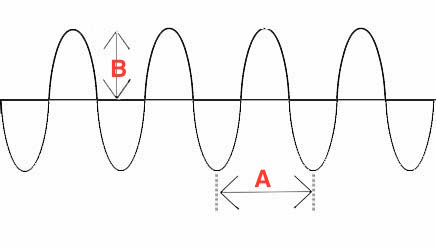
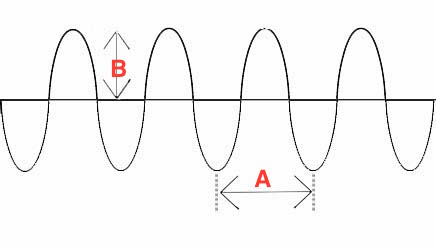
What property of this wave is represented by the letter "A"
a)
amplitude
b)
crest
c)
trough
d)
wavelength
83.
What property of the wave is represented by the letter "B"?
a)
amplitude
b)
crest
c)
trough
d)
wavelength
84.
What do waves carry from place to place?
a)
Energy, but not matter or particles
b)
Energy and matter or particles
c)
Matter or particles but not energy
d)
Neither energy nor matter or particles
85.
What is the theory that states the universe began with a huge explosion?
a)
Apparent Magnitude
b)
Light year
c)
Big Bang Theory
d)
Galaxy
86.
What is the brightness of a star as it appears to an observer on Earth?
a)
Big Bang Theory
b)
Apparent Magnitude
c)
Light year
d)
Spiral Galaxy
87.
What is the distance that light can travel in one year? 
a)
Light year
b)
Irregular Galaxy
c)
Supernova
d)
Quasar 
88.
What is a small, hot, dim star that is the leftover center of an old star?
a)
Spiral Galaxy
b)
Supernova
c)
White Dwarf
d)
Black Hole
89.
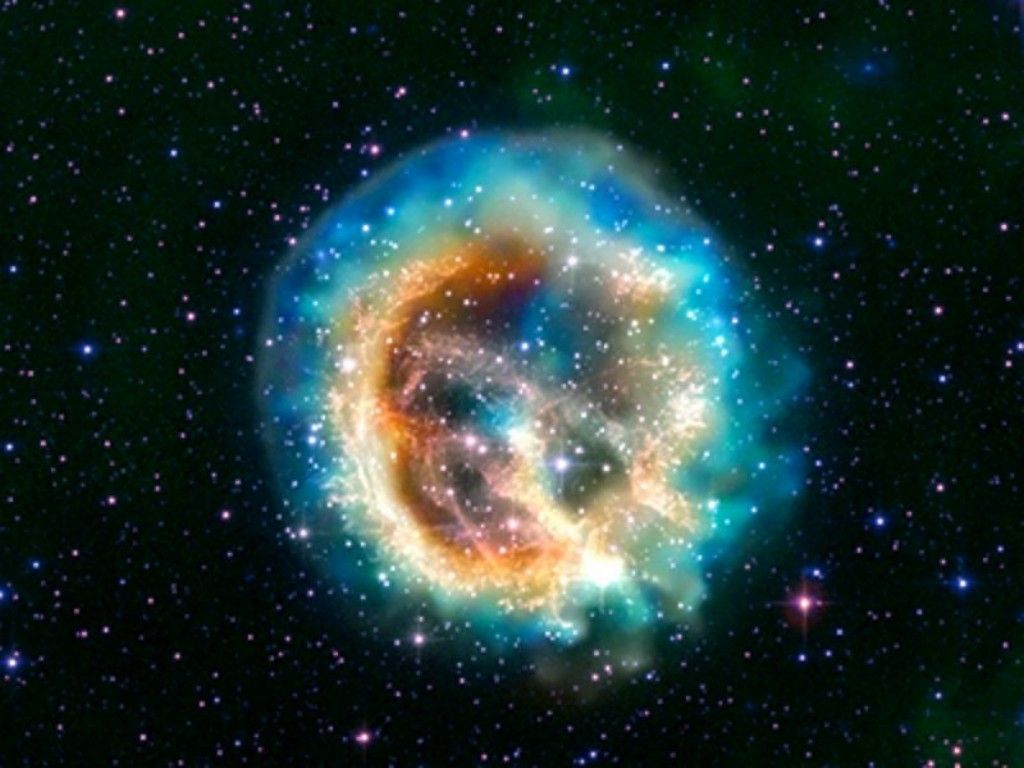
What is gigantic explosion that causes the death of a massive star?
a)
Supernova
b)
Nebula
c)
Red Giant
d)
White Dwarf
90.
What is an object that is so massive and dense that even light can not escape its gravity?
a)
Main-sequence
b)
black hole
c)
Apparent Magnitude
d)
Comet
91.
What is a large grouping of stars, dust, and gas bound together by gravity?
a)
Nebula
b)
Galaxy
c)
Cosmology
d)
Gravity
92.
What is a large cloud of dust and gas where new stars are formed or stars explode?
a)
quasar
b)
black hold
c)
supernova
d)
nebula
93.
The Milky Way Galaxy is most likely 
a)
an irregular galaxy
b)
a spiral galaxy
c)
an elliptical galaxy
d)
a nebula
94.
Which shows the correct sequence of a star's life cycle?
a)
main sequence, red giant, white dwarf
b)
main sequence, white dwarf, red giant
95.
The sun appears brighter than other stars because
a)
it is the largest star in the universe
b)
it is the hottest star in the universe
c)
able to radiate more energy than other stars
d)
is closer to Earth than other stars
96.
Which of the following is not a type of galaxy?
a)
Irregular
b)
Triangular
c)
Spiral
d)
Elliptical 
97.
The color of a star depends on its
a)
size
b)
temperature
c)
shape
d)
magnitude
98.
What color are the hottest stars?
a)
red
b)
yellow
c)
orange
d)
blue
99.
Which of the following is a piece of evidence supporting the Big Bang Theory?
a)
Cosmic X-ray Background Radiation
b)
Large amounts of gold and lead in the universe
c)
Black holes
d)
Large amounts of hydrogen and helium in the universe
100.

You look into the night sky and see two bright objects. One is twinkling and the other is not. Which of the following is true?

a)

They are both stars.

b)

They are both planets.

c)

The twinkling object is a star, the other is a planet.

d)

The twinkling object is a planet, the other is a star.