Font size
 Worksheets
meiosis
Total questions: 92
Worksheet time: 51mins
chromosomes with the same genes, one originally from each of the organism’s parents
Diploid
Haploid
Homologous
Heterologous
containing both sets of homologous chromosomes; 2N
Diploid
Haploid
Homologous
Heterologous
containing only a single set of chromosomes; 1N
Diploid
Haploid
Homologous
Heterologous
The end product of meiosis is ____________ daughter cells
2
3
4
5
daughter cells in Meiosis
have _________ the normal chromosome number.
half
equal
more than
double
Alleles of different genes tend to be inherited together when those genes are located on _________
The same gene
different genes
the same chromosome
different chromosomes

this picture shows__________
Gene link
Gene ratio
Gene control
Gene Map

this picture shows
Cytokinesis
Gene Linkage
Mitosis
Meiosis II

Mitosis
Meiosis I
Meiosis II
Interphase
The end product of meiosis is four daughter cells with
1N
2N
3N
4N
The end product of mitosis is two daughter cells with
1N
2N
3N
4N
The end product of mitosis is ____________ daughter cells
2
3
4
5
Crossing over occurs in
Metaphase I
Anaphase I
Prophase II
Prophase I

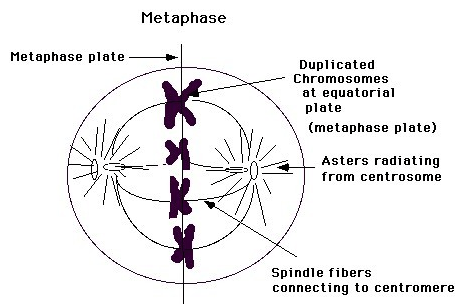
This picture shows _____________
Prophase I
Metaphase I
Anaphase I
Telophase I

This picture shows_____________
Prophase I
Metaphase I
Anaphase I
Telophase I

This picture shows____________
Prophase I
Metaphase I
Anaphase I
Telophase I
Meiosis produces_____________
Body cells
Gametes
Which of the following is true of both meiosis and mitosis?
Both are preceded by chromosome/DNA replication
The chromosome number from the original cell changes
Homologous chromosomes may stay together.
Both result in the formation of human cells
Meiosis produces_________
four genetically identical diploid cells.
four genetically identical haploid cells.
four genetically different diploid cells.
four genetically different haploid cells.
What assorts independently during meiosis?
chromosomes
genes
alleles
phenotypes

What phase is shown here? Hint: you are starting to see the nuclear membrane again!
Metaphase II
Telophase I
Telophase II
Metaphase I

What phase is this?
Hint: membrane is disappearing
Interphase II
Prophase I
Metaphase I
Anaphase II


CROSSING OVER INCREASES
LIFE SPAN
GENETIC VARIATION
THE NUMBER OF OFF-SPRING
ALL ARE TRUE


What phase of Meiosis is this?
Telophase I
Anaphase I
Anaphase II
Telophase II
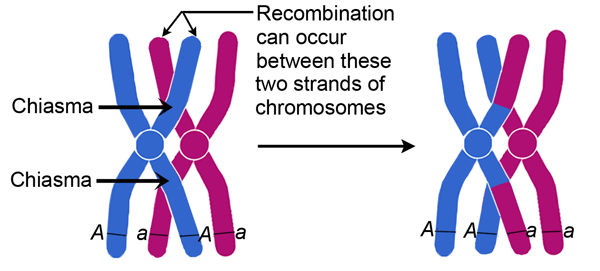
Cells undergo a round of DNA replication, forming duplicate chromosomes
Interphase
Prophase II
Anaphase II
Prophase I
Each chromosomes pairs with its corresponding homologus chromosome to form a tetrad
Metaphase I
Telophase I & Cytokinesis
Prophase I
Anaphase II
Spindle fibers attach to the chromosomes that are arranged across the middle of the cell
Interphase
Anaphase II
Metaphase I
Telophase II & Cytokinesis
The fibers pull the homologous chromosomes toward opposite ends of the cell
Metaphase I
Prophase I
Anaphase I
Interphase
Nuclear membranes form; the cell separates into two cells
Interphase
Telophase I & Cytokinesis
Prophase II
Metaphase I
Meiosis I results in two haploid daughter cells; Meiosis II starts when the cells once again lose their nuclear membranes, chromosomes condense
Metaphase II
Prophase II
Anaphase II
Interphase
The chromosomes line up across the middle, in a similar way to the metaphase I
Metaphase II
Anaphase II
Prophase II
Telophase II & Cytokinesis
The sister chromatids separate and move toward opposite end of the cell
Metaphase I
Prophase II
Anaphase II
Prophase I
Meiosis II results in four haploid daughter cells
Prophase II
Anaphase II
Telophase II & Cytokinesis
Metaphase II


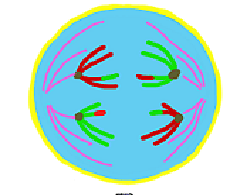
what phase am I?
Prophase 1
Metaphase 1
Anaphase 1
Telophase 1
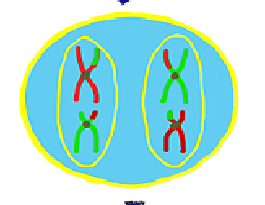
what phase am I?
Prophase 1
Metaphase 1
Anaphase 1
Telophase 1
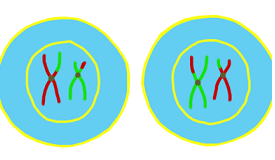
what phase am I?
Prophase II
Metaphase II
Anaphase II
Telophase II

What is the name of the Belgium scientist who first discovered meiosis in 1883?
Edouard van Beneden
Gregor Mendel
Aristotle
Rosalind Franklin

In humans, the haploid number of chromosomes is ____.
23
46
69
92
Which of the following is the best definition for MEIOSIS?
the process of two haploid cells uniting
the counting of chromosomes within a diploid cell
a two-step process that reduces the number of chromosomes in half such that there is only one copy of all the chromosomes
the equational division of a cell into two identical copies
True or False? Before cells undergo meiosis they pass through interphase first.
true
false
What is unique to Prophase I- is that the duplicated chromosomes pair up to form _______.
a centrosome
a tetrad
the mitotic spindle
sister chromatids

In which stage of MEIOSIS does crossing over occur? (The exchange of genetic material between chromosomes in a tetrad.)
Anaphase I
Metaphase I
Prophase I
Telophase I
In Metaphase I, tetrads line up along the _______.
mitotic spindle
centrosomes
equatorial plane
contractile ring
In Anaphase I, the _________ are separated by the pulling of the spindle fibers to opposite poles of the cell.
homologous pairs of chromosomes
sister chromatids
centromeres
centrosomes
Check all of the following that DO occur during Telophase I and cytokinesis.
The separated homologous chromosomes are at opposite poles of the cell.
The cell divides in two.
The chromosomes do not uncoil, since they are getting ready for Meiosis II.
Sister chromatids are pulled away from each other.
At the start of Meiosis II, which of the following is NOT true?
There are two cells.
The cells are haploid.
The chromosomes are paired up as homologues.
DNA is present as two sister chromatids joined at the centromere.
In Prophase II, the_________ reforms and the spindle fibers attach to each chromosome.
mitotic spindle
centrosomes
nucleus
cell plate
In Metaphase II, _________ line up on equatorial plane.
homologous pairs of chromosomes
single chromosomes (made up of 2 sister chromatids)
tetrads
centrosomes
In Anaphase II, the _________ separate.
Homologues
Sister Chromatids
Tetrads
Centrioles
How many cells are formed at the end of Meiosis II?
2
3
4
8
True or False. In Meiosis II, there are TWO cells that go through each phase at the same time.
true
false
Which of the following does NOT happen during Telophase II?
the nuclei reform
each cell begins to split evenly in two
the chromosomes duplicate
the nuclei contain a haploid number of chromosomes
Which of the following are CORRECT observations about the differences between MITOSIS and MEIOSIS? (Check all that apply.)
Mitosis produces cells that identical to the parent cell.
Meiosis produces cells that have half the number of chromosomes as the parent cell.
All cells go through INTERPHASE as part of the cell cycle, whether it goes to mitosis or meiosis next.
In both types of cell division, the chromosomes are only duplicated once.
Only in Mitosis, do you see chromosomes pair up to form a tetrad.
Which part of MEIOSIS is identical to MITOSIS?
Meiosis I
Meiosis II
The products of MEIOSIS have _______ number of chromosomes.
haploid
diploid