
 Worksheets
IB-Mitotic Cycle
Total questions: 115
Worksheet time: 10hrs 35mins
Which of the following occurs latest in the cell cycle?
Chromosomes move to the center of the cell.
Chromosomes move to opposite ends of the cell.
Microtubules begin to form.
The nucleus breaks down.
The mitotic spindle fibers attach to chromosomes via special structures termed _____.
centrioles
asters
kinetochores
centrosomes
Which series progresses from the thinnest to the thickest in diameter?
DNA > histone > chromosome > nucleosome
histone > chromosome > DNA > nucleosome
nucleosome > histone > DNA > chromosome
DNA > histone > nucleosome > chromosome
The following are the activities of cells that need to carry out before mitosis, except _____.
replicate its DNA
duplicate its centrosome
undergo cytokinesis
make sister chromatids
During which stages of mitosis does a typical cell contain twice its normal number of chromosomes?
1. Prophase
2. Metaphase
3. Anaphase
4. Telophase
1 and 2
2 and 3
3 and 4
1, 2, 3 and 4
A scientist stains the chromosomes of a diploid plant cell with a fluorescent dye to observe the telomeres.
This cell has 38 chromosomes.
How many telomeres will the scientist observe in one of the nuclei during telophase of mitosis?
38
76
114
152

This cell is in which stage of mitosis?
Early prophase
Late prophase (prometaphase)
Metaphase
Anaphase
During mitosis in animal cells, which process occurs after prophase?
Centrioles move towards the poles of the cell.
Centromeres attach to spindle microtubules.
Chromatids join to form chromosomes.
Chromosomes condense and become visible.
Which events listed are part of mitosis?
1 interphase
2 prophase
3 cytokinesis
1, 2 and 3
1 and 2 only
1 only
2 only
Which of the following events do NOT occur in prophase of mitosis?
DNA condenses to form chromosomes
nuclear membrane breaks down
mitotic spindle begins to form
chromosomes are replicated
Which of the following occurs latest in the cell cycle?
Chromosomes move to the center of the cell.
Chromosomes move to opposite ends of the cell.
Microtubules begin to form.
The nucleus breaks down.
The following are the activities of cells that need to carry out before mitosis, except _____.
replicate its DNA
duplicate its centrosome
undergo cytokinesis
make sister chromatids
During which stages of mitosis does a typical cell contain twice its normal number of chromosomes?
1. Prophase
2. Metaphase
3. Anaphase
4. Telophase
1 and 2
2 and 3
3 and 4
1, 2, 3 and 4
This cell is in which stage of mitosis?
Early prophase
Late prophase (prometaphase)
Metaphase
Anaphase
Which events listed are part of mitosis?
1 interphase
2 prophase
3 cytokinesis
1, 2 and 3
1 and 2 only
1 only
2 only
During mitosis in animal cells, which process occurs after prophase?
Centrioles move towards the poles of the cell.
Centromeres attach to spindle microtubules.
Chromatids join to form chromosomes.
Chromosomes condense and become visible.

In the eukaryotic cell, it is the longest stage of the cell cycle and generally its function is to prepare the cell to division process.
Interphase
Mitotic phase
Synthesis Phase
All of the above
Programmed cell death is known as ____________.
Apoptosis
Oncogene
Proto-oncogene
Tumor suppressor gene
The monomers units of DNA and RNA are
amino acids
monosaccharides
nucleotides
fatty acids
Which of the following enzymes catalyzes the linkage together of RNA nucleotides to form RNA?
polymerase
ligase
ribozyme
reverse transcriptase
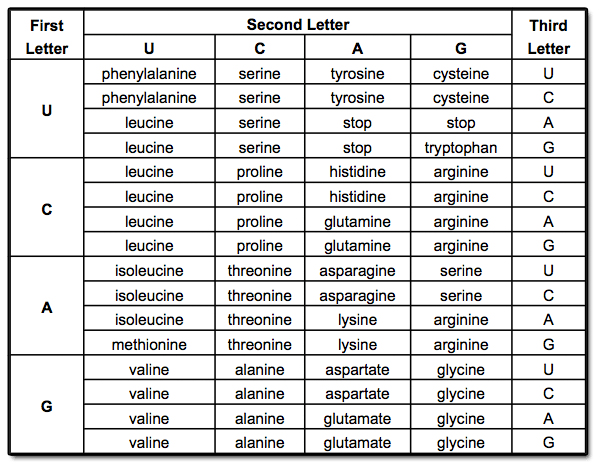
The RNA codon AUG means
add amino acid methionine
start the protein here
add the amino acid tyrosine
end the polypeptide chain here
The transfer of genetic info from DNA to RNA is called
translation
transcription
initiation
elongation
Which of the following sequences best describes the flow of information that takes place when a gene directs the synthesis of a cellular component?
RNA-DNA-RNA-PROTEIN
DNA-RNA-PROTEIN
PROTEIN-RNA-DNA
DNA-AMINO ACID-RNA-PROTEIN
When RNA is being made, the RNA base ____ always pairs with the base ___ in DNA.
U-T
T-G
U-A
A-U
GTAGTCA
TGGCAAGTACGT
ATG GGA ACT CCA

A nucleotide in DNA is composed of
A deoxyribose sugar, a phosphate, and a nitrogen
Only a deoxyribose sugar and nitrogen base
Only a deoxyribose sugar and a phosphate
None of the above
Between the two strands of a DNA segment the nitrogen bases are held together by
Covalent bond
Hydrogen bond
Ionic bond
Metallic bond

How many hydrogen bonds are involved in holding these strands of DNA together?
11
9
8
4
which nucleotides are considered purines?
adenine & thymine
cytosine & guanine
adenine & guanine
cytosine & thymine
one strand of DNA reads 5'-AAAGTTCCG-3'
the complementary strand would read:
3'-TTTCAAGGC-5'
3'-CGGAACTTT-5'
5'-TTTCAAGGC-3'
DNA replicates during
G1 phase
G2 phase
S phase
Prophase
Replication of centriole occurs in
Interphase
Prophase
Metaphase
Anaphase
Chromosomes are separated during?
Prophase
Anaphase
Metaphase
Telophase
Which statement describes event during intephase of mitosis?
Chromosomes start to coil, becoming shorter and fatter
Chromosomes line up on the equator of the spindle
Chromatids are pulled apart by spindle fiber
Chromosomes are replicated ready for the next division

The diagram shows the chromosomes in a nucleus
What are the Z?
chromatid
centriol
centromere
centrosome
Which process occur by mitosis?
- Cloning of plasma cell
- Gamete reproduction
- Reducing damaged cell
1,2,3
1 and 3 only
2 only
3 only
Chromosomes are arranged along equator during
Prophase
Metaphase
Anaphase
Telophase

The diagrams show chromosomes at the different stage of mitosis.
Which shows the correct of the cell cycle?
W-X-Y-Z
X-Y-Z-W
Y-Z-W-X
Z-W-X-Y
If a cell has 24 chromosomes, how many chromosomes will each of its daughter cells have after mitosis?
12
6
20
24
what is the final phase of mitosis?
G2 phase
cytokinesis
telophase
prophase


Which letter represents Prophase?
A
B
C
D

Which letter represents Metaphase?
A
B
C
D

Which letter represents Anaphase?
A
B
C
D

Which letter represents Telophase?
A
B
C
D

What feature is the arrow pointing to?
Cleavage Furrow
Mitosis Indentation
Pinch Point
Cell Split Point
When does the cytosol and organelles split and divide into two identical copies?
Cytokinesis
Telophase
Interphase
G-Phase
In general terms, virus replication involves how many broad stages which are present in all viruses?
2
3
5
6
How many chromosomes will a normal human have after a complete cell cycle?
23
46
47
92
What is the longest stage of the cell cycle?
Interphase
Mitosis
Cytokinesis
Prophase
What is feature unique to plant cells will appear during telophase and cytokinesis?
Cleavage Furrow
Cell Plate
Peptidoglycan
Nuclear Membrane
What is one of the main proteins that will signal a cell to divide?
Mitogen
Mitotic Signalation
Norepinephrine
Dopamine
What is Interphase?
structure that holds the sister chromatids together.
the phase of the cell cycle in which the nucleus and its contents divide.
the phase in which the cytoplasm and its contents divide.
the period during the cell cycle of a cell’s growth and development.
What is a Centromere?
structure that holds the sister chromatids together.
the phase of the cell cycle in which the nucleus and its contents divide.
the phase in which the cytoplasm and its contents divide.
the period during the cell cycle of a cell’s growth and development.
What is Mitosis?
structure that holds the sister chromatids together.
the phase of the cell cycle in which the nucleus and its contents divide.
the phase in which the cytoplasm and its contents divide.
the period during the cell cycle of a cell’s growth and development.
What is Cytokinesis?
structure that holds the sister chromatids together.
the phase of the cell cycle in which the nucleus and its contents divide.
the phase in which the cytoplasm and its contents divide.
the period during the cell cycle of a cell’s growth and development.
What might happen if cytokinesis did not occur after mitosis?
The cell becomes stronger because it has two sets of organelles.
The cell becomes heavier because it has two sets of organelles.
The cells would remain fused together and the new double cell would have duplicates of all parts.
The cell becomes bigger because it has two sets of organelles.
During the cell cycle, the cell’s nucleus and its contents divide to create two ____________.
organelles
organisms
identical daughter cells
organs
Why is the cell cycle so important?
because it helps for growth and develop
because it replaces cells that are old or damaged
because it produces new cells
All of the above
Where does the cell spend most of its life?
prophase
anaphase
interphase
telophase
Interphase is followed by a shorter phase of the cell cycle called ____________.
mitotic phase
metaphase
telophase
Anaphase
What are the two stages of the Mitotic Phase?
telophase and metaphase.
mitosis and cytokinesis.
anaphase and telophase
telophase and anaphase.
Why is the Cell Cycle often represented as a circle?
Because it is easy to draw
Because cell cycles has a distinct beginning and end point
to highlight the checkpoints
to show that it repeats over and over
In which part of Interphase are the chromosomes replicated?
G0
G1
S
G2
Spinal cord injuries are difficult to treat because damaged nerce cells do not regenerate. Which of the following most accurately explains why damaged nerve cells no longer regenerate?
Mature nerve cells are in a resting state; the no longer divide during mitosis
Nerve damage disrupts the cell cycle at the G1 phase
Nerve damage disrupts the cell cycle at the S phase
Nerve damage prevents centrioles from being synthesized
During which stage of the cell cycle does the nucleus divide?
interphase
mitosis
endocytosis
cytokinesis
Which statement below desribes the events during G2 of Interphase?
The cell grows, develops, and makes new proteins
The DNA replicates to form a new set of identical chromosomes
The cell grows, makes new organelles, and prepares for mitosis
the nucleolus disappears and the nuclear envelope disintegrates
Which stage of the cell cycle is MOST critical for ensuring that daughter cells are identical?
G1
S
Prophase
G2
Which is not a phase of the cell cycle?
Interphase
Mitosis
Cytokinesis
Duplication
Select all stages of interphase?
G1
S
G2
Mitosis
In which stage of the cell cycle does the cell split into two?
Mitosis
G1
Cytokinesis
S
_____ is the uncontrolled growth of cells, often resulting in a tumor or mass of abnormal cells
Cancer
Apoptosis
Radiation
Apoptosis is
programmed cell death
mysterious cell death
programmed cellular mutation
mysterious cellular mutation
If you look at a cell under a microscope, which phase is it MOST likely to be in?
Cytokinesis
M phase
Interphase
G1 Phase
What does DNA replication mean?
DNA is made.
DNA makes new cells.
DNA copies itself.
DNA starts the cell cycle.
the division of the cytoplasm is called
mitosis
interphase
cytokinesis
somatic
What is the division of the nucleus called?
chromosome
mitotic phase
cytokinesis
the cell cycle
________________is a critical point where stop and go signals can regulate the cycle
Metastasis
Checkpoint
Malignant
Benign
Cells that rarely divide will spend most of their time in what particular phase of the cell cycle?
Go
G1
G2
S
This check point of the cycle dictates whether the cell will continuously divide or stop, and it also checks the cell size, presence of growth factors and damage of the DNA.
G1 checkpoint
G2 checkpoint
S checkpoint
M checkpoint
In this phase, the cell is preparing for the cell division in the mitotic stage.
Go
G1
G2
S
In the eukaryotic cell, it is the longest stage of the cell cycle and generally its function is to prepare the cell to division process.
Interphase
Mitotic phase
Synthesis Phase
All of the above
DNA replication occurs in what phase of cell cycle?
Interphase
Growth phase
Mitotic phase
Synthesis Phase
Which checkpoint ensures sister chromatids are positioned to be split correctly?
G1 checkpoint
G2 checkpoint
S checkpoint
M checkpoint
In this phase, the cell is preparing for the cell division of the mitotic phase.
Go
G1
G2
S
If the M checkpoint is not cleared, what specific stage of mitosis will be blocked?
Anaphase
Metaphase
Prophase
Telophase
Programmed cell death is known as ____________.
Apoptosis
Oncogene
Proto-oncogene
Tumor suppressor gene

Identify the stage in mitosis
Anaphase
Telophase
Metaphase
Interphase

State the process taking place in the image
(a)

Which stage of mitosis is taking place in the image?
Anaphase
Telophase
Metaphase
Prophase
What process does DNA undergo when chromosomes condense in prophase?
(a)
What are the molecules with a regulatory function in the cell cycle whose discovery is an example of serendipity?
(a)
When in the cell cycle does DNA replication occur?
G1
S phase
G2
Prophase
Which phase of mitosis follows anaphase?
Telophase
Prophase
Metaphase
Cytokinesis

Identify the structure in the image
Sister pair of chromatids
Bivalent
Integral protein
Large circular chromosome
What term describes the ratio between the number of cells in mitosis and the total number of cells?
(a)

