
 Worksheets
Review: Biogeochemical Cycles
Total questions: 97
Worksheet time: 49mins

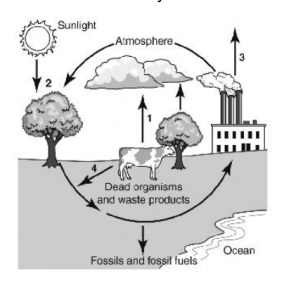
Which cycle is shown in this diagram?
Nitrogen
Carbon
Phosphorus
Water
Oxygen


the flow of water from land caused by precipitation
run-off
upwelling
assimilation
leaching
When water vapor is cooled and forms droplets of liquid water
Condensation
Evaporation
Transpiration
Runoff
________________ is movement of water past the soil going deep into the groundwater.
Evaporation
Transpiration
Percolation
Sublimation
____________________ is the process by which water on the ground surface enters the soil.
Infiltration
Percolation
Deposition
Condensation
__________________ is the process by which moisture is carried through plants from roots to small pores on the underside of leaves, where it changes to vapor and is released to the atmosphere. It is essentially evaporation of water from plant leaves.
Transpiration
Percolation
Infiltration
Plant Uptake
Water that flows across the land and enters rivers and streams. It eventually flows into lakes and the ocean.
Transpiration
Surface Runoff
Deposition
Precipitation
How does water enter a plant?
through the stomata
through the roots
by active transport in root hair cells
by osmosis in root hair cells
What allows water to stick to particles of dust in the air, thereby condensing to form clouds?
Cohesion
Adhesion
Dipole moment
Phloem
What is it called when water sticks to water?
Cohesion
Adhesion
Capillary Action
Xylem
This vascular tissue (tubes) is responsible for the transportation of water and minerals up from the roots to the stem then leaves
Stomata
Shoot
Phloem
Xylem
Select one way to reduce water use.
wash dishes under a running tap
install a rain barrel to downspouts
take baths instead of showers

Which cycle is shown in this diagram?
Nitrogen
Carbon
Phosphorus
Water
Oxygen

What is the formula for atmospheric nitrogen?
N
N2
NH3
NO3
What organisms need nitrogen to survive?
only plants
only animals
only bacteria
all living organisms
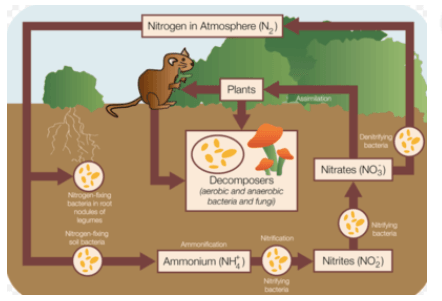
A correct path that nitrogen could take would be
air -> animals -> plants -> bacteria
animals -> air -> bacteria -> plants
bacteria -> air -> plants -> animals
air -> bacteria -> plants -> animals

In the nitrogen cycle, what does label 1 in the diagram represent?
Gas
Clouds
Carbon dioxide in the atmosphere
Nitrogen in the atmosphere
The nitrogen cycle is unique in that atmospheric nitrogen cannot be converted directly by organisms into usable nitrogen. What is necessary in order for atmospheric nitrogen to be converted to a usable form of nitrogen by organisms?
Ammonification
Denitrifying bacteria
Nitrifying bacteria
Decomposition
Nitrogen fixation

In the diagram, where is nitrogen "fixed" into a usable form for plants?
Through action of nitrogen fixing bacteria only (#3)
Through lightning only (#8)
Through action of nitrogen fixing bacteria and lightning (#3 and 8)
Through photosynthesis (#12)
Nitrogen fixation is a necessary part of the nitrogen cycle because
Atmospheric nitrogen cannot be used directly by organisms
There is not enough nitrogen in the atmosphere
Nitrogen needs to be combined with phosphorus
Bacteria needs to be created to help with plant growth
Nitrogen in the soil needs to be fixed to go back to the atmosphere

Nitrogen-fixing bacteria at step 10 are responsible for converting...
ammonia, ammonium ions, and nitrate ions to DNA, amino acids, and proteins
ammonia and nitrite ions to nitrate ions
nitrogen gas in the atmosphere to ammonia and ammonium
nitrates back into nitrogen gas
In which stage of the nitrogen cycle do soil bacteria convert ammonium ions (NH4+) into nitrites (NO2-) and then nitrate ions (NO3-); a form of nitrogen that can be used by plants?
Nitrogen fixation
Nitrification
Assimilation
Ammonification
Denitrification
Which of the following bacteria are able to convert soil nitrites to nitrates?
Nitrosomonas
Nitrifying Bacteria
Rhizobium
Penicillium
Clostridium

Which stage of the nitrogen cycle diagram shows a soil bacteria that can convert ammonium ions into nitrites?
10
5
14
3
9
Which form of nitrogen is most usable by plants?
Nitrate
Nitrite
Nitrogen gas
Ammonia
Atomic nitrogen

What step in the nitrogen cycle requires plants to take up nitrates to help make plant proteins?
Nitrogen Fixation (#10)
Ammonification (#9)
Denitrification (#14)
Assimilation (#15)
What step in the nitrogen cycle involves bacteria changing usable nitrates back into nitrogen gas?
Nitrogen Fixation (#10)
Ammonification (#9)
Denitrification (#14)
Assimilation (#15)
What step in the nitrogen cycle involves bacteria and fungi working to convert organic material back into ammonium?
Nitrogen Fixation (#10)
Ammonification (#9)
Denitrification (#14)
Assimilation (#15)
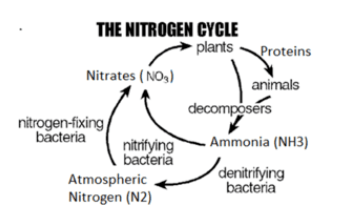
According to this diagram, plants use nitrogen to make ________.
bacteria
animals
proteins
decomposers
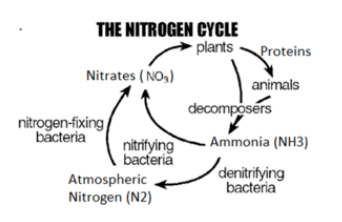
According to this diagram, animals get proteins from eating ________.
decomposers
bacteria
plants
sunlight

Looking at the diagram, nitrates are poisonous to fish. What should you add more of to get rid of nitrates without having to change the water in your fish tank?
More fish
Nitrobacter bacteria
Nitrosomonas bacteria
Plants

What would happen to this nitrogen cycle if a virus killed all the bacteria?
Nitrogen would just keep on cycling
There would be a build up of ammonia
Plants would take over for the bacteria
Fish would grow more because there's no bacteria

What type of plant is found at step 16 in the diagram, and why is it special?
Photoautotroph - it can do photosynthesis without light
Legume - it has a symbiotic relationship with nitrogen fixing bacteria
Chemoautotroph - it can make food without carbon or light
Leginal - it has special bacteria to make food
The following are examples of legumes:
corn and wheat
clover and corn
soybeans and alfalfa
peanuts and rice
What type of bacteria can convert nitrates back into nitrogen gas by using it as an oxygen source?
Nitrogen Fixing Bacteria
Nitrifying Bacteria
Denitrifying Bacteria
Decomposing Bacteria
The nitrogen cycle is one of the most important and complex of the biogeochemical cycles. It is important because nitrogen:
is a greenhouse gas
is an essential part of biological molecules such as proteins and nucleic acids (DNA)
is the most toxic element to living organisms
dilutes the oxygen in the atmosphere causing respiratory problems
is a crucial part of the process of photosynthesis
The most abundant gaseous components of the Earth's atmosphere are:
carbon dioxide and oxygen.
nitrogen and hydrogen.
nitrogen and carbon dioxide.
nitrogen and oxygen.
oxygen and carbon dioxide.
The use of nitrogen-based fertilizers in the Midwestern United States is a major contributing factor to which of the following?
Spread of the West Nile virus
Hypoxia in the Gulf of Mexico
Water shortages in communities near the Great Lakes
Soil erosion in Texas
The increase in severe storms in the Southeastern United States
A field is abandoned, and an invasive plant that can live in
nutrient-poor soil moves into the field. If the land is later
cleared of this invasive species and it is discovered that the
soil has an abundance of nitrogen compounds, what
the conclusion can best be made?
The plants used up all of the phosphorus and potassium and left the nitrogen behind.
Bacteria in soil and in root nodules converted free nitrogen into nitrogen compounds.
The plants were able to produce nitrogen in their leaves.
More rock was weathered and broken down to release nitrogen compounds.
Which statement correctly describes the role of bacteria/fungi in the nitrogen cycle?
The bacteria/fungi convert radiant energy into chemical energy.
The bacteria/fungi directly provide a source of nutrition for animals.
The bacteria/fungi are decomposers, restoring inorganic material to the environment so elements are made available to other organisms.
The bacteria/fungi convert atmospheric nitrogen into minerals and are found in the nodules of cacti.
Which of the following processes are also a part of or known as ammonification (organic nitrogen to ammonia)? Check all that apply.
Mineralization
Nitrification
Assimilation
Decomposition

The Water cycle
The Carbon cycle
The Nitrogen cycle
The Phosphorus Cycle
All of the carbon in existence is continually recycled in the carbon cycle.
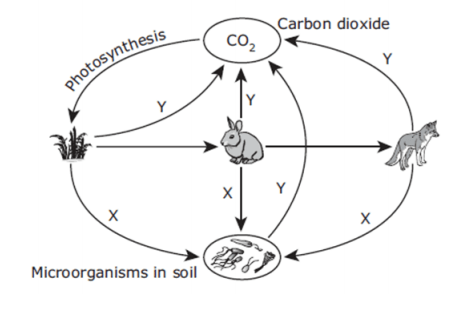
Y : Predation
Y : Decomposition
Y : Nitrogen Fixation
Y : Respiration
Photosynthesis makes C6H12O6 - also known as ______.
amino acid
glucose
nucleic acid
fatty acid
How do animals get carbon?
By eating plants and or other animals.
They absorb it from the atmosphere.
From the ground
They do not get carbon from anywhere.
When humans EXHALE, we release __________________.
Oxygen
Carbon Dioxide
Nitrogen
Water
What is CO2?
Carbon Monoxide
Carbon Trioxide
Carbon Dioxide
Oxygen
Which of the following are fossil fuels?
Coal, water, oil
Oxygen, coal, oil
Coal, Oil, Natural Gas
None of the above

What goes in Box 5 of the food web in the picture?
herbivores
scavengers
carnivores
decomposers
The major source of carbon dioxide in seawater is:
from photosynthesis by marine plants.
from rain falling into the ocean.
from the respiration of marine animals and other organisms.
from seafloor sediments.
runoff from land
Select all the reasons there is more dissolved oxygen at the surface than the deeper part of the ocean.
Less diffusion from the atmosphere
More producers= less photosynthesis
Algae and phytoplankton are present
there is more turbulence and mixing produces air bubbles
Which molecule is consumed during decomposition in an aquatic environment, potentially leading to a hypoxic (low-oxygen) situation?
Nitrogen
Phosphorus
Calcium
Carbon
Oxygen
a simple type of sugar that is an important energy source in living things and which is a part of many carbohydrates
Reservoir
Glucose
Carbon
Carbon dioxide
the process by which green plants turn carbon dioxide and water into food using energy obtained from light from the sun
Photosynthesis
Respiration
Decomposition
Diffusion
a process in living organisms involving the production of energy, typically with the intake of oxygen and the release of carbon dioxide
Decomposition
Respiration
Diffusion
Combustion
What is the greatest contributor to atmospheric carbon?
burning garbage
burning biomass
transportation
household usage

What are two (2) ways to reduce the carbon emissions from passenger cars?
Use less expensive gas
Carpooling
Public Transportation
Driving only passenger cars

Phosphorus enters the atmosphere as phosphates.
The phosphorus cycle utilizes the processes of erosion and weathering of rocks.
Phosphates are used in carbohydrate and glucose storage.
The phosphorus cycle utilizes bacteria to breakdown phosphates and make them available for plants.
What is the original, and primary reservoir of inorganic phosphate (PO43-) in terrestrial ecosystems?
live plants and animals
groundwater
the atmosphere
rocks
Nitrogen and carbon are cycled on a global scale. Why does phosphorus cycling tend to occur more locally?
it primarily involves the weathering of rocks, which are mostly stationary
it only involves land animals that cannot swim across oceans to transport the nutrient
it occurs in areas where cloud formation is low, so it rarely gets trapped in water vapors
all of the answers are correct
The phosphorus cycle occurs much more quickly than the carbon and nitrogen cycles.
true
false
Phosphorous is passed from plants to ____ who eat them.
plants
animals
scavengers
This is NOT a part of the phosphorus cycle.
Phosphate is incorporated into sedimentary rocks
Phosphate bound to soil
Atmospheric or gaseous phosphate
Phosphate is absorbed from the soil by plants
How do plants obtain phosphorus?
Absorbing it from gas in the air
Absorbing from the soil

Which of the following is a human activity that allows us to utilize large amounts of phosphorus?
Deforestation
Digging up fossil fuels
Digging up uplifted rock formations

Looking at the diagram, which of the following have an impact on the phosphorus cycle? Check all that apply.
Fertilizer runoff
Crop harvest
Livestock wastes
Atmospheric pollution
Which of the following is NOT true of phosphorus?
Can be used by vegetation and soil microbes for normal growth
Can be found in nucleic acids
Can be found in sugar or carbohydrates
Can be found in cell membranes
Match the following Monomer to the Macromolecule
Fatty acid & Glycerol
Lipid
monosaccharide
Carbohydrate
Amino acid
Protein
nucleotide
Nucleic Acid


