
 Worksheets
review for final
Total questions: 121
Worksheet time: 2hrs 1mins
Isomer
Same protons different neutrons
Same name different structure
Same molecular formula different structural formula
Same chemical property different physical property
For the following reaction, determine which species is acting as the Arrhenius acid:
HCl + KOH --> KCl + H2O
HCl
KOH
KCl
H2O
In the following reaction, which substance is classified as an acid according to Arrhenius?
CH3COOH + Al(OH)3 --> CH3COOAl + H2O
CH3COOH
Al(OH)3
CH3COOAl
H2O
Complete the following reaction:
HNO3 + Ca(OH)2 -->
Ca(NO3)2 + H2O
Ca +H2O
Ca(NO3)2 + H2
Ca(NO3)2 + H2O + CO2
30mL of NaOH is neutralized by 12.3mL of 0.2M HCl. What is the concentration of the NaOH.
82 mol/l
0.82 mol/l
0.49 mol/l
0.082 mol/l
The pH scale is an inverse function. This means the ___________ the concentration of hydrogen ions, the ___________ the pH is. (select all that apply)
higher, lower
lower, higher
higher, higher
lower, lower

Choose the substance that is more acidic using the scale
Milk
Soap
Coffee
Stomach acid
If element X forms the oxides XO and X2O3, the oxidation numbers of element X are
+1 and +2
+2 and +3
+1 and +3
+2 and +4
Which half-reaction shows both the conservation of mass and conservation of charge?
Cl2 + 2e- → 2Cl-
Cl2 → Cl- + 2e-
2 Br- + 2e- → Br2
Br- → Br2 + 2e-
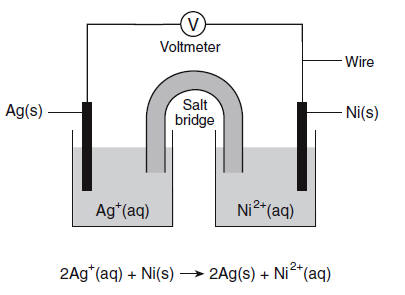



(a) Nuclear waste is toxic and must be stored far away from people, and food and water supplies
(a) Nuclear waste must be stored for thousands of years
finish the equation
18173Ta --> ____ + 18174W
42He
0-1e
y
Identify the type of nuclear decay shown here
21483Bi → 0-1e + 21484Po
alpha
beta
gamma
Finish this equation
20983Bi--> _______ + 20581Tl
42He
0-1e
y
What type of nuclear decay is shown here
13756Ba →→ 13756Ba + γ rays
alpha
beta
gamma
Solve this equation for.
614C = ___ + -10e
410Be
714N
210He
613C
94Be + 11H → _____ + 42He
Which of these processes describes a nuclear fusion reaction?
A nucleus absorbs energy to produce lighter nuclei.
A nucleus splits to produce energy and lighter nuclei
Two nuclei bind together to produce energy and heavier nuclei.
Two nuclei bind together to produce energy and a lighter nuclei.
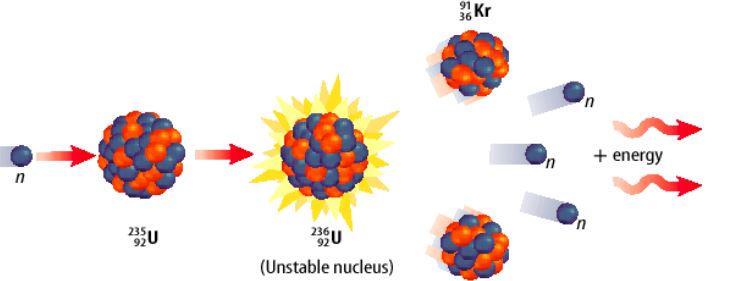
If there are 340 grams of a substance and it's half-life is 23 years how many grams would be left after 46 years?
170 grams
85 grams
340 grams
42.5 grams
If there are 340 grams of a substance and it's half-life is 23 years what percent of the substance would there bve left after 5 half-lives?
50%
25%
12.5%
6.25%
3.125%

What is kinetic energy?
stored energy
energy of motion
elastic energy
gravity

Which of the following is an example of thermal energy?
heat
light
sound
mass

The potential energy stored in chemical bonds in substances is called
chemical energy.
nuclear energy.
electrical energy.
thermal energy.
A 2400.-gram sample of an aqueous solution contains 0.012 gram of NH3. What is the concentration of NH3 in the solution, expressed as parts per million?
5.0 ppm
15 ppm
20. ppm
50. ppm
What is the concentration of a solution in parts per million if 0.02 grams of NaCl is dissolved in 1000 grams of solution?
2 ppm
20 ppm
200 pm
0.2 ppm
Helium gas, 3.0 x 10⁻⁴ g, is dissolved in 200 g of solution. Express this concentration in parts per million.
(a)
What is the percent by mass of HYDROGEN in sugar, C12H22O11?
What is the empirical formula for C4H6?
CH
CH3
C2H3
C4H6
Given the following: 42.07% Na, 18.89% P, and 39.04% O, determine the empirical formula.
NaPO2
Na2PO3
Na3PO4
NaPO4
__ Al + __ FeO → Al2O2 + __ Fe
1, 1, 2
2,1,2
2, 2, 2
2,4,2
PCl5 + ___ H2O → ___ HCl + H3PO4
4, 5
1, 6
3, 8
2,2
Thermo-energy, heat, always flow from (a) energy area to (b) enenrgy area.

Which statement correctly describes this reaction?
It is endothermic and energy is absorbed.
It is endothermic and energy is released.
It is exothermic and energy is absorbed.
It is exothermic and energy is released

Which letter in the diagram represents the heat of reaction?
A
B
C
D
For any chemical reaction at equilibrium, the rate of the forward reaction is
less than the rate of the reverse
greater than the rate of the reverse
equal to the rate of the reverse
unrelated to the rate of the reverse
For a chemical reaction, the difference between the potential energy of the products and the potential energy of the reactants is equal to the
heat of fusion
heat of reaction
activation energy of the forward reaction
activation energy of the reverse reaction
As the number of effective collisions between reacting particles increases, the rate of reaction
decreases
increases
remains the same
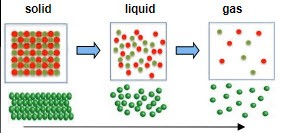
Systems in nature tend to undergo changes toward
lower energy and less disorder
lower energy and more disorder
higher energy and less disorder
higher energy and more disorder
The entropy will usually increase when
a molecule is broken into two or more smaller molecules
a reaction occurs that results in an increase in the number of moles of gas
a solid changes to a liquid
all of these
Potential and Kinetic Energy have a _______________ relationship. When one goes up the other goes down
inverse
direct
How do you calculate Enthalpy of a reaction?
ΔH = ΔHproducts - ΔHreactants
ΔT = q / mC
ΔG = ΔH -TΔS
E = mc2
Calculate the change in enthalpy ΔH for the following reaction:
2CO + O2 ⟶ 2CO2
Use your heats of formation table from your worksheet
-393.5 kJ/mol
-566.0 kJ/mol
566.0 kJ/mol
-369 kJ/mol
What is the difference between calculating ΔH with bond energies versus with heats of formation?
Bond energies are averages based on multiple scenarios of breaking bonds, heats of formation is the energy required to form a specific molecule from its elemental forms.
Heats of formation are averages based on multiple scenarios of breaking bonds, bond energies is the energy required to form a specific molecule from its elemental forms.
Bond energies are calculated using only lewis dot structures, but heats of formation requires a reference table
Heats of formation helps calculate enthalpy, while bond energies helps calculate entropy
A sample of liquid has a mass of 300 g and occupies 50 mL in a graduated cylinder. What is the density?
15,000 g/mL
.16667 g/mL
6 g/mL
Yup, still no clue

An object is is placed into 45 mL of water. The water rises to 48 mL. What is the volume of the object?
3 mL
93mL
8 mL
83 mL
Which of the following will have similar properties?
O, S, Se
O, F, Ne
N, Ne, Na
H, K, P

The blue elements (left side) are called
The yellow elements (right side) are called
When an atom loses a valence electron, it becomes a(n) _____________.
cation
anion
dogion
clingon
What is the charge of a sodium ion?
+2
+1
-1
-2

An atom with 2 protons, 3 neutrons, and 4 electrons has a charge of ____.
+2
-2
+3
0
CaC₂(s) + H₂O(l) --> C₂H₂(g) + Ca(OH)₂(aq)
I use mole ratio (coefficients) from balanced chemical equation?
True
False
Pressure is
defined as the mass that an object exerts when at rest.
not a measurable in gases.
defined as the number of moles of substance divided by the mass of the substance.
created by the force of the gas particles impacting the walls of the container.

Which container will have lower pressure?
First container
second container
As temperature rises ___________.
an atom's kinetic energy decreases
an atom's kinetic energy increases
an atom's kinetic energy stays the same

A student measures the pressure and volume of an empty water bottle to be 1.4 atm and 2.3 L. She then decreases the pressure to 0.65 atm. What is the new volume?
2.1 L
5.0 L
8.2 L
3.9 L
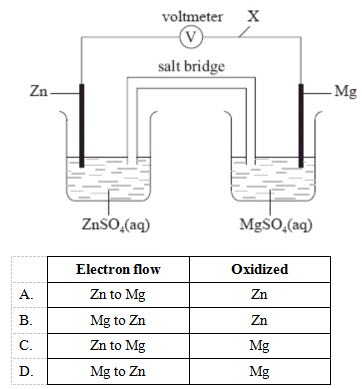

How is voltaic cell electricity produced?
A chemical reaction
It is pumped into the cell
It injects itself
An injected chemical reaction
In the reaction Zn + 2HCl --> ZnCl2 + H2
which element, if any, is oxidized?
Zinc
Hydrogen
Chlorine
None
Given the reaction:
Fe(s) + Cu2+(aq) → Fe2+(aq) + Cu(s)
Which half-reaction correctly shows the oxidation that occurs?
Fe(s) → Fe2+(aq) + 2e-
Fe(s) + 2e- → Fe2+(aq)
Cu2+(aq) → Cu(s) + 2e-
Cu(s) → Cu2+(aq) + 2e-
Given the balanced equation representing the reaction occuring in a voltaic cell:
Zn(s) + Pb2+(aq) → Zn2+(aq) + Pb(s)
In the completed external circuit, the electrons flow from
Pb(s) to Zn(s)
Pb2+(aq) to Zn2+(aq)
Zn(s) to Pb(s)
Zn2+(aq) to Pb2+(aq)
_______ separates mixtures based on differences in boiling point.
filtering
distillation
chromatography
_____ is the average amount of kinetic energy found in an object/system.
Temperature
Kinetic Energy
Heat
Thermal Energy
Adding a solute will ____________ the boiling point and ___________ the freezing point
Decrease, decrease
Decrease, increase
Increase, increase
Increase, decrease


What is the formula of this molecule?
CH
HC4
CH4
C4H4
Element with 5 valence electrons
Phosphorus
Oxygen
Hydrogen
Chlorine
In the quantum mechanical model, there is a higher chance of finding electrons when they are _____
far away from the nucleus
close to the nucleus


located in the nucleus
protons and electrons
protons and neutrons
neutrons and electrons

12 protons and 13 neutrons
Mg-12
Mg-13
Mg-25
Mg-24.305
The atomic mass of an element depends upon the ___.
relative abundance of protons in that element
mass and relative abundance of each isotope of that element
mass of each isotope of that element
mass of each electron in that element
What are the steps for finding the Average Atomic Mass?
1) write given mass, 2) write given %, 3) % to decimal, 4) Mass x abundance decimal 5) Add
1) % to decimal, 2) write given %, 3)write given mass, 4) Mass x abundance decimal 5) Add
1) write given mass, 2) write given %, 3) % to decimal, 4) Mass divided by abundance decimal 5) Add
1) write given mass, 2) write given %, 3) % to decimal, 4) Mass x abundance decimal 5) Subtract
The atomic mass of an element is the ___.
average of the mass number and the atomic number for the element
weighted average of the masses of the isotopes of the element
total mass of the isotopes of the element
total number of subatomic particles in the nucleus
What is the lowest possible energy level that an electron can occupy?
Lower energy level
Ground State
Excited State
Depressive State
To jump to an excited state the electron must____
emit energy
absorb energy
The electron started in the ____ state
ground state
excited state
When an electron ABSORBS energy:
The electron moves from a ____energy level to a____ energy level
higher / lower
lower / higher
Exothermic reactions release heat into the surroundings, so you observe a...
temperature increase
temperature decrease
no temperature change
Endo means within. Endothermic reactions
Release heat
Absorb heat
Absorb coldness

