wayground logo

Free Printable Worksheets

Font size

S
M
L
XL
Worksheets

Water Cycle

Total questions: 106

Worksheet time: 2hrs 10mins

Name
Class
Date
1.

What effect does the sun have on surface water?

a)

It causes it to boil

b)

It causes it to rain

c)

It causes it to sink

d)

It causes it to evaporate

2.

When water vapor is cooled and forms droplets of liquid water

a)

Condensation

b)

Evaporation

c)

Transpiration

d)

Runoff

3.
Precipitation occurs because 
a)
the droplets evaporate in the air
b)
the droplets are too light for the air to hold
c)
the droplets are too heavy for the air to hold
4.
When water turns into a gas
a)
condensation 
b)
evaporation
c)
precipitation
5.
What is water that flows in rivers and streams into the oceans and lakes?
a)
evaporating
b)
condensing
c)
precipitating
d)
runoff
6.

What is precipitation?

a)

Sweat from our bodies on hot days

b)

Warm rain but not cold snow or sleet

c)

Gas that we use in furnaces or ovens

d)

Any form of water that falls from the sky

7.

The process when plants release water vapor from their leaves is called _____________.

a)

precipitation

b)

evaporation

c)

transpiration

d)

condensation

8.

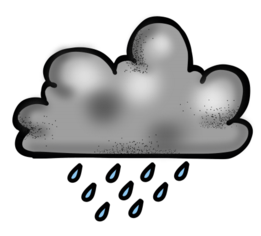
What step of the water cycle does this picture show?

a)

Condensation

b)

Runoff

c)

Precipitation

d)

Evaporation

9.
The water cycle has
a)
a beginning and an end. 
b)
no beginning an no end. 
c)
only a beginning. 
d)
only an end. 
10.
What source of energy evaporates the most water from Earth’s surface?
a)
volcanoes
b)
the sun
c)
lightning
d)
wind
11.

What are formed when water vapor condenses and come together?

a)

Clouds

b)

Mountains

c)

Transpiration

d)

Valleys

12.
Which of these is an example of precipitation?
a)
snow
b)
air
c)
clouds
d)
vapor
13.

Is precipitation any form of water that falls back to earth?

a)

Yes

b)

No

14.
The most common form of precipitation in the summer is...
a)
Rain
b)
Snow
c)
Sleet
d)
Hail
15.

When clouds fill with water and can't hold anymore, the water falls from the clouds as -

a)

precipitation

b)

clouds

16.
How much of Earth's freshwater is available for use?
a)
97%
b)
3%
c)
2%
d)
1%
17.
How much of Earth's freshwater is available for use?
a)
97%
b)
3%
c)
2%
d)
1%
18.
What is the energy source for the water cycle?
a)
the sun
b)
the earth
c)
water
d)
the moon
19.
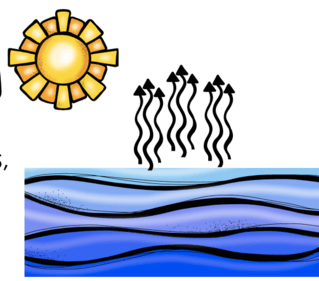
What part of the water cycle does this picture show?
a)
condensation
b)
precipitation
c)
evaporation
20.
What part of the water cycle does this picture show?
a)
condensation
b)
precipitation
c)
evaporation
21.
What is evaporation?
a)
The part of the water cycle when the sun heats up water, turning it from a liquid into water vapor or steam. It rises from the ground into the air.
b)
The part of the water cycle when the water vapor in the air gets cold. The water turns back into a liquid and forms clouds.
c)
The part of the water cycle when clouds get heavy and can no longer hold the liquid water. This causes the water to fall from the sky to the earth as rain, snow, sleet, or hail.
22.
What is condensation?
a)
The part of the water cycle when the sun heats up water, turning it from a liquid into water vapor or steam. It rises from the ground into the air.
b)
The part of the water cycle when the water vapor in the air gets cold. The water turns back into a liquid and forms clouds.
c)
The part of the water cycle when clouds get heavy and can no longer hold the liquid water. This causes the water to fall from the sky to the earth as rain, snow, sleet, or hail.
23.
What is precipitation?
a)
The part of the water cycle when the sun heats up water, turning it from a liquid into water vapor or steam. It rises from the ground into the air.
b)
The part of the water cycle when the water vapor in the air gets cold. The water turns back into a liquid and forms clouds.
c)
The part of the water cycle when clouds get heavy and can no longer hold the liquid water. This causes the water to fall from the sky to the earth as rain, snow, sleet, or hail.
24.
When water condenses, the water vapor in the air gets ___________ and changes back into liquid.
a)
cold
b)
hot
c)
warm
d)
solid
25.
Which is the opposite of condensation?
a)
runoff
b)
evaporation
c)
precipitation
d)
transpiration
26.
Which best explains why runoff is important?
a)
It returns water to other locations on Earth
b)
It increases the chance of flooding
c)
It makes evaporation occur faster
d)
It increases condensation
27.
What is it called when plants give off water vapor as a waste product?
a)
condensation
b)
evaporation
c)
sublimation
d)
transpiration
28.
When water _________, dew forms.
a)
Melts
b)
Evaporates
c)
Condenses
d)
Precipitates
29.
What is a layer of rock or sediment that holds water?
a)
glacier
b)
well
c)
aquifer
d)
natural spring
30.
How much of our planet is estimated to be covered with water?
a)
68%
b)
50%
c)
97%
d)
75%
31.
How much of our planet's water is saltwater?
a)
75%
b)
1%
c)
99%
d)
97%
32.
Which of these is an example of precipitation?
a)
snow
b)
air
c)
clouds
d)
vapor
33.
Which is the opposite of condensation?
a)
runoff
b)
evaporation
c)
precipitation
d)
transpiration
34.
What is it called when plants give off water vapor as a waste product?
a)
condensation
b)
evaporation
c)
sublimation
d)
transpiration
35.

Water in its gas form is called ____________________,

a)

water vapor

b)

precipitation

c)

ice

d)

air

36.
During which stage do clouds form?
a)
condensation
b)
evaporation
c)
precipitation
37.
Which stages does liquid water from the ocean turn into water vapor?
a)
condensation
b)
evaporation
c)
precipitation
d)
run off
38.
What is A?
a)
Evaporation
b)
Condensation
c)
Precipitation
d)
Runoff
39.
What is B?
a)
Evaporation
b)
Condensation
c)
Precipitation
d)
Runoff
40.
What is C?
a)
Evaporation
b)
Condensation
c)
Precipitation
d)
Runoff
41.

Gravity causes ___________________ to occur.

a)

condensation

b)

precipitation

c)

evaporation

d)

none of the above

42.

This provides the power to keep the water cycle running.

a)

The Sun

b)

The Earth

c)

The wind

d)

living things

43.

Which example is a form of precipitation?

a)

Dew

b)

Fog

c)

Frost

d)

Hail

44.

Rain and snow are two different forms of precipitation that fall on Earth's surface. Which factor is responsible for there being different forms of precipitation?

a)

Evaporation

b)

Run-off

c)

Temperature

d)

Transpiration

45.

Groundwater moves from a lower elevation to a higher elevation.

a)

true

b)

false

46.
Condensation is when...
a)
A liquid turns to gas.
b)
A gas turns to liquid.
c)
A liquid turns to ice.
d)
All of the answers.
47.
Evaporation is...
a)
When water changes from a solid to a liquid.
b)
When water changes from a gas to a liquid.
c)
When water changes from a liquid to a gas.
d)
None of the answers.
48.
What changes water from one state to another.
a)
An airplane.
b)
Gravity
c)
A change in temperature.
d)
None of the answers.
49.
What do we call it when water evaporates, condenses, then precipitates to the earth and then repeats?
a)
A Bicycle.
b)
The Life Cycle of a butterfly.
c)
The Water Cycle.
d)
All of the answers.
50.

Aquifers are __________.

a)

not a part of the water cycle

b)

underground water

c)

caused by evaporation

d)

none of the above

51.

What causes condensation?

a)

is not part of the water cycle

b)

water vapor does not change and becomes a liquid

c)

water vapor heats up and becomes a liquid

d)

water vapor cools and becomes a liquid

52.

What is the role of the sun in the water cycle?

a)

provide heat energy for evaporation

b)

provide heat energy for condensation

c)

dry out the soil for runoff to occur

d)

provide thermal energy for accumulation

53.

What process is shown by letter B in the diagram?

a)

condensation

b)

transpiration

c)

evaporation

d)

precipitation

54.

During evaporation, water changes from a _________ to a __________.

a)

solid, liquid

b)

gas, liquid

c)

liquid, gas

d)

liquid, solid

55.

What process is show by letter A in the diagram?

a)

condensation

b)

evaporation

c)

accumulation

d)

precipitation

56.

Water that falls to the ground from the clouds is ___.

a)

condensation

b)

evaporation

c)

precipitation

d)

transpiration

57.

What is it called when plants release water vapor through their leaves?

a)

sublimation

b)

respiration

c)

transpiration

d)

precipitation

58.

What is shown by letter D in the diagram?

a)

runoff

b)

groundwater

c)

melting

d)

vapor

59.
Which of these is not an example of precipitation?
a)
rain
b)
clouds
c)
sleet
d)
snow
60.
What is the process during which water cools and turns from a gas to a liquid?
a)
Condensation
b)
Runoff
c)
Precipitation
d)
Evaporation
61.
True or False: Water is constantly being recycled because of the water cycle.
a)
True
b)
False
62.

What is it called when water droplets form on the outside of a cool glass?

a)

Condensation

b)

Transpiration

c)

Precipitation

d)

Evaporation

63.

What step of the water cycle is shown in this picture?

a)

Condensation

b)

Runoff

c)

Precipitation

d)

Evaporation

64.

The water cycle is driven by ...

a)

wind and water

b)

people

c)

sun and gravity

d)

the moon

65.

The movement caused within a fluid by the tendency of hotter and therefore less dense material to rise, and colder, denser material to sink under the influence of gravity, which consequently results in transfer of heat. ____________________

a)

Evaporation

b)

Convection

c)

Precipitation

d)

Transpiration

66.

These containers have the same volume of beads which are representing soil particles. What is the relative porosity and permeability of each?

a)

The container on the left has the higher permeability and porosity

b)

The container on the right has the higher permeability and porosity

c)

The container on the left has the higher permeability, but they both have the same porosity

d)

The container on the right has the higher permeability, but they both have the same porosity

67.

Which surface would be impermeable?

a)
b)
c)
d)
68.

Which surface would have the most runoff from it after a rainstorm?

a)
b)
c)
d)
69.

C

a)

Evaporation

b)

Transpiration

c)

Sublimation

d)

Condensation

e)

Precipitation

70.

A

a)

Evaporation

b)

Transpiration

c)

Sublimation

d)

Condensation

e)

Precipitation

71.

E

a)

Evaporation

b)

Transpiration

c)

Sublimation

d)

Condensation

e)

Precipitation

72.

A

a)

Evaporation

b)

Transpiration

c)

Sublimation

d)

Condensation

e)

Precipitation

73.

B

a)

Evaporation

b)

Transpiration

c)

Sublimation

d)

Condensation

e)

Precipitation

74.

Does the following process absorb or release energy: Condensation

a)

Absorb

b)

Release

75.

Does the following process absorb or release energy: Evaporation

a)

Absorb

b)

Release

76.

Does the following process absorb or release energy: Sublimation

a)

Absorb

b)

Release

77.

Does the following process absorb or release energy: Transpiration

a)

Absorb

b)

Release

78.

Does the following process absorb or release energy: Melting

a)

Absorb

b)

Release

79.

Does the following process absorb or release energy: Deposition (Frost)

a)

Absorb

b)

Release

80.

Does the following process absorb or release energy: Freezing

a)

Absorb

b)

Release

81.

Raindrops form when water vapor condenses. In order to do this, the droplets must stick to dust particles. This is an example of:

a)

adhesion

b)

cohesion

82.

Raindrops form when water vapor condenses. In order to do this, the droplets must stick to other droplets. This is an example of:

a)

adhesion

b)

cohesion

83.

What is the driving force of the water cycle?

a)

adhesion

b)

cohesion

c)

the sun

d)

the oceans

84.

Plants use 3 things during photosynthesis. Which of the following is needed by the plant? - Pick 3 answers

a)

water

b)

oxygen

c)

sunlight

d)

carbon dioxide

e)

sugar

85.

Plants produce 2 things during photosynthesis. Which of the following are produced by the plant? - Pick 2 answers

a)

water

b)

oxygen

c)

sunlight

d)

carbon dioxide

e)

sugar

86.

As a part of the water cycle, water from Earth's surface enters the clouds and finally falls back to the ground in the form of rain. What is the correct sequence of processes water undergoes?

a)

Evaporation, Condensation, Precipitation

b)

Precipitation, Condensation, Evaporation

c)

Condensation, Evaporation, Precipitation

d)

Evaporation, Precipitation, Condensation

87.

What would happen if the Sun is removed from the water cycle?

a)

The water cycle would not include precipitation but would continue with groundwater flow.

b)

The water cycle would no longer occur because the Sun provides the energy for evaporation and transpiration.

c)

The water cycle would no longer occur because the Sun provides energy for the formation of clouds.

d)

The water cycle would not include evaporation and transpiration but would continue with condensation.

88.

What is another name or synonym for the water cycle?

a)

Geologic cycle

b)

Hydrologic cycle

c)

Geosphere

d)

Carbon cycle

89.

What is the energy source that drives the water cycle?

a)

The moon T

b)

The heat from our home in the winter all around the world

c)

The sun

d)

he heat generated solely from the core of the earth

90.

The movement caused within a fluid by the tendency of hotter and therefore less dense material to rise, and colder, denser material to sink under the influence of gravity, which consequently results in transfer of heat. ____________________

a)

Evaporation

b)

Convection

c)

Precipitation

d)

Transpiration

91.
What is it called when plants give off water vapor as a waste product?
a)
condensation
b)
evaporation
c)
sublimation
d)
transpiration
92.
Which is the opposite of condensation?
a)
runoff
b)
evaporation
c)
precipitation
d)
transpiration
93.
Which best explains why runoff is important?
a)
It returns water to other locations on Earth
b)
It increases the chance of flooding
c)
It makes evaporation occur faster
d)
It increases condensation
94.
What is it called when WATER is FORMED from an LIQUID to a WATER VAPOR Oor an [GAS]?
a)
EVAPORATION
b)
PRECIPITATION
c)
TRANSPIRATION
95.
What is the process during which water cools and turns from a gas to a liquid?
a)
Codensation
b)
Runoff
c)
Precipitation
d)
Evaporation
96.
The ________ is the driving force of the earth's surface.
a)
sun
b)
moon 
c)
stars
97.
True or False: Water droplets bond together with dust particles to form clouds during condensation.
a)
True
b)
False
98.

How does cellular respiration contribute to the process of evaporation?

a)

When organisms perform cellular respiration, they exhale water vapor, which contributes to evaporation.

b)

When organisms perform cellular respiration, they inhale water vapor, which contributes to evaporation.

c)

When organisms perform cellular respiration, they exhale carbon dioxide, which contributes to evaporation.

d)

When organisms perform cellular respiration, they inhale oxygen, which contributes to evaporation.

99.

Precipitation might contribute to the addition of pollutants to rivers, lakes, and oceans because...

a)

it carries pollutants from the atmosphere into bodies of water

b)

it collects any pollutants that are in or on the ground in the water supply

100.

Runoff might contribute to the addition of pollutants to rivers, lakes, and oceans because...

a)

it carries pollutants from the atmosphere into bodies of water

b)

it collects any pollutants that are in or on the ground in the water supply

101.

Which of the processes associated with the water cycle might be responsible for helping to clean or filter the water? (Select TWO answers)

a)

Infiltration (also called percolation)

b)

Transpiration

c)

Precipitation

d)

Runoff

102.
Freshwater that is stored in the form of snow and ice.
a)
Frozen Water
b)
Aquifer
c)
Atmosphere
d)
Snowmelt
103.
The flow of excess water on Earth’s surface due to too much meltwater or stormwater. 
a)
Surface runoff
b)
Infiltration
c)
Water Cycle
d)
Glacier
104.
The process where plants absorb water through the roots and then give off water vapor through their leaves.
a)
Transpiration
b)
Respiration
c)
Oxygen
d)
Infiltration
105.
A slow-moving mass of ice formed from snow accumulation over hundreds to thousands of years. 
a)
Glacier
b)
Groundwater
c)
Lake
d)
Ocean
106.

Which processes of the water cycle gain energy? Select all that apply.

a)

condensation

b)

sublimation

c)

evaporation

d)

deposition