wayground logo

Free Printable Worksheets

Font size

S
M
L
XL
Worksheets

Organization in living things

Total questions: 70

Worksheet time: 51mins
Name
Class
Date
1.
Eyes, nose, mouth would each be an example of a(n)
a)
organ system
b)
cell
c)
organ
d)
tissue
2.
The ___________ is the basic unit of life
a)
organ
b)
cell
c)
atom
d)
tissue
3.
A group of tissues that perform a similar function is called_____. (Examples include the heart, lungs or stomach)
a)
cells
b)
tissues
c)
organs
d)
organ system
4.
When many organ systems work together it can form...
a)
organ
b)
cells
c)
organ system
d)
organism 
5.
What is the correct order of organization
a)
tissues-cells-organs-organ systems-organism
b)
cell-tissue-organs-organ systems-organism
c)
organism-cells-tissues-organ systems-organism
d)
tissues-cells-organs-organ sytems-organism
6.
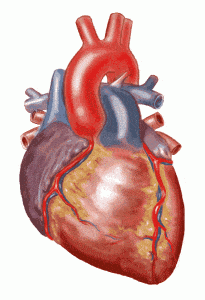
This is a example of ........
a)
cell
b)
organ system
c)
organ
d)
tissue
7.
 A group of cells that have similar functions? Examples are nervous, epithelial, muscle and connective
a)
cells
b)
tissues
c)
organs
d)
atoms
8.
Which of the following systems would allow your arms to move?
a)
excretory and digestive
b)
muscular and skeletal
c)
muscular and excretroy
d)
excretory and skeletal
9.
Which of the following organelles could be compared to the nervous system?
a)
mitochondria
b)
nucleus
c)
lysosome
d)
ribosome
10.
This is a example of ........
a)
organ
b)
organ system
c)
tissue
d)
cell
11.
Which of the following systems could be compared to the lysosomes?
a)
excretory system
b)
respiratory system
c)
digestive system
d)
circulatory system
12.

How does an organ system differ from an organ?

a)

A system is more complex and contains several organs

b)

A system is not made up of cells like an organ is.

c)

A system is only found in very large organisms.

d)

A system is just one part of an organ.

13.
Which of the following systems would allow a student to breathe and read music?
a)
respiratory and excretory
b)
nervous and circulatory
c)
circulatory and excretory
d)
respiratory and nervous
14.

Justin has learned that the brain, spinal cord, and peripheral nerves work together. What do they combine to form?

a)

A cell

b)

A tissue

c)

An organ

d)

An organ system

15.

In what organelle is the genetic material found inside?

a)

cell membrane

b)

chloroplast

c)

nucleus

d)

ribosome

16.
Which of the following systems would break down food and deliver nutrients through the body?
a)
digestive and excretory
b)
excretory and muscular
c)
digestive and circulatory
d)
excretory and circulatory
17.

A large central vacuole is found in a _____ cell.

a)

animal

b)

plant

18.

What is the function of a chloroplast?

a)

makes proteins for animal cells

b)

allows materials in and out of the cell

c)

provides structure and support

d)

absorbs sunlight for photosynthesis

19.

Identify the structure that is indicated by the arrow in the image.

a)

cell wall

b)

central vacuole

c)

chloroplast

d)

cell membrane

20.

The arrow is showing the fluid inside the cell that surrounds the cell organelles. What is the arrow pointing to in the cell?

a)

cytoplasm

b)

mitochondria

c)

ribosomes

d)

nucleus

21.

What type of cell is being shown in the image?

a)

plant

b)

animal

22.
What are the biotic factors in this image?
a)
sunlight, elephants, and grasses
b)
sunlight, water,  and air
c)
elephants, plants, trees 
23.

This organelle controls what goes in and out of plant and animal cells.

a)

Cell Wall

b)

Cell Membrane

c)

Chloroplasts

d)

Cytoplasm

24.
The 4th level of organization in a multicellular organism
a)
tissue
b)
organ
c)
organism
d)
organ system
25.
Cell membranes are found in
a)
Only animal cells
b)
Only plant cells
c)
Some plant and animal cells
d)
All plant and animal cells
26.
What organelle helps with cell digestion?
a)
Lysosomes
b)
Ribosomes
c)
Golgi Complex
d)
ER
27.
What is the difference between rough and smooth ER?
a)
There is no difference.
b)
Plants have rough ER, animals have smooth ER.
c)
What type of injuries the Doctors treat.
d)
Rough has ribosomes, smooth does not.
28.
Where are chloroplasts found?
a)
Plant cells only
b)
Both plant and animal cells
c)
Animal cells only
29.

The cell wall is found in which cell

a)

bacteria

b)

animal cell

c)

plant cell

d)

virus

30.
Plants and animal cells both have a nucleus.
a)
True
b)
False
31.
What is the name of the genetic material that is inside the nucleus?
a)
ER
b)
ATP
c)
YOLO
d)
DNA
32.
The 1st level of organization in a multicellular organism
a)
tissue
b)
organism
c)
cell
d)
organ
33.
The 2nd level of organization in a multicellular organism
a)
cells
b)
organism
c)
organ system
d)
tissue
34.

Cells in your body have different jobs

a)

true

b)

false

35.

What organelle is called the "powerhouse" of a cell?

a)

mitochondria

b)

nucleus

c)

cell wall

d)

cell membrane

36.

Which system is the heart a part of?

a)

circulatory

b)

digestive

c)

lymphatic

37.
Describes an organism made of only one cell (it does everything for itself)
a)
multicellular
b)
specialized
c)
unicellular
d)
interdependence
38.
Use this diagram of living systems to answer this question. Which figure is a tissue?
a)
1
b)
2
c)
1 & 2
d)
1 & 3
39.

A population must be of the same ________________?

a)

Color

b)

Gender

c)

Age

d)

Species

40.
What are the abiotic factors in this image? 
a)
water, sunlight, dirt, air
b)
birds and plants
c)
water, plants, and birds 
41.

I make proteins for the cell. What am I?

a)

ribosome

b)

cell membrane

c)

nucleus

d)

chloroplast

42.

Jacob is going out to his grandparents farm. On the farm is a stream that he likes to fish at. When he is fishing he sees many differernt speacies of fish as well as maple and oak trees and dragonflies. What Jacob is seeing is an example of what level of organization?

a)

organism

b)

population

c)

community

d)

ecosystem

43.
A duck, a dragonfly, a morel mushroom and a bobcat are all examples of...
a)
organisms.
b)
populations.
c)
communties.
d)
ecosystems.
44.

All the organisms that are the same type in a certain area

a)

Population

b)

Organism

c)

Community

d)

Ecosystem

45.

The biotic and abiotic factors that work together in an area

a)

Community

b)

Ecosystem

c)

Organism

d)

Population

46.

Which of the following correctly lists the levels of organization from most complex to least complex?

a)

Community, Organism, Population, Ecosystem

b)

Population, Community, Ecosystem, Organism

c)

Ecosystem, Community, Population, Organism

d)

Organism, Population, Community, Ecosystem

47.

Name 2 unicellular microorganisms.

4 lines
48.

The fine branches given out from the cell body of a nerve cell are

a)

cyton

b)

dendrites

c)

axon

d)

neurons

49.

Fluid connective tissue of humans is

a)

blood and cartilage

b)

lymph and plasma

c)

blood and lymph

d)

stroma and matrix

50.

How is Meristematic tissue different from permanent tissue

4 lines
51.

A tissue is formed of only one type of cells

a)

true

b)

false

52.

Only one type of tissue forms an organ

a)

true

b)

false

53.

Meristematic tissue is found at the growing tips of a plant

a)

true

b)

false

54.

How do you rank the amoeba?

a)

cell

b)

tissue

c)

organ

d)

organism

55.

How do you rank the Neuron?

a)

cell

b)

tissue

c)

organ

d)

organ system

56.

How do you rank the cardiac muscle?

a)

cell

b)

tissue

c)

organ sytem

d)

organ

57.

The (a)   or nerve fibres constitute the nerves

58.

(a)   connects one bone to another

59.

(a)   are connected to brain and spinal cord.

60.

Tendons connect muscle to muscle

a)

True

b)

False

61.

Cardiac muscles are involuntary muscles

a)

True

b)

False

62.

RBCs and WBCs are formed in bone marrow

a)

True

b)

False

63.

(a)   are the structures that help in the clotting of the blood.

64.

Fluid part of the blood is called (a)  

65.

Differentiate between community and biosphere.

4 lines
66.

What is an ecosystem?

4 lines
67.

What constitutes the vascular system of the plant?

(a)  

68.

Which tissue is responsible for the increase in the height of a plant and where is it located?

(a)  

69.

Name these three epithelium tissues by sequence.

(a)  
70.

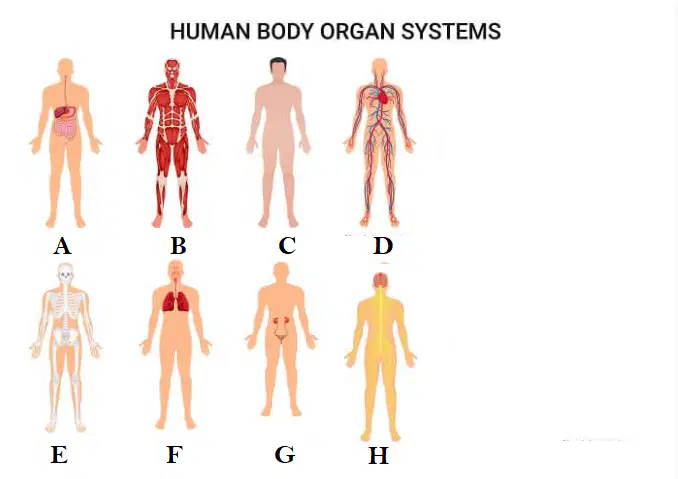
Name all the systems.

(a)