wayground logo

Free Printable Worksheets

Font size

S
M
L
XL
Worksheets

9700 AS Bio B4 Cell membranes and transport

Total questions: 106

Worksheet time: 2hrs 32mins

Name
Class
Date
1.
Which type of transport requires an input of energy?
a)
Passive Transport
b)
Osmosis
c)
Simple Diffusion
d)
Active Transport
2.
Which form of active transport is being shown?
a)
Pinocytosis
b)
Endocytosis
c)
Exocytosis
d)
Osmosis
3.
Most of the cell membrane is made of...
a)
Lipids
b)
Carbohydrates
c)
Proteins
d)
Nucleic acids
4.
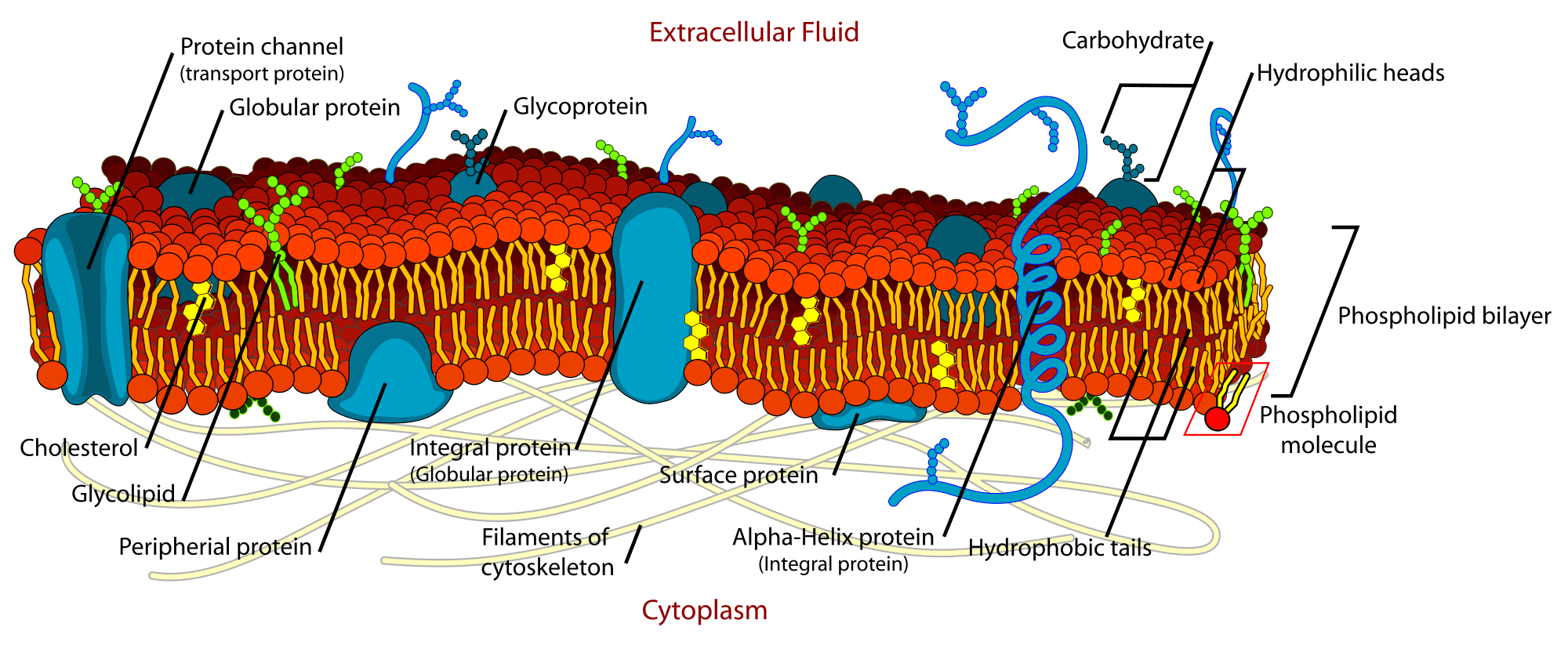
What forms the channels and pumps in the phospholipid bilayer?
a)
carbohydrates
b)
proteins
c)
hydrophilic heads 
d)
lipids
5.
Which of the following is responsible for getting large or charged (polar) molecules across the cell membrane?
a)
E
b)
B
c)
C
d)
D
6.
Hydrophobic region of the cell membrane?
a)
E
b)
B
c)
C
d)
7.
Why is diffusion and osmosis important to cells?
a)
It allows them to take in materials without using energy.
b)
It allows them to reproduce.
c)
It allows them to absorb sunlight.
d)
It allows cells to use all energy.
8.
Diffusion allows cells to take in small particles that can pass through the cell membrane. How are large particles taken in?
a)
Endocytosis
b)
Exocytosis
c)
Mitosis
d)
Photosynthesis
9.
What type of transport is this?
a)
facilitated diffusion
b)
active transport
c)
diffusion
d)
osmosis
10.
What are two types of passive transport?
a)
endo and exocytosis 
b)
in a minute and later
c)
hydrophobic and hydrophillic 
d)
osmosis and diffusion
11.
Special proteins help move particles, but NO energy is needed. This is..
a)
facilitated diffusion
b)
exocytosis
c)
active transport
d)
equilibrium
12.
What is this image?
a)
cell membrane
b)
mitochondria
c)
golgi apparatus
d)
endoplasmic reticulum
13.
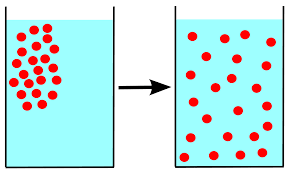
In which direction will these molecules diffuse?
a)
from right to left
b)
from left to right
c)
they will not move at all
d)
they will move in both directions equally
14.
Which part of this phospholipid is hydrophobic?
a)
fatty lipid tails
b)
head
c)
all of it is hydrophobic
d)
none of it is hydrophobic
15.
A phospholipid has 2 parts. What are they called? 
a)
Hydrophilic Head, Hydrophobic Tail 
b)
Hydrophobic Head, Hydrophilic Tail 
16.
Describes the arrangement of the cell membrane as bendable and made of many parts. 
a)
The Fluid Mosaic Model 
b)
The Major Mobility Model 
c)
The Crazy Cell Model
d)
The Maze Model
17.
___________ strengthens and stabilizes the cell membrane.
a)
Carbohydrates 
b)
Proteins 
c)
Phospholipids 
d)
Cholesterol
18.
A type of active transport that releases particles that were enclosed from a cell when the membrane of the vesicle fuses with that of the cell membrane
a)
Exocytosis
b)
Osmosis
c)
Mitosis
d)
Endoyctosis
19.
A type of passive transport that moves particles from high concentration to low concentration; like the iodine into the cornstarch bag
a)
Exocytosis
b)
Osmosis
c)
Diffusion
d)
Endoyctosis
20.
A type of active transport that brings particles into a cell when the cell membrane encloses a particle to make a vesicle
a)
Diffusion
b)
Passive Transport
c)
Active Transport
d)
Endocytosis
21.

Diffusion & Facilitated Diffusion are both __________ transport.

a)

Passive

b)

Active

c)

Easy

d)

Free

22.
What do the brown structures represent?
a)
Phospholipids
b)
Glycoproteins
c)
Channel Proteins 
d)
Cyctoskeleton Filaments
23.

The type of transport that requires the use of transport proteins

a)

Passive Transport

b)

Facilitated Diffusion

c)

Active Transport

d)

Vesicular Transport

24.

The energy molecule that powers some modes of transport

a)

ADP

b)

ATP

c)

AGP

d)

ABP

25.

The yellow and brown portion of this image is:

a)

protein

b)

phopholipid

c)

carbohydrate

d)

cholesterol

26.

The purple regions of the image represent:

a)

phospholipid

b)

cholesterol

c)

proteins

d)

carbohydrates

27.

Examples of particles that can diffuse across through the phospholipid bilayer include:

a)

oxygen and carbon dioxide

b)

sugar

c)

water

d)

calcium ions

28.
A phospholipid has 2 parts. What are they called? 
a)
Hydrophilic Head, Hydrophobic Tail 
b)
Hydrophobic Head, Hydrophilic Tail 
29.
Describes the arrangement of the cell membrane as bendable and made of many parts. 
a)
The Fluid Mosaic Model 
b)
The Major Mobility Model 
c)
The Crazy Cell Model
d)
The Maze Model
30.
Which of the following is NOT part of the cell membrane?
a)
Lipids
b)
Carbs
c)
Proteins
d)
Nucleic Acids
31.
The picture below is an example of _________________.
a)
osmosis
b)
isotonic
c)
diffusion
d)
active transport
32.
Exocytosis
a)
Passive Transport
b)
Active Transport
33.
Endocytosis
a)
Passive Transport
b)
Active Transport
34.
The diffusion of WATER across a semi-permeable membrane is
a)
osmosis
b)
diffusion
c)
endocytosis
d)
exocytosis
35.
The movement of molecules from higher concentration to lower concentration is
a)
diffusion
b)
cell division
active transport
c)
active transport
d)
tonicity
36.
This picture represents what type of cell transport?
a)
endocytosis
b)
exocytosis
c)
osmosis
d)
passive transport
37.
The cell membrane is selectively permeable, which means...
a)
All materials can enter and leave the cell
b)
Certain things can enter while others cannot
c)
The cell manually sorts through all materials
d)
Only certain cells can interact with the cell.
38.
"Water Fearing" 
a)
Hydrophobic
b)
Hydrophilic 
c)
Hydroelectric 
d)
Hydroloric
39.
"Water Loving"
a)
Hydrophobic
b)
Hydrophilic 
c)
Hydroelectric 
d)
Hydroloric
40.
What is "A"?
a)
Glycoprotein
b)
Phospholipid Bilayer
c)
Cholesterol
d)
Carbohydrate Chain
41.
What is "B"?
a)
Peripheral Protein
b)
Glycoprotein
c)
Cholesterol
d)
Integral Protein
42.
What is "I"?
a)
Carbohydrate
b)
Glycoprotein
c)
Peripheral Protein
d)
Cholesterol
43.
What is "C"?
a)
Glycoprotein
b)
Carbohydrate
c)
Phosphate
d)
Integral Protein
44.
What is "H"?
a)
Peripheral Protein
b)
Phospholipid
c)
Integral Protein
d)
Fatty Acid
45.
What is "F"?
a)
Fatty Acid Tail
b)
Carbohydrate Chain
c)
Glycoprotein
d)
Peripheral Protein
46.
What is the function of "C"?
a)
Involved in cell-to-cell recognition
b)
Attract water
c)
Makes up bilayer
d)
Repels water
47.
What is the function of "I"?
a)
Helps maintain flexibility of membrane
b)
Attracts water
c)
Help transport certain materials across the cell membrane
d)
Involved in cell-to-cell recognition
48.
What is the function of "B"?
a)
Help transport certain materials across the cell membrane
b)
Makes up bilayer
c)
Involved in cell-to-cell recognition
d)
Repels Water
49.
What is the function of the cell membrane?
a)
It regulates which materials enter and leave the cell.
b)
It contains the genetic information for the cell.
c)
It manufactures proteins for the cell.
d)
It generates chemical energy for the cell.
50.
What is the structure of a phospholipid in the cell membrane?
a)
a "water-fearing" head and two "water-loving" tails
b)
two "water-loving" heads and a "water-fearing" tail
c)
a "water-loving" head and two "water-fearing" tails
d)
two "water-fearing" heads" and a "water-loving" tail
51.
What does the "fluid mosaic model" mean about the cell membrane?
a)
It can dissolve into fluid.
b)
The cell is mostly made of mosaic molecules.
c)
It looks like a flexible pattern.
d)
Somebody else should name these things.
52.
Most of the cell membrane is made of...
a)
Lipids
b)
Carbohydrates
c)
Proteins
d)
Nucleic acids
53.
Phospholipid heads are...
a)
Hydrophobic
b)
Hydrophilic
54.
How many layers is the lipid bilayer?
a)
1
b)
2
c)
3
d)
4
55.

Diffusion & Facilitated Diffusion are both __________ transport.

a)

Passive

b)

Active

c)

Easy

d)

Free

56.

Passive Transport uses ____ energy

a)

no

b)

a lot of

c)

a little bit of

d)

some

57.

An example of facilitated diffusion is

a)

CO2 and O2 exchange in the lungs

b)

Glucose transport

c)

Na+ / K+ Pumps

d)

Endocytosis

58.

The cell membrane is _______________ permeable.

a)

selectively

b)

somewhat

c)

physically

d)

ionically

59.

are proteins that carry substances from one side of a biological membrane to the other

a)

carrier protein

b)

channel protein

c)

receptor protein

60.

An embedded protein in the cell membrane, providing a hydrophilic passageway for small, polar ions.

a)

carrier protein

b)

channel protein

c)

receptor protein

61.
The function of the plasma membrane is....
a)
to regulate what enters and leaves the cell.
b)
fight bacteria and viruses that enter the cell.
c)
provide rigid support and protection to the cell.
d)
make sure each cell can move
62.

Small, nonpolar, hydrophobic molecules such as fatty acids

a)

easily pass through the membrane's bilayer

b)

very slowly diffuse through the bilayer

c)

require transport proteins

d)

enter through endocytosis

63.

The cholesterol associated with membranes

a)

is attached to proteins and extends into the environment surrounding the cell

b)

helps stabilize the membrane at body temperature

c)

is an abnormality resulting from a diet high in cholesterol

d)

both a and c

64.

A major function of glycoproteins and glycolipids in the membane is to

a)

glue cells together to form tissues

b)

allow cells to identify each other

c)

attach membrane to cytoskeleton

d)

help retain shape

65.

Active transport is the movement of large materials across a cell membrane from ______ to ______ concentration

a)

high to low

b)

low to high

c)

high to high

d)

low to low

66.
Hydrophobic region of the cell membrane?
a)
E
b)
B
c)
C
d)
67.
Part of the plasma membrane responsible for cell recognition... 
a)
C
b)
E
c)
B
d)
D
68.
Even though the concentration of salt is high in some gland cells and low in the blood, these cells can move salt out of blood and into the cells.  This is an example of
a)
passive transport
b)
active transport
c)
diffusion
d)
osmosis
69.
In this situation, where the solute is illustrated by red dots, predict if will WATER move into or out of the cell, and how that will affect the cell.
a)
Water will move into the cell and the cell will expand.
b)
Water will move into the cell and the cell will shrink.
c)
Water will move out of the cell and the cell will expand.
d)
Water will move out of the cell and the cell will shrink.
70.

Why does active transport need the following organelle

a)

Mitochondria carry out photosynthesis

b)

Mitochondria are pink

c)

Mitochondria release Energy

d)

Mitochondria produce proteins

71.
A signal molecule that binds to a plasma-membrane protein is a
a)
ligand
b)
second messenger
c)
protein kinase
d)
receptor protein
72.

Distilled water diffuses into a potato strip and causes it to increase in mass. What is the process involved?

a)

Simple diffusion

b)

Facilitated diffusion

c)

Osmosis

d)

Avtive transport

73.

Osmosis is the movement of water from

a)

high water potential to low water potential

b)

low water potential to high water potential

74.

Glucose and amino acids move across the plasma membrane with the help of

a)

channel protein

b)

carrier protein

c)

phospholipid bilayer

d)

glycoprotein

75.

The movement of substances from low concentration region to high concentration region across a plama membrane is known as

a)

simple diffusion

b)

active transport

c)

facilitated diffusion

d)

osmosis

76.

Absorption of glucose and amino acids in the

villus occur through

a)

active transport

b)

facilitated diffusion

c)

osmosis

d)

simple diffusion

77.

Which of the following are examples of passive transport?

a)

gaseous exchange between an alveolus and

a blood capillary

b)

absorption of mineral ions by a plant root hair

cell

c)

reabsorption of glucose through the renal

tubule in the kidney

d)

absorption of glucose and amino acids in the

villus

78.

Which of the following statement is true about

facilitated diffusion?

a)

The process is passive.

b)

Facilitated diffusion does not involve carrier

protein.

c)

This process requires expenditure of energy by

the cell.

d)

Facilitated diffusion does not occur in the

presence of respiratory poison.

79.

Which of the following statement is true about active transport?

a)

Occurs against the concentration of the gradient

b)

Requires energy

c)

Occurs until a dynamic equilibrium is achieved

d)

Occurs following the concentration of the gradient

80.

Diagram shows the movement of molecule X across the plasma membrane through process Y. What is process Y?

a)

simple diffusion

b)

facilitated diffusion

c)

active transport

d)

osmosis

81.

Name the process that causes the level of sucrose solution increases.

a)

simple diffusion

b)

osmosis

c)

facilitated diffusion

d)

active transport

82.

Process shown in the diagram occur through

a)

simple diffusion

b)

active transport

c)

osmosis

d)

facilitated diffusion

83.

Diagram shows the diffusion of water molecules through a Visking tubing. After one hour, the Visking tubing becomes turgid. What are P and Q?

a)

P: 20% sucrose solution

Q: 20% sucrose solution

b)

P: 20% sucrose solution

Q: 5% sucrose solution

c)

P: 5% sucrose solution

Q: 20% sucrose solution

d)

P: 5% sucrose solution

Q: 5% sucrose solution

84.

The surface area of a cell is

a)

the total amount of space taken up by a cell

b)

the area of a cell

c)

the outer surface of the cell, the plasma membrane

d)

a comparison between the surface area and the volume of the cell

85.

The volume of a cell is

a)

the cytoplasm in the cell

b)

the outer surface of the cell

c)

how loud the cell is

d)

the total amount of space taken up by a cell, including all cellular contents

86.

How is the surface area to volume ratio of a cell calculated

a)

surface area plus volume

b)

surface area divided by volume

c)

surface area multiplied by volume

d)

surface area minus volume

87.

Diffusion is

a)

movement of molecules across a plasma membrane from a high concentration to a low concentration along a concentration gradient

b)

movement of larger molecules dragged through channels within the membrane from a high concentration to a low concentration along a concentration gradient

c)

movement of molecules through channels within the membrane from a low concentration to a high concentration against the concentration gradient

d)

movement of water molecules across a plasma membrane from a high concentration to a low concentration along a concentration gradient

88.

Osmosis is

a)

movement of molecules across a plasma membrane from a high concentration to a low concentration along a concentration gradient

b)

movement of larger molecules dragged through channels within the membrane from a high concentration to a low concentration along a concentration gradient

c)

movement of molecules through channels within the membrane from a low concentration to a high concentration against the concentration gradient

d)

movement of water molecules across a plasma membrane from a high concentration to a low concentration along a concentration gradient

89.

Facilitated Diffusion is

a)

movement of molecules across a plasma membrane from a high concentration to a low concentration along a concentration gradient

b)

movement of larger molecules dragged through channels within the membrane from a high concentration to a low concentration along a concentration gradient

c)

movement of molecules through channels within the membrane from a low concentration to a high concentration against the concentration gradient

d)

movement of water molecules across a plasma membrane from a high concentration to a low concentration along a concentration gradient

90.

Active Transport is

a)

movement of molecules across a plasma membrane from a high concentration to a low concentration along a concentration gradient

b)

movement of larger molecules dragged through channels within the membrane from a high concentration to a low concentration along a concentration gradient

c)

movement of molecules through channels within the membrane from a low concentration to a high concentration against the concentration gradient

d)

movement of water molecules across a plasma membrane from a high concentration to a low concentration along a concentration gradient

91.

Why are cells microscopic in size?

a)

they need to be able to hide

b)

they need to maximise their SA:V to ensure they are efficiently supplied with nutrients so they can survive

c)

they want to minimise their surface area

d)

they need to minimise their SA:V to ensure they are efficiently supplied with nutrients so they can survive

92.

Objects can increase their SA:V by...

a)

shrinking

b)

creating more volume

c)

growing larger

d)

having a long, flat shape

93.

Multicellular organisms overcome the problem of SA:V by

a)

shrinking as they get older

b)

growing really large

c)

dividing into many cells

d)

having many small cells that all have a different role, but work together to allow function

94.

How can surface area (SA) be increased?

a)

Grow larger

b)

Divide into smaller pieces

95.

High Surface area to volume ratio allows cells to do what quickly?

a)

Move materials around inside the cell

b)

Move materials in and out of the cell

c)

Communicate to other cells

d)

Divide

96.

Which cells are more efficient at obtaining nutrients?

a)

Small Cells

b)

Medium Size Cells

c)

Large Cells

d)

X-Large Cells

97.
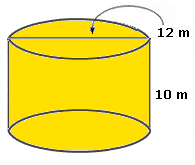
 Find the volume of the Cylinder
a)
7230
b)
6621
c)
1130
d)
907
98.
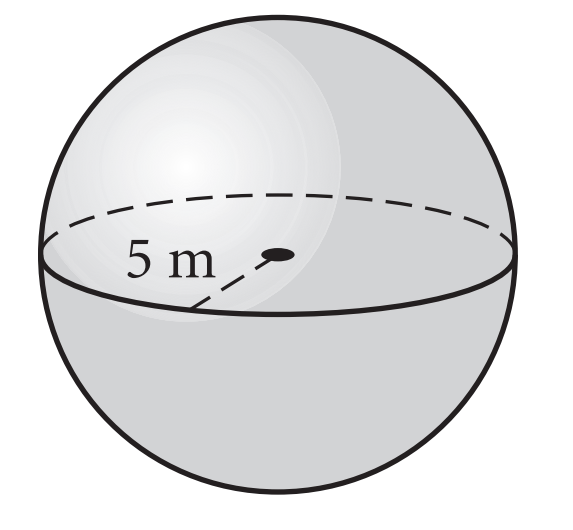
Find the volume of the Sphere
a)
78.5 m3
b)
392.5 m3
c)
523.6 m3
d)
62.8 cm3
99.
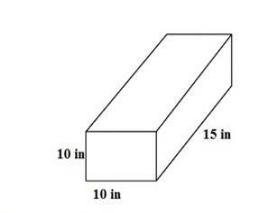
What is the surface area of this figure?
a)
200 cm 2
b)
800 cm 2
c)
400 cm 2
d)
100 cm 2
100.
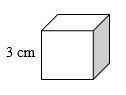
Find the surface area of this cube.
a)
18 sq cm
b)
36 sq cm
c)
54 sq cm
d)
60 sq cm
101.
As a cell’s size increases, its ratio of surface area to volume decreases.
a)
True
b)
False
102.

Cells tend to be small, with sizes ranging between 1 and 100 mm. These small sizes help to ensure that cells have a favorable surface-area-to-volume ratio. Choose the statement that explains why a favorable surface-area-to-volume ratio is advantageous.

a)

Higher surface-area-to-volume ratios improve the efficiency of transporting materials in and out of cells.

b)

Lower surface-area-to-volume ratios improve the efficiency of transporting materials in and our of cells.

c)

Higher surface-area-to-volume ratios speed up the flow of cytoplasm within cells.

d)

Higher surface-area-to-volume ratios slow down the flow of cytoplasm within cells.

103.
As a cell increases in size, the surface area to volume ratio _________________.
a)
increases
b)
decreases
c)
stays the same
104.
The larger the surface area to volume ratio, the _______________ efficient the cell is in transporting nutrients and waste in and out of the cell. 
a)
less
b)
more
105.

Which of these is NOT a feature of a specialised gas exchange surface?

a)

Large surface area

b)

Very thick to provide long diffusion distance

c)

Selectively permeable

d)

A transport system to maintain diffusion gradient
106.

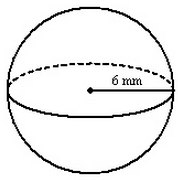
What is the surface area?

a)

6658.56 mm2

b)

452.16 mm2

c)

904.32 mm2

d)

108.8 mm2