Wayground logo

Free Printable Worksheets

Font size

S
M
L
XL
Worksheets

Summative Assessment Living Environment

Total questions: 104

Worksheet time: 5hrs 12mins

Name
Class
Date
1.

What term is used to describe the living components of an ecosystem?

a)

Abiotic

b)

Biotic

c)

aerobic

d)

anaerobic

2.

What occurs in the organelle that looks like this?

a)

Break down excess or worn-out cell parts.

b)

Helps process and package proteins and lipid molecules

c)

Production of Ribosomes

d)

Production of Energy

3.

What form is energy made in?

a)

ATP

usable

b)

Lithium

transportable

c)

Fat

storable

4.

What direction does a microscope turn the object you are viewing?

a)

Forward

b)

Inside out

c)

Backwards and upside down

d)

Sideways

5.

What is the substance the enzyme works on called?

a)

Substrate

b)

Product

c)

Active Site

d)

Complex

6.

Name the most important inorganic compound to living things…

a)

Carbon Dioxide

b)

Oxygen

c)

Glucose

d)

Water

7.

How should the control group be treated differently than the experimental group?

a)

The control group gets double the variable.

b)

Both groups should be exactly the same EXCEPT for the variable. The control group doesn’t get the variable.

c)

The control group gets half the variable.

8.

If a 20% salt solution is put into dialysis tubing & added to a beaker of distilled water - what way will the water move?

a)

The water will move into the cell / dialysis tubing.

b)

Into the beaker

9.

What term defines a cell without a nucleus?

a)

Dead

b)

Virus

c)

Prokaryote / prokaryotic

d)

Eukaryote /

eukaryotic

10.

A cell maintains life by undergoing ….

a)

Metabolic (life) functions

b)

Homeostasis

c)

Mitosis

d)

Budding

11.

What part of a plant cell allows them to make their own food?

a)

Chloroplast

b)

Golgi Body

c)

Rough Endoplasmic Reticulum

d)

Mitochondria

12.

What molecule has the instructions (blueprint) for the cell?

a)

ATP

b)

RTI

c)

DNA

13.

Name the building block of a starch

a)

Polysaccharide

b)

Monosaccharide

c)

Amino Acid

d)

Lipid

14.

If a segment of DNA is ATCGA what would its complement be?

a)

UAGCU

b)

TAGCT

15.

What organism is an ecosystem that would be most affected by a decrease in CO2?

a)

Bacteria

b)

Consumers

c)

Green Plants/Algae

d)

Humans

16.
Proteins are composed of what smaller building blocks?
a)
amino acids
b)
nucleic acids
c)
fatty acids
d)
nucleotides
17.

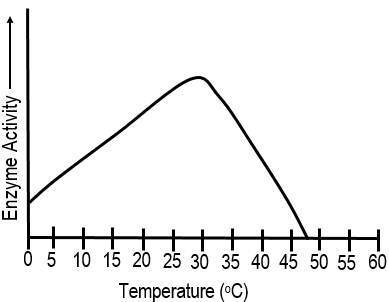
Based on the graph, what is the optimum temperature for this enzyme? 

a)
15 C
b)
40 C
c)
30 C
18.
What happens when enzymes are heated to a high temperature?
a)
The enzymes die.
b)
The shapes of the enzyme are altered or denatured
c)
The enzymes' amino acid sequence changes.
d)
The enzymes remain the same
19.
Enzymes are
a)
nucleic acids
b)
proteins
c)
lipids
d)
carbohydrates
20.

Which is the strongest acid?

a)

ph of 1

b)

ph of 4

c)

ph of 7

d)

ph of 9

21.
DNA and RNA are two types of
a)
proteins
b)
lipids
c)
carbohydrates
d)
nucleic acids
22.

Which is the initial color of starch indicator solution?

a)

blue

b)

yellow/brownish orange

c)

amber

d)

blue-black

23.

In our diffusion lab, what happened to the “cell” that contained starch solution after 20 minutes?

a)

The contents of the dialysis tube turned blue-black.

b)

The liquid in the beaker would turn blue-black.

c)

The dialysis tube would burst.

d)

There would be no change.

24.

When a cell shrinks in size, what type of solution was added to it?

a)

Salt solution

b)

Tap water

c)

distilled water

d)

iodine solution

25.
Cell membranes are said to be selectively permeable. Which statement best explains what selectively permeable means?
a)
The cell membrane prevents any harmful substance from entering the cell.
b)
The cell membrane lets certain substances enter the cell and keeps certain substances out of the cell.
c)
The cell membrane allows only large molecules to diffuse into the cell.
d)
The cell membrane has pores that let only water and glucose into the cell and carbon dioxide out.
26.
Base your answer to the question on the diagram below and on your knowledge of biology. The diagram represents two solutions, A and B, separated by a selectively permeable membrane. Which statement best describes the outcome after 20 minutes?
a)
Solution A will contain approximately the same number of glucose molecules as solution B.
b)
Solution A will contain all of the water molecules.
c)
Solution B will remain unchanged.
d)
Solution B will lose all of the glucose molecules to solution A.
27.
The diagram below represents a cell in water.  Formulas of molecules that can move freely across the cell membrane are shown.  Some molecules are located inside the cell and others are in the water outside the cell.

Based on the distribution of these molecules, what would most likely happen after a period of time?
a)
The concentration of O2 will increase inside the cell.
b)
The concentration of CO2 will remain the same inside the cell.
c)
The concentration of O2 will remain the same outside the cell.
d)
The concentration of CO2 will decrease outside the cell.
28.
A substance is most likely to diffuse into a cell when
a)
it is a large organic food molecule such as protein or starch
b)
it is enclosed in an organelle such as a vacuole
c)
the concentration of the substance is greater outside the cell than inside
d)
the pH of the substance is greater than the pH of the cellListen
29.
The diagram below shows the relative concentration of molecules inside and outside of a cell.

Which statement best describes the general direction of diffusion across the membrane of this cell?
a)
Glucose would diffuse into the cell.
b)
Protein would diffuse out of the cell.
c)
Oxygen would diffuse into the cell.
d)
Carbon dioxide would diffuse out of the cell.
30.

If an DNA sequence reads AGGCTA then the mRNA sequence would read

a)

TCCGAT

b)

UGGCUA

c)

UCCGAU

31.

What is the total magnifications of a microscope on high power (40x) if the eyepiece is 10x?

a)

40x

b)

400x

c)

4000x

d)

4x

32.

What process requires energy?

a)

active transport

b)

osmosis

c)

diffusion

d)

passive transport

33.

creating large, complex molecules by combining smaller molecules is referred to as ____

a)

excretion

b)

transport

c)

synthesis

d)

homeostasis

34.

A solution with a pH of 9 is a(n) ___.

a)

Acid

b)

Base

35.

Organic compounds such as starch are too ___ to fit though the cell membrane. They must be digested into ___ before they can be absorbed

a)

Big

simple sugars

b)

Big

amino acids

c)

small

amino acids

d)

Big

fatty acids

36.

Energy for this ecosystem originally comes from

a)

water

b)

consumers

c)

sunlight

d)

plants

37.

An environment can support only as many organisms as the available energy, minerals, and oxygen will allow. Which term is best described by this statement?

a)

biological feedback

b)

carrying capacity

c)

homeostatic control

d)

biological diversity

38.

What impact do the amounts of available energy, water, and oxygen have on an ecosystem?

a)

They act as limiting factors.

b)

]They are used as nutrients.

c)

They recycle the residue of dead organisms.

d)

They control environmental temperature.

39.

Which sequence shows increasing complexity of levels of ecological organization?

a)

biosphere, ecosystem, population, community,

b)

population, biosphere, community, ecosystem

c)

population, community, ecosystem, biosphere

d)

ecosystem, population, biosphere, community

40.

Great horned owls and red-tailed hawks have similar requirements for food, space, and nesting materials. What would most likely be the result of great horned owls and red-tailed hawks living in the same community?

a)

ecological succession

b)

competition

c)

habitat destruction

d)

parasitism

41.

Which organisms are not shown in this diagram but are essential to a balanced ecosystem?

a)

heterotrophs

b)

autotrophs

c)

producers

d)

decomposers

42.

Organisms that can make their own food are called

a)

consumers

b)

heterotrophs

c)

detrivores

d)

autotrophs

43.

An organism that eats both plants and animals is a

a)

carnivore

b)

herbivore

c)

omnivore

d)

detrivore

44.

Which of these is an abiotic factor?

a)

Bacteria

b)

Sunlight

c)

Worms

d)

Algae

45.
All of the living and nonliving things in an area that interact with each other are called a/an ______.
a)
community
b)
habitat
c)
population
d)
ecosystem
46.
The living part of an ecosystem
a)
Biotic
b)
Abiotic
c)
Mother Earth
d)
Flowers
47.
Examples of a producer
a)
frog
b)
algae
c)
worm
d)
mouse
48.
What is a herbivore?
a)
an animal that gets energy from eating other animals
b)
an organism that gets energy from eating only plants
c)
an animal that gets energy by eating both plants and other animals
d)
an animal that eats only herbs
49.
The shrew provides energy for the _______?
a)
cricket
b)
grasshopper
c)
frog
d)
snake
50.
What is this called?
a)
Food Web
b)
Food Chain
c)
Abiotic Factors
51.
What is this called?
a)
Food Web
b)
Food Chain
c)
Abiotic Factors
52.
An animal that eats other animals is a....
a)
carnivore
b)
omnivore
c)
herbivore
d)
decomposer
53.
Another name for a consumer is a
a)
heterotroph
b)
autotroph
c)
producer
d)
plant
54.
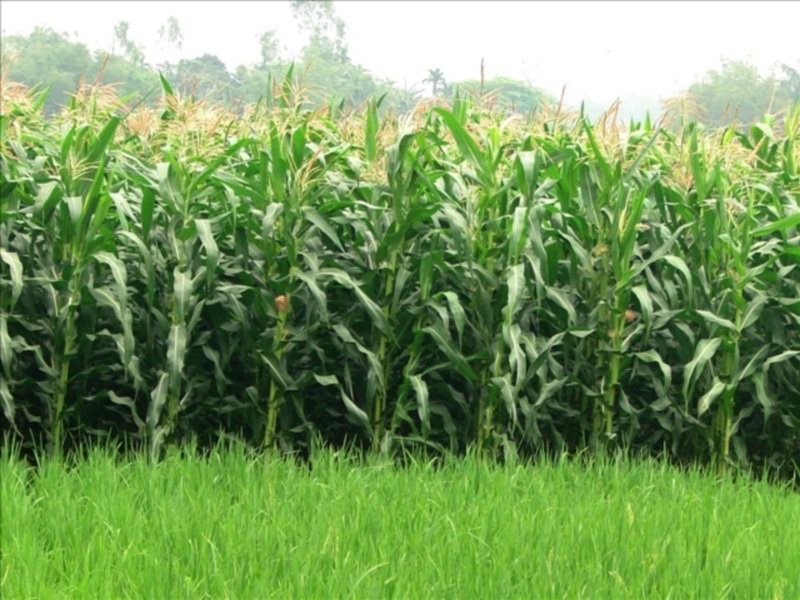
The image provided is an example of a:
a)
Producer
b)
Heterotroph
c)
Consumer
d)
Decomposer
55.
The study of how living things interact in an environment is called
a)
Ecosystem
b)
Biology
c)
Ecology
56.
Organisms that breaks down and absorbs nutrients from dead organisms 
a)
consumer
b)
trophic level
c)
decomposer
d)
species
57.
a relationship between two in which one species, the predator, feeds on the other species, the prey
a)
chemosynthesis
b)
predation
c)
cellular respiration 
d)
commensalism
58.
An organism that is killed and eaten by another organism
a)
Predator
b)
Prey
c)
Competition
d)
Adaptation
59.
A frog eats a fly. The frog and fly are demonstrating ________.
a)
mutualism
b)
competition
c)
predator/prey
d)
parasitism
60.

What happens if a population grows past its carrying capacity?

a)

The population keeps growing

b)

The population starts to die off

c)

The entire species will go extinct

d)

The carrying capacity just increases

61.
Between starch, glucose, water, and starch indicator, which could NOT pass through an artificial membrane in our lab, because its particles were too big?
a)
starch
b)
glucose
c)
water
d)
starch indicator
62.
When was this viewed?
a)
After distilled (pure) water was added
b)
after salt water was added
63.
These onion cells have lost water from their cytoplasm after a certain procedure has been performed. What has caused the change?
a)
diffusion
b)
active transport
c)
photosynthesis
d)
cellular respiration
64.
When was this viewed?
a)
After distilled (pure) water was added.
b)
After salt water was added
65.
At this stage of the experiment, have either starch or starch indicator passed (noticeably) though the dialysis tubing?
a)
yes, both
b)
yes, starch only
c)
yes, starch indicator only
d)
no
66.
what does the amber coloring of the fluid indicate?
a)
glucose has passed through membrane
b)
starch has passed through membrane
c)
it proves NO glucose passed through membrane
d)
it proves NO starch has passed through membrane
67.
what does the white coloring inside the artificial cell indicate?
a)
starch indicator has passed through membrane
b)
glucose indicator has passed through membrane
c)
it proves NO glucose indicator passed through membrane
d)
it proves NO starch indicator has passed through membrane
68.
What does the blue black coloring inside the artificial cell indicate?
a)
starch indicator passed through dialysis membrane
b)
glucose indicator passed through dialysis membrane
c)
glucose had a chemical reaction with starch
d)
someone spilled ink in their "cell"
69.
This procedure proves glucose passed through the dialysis membrane. What was in that test tube?
a)
glucose indicator, fluid from outside the "cell"
b)
glucose indicator, sample from inside "cell"
c)
starch indicator, fluid from outside the "cell"
d)
starch indicator, sample from inside the "cell"
70.
The test tube was originally blue, but turned orange when heated. How can we interpret this?
a)
its positive, so glucose passed through the dialysis membrane
b)
 its positive, so starch passed through the dialysis membrane
c)
 its negative, so glucose passed through the dialysis membrane
d)
 its negative, so starch passed through the dialysis membrane
71.
.
a)
there will be a color change inside the "cell" AND in its environment
b)
there will be a color change inside the "cell" but NOT in its environment
c)
No color change in the cell or its environment
72.
When you are viewing some onion cells under the microscope, and you add salt water to observe changes, and later add distilled (pure) water and observe further changes, what do you see?
a)
whole cell (cell wall, cell membrane, cytoplasm) shrinks and expands
b)
cell wall remains unchanged, cell membrane and cytoplasm change in response to diffusion
c)
cell membrane remains unchanged, cell wall and cytoplasm change in response to diffusion
73.
What is the purpose of adding a biological stain to these cheek cells before viewing?
a)
to cause diffusion to occur 
b)
to shrink the cell
c)
to make everything darker and easier to view
d)
to increase magnification
74.
this coverslip is being lowered over the specimen (which is in a few drop of water) at a 45 degree angle. What is the importance of this angle?
a)
it decreases water bubbles
b)
no importance
c)
it will make the specimen more focused
d)
it will make the specimen darker and easier to view
75.
Why could many students squeeze a clothespin more times in a minute after exercising? 
a)
heart beating faster delivers more glucose and oxygen to muscle cells
b)
you do better when you're tired
76.
Exercise causes your heart and lungs to work faster. Which organ systems does this most directly involve, and which process is sped up?
a)
circulatory and digestive; photosynthesis
b)
nervous and endocrine; active transport
c)
respiratory and skeletal; diffusion
d)
circulatory and respiratory; (cellular) respiratory
77.
When we were determining our average pulse rate, what was NOT part of our procedure?
a)
count pulse beats for 20 seconds, then multiply by 3 to get rate per minute
b)
take the pulse in different locations for different trials
c)
do 3 trials and then take average
78.
what is a possible disadvantage to humans if deforestation continues, as represented by the fictional plant "Botana curus"
a)
loss of future sources of medicine or food
b)
loss of income for the logging industry
c)
loss of sources of renewable energy
79.
Which gives more accurate information regarding relationships between species?
a)
structural evidence
b)
molecular evidence
80.
which was NOT a test we performed on Botana curus and species X, Y and Z?
a)
gel electrophoresis
b)
paper chromatography
c)
pH indicator
d)
test for enzyme M
81.
what does a paper chromatography do?
a)
compares DNA of various organisms
b)
tells whether a particular enzyme is present
c)
separates substances in a liquid compound
d)
gives a view of cross section of stems
82.
Which amino acid is coded for by the codon GUG?
a)
val
b)
ile
c)
gly
d)
phe
83.
Which amino acid is coded for by the codon that is formed by basepairing with the DNA code TCG?
a)
ser
b)
ile
c)
val
d)
phe
84.
What codons are formed by transcription of the following DNA code: TAG GTC AAA CAC CGT
a)
TAG GTC AAA CAC CGT
b)
ATC CAG TTT CTC GCA
c)
AUC CAG UUU GUG GCA
85.
What is this equipment used for?
a)
paper chromatography
b)
gel electrophoresis
c)
test for enzyme m
d)
pH test
86.
What is a gel electrophoresis used for?
a)
separate compounds in a liquid mixture
b)
compare DNA samples
c)
test for the presence of an enzyme
87.
according to this, which species is the closet relative of botana curus (green)?
a)
species x (red)
b)
species z (yellow)
c)
species y (blue)
88.
which would be least likely to coexist on an island with the large tree finch.
a)
vegetarian finch
b)
small ground finch
c)
woodpecker finch
d)
cactus finch
89.
what was the selecting agent that caused finches to evolve into a number of individual species from a single ancestral species.
a)
available food on individual islands
b)
mating preferences
c)
adaptation to environmental toxins
d)
weath
90.
which would be least likely to coexist on an island with the large tree finch.
a)
vegetarian finch
b)
small ground finch
c)
woodpecker finch
d)
cactus finch
91.
What cuts DNA into fragments in Gel Electrophoresis (the same molecule is used in gene splicing).
a)
restriction enzymes
b)
the hormone thyroxine
c)
the protein melanin
d)
an antioxidant
92.
•What molecule is needed to start cellular respiration and fermentation?
a)
glucose
b)
oxygen
93.
•What molecule is needed for cellular respiration but NOT fermentation?
a)
glucose
b)
oxygen
94.
This is the manipulated variable, or the variable you control.
a)
Independent
b)
Dependent
c)
Control
d)
Constant
95.
This is the responding variable, or the variable you observe or measure. 
a)
Independent
b)
Dependent
c)
Control
d)
Constant
96.
This group in an experiment that does not receive the independent variable.
a)
Independent variable
b)
Dependent variable
c)
Control group
d)
constant
97.
When experimenting with the growth of a plant, a scientist uses three (of the same type of) plants, two different fertilizers, equal light, and equal water. What type of variable is the water?
a)
Dependent
b)
Independent
c)
Control
d)
Constant 
98.
When experimenting with the growth of a plant, a scientist uses three (of the same type of) plants, two different fertilizers, equal light, and equal water. What type of variable is the fertilizer?
a)
Dependent
b)
Independent
c)
Control
d)
Constant 
99.
Which variable is the same for each test subject in an experiment?
a)
Dependent
b)
Independent
c)
Control
d)
Constant
100.
Students were involved in an experiment to investigate whether playing music while they took a test affected their scores. What would their test scores be?
a)
Independent variable
b)
Dependent variable
c)
Controlled variable
d)
Hypothesis
101.
An investigation in which only one variable is changed at a time. 
a)
Control group
b)
Experimental group
c)
Constants
d)
Controlled Experiment 
102.
On what axis should the independent variable always be?
a)
X
b)
Y
103.
The __________ variable is located on the y-axis.
a)
Independent
b)
Dependent
c)
Control
d)
Constant
104.
How can you make an experiment more valid?
a)
Increase the sample size
b)
Repeat the experiment
c)
Add more trials 
d)
All of the above