
 Worksheets
E.S.S. 2 FINAL EXAM Practice
Total questions: 100
Worksheet time: 3hrs 14mins

A composite volcano...
is steep sided.
sometimes erupts violently.
is composed of alternating layers of lava and tephra.
All of the responses are correct.
Which statement is true of P-Waves?
they are the most damaging
they vibrate at 90 degrees to the wave motion
they are last to the epicenter
they travel the fastest through the rocks
Earthquake waves are called:
divergent waves
convergent waves
seismic waves
wave amplitudes
In an earthquake, the point where the first movement of rock occurs and energy is released is the __.
FAULT
FOCUS/ORIGIN
EPICENTER
REVERSE FAULT
At a divergent plate boundary___.
one plate slides under another plate
the edge of one plate becomes magma
plates move apart
plates grind past each other
At a transform plate boundary, ____.
plates grind past one another
plates converge
plates diverge
hot spots form

Soil is a mixture of weathered rock, mineral fragments, water, air and ____.
clay
sand
moss
decayed organic matter
What are some types of SHORT TERM climate change?
Fall & Spring Equinoxes
El Nino & La Nina
Winter & Summer Solstices
variations in solar radiation (sunspots), plate tectonics
The layer on which the tectonic plates move is the ____.
lithosphere
core
mantle
asthenosphere
The difference between mechanical and chemical weathering is ____.
that only chemical weathering involves water
the length of time each takes to break up a rock
the way they affect the makeup of a rock
All responses are correct.
All of the following cause mechanical weathering EXCEPT ____.
ice
carbonic acid
burrowing animals
tree roots

Minerals found in the B horizon were dissolved in water and carried there by a process called:
littering
oxidation
weathering
leaching
This gas has the highest percentage make-up in our atmosphere.
Carbon Dioxide
Nitrogen
Oxygen
Argon

Plants don't grow as well when ____ has been lost.
topsoil
clay
parent rock
slope
Mechanical weathering...
occurs when chemical reactions change the minerals in rocks.
occurs when iron is exposed to oxygen and water.
never occurs.
breaks apart rocks by physical processes.
Moderate temperatures are characteristic of ____.
the Tropics Zone
the Polar Zone
the Temperate Zones
both Polar and Tropic Zones
Climate is different from weather in that climate ____.
changes less frequently
changes more frequently
gets more attention on television
is more extreme

One cause of ____ may be deforestation.
precipitation
thunderstorms
clouds
global warming
Climate is the weather that:
is closer to the equator.
changes from day to day.
in a region is averaged over a long period of time.
is found at the poles only,
A major influence on climate is ____.
the types of plants found in a region.
temperature.
the amount of precipitation.
All responses are correct.
____ occur because of changes in temperature and pressure.
Winds
Aerosols
Clouds
None of the responses are correct.
A storm with winds over 120 km/h that can last several weeks is a ____.
hurricane
jet stream
tornado
thunderstorm
Earth can be cooled greatly by ____.
the greenhouse effect
deforestation
volcanic eruptions
the burning of fossil fuels

Factors of weather include ____.
All of the responses are correct.
temperature and cloud cover
air pressure and wind direction
wind speed and humidity

The modified Mercalli scale measures the ____ of an earthquake.
energy released
magnitude
amplitude
intensity
____ is a factor that affects soil development.
Type of rock
Time
Slope
All responses are correct.
The longest division of Geologic Time is the____.
Epoch
Era
Eon
Age
These events are markers in the Geologic Time Scale:
meteorological and astrological
biological and geological
cryological and ecological
None of the responses are correct.
This is a "ball park estimate" method of determining the age of a fossil:
absolute dating
radioactive dating
relative dating
superposition dating
Volcanoes that have erupted in (early) recorded history, but are fairly unlikely to erupt again are called:
INACTIVE VOLCANOES
ACTIVE VOLCANOES
DORMANT VOLCANOES
None of the responses are correct.
How can volcanic eruptions be beneficial?
All responses are correct.
Islands can form from Hot Spots underneath the lithosphere.
Minerals in volcanic ash can help crops/plants grow.
Magma/lava brings new land surface to the Earth.
Thinner, easy-flowing lavas are rich in ____.
Volcanic Ash
Water Vapor
Iron & Magnesium
Silica
A shield volcano ____.
All of the responses are correct.
Erupts with thin, basaltic lava.
Has a steep-sloping cone made up of rocks and lava.
hrows rocks and cinders in the air.
The Richter scale measures the ____ of an earthquake.
ENERGY
INTENSITY
EPICENTER
ORIGIN
Rigid outer layers of Earth's surface – 12 plates
HYDROSPHERE
CRYOSPHERE
ASTHENOSPHERE
LITHOSPHERE
Primary Waves (p-waves) have this type of motion:
side to side
up & down
push/pull
up & down & rolling
Hollister, California, lies directly over the San Andreas strike-slip fault. Every five or six years the streets and sidewalks crack and have to be repaired. Explain:
Since the city is on a convergent boundary- plates are moving towards each other.
Since the city is on a divergent boundary- plates are moving away from each other.
Construction workers did not pour the cement correctly.
Since the city is on a fault line, the rocks are slowly moving past each other in opposite directions. Stress is applied to the streets and sidewalks, and they break.
Primary (p-waves) can travel through:
solid, liquid & gasses
liquids only
solids only
gasses only
Rayleigh waves (r-waves) have this type of motion:
up & down & rolling
side to side
push/pull
up & down

ACCORDING TO THE CHART HOW MANY KILOMETERS DID THE S WAVE TRAVEL IN 12 MINUTES?
2,000 KM
4,000 KM
6,000 KM
8,000
A crack along which movement has taken place:
FOCUS
EPICENTER
FAULT
SEISMIC WAVES
A continuous “dividing line” around sea floor:
Mid-Ocean Focus
Mid-Ocean Epicenter
Mid-Ocean Ridge
Mid-Ocean Fault
Sticky, thicker lavas ____.
form flood basalts.
are rich in silica.
are rich in sodium & magnesium
flow very easy.
If a material retains it’s shape after an earthquake, that material is said to exhibit ___ deformation.
elastic
plastic
stress
strain
A detrital rock is named according to ____.
it's age.
the shape and size of sidements.
the color of it's sediments.
it's location
The rock cycle indicates that each type of rock can ____.
be changed by forces at Earth's surface.
form other rocks.
provide materials to make other rocks.
All responses are correct.
Metamorphic rocks can undergo all of the following changes EXCEPT ____.
melting.
an exchange of atoms between minerals.
the formation of new, bigger minerals.
the flattening of mineral grains.
Which of the following would cause a COARSE-GRAINED TEXTURE in an intrusive igneous rock?
A fast cool from magma above Earth's surface.
Clasts compacting and cementing together.
A slow cool from magma under Earth's surface.
Layers or banding of minerals.
Which of the following would cause a FINE-GRAINED TEXTURE in an extrusive igneous rock?
Water evaporating, leaving crystals behind.
A slow cool of magma under the Earth's surface.
Chemicals coming out of solution.
A fast cool of lava on the Earth's surface.
Which of the following would cause a PORPHYRITIC TEXTURE in an igneous rock?
Start with a slow cool of magma under Earth's surface, then a fast cool of on Earth's surface (large and small grains).
Water evaporating leaving crystals behind.
Being ejected from a composite volcano.
None of the responses are correct.
The largest group of rock-forming minerals consists of the ____.
quartzites.
halides.
silicates.
oxides.
Sedimentary rocks formed from broken fragments of other rocks are ____.
organic.
chemical.
foliated.
detrital.
Metamorphic rocks that show layers of dark minerals alternating with layers of light minerals are classified as ____.
intrusive
foliated.
extrusive
non-foliated
The scale used to measure hardness in minerals is the:
Mohorovocic Discontinuity
Mercalli Scale
Richter Scale
Mohs Scale
All minerals share the following characteristics EXCEPT that of ____.
being formed from living organisms.
being formed by natural processes.
being solids.
having the atoms within the mineral arranged in a pattern
This is any chemical & physical conditions that continuously form & change rocks:
Mohs Cycle
Rock Cycle
Mercalli Cycle
Richter Cycle
Sedimentary rocks are ____.
a type of foliated igneous rock.
formed because of changes in temperature and pressure, or the presence of hot watery fluids.
formed when loose materials become pressed or cemented together or when minerals form from solutions.
formed from magma.
Which of the following would cause a VESICULAR TEXTURE in an igneous rock?
A slow cool from lava below the Earth's surface.
Layering of minerals grains.
A fast cool from magma above Earth's surface.
Gas that is trapped in the magma/lava that cools and leaves air holes behind.
Sedimentary rocks form because of all of the following EXCEPT ____.
sediments forming from solution.
crystals solidifying from magma.
sediments becoming pressed or cemented together.
water evaporating, leaving crystals behind.
This is the way a mineral reflects light:
foliation
granular
luster
fracture
A mineral’s resistance to scratching:
fracture
cleavage
hardness
cementation
A rock is always ____.
a mixture of minerals, organic matter, volcanic glass, or other materials.
formed by heat and pressure
either igneous or sedimentary
made of molten material
This is the color of mineral in powdered form:
streak
cleavage
compaction
luster
Speaking of ROCK...the GREATEST Rock 'n Roll band OF ALL TIME (according to Mrs. W) is:
The Bee Gees
Bella Fleck and The Flecktones
Motley Crue
The Bruebeck Quartet
CONTINENTAL Climates tend to have:
more consistent temperatures, humid
steep temperature differences, seasonal weather, drier
hurricanes/typhoons
None of the responses are correct.
During an occluded front a fast moving cold front overtakes a slower moving ____ front.
cold
stationary
warm
All responses are correct.
What are some types of LONG TERM climate change?
Winter & Summer Solstices
Cycles of glaciation, variation in solar radiation (sunspots), volcanic eruptions
El Nino & La Nina
Fall & Spring Equinoxes
A climate classification system divides regions according to ____.
temperature
the types of plants found there
amount of precipitation
All of the responses are correct.
During El Niño years, ____.
trade winds strengthen
ocean temperatures decrease off the coast of Peru
ocean temperatures increase off the coast of Peru
the jet stream is usually unaffected
Moderate temperatures are characteristic of ____.
temperate zones
the tropics
the polar zone
both polar and tropics
What type of weather is most closely associated with a warm front?
downbursts or windshear
thunderstorms
drizzle or steady rain
hurricanes & tornadoes
This is the fast stream of air high in the troposphere that control many weather processes:
chemtrail
jet stream
tornado
hurricane
This is where air masses interact:
over land surface only
over the ocean only
the jet stream
fronts
This layer of atmosphere contains the ozone layer:
stratosphere
exosphere
mesosphere
troposphere
This is a rain effect – it occurs when precipitation is mostly on west side of mountain:
windward-rain shadow
p-wave shadow zone
lee-rain shadow
None of the responses are correct.
This is heat energy released or absorbed to make precipitation (how we get rain vs. snow):
warm front
latent heat
cold front
cumulonimbus heat
These global wind patterns affect us here in Kasson, MN the most- they are the winds that blow from the west in the middle latitudes:
westerlies
easterlies
Trade Winds
Coriolis Winds
___ is the removal by wind of small particles, leaving larger particles behind.
Superposition
Saltation
Deflation
All of the responses are correct.
____ are gaps in the rock record from erosion or absence of deposition.
None of the responses are correct.
Cross-Cuttings
Aretes
Unconformities
____leave grooves in the bedrock to show direction of glacial movement.
Striations
End Moraines
Cirques
Deltas
A/an ____ is a triangle-shaped deposit found at the mouth of a river.
cirque
arete
sandbar
delta
Soil erosion occurs ____.
when forests are removed.
All responses are correct.
when animals eat away all the vegetation in the area.
on steep slopes
Chemical weathering ____.
is caused by freezing and thawing
breaks apart rocks by physical processes
occurs when chemical reactions dissolve or change the minerals in rocks
None of the responses are correct.
All of the following cause mechanical weathering EXCEPT ____.
carbonic acid
burrowing animals
tree roots
ice (frost wedging)
The key factors in this type of weathering are H2O, oxygen and naturally occurring acids attacking the surface of the rock over time.
Mechanical Weathering
Chemical Weathering
None of the responses are correct.
Physical Weathering
The Principle of ____ states that in an undisturbed layer of rocks, the oldest rock should be at the bottom of the deposit.
Superposition
Cross-Cutting
Uniformitarianism
Original Horizontality
The division of Earth’s history into smaller units makes up the ____.
Eras
Sequences of Events
Geologic Time Scale
Periods
The ____ is the zone where pores are full of water.
zone of aeriation
zone of saturation
zone of fractures
zone of slope
The mass of clay, silt, sand, and boulders that covers much of the United States was deposited by ____.
All of the responses are correct.
tornadoes
droughts
glaciers
The layer of soil that contains the most organic material is called the ____ horizon.
B
E
A
O
The rock and mineral fragments in soil come from rock that has been ____.
blasted
weathered
carved
chemically treated
The longest subdivision in geologic time is a(n) ____.
Era
Eon
Epoch
Age
The Principle of ____ states that sedimentary layers are always deposited horizontally.
Superposition
Uniformitarianism
Cross Cutting
Original Horizontality
The Principle of ___ states that any rock formation/fault is younger than the rock/feature that it cuts through.
Cross-Cutting Relationships
Relative Dating
Half-Life
Superposition

This image shows what kind of weathering?
Saltation
Freeze/Thaw Cycle
Honey Comb Salt Erosion
Pressure Release
What is the correct order of the processes (in changing Earth's Surface)?
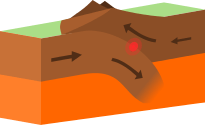

Which of the following are consequences of climate change?
Glaciers are shrinking and sea levels are rising
Heat wave are longer and more intense
Plant and animal habitat ranges are shifting
All of the above
This is a cause of too much atmospheric carbon dioxide:
Deforestation
Desertification
Global warming
Ozone depletion
The layers of the atmosphere are classified according to changes in
temperature and air pressure
altitude and air quality
humidity and temperature
air pressure and oxygen

