
 Worksheets
Chapter 25: Stars Galaxies Universe
Total questions: 100
Worksheet time: 51mins
What is a constellation?
A single star in the sky
A pattern of stars representing mythological characters, animals, or objects
A planet in the solar system
A type of galaxy
Why are some constellations called circumpolar?
They are visible only in the summer.
They circle around Polaris.
They are part of the zodiac.
They are only visible in the southern hemisphere.
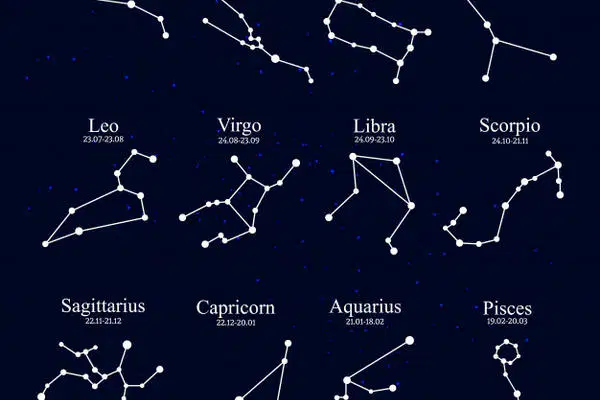
What happens to constellations as Earth orbits the Sun?
They remain visible all year.
They change their shape.
Different constellations come into view.
They disappear completely.

What is the absolute magnitude of a star?
A measure of the star's distance from Earth
A measure of the amount of light a star gives off
A measure of the star's size
A measure of the star's temperature
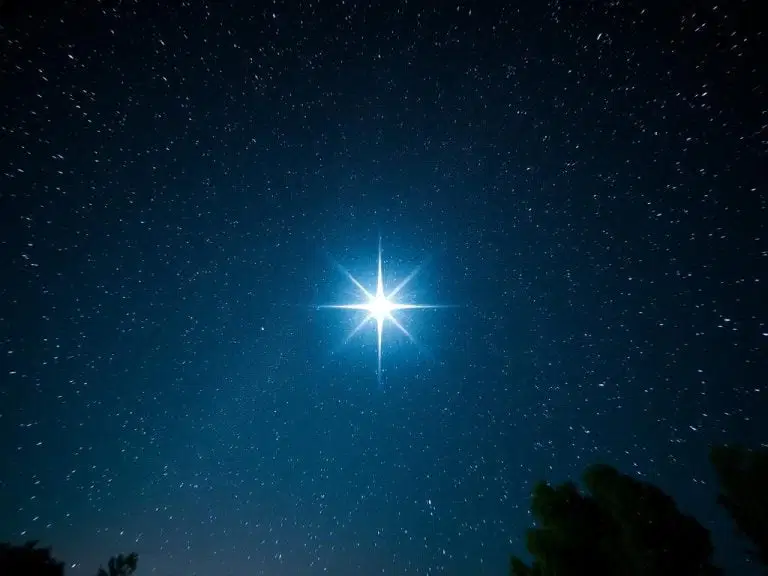
What is the apparent magnitude of a star?
A measure of the star's distance from Earth
A measure of the amount of light received on Earth
A measure of the star's size
A measure of the star's temperature

What is parallax in the context of measuring distances to stars?
The apparent shift in the position of an object when viewed from two different positions
The actual movement of stars in space
The change in brightness of a star over time
The rotation of Earth around the Sun
What is a light-year?
The time it takes for light to travel from the Sun to Earth
The distance light travels in one year
The time it takes for Earth to orbit the Sun
The distance between the Earth and the Sun
Which star is the nearest to Earth other than the Sun?
Alpha Centauri
Betelgeuse
Proxima Centauri
Sirius
What is a constellation?
A group of stars forming a recognizable pattern
A single star with a unique color
A planet orbiting a star
A type of galaxy
What is the Sun mainly made of?
Water and dust
Oxygen and nitrogen
Carbon and iron
Hydrogen and helium
Which layer is called the Sun's surface?
Photosphere
Corona
Chromosphere
Core
Sunspots appear dark because they are?
Sun flares
Cooler areas
Hotter areas
Gas clouds
Sunspots follow a cycle of about how many years?
20 days
5 years
11 years
50 years
Which layer extends millions of kilometers into space?
Photosphere
Corona
Radiation zone
Chromosphere
What is the Sun's atmosphere made of?
Core and radiation zone
Sunspots and flares
Photosphere, chromosphere, corona
Convection and core
What is the closest star system to the Sun?
Alpha Centauri
Beta Centauro
Omega Centauri
Centauri Alpha
What is solar wind?
Sun's magnetic field
Charged particles escaping
Sunspots moving
Sun's light rays
Which process powers the Sun's energy?
Hydrogen fusion
Chemical burning
Solar wind
Electricity
Which layer is the Sun's surface?
Corona
Photosphere
Core
Chromosphere
What causes solar wind?
Core
Corona
Photosphere
Sunspots
What is a sunspot?
dark area
solar flare
bright area
gas cloud
What is the Sun's age category?
young
Old
Middle-aged
Ancient
What is the Sun's role in the solar system?
Asteroid
Planet
Moon
Center
What is the Sun's surface temperature?
2 million K
6,000 K
1,000 K
10,000 K
What is the Sun's energy source?
nuclear fusion
fission
combustion
magnetism
What is the Sun's role in life on Earth?
none
minimal
harmful
essential
What is a CME?
Radiation
Solar flare
Sunspot
Corona Mass Ejection
True or false: The Sun is a binary star.
true
false
What is the Sun's core made of?
iron
oxygen
carbon
hyrdrogen
What is the term for a small, hot star consisting of a dense core contracting under the force of gravity?
Supergiant
White dwarf
Neutron star
Black hole
What is the classification for about 90 percent of the stars?
Main sequence
Supernova
Binary system
Nebula
What is the explanation for the beginning of the universe called?
Supernova
Big Bang theory
Galaxy
Corona
Which term refers to the outer layer and largest part of the Sun’s atmosphere?
Photosphere
Chromosphere
Corona
Sunspots
Sequence the colors of stars by temperature, labeling the hottest star as number 1.
Blue, Yellow, Red
Red, Yellow, Blue
Yellow, Blue, Red
Red, Blue, Yellow
Which of the following is a characteristic of the Milky Way galaxy?
Spiral Galaxy
Elliptical Galaxy
5.8 Million Light-Years from Andromeda
100,000 Light-Years in Diameter
How does the Sun produce energy?
Through nuclear fusion in its core
By burning hydrogen like a fire
Through gravitational contraction
By absorbing energy from nearby stars
What does the Doppler shift to red indicate about galaxies outside the Local Group?
Galaxies are moving closer to the Local Group
Galaxies are moving farther apart
Galaxies are stationary
Galaxies are merging
What is the difference between apparent magnitude and absolute magnitude of a star?
Apparent magnitude measures the actual light emitted by a star, while absolute magnitude measures the brightness as seen from Earth
Apparent magnitude measures the brightness as seen from Earth, while absolute magnitude measures the actual light emitted by a star
Both apparent and absolute magnitude measure the distance of a star
Both apparent and absolute magnitude measure the size of a star
What does the Big Bang theory suggest about the formation of the universe?
The universe was formed from a slow cooling process
The universe was formed as a result of a large explosion
The universe was formed from merging galaxies
The universe was formed from a collapsing star
About 90 percent of all stars are _______ stars.
nebula
giant
main sequence
white dwarf
The hottest stars in space are _______ in color.
yellow
red
blue
green
A main sequence star becomes a _______ after it uses up the hydrogen in its core.
nebula
supernova
black hole
giant
The Sun produces energy by fusing hydrogen into _______ in its core.
carbon
helium
iron
oxygen
The intense magnetic field associated with sunspots may cause huge arching columns of gas called _______.
solar flares
coronas
photospheres
prominences
A galaxy that has a shape similar to a football is a(n) _______ galaxy.
normal spiral
barred spiral
elliptical
irregular
The Big Bang theory of the formation and expansion of the universe is supported by the observed _______.
blue-violet shift in light beyond the Local Group
red shift in light beyond the Local Group
gravity of matter
shorter light wavelengths
A ______ is an object so dense that nothing can escape its gravity field.
supernova
neutron star
black hole
supergiant
Dark, cooler areas on the Sun’s surface are called ______.
sunspots
solar flares
coronas
prominences
The coolest stars in the sky are ______ in color.
yellow
red
blue
green
A large group of stars, gas, and dust held together by gravity is a ______.
galaxy
constellation
Local Group
elliptical galaxy
What happens to the wavelengths of light when an object moves away from you?
They get shorter and shift to blue on a spectrum.
They get longer and shift to red on a spectrum.
They remain the same.
They disappear completely.
What is the cause of a supernova?
A star’s core collapses and its outer portion explodes.
A star’s temperature drops significantly.
A star’s gravity weakens.
A star’s orbit changes.
How does the Big Bang theory help explain the observed Doppler effects?
It explains the redshift observed in distant galaxies.
It describes the formation of stars and planets.
It predicts the existence of black holes.
It explains the gravitational pull of the Sun.
The Doppler shift shows a shift to blue-violet on the spectrum. Would the Big Bang theory help explain this shift?
Yes, because it indicates galaxies are moving closer.
No, because the Big Bang theory only explains redshift.
Yes, because it shows the expansion of the universe.
No, because blue-violet shifts are unrelated to the Big Bang theory.
Why is energy produced by the Sun when hydrogen fuses into helium?
Because fusion releases energy as light and heat.
Because helium absorbs energy from hydrogen.
Because hydrogen atoms split into smaller particles.
Because the Sun's gravity compresses hydrogen atoms.
What does the Big Bang theory suggest about the universe?
The universe has always existed in its current state
The universe was formed and is expanding as a result of a large explosion
The universe is contracting and will eventually collapse
The universe is stationary and unchanging
What happens to the "lost" mass when hydrogen fuses into helium in the Sun?
It is converted into energy.
It disappears completely.
It forms new hydrogen atoms.
It becomes part of the Sun's core.
What is the solar wind primarily composed of?
Water vapor from the Sun.
Charged particles from the Sun.
Dust and debris from space.
Light waves from the Sun.
What phenomenon is caused by the interaction of the solar wind with Earth's magnetic field?
Solar flares.
Aurora borealis.
Sunspots.
Solar eclipses.
How do constellations help sailors navigate?
By providing a map of the ocean floor.
By indicating the direction of the wind.
By serving as fixed points in the night sky.
By predicting weather patterns.
What is the estimated remaining lifespan of the Sun?
1 billion years.
5 billion years.
10 billion years.
20 billion years.
What is the outermost layer of the Sun called?
The core.
The corona.
The photosphere.
The chromosphere.
What type of constellations circle Polaris?
Circumpolar
Binary
Galaxies
Spectrographs
What do scientists use to break visible light from a star into its component colors?
Telescopes
Spectrographs
Light-years
CMEs
How are distances in space measured?
Light-years
CMEs
Magnitude
Brightness
What is the measure of the amount of light received on Earth called?
Absolute magnitude
Apparent magnitude
Brightness
Circumpolar magnitude
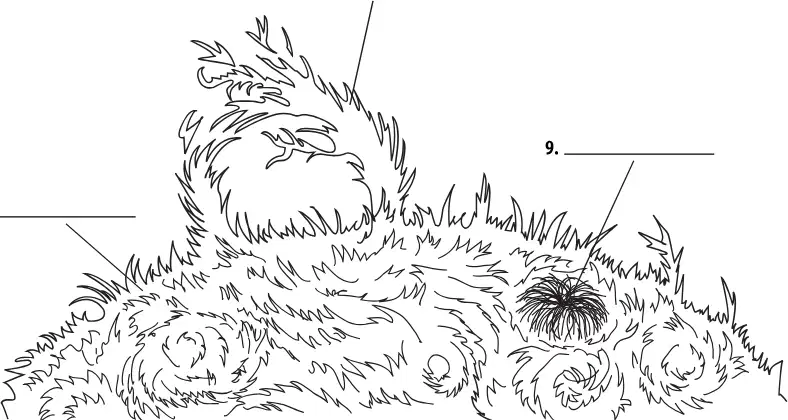
Identify the labeled part of the Sun marked as '7' in the diagram.
Prominence
Surface
Sunspot
CME
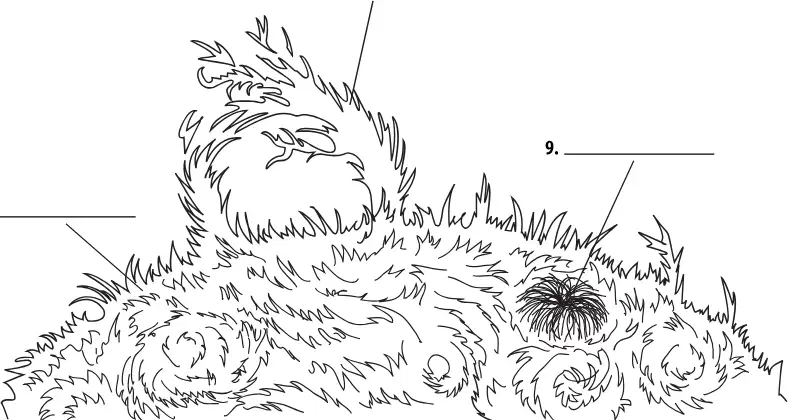
Identify the labeled part of the Sun marked as '9' in the diagram.
Prominence
Surface
Sunspot
CME
Which color is associated with relatively cool stars?
Blue
White
Red
Yellow
What is the distance that light travels in one year, approximately 9.5 trillion kilometers, called?
Light Year
Astronomical Unit
Parsec
Cosmic Year
Which of the following is a type of star that is small and dense, often the remnant of a star that has exhausted its nuclear fuel?
Supergiant
White dwarf
Spiral
Nebula
Which of the following best describes the Milky Way?
A supergiant star
A spiral galaxy
A white dwarf
A red shift
What is the term for the phenomenon where light from a galaxy shifts toward the red end of the spectrum, indicating that the galaxy is moving away from us?
Blue shift
Red shift
Supernova
Big Bang
Which of the following is the correct sequence of a star's life cycle?
Nebula → Main sequence → Giant → White dwarf
Main sequence → Nebula → Giant → White dwarf
Giant → Nebula → Main sequence → White dwarf
White dwarf → Giant → Main sequence → Nebula

What is the primary classification of the Sun?
A red giant
A white dwarf
A main sequence star
A neutron star
How is the energy of the Sun produced?
Through chemical reactions
Through nuclear fusion in its core
By gravitational contraction
By burning fossil fuels
How do coronal mass ejections (CMEs) affect Earth?
They cause earthquakes
They disrupt Earth's magnetic field and can affect satellites
They increase Earth's temperature significantly
They create new landforms on Earth
What is the relationship between sunspots, prominences, and solar flares?
They are unrelated phenomena
Sunspots are cooler regions, and prominences and solar flares are related to magnetic activity around sunspots
Sunspots cause prominences, but not solar flares
Prominences and solar flares occur only in the absence of sunspots
Which of the following is a type of star that is small and dense, often the remnants of a star that has exhausted its nuclear fuel?
Supergiant
White dwarf
Spiral
Nebula
Why is the concept of "red shift" important in understanding the universe?
It explains the lifecycle of stars.
It provides evidence for the expansion of the universe.
It describes the formation of galaxies.
It measures the brightness of stars.
Which of the following is a characteristic of a supergiant star?
It is smaller than the Sun.
It is cooler and less bright than a white dwarf.
It is one of the largest and brightest types of stars.
It is found only in the Milky Way galaxy.
What is the Sun classified as?
A red giant star
A yellow main sequence star
A white dwarf star
A neutron star
What is the primary source of the Sun's energy?
The fusion of helium into carbon
The fusion of hydrogen into helium
The splitting of uranium atoms
The burning of methane gas
What can cause prominences that erupt from the Sun?
The intense magnetic field of sunspots
The gravitational pull of the Moon
The Earth's magnetic field
The rotation of the Sun
What is the term for the sudden brightening of sunspots caused by magnetic energy release?
Solar flares
Coronal mass ejections
Aurora borealis
Solar prominences
What is the name of the region outside a black hole where nothing can escape its gravitational pull?
The Event Horizon
The Singularity
The Schwarzschild Radius
The Accretion Disk
A large cloud of dust and gas that becomes a star is called a __________.
Nebula
Supernova
Black Hole
White Dwarf
What graph shows the relationship between a star’s absolute magnitude and temperature?
Hertzsprung-Russell Diagram
Periodic Table
Star Evolution Chart
Fusion Energy Graph
What powers the Sun and other stars by the fusion of atoms?
Hydrogen
Helium
Carbon
Oxygen
What is formed when a collapsed core becomes so dense that only neutrons can exist there?
Neutron Star
Black Hole
White Dwarf
Supernova
What is so dense that nothing, including light, can escape its gravity field?
Black Hole
Neutron Star
Supernova
White Dwarf
What is the energy of the Sun produced by?
The fusion of helium
The fusion of hydrogen
The fission of uranium
The combustion of carbon
What phenomenon can disrupt radio signals and interact with Earth's magnetic field, causing auroras near the polar regions?
Solar flares
Coronal mass ejections (CMEs)
Sunspots
Prominences
What is the intense magnetic field of sunspots capable of causing?
The formation of black holes
The eruption of prominences
The creation of supernovae
The fusion of hydrogen

What did Einstein propose about mass and energy?
Mass can be converted into energy
Energy can be converted into mass
Mass and energy are unrelated
Mass and energy are infinite
Which galaxy is a member of the Local Group?
Clouds of Magellan
Andromeda
Milky Way
Oscillating model
What is the explanation for the formation of the universe according to one model?
Big Bang theory
Steady state theory
Oscillating model
Doppler shift
What is the name of the galaxy that contains more than 200 billion stars?
Milky Way
Andromeda
Clouds of Magellan
Spiral galaxy
What can CMEs (Coronal Mass Ejections) disrupt?
The Sun's core temperature
Earth's magnetic field
The orbit of planets
The Sun's fusion process

Name each type of the galaxies
Galaxy 1
Spiral
Galaxy 2
Elliptical
Galaxy 3
Irregular

