
 Worksheets
Ecology Final Review
Total questions: 102
Worksheet time: 1hrs 5mins
A pack of wolves are hunting within their ecosystem. These wolves are an example of a(n)
population
organism
biome
biosphere
A group of foxes are roaming in an open field in which a spider, two rabbits and three squirrels are also living. Which level of ecological organization is this?
community
population
organism
none of the above


New York City

This organism is a lynx that is stalking its prey (the arctic hare). Which of the following represents the relationship between the hare and the lynx?
Predation
Competition
Parasitism
Mutualism

These two bears are fighting over territory along this stream. The stream holds an abundance of food that the bears desire access to. This situation is an example of which symbiotic relationship?
Competition
Predation
Mutualism
Commensalism

This dog is scratching behind his ears and along the side of his body. First, what could cause him to scratch this way? Second, what symbiotic relationship does this represent?
1: Fleas
2: Parasitism
1: Skin Allergies
2: Mutualism
1: Ticks
2: Commensalism
1: Hot Weather
2: Parasitism
Which of the following habitats is located furthest from the equator?
Polar Habitats
Tropical Rainforests
Seasonal Forests
Deserts
Which of the following habitats has extremely hot days and much colder nights?
Deserts
Tropical Rainforests
Tundra
Seasonal Forests
Which of the following choices best describes an adaptation you would see in the Tundra?
Plants have shallow roots to avoid the layer of permanently frozen ground (permafrost).
Leaves on trees change colors and fall off as the seasons get cooler, and they return as the warmer seasons arrive.
A taproot accesses water that is deep under the surface in this hot and dry habitat.
A tree has wide branches in order to catch as much rainfall as possible.
Which of the following habitats cover over 70 percent of the Earth's surface?
Oceans
Deserts
Seasonal Forests
Tropical Rainforests
Which of the following adaptations would you see in a seasonal forest habitat?
Birds migrate as the seasons change. They move further from the equator in the warmer months and closer to equator in the cooler months.
An animal is nocturnal to avoid the brutally hot temperatures that this habitat experiences each day.
Trees have needles instead of leaves due to the fact that there is less water available in this habitat than most.
None of these answers are correct.
In this habitat, you would see some of the fastest animals in the world due to its wide open spaces with lots of grass and very few trees.
Grasslands
Evergreen Forests
Seasonal Forests
Deserts
An animal may hibernate during the colder months that this habitat experiences. (Hint: the trees have needles and stay green all the time.)
Evergreen Forest
Seasonal Forest
Desert
Grassland
A regularly seen adaptation in this habitat is camouflage which allows smaller organisms to blend in with their surroundings to avoid predators. (Hint: this habitat has the greatest number of plant and animal species in the world.)
Tropical Rainforests
Seasonal Forests
Deserts
Tundra

What is this diagram called?
Food web
Food chain
Food map
Food menu
An organism that eats both plants and animals is known as a(n)
Carnivore
Omnivore
Herbivore
Decomposer
Autotrophs are organisms that produce their own food. Which do scientists classify as autotrophs?
Chordates
Fungi
Plants
Molds
What is the first source of energy for almost all food webs?
Plants
Sunlight
Mineral in the soil
Decomposers
Which organisms are at the bottom level of an energy pyramid?
Producer
Consumer
Decomposer
Scavenger
Which organisms have the most available energy in an energy pyramid?
Producers
Consumers
Decomposers
Detritivores


If there are 47,802 calories (energy) available at the producer level of this food chain, how many calories would be available at the tertiary consumer level?
47.802
478.02
4.7802
0

In this food chain, the snake would be a
tertiary consumer
secondary consumer
primary consumer
producer
Which one of the following questions should I ask an environmental scientist if I was trying to discover what type of consumer (herbivore, carnivore, omnivore,etc.) a kangaroo is?
What do they eat?
Where do they live?
Are they mammals?
How much do they eat?

Based on your knowledge of the pyramids of energy and numbers, which organism would have the smallest population in the pyramid pictured?
hawks
frogs
insects
plants

There are 1,567 calories available at the producer level of this pyramid, and there are only 15.67 calories available at the secondary consumer level. Which of the following choices BEST explains why there is less energy available at the secondary consumer level?
There are less organisms at the secondary consumer level.
Secondary consumers can't do photosynthesis.
The secondary consumers are more likely to go extinct.
90% of energy is lost as it is transferred to the next trophic level.


This Japanese kudzu was brought into the U.S. It quickly grew out of control and took over many forest ecosystems. This is an example of
invasive species
native species
endangered species
keystone species


Mass extinction is
when many species die over a short period of time.
when one species dies over a short period of time.
when many species die over a very long period of time.
a made up idea.
Large populations with high genetic diversity are
more likely to go extinct
more likely to be invasive
less likely to go extinct
less likely to be invasive

Which of the following pictures represents the place that is MOST likely to have the highest species diversity?


This island is more likely to have __________ species due to its unique climate and isolated location.
endemic
keystone
extinct
healthy
The Mojave Desert Tortoise is responsible for digging many areas throughout the desert in order for it to live. A byproduct of the tortoise digging these holes is that many species are provided shelter from the harsh conditions of the desert. Without the tortoise, many of these species would not survive because they are not able to build their own homes. The Mojave Desert Tortoise would be considered a(n)
Keystone Species
Endangered Species
Endemic Species
Invasive Species
The snowshoe hare is a key food source for many predators in the tundra and evergreen forest habitats. If the hare were to go extinct, many of these predators would lose a food source that is key to their survival. The snowshoe hare would be an example of a(n)
Keystone Species
Endangered Species
Extinct Species
Invasive Species
Genetic diversity is important because
The more genetically diverse a population is, the more likely it is to survive environmental changes.
The more genetically diverse a population is, the cooler they look for National Geographic.
The more genetically diverse a population is, the more likely they are to go extinct.
Coach Reed says it is important, so it must be important.
Spotted Owls do not build their own nests in forest lands, so they rely on the forest being older and very dense to help provide a safe home. If the population of these owls begins to decline, that means the forest's health and supply of older trees must be declining. The Spotted Owl is an example of a(n)
Indicator Species
Endangered Species
Keystone Species
Invasive Species
In the last 2 centuries, extinction rates have increased along with
an increase in human population
a decrease in human population
an increase in biodiversity
a decrease in biodiversity

After years of DDT pesticide use, the bald eagle was nearing extinction. When scientists realized this, they placed it on the
endangered species list
keystone species list
invasive species list
illegal species list


The island of Madagascar is home to some of the rarest species in the world, and it also has a limited amount of space for them to live in due to human expansion in the area. This island country is an example of a
biodiversity hot spot
germ plasm
endangered land
biological phenomenon

What type of growth does this graph of human population growth represent?
Logistic
Exponential
Random
Slow
What caused the human population to increase so rapidly after the late 1700s/early 1800s?
World War II
Industrial Revolution
Cold War
Dust Bowl
What historical event led to the only decrease in the human population to ever occur?
Black Death/Plague
The Civil War
World War I
The Holocaust
Which of the following is a reason that human population growth has slowed in recent years?
Less birth control is available around the world.
The population controller has taken a leave of absence.
Birth control is more widely available.
We are in the middle of a world war.

Afghanistan is a developed country?
True
False

True or False? The United States is a developed country?
True
False
Which of the following are characteristics of a developing country that affect population growth?
There are no characteristics that affect population growth in a developing country.
lack of stable government, lack of healthcare, and little access to birth control
the government is stable, has a good healthcare system, and easy access to birth control
Which of the following are characteristics of a developed country that affect population growth?
There are no characteristics that affect a developed country.
the government is stable, has a good healthcare system, and easy access to birth control
the government is unstable, inadequate healthcare system, little access to birth control
If the human population reaches its carrying capacity in 2100, what type of growth will the human population represent?
Exponential
Logistic

If the mortality of a population is greater than the natality, the population shrinks.
True
False


Carrying Capacity is
the capacity of what one person can carry per day
how many animals you have in your daily bag limit at the end of the year
wildebeest at a watering hole with zebras
the maximum number of individuals that the environment can support
If a population grows larger than its environmental carrying capacity, then
death rate may rise.
death rate may fall significantly.
birth rate may rise significantly.
immigration rate may increase.

The lighter (pink) curve in this graph represents
Logistic Growth
Exponential Growth
Light Growth
Sideways Growth

The seal population shown in this graph is growing logistically. The highest the population of seals is achieved around 1992 at about 7500 total seals. This would be known as this population's
carrying capacity
limiting factor
exponential growth period
minimum population

In a population of chimpanzees, 13 chimps are born, 7 die and 20 immigrate during one week. Is this population of chimpanzees increasing, decreasing or staying the same?
Increasing
Decreasing
Staying the same
In a population of squirrels, 22 squirrels die, 14 are born and 8 immigrate. Is this population of squirrels increasing, decreasing or staying the same?
Increasing
Decreasing
Staying the same
Which of the following is considered a density dependent factor?
diseases
tornadoes
fires
floods
Which of the following pics represents a clumped population dispersion?


Which of the following pics represents a uniform population dispersion?
Which of the following pics represents a random population dispersion?
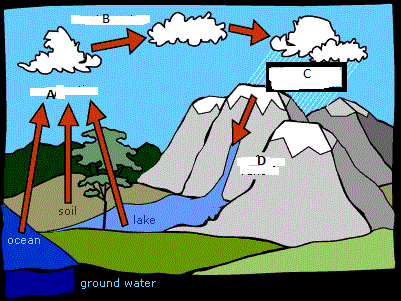
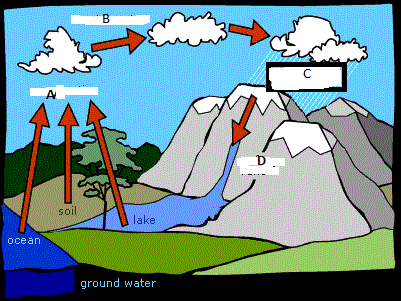
What is the process that converts nitrogen into a form that can be used by plants and animals?
How does phosphorus travel through an ecosystem?
From the soil to producers and then from producers to consumers.
From the air directly into consumers and then from consumers to producers.
Phosphorus cannot travel through an ecosystem.
From the soil to producers and that is as far as phosphorus may travel.
Which of the following describes the long-term portion of the water cycle?
69% of all freshwater is trapped in ice caps and glaciers.
Transpiration through the leaves of plants.
Formation of fossil fuels due to intense heat and pressure.
Different forms of precipitation such as rain, snow or sleet.

As CO2 concentration increases in this graph, how is average global temperature affected?
As CO2 concentration increases, average global temperature increases.
As CO2 concentration increases, average global temperature decreases.
As CO2 concentration increases, global temperature stays the same.
CO2 concentration and average global temperature have no relationship.

Based on this graph, you can infer that
CO2 absorbs heat which makes global temperature rise as CO2 concentration increases.
CO2 levels do not affect the global temperature because the graph shows no correlation between the two.
Global temperature is going to increase so much that the ice caps and glaciers will melt in a few years.
Global temperature is increasing which means CO2 concentration will decrease in the next few years.
Which of the following explains the long term portion of the phosphorus cycle?
Phosphorus is stored in rocks, and it is slowly recycled back into the ecosystem through weathering and erosion.
Phosphorus is constantly cycled through the food chain starting at the producer level and working its way to the apex predator.
Phosphorus does not have a long term portion.
Phosphorus cannot be recycled and reused because it is a nonrenewable resource.
If a farmer uses an excessive amount of fertilizer and this fertilizer washes into a nearby lake in runoff, what is likely to happen in this area?
The plant life will grow exponentially, and many of the fish living in this area will die.
The plant life will be destroyed, and many of the fish in this area will die due to a lack of food.
The fish in this area will multiply exponentially, and they will destroy the plant life.
Fertilizer will not affect the area because it only affects the growth of plants that grow on land.
Artificial eutrophication occurs when nutrients like phosphorus and nitrogen are introduced to an area as a byproduct of human activities. Which of the following human activities could lead to this environmental issue?
A farmer using an excessive amount of fertilizer on their crops.
A construction company working all through the night in a large city.
A man watering his front lawn on a daily basis during a drought.
Feeding the ducks at a local pond when a sign specifically states that you should not feed the ducks.
Which of the following choices names the process in which phosphorus is broken down and reintroduced into ecosystems?
Erosion
Nitrogen Fixation
Denitrification
Condensation

