wayground logo

Free Printable Worksheets

Font size

S
M
L
XL
Worksheets

Unit 9- Chemical Reactions

Total questions: 95

Worksheet time: 3hrs 45mins

Name
Class
Date
1.

What is the Law of Conservation of Mass?

a)

It states that matter cannot be created or destroyed.

b)

It states that energy cannot be created or destroyed.

c)

It states that matter can be created or destroyed.

d)

It states that sound can be created or destroyed.

2.
What is a coefficient?
a)
The small number on the right of the chemical symbol.
b)
The large number in front of a chemical formula.
c)
The number in between the chemical symbols.
d)
The number behind a chemical formula.
3.
What is the part of the chemical equation in green called? 
Fe + S --> FeS
a)
products
b)
reactants
c)
yield
d)
chemical formula
4.
What is the little number after an element in a chemical equation called.
Example: H2
a)
Coefficient 
b)
Subscript
c)
Atom
d)
Equation
5.
What coefficient should be used to make the following equation balanced?
N2+O2--> _NO 
a)
1
b)
2
c)
3
d)
4
6.
Which problem is balanced?
(Check ALL answers)
a)
PbO2 + 2H2
b)
SO2 + H20 --> H2SO4
c)
2Na + 2H2O --> 2NaOH + H2
7.
How many elements are in C6H12O6?
a)
1
b)
2
c)
3
d)
4
8.
Element or compound?
H2O
a)
element
b)
compound
9.
How many HCl molecules do you need to balance this equation? 
Mg +  __HCl --->  MgCl2 + H2
a)
1
b)
2
c)
3
d)
4
10.
Is this balanced?
Al + O2 → 2Al2O3
a)
Yes
b)
No
11.

Is the equation balanced?: 2H2O + O2 --> 4MgO + 3Fe

a)

yes

b)

no

12.

Balance this equation

_Al +_HCl --> _H2 +_AlCl3

a)

2,6,3,2

b)

it's already balanced

c)

4,12,3,4

d)

2,1,4,5

13.
What is the total number of atoms present in 5Na3PO4
a)
5
b)
40
c)
55
d)
8
14.
Is the following equation balanced?
2C2H2 + 5O2 --> 4CO2 + 2H2O
a)
yes
b)
no
15.
Is the following equation balanced?
4Fe + 3O2 --> 2Fe2O3
a)
yes
b)
no
16.
Is the following reaction balanced?
NaHCO3 --> Na2CO3 + H2O + CO2
a)
yes
b)
no
17.
Is the following reaction balanced?
2CH3OH + 3O2 --> 2CO2 + 4H2O
a)
yes
b)
no
18.
What coefficient should be used to make the following equation balanced?
N2+O2--> _NO 
a)
1
b)
2
c)
3
d)
4
19.
What are the smaller numbers that you CANNOT change in a chemical equation? 
a)
Coefficient
b)
Products
c)
Reactants
d)
Subscript
20.
What are the larger numbers that you CAN CHANGE in a chemical equation? 
a)
Coefficient 
b)
Products
c)
Reactants
d)
Subscripts
21.
Combining substances to form a new substance
a)
Displacement
b)
Synthesis
c)
Decomposition
d)
Oxidation
22.
Breaking down a substance into simpler substances
a)
Displacement
b)
Synthesis
c)
Decomposition
d)
Oxidation
23.
Switching one substance for another
a)
Displacement
b)
Synthesis
c)
Decomposition
d)
Oxidation
24.
What type of reaction is the equation C + O→ CO2?
a)
Synthesis Reaction
b)
Decomposition Reaction
c)
Single Displacement Reaction
d)
Double Displacement Reaction
25.
What type of reaction is the equation 2NaCl →2Na +Cl2?
a)
Synthesis Reaction
b)
Decomposition Reaction
c)
Single Displacement Reaction
d)
Double Displacement Reaction
26.
Cu + 2Ag(NO3) → 2Ag + Cu(NO3)
a)
Synthesis Reaction
b)
Decomposition Reaction
c)
Single Displacement Reaction
d)
Double Displacement Reaction
27.
Ca3(PO4)2 + 3 H2SO4 + 3 CaSO4 + 2 H3(PO4)
a)
Synthesis Reaction
b)
Decomposition Reaction
c)
Single Displacement Reaction
d)
Double Displacement Reaction
28.
Consider the chemical equation CH4 + 2 O2 → CO2 + 2 H2O. In this equation, CH4 is a
a)
product
b)
reactant
c)
displacement
29.
Consider the equation 4 Fe+3 O2 → 2 Fe2O3 . In this equation, 3 O2 is a
a)
product
b)
reactant
c)
compound
30.
Which of the following is an example of a physical change to matter?
a)
rusting
b)
digestion
c)
freezing
31.
Photosynthesis is a chemical reaction that involves the production of glucose (sugar) from carbon dioxide and water in the presence of sunlight. Photosynthesis is what kind of reaction?
a)
Exothermic
b)
Endothermic
c)
Decomposition
32.
During an endothermic reaction, what happens to energy in relation to the surroundings?
a)
released to
b)
absorbed from
c)
 mixed with
33.
During an exothermic reaction, what happens to energy in relation to the surroundings?
a)
released to
b)
absorbed from
c)
 mixed with
34.
In a cold pack, which type of reaction draws heat from the surroundings?
a)
exothermic
b)
endothermic
c)
exergonic
35.
Which generalized equation represents a synthesis reaction?
a)
A + BC → AC+ B
b)
A + B → AB
c)
AB → A + B
36.
Which generalized equation represents a decomposition reaction?
a)
A + BC → AC+ B
b)
A + B → AB
c)
AB → A + B
37.
Which generalized equation represents a single displacement reaction?
a)
A + BC → AC+ B
b)
A + B → AB
c)
AB → A + B
38.

Identify the following chemical reaction.

2 NaBr + 1 Ca(OH)2 ----> 1 CaBr2 + 2 NaOH

a)

Synthesis (or combination)

b)

Decomposition

c)

Single displacement

d)

Double displacement

39.

Identify the following chemical reaction.

3 HBr + 1 Al(OH)3 ----> 3 H­2O + 1 AlBr3

a)

Synthesis (or combination)

b)

Decomposition

c)

Single displacement

d)

Double displacement

40.

Identify the following chemical reaction.

Pb + FeSO4 ----> PbSO4 + Fe

a)

Synthesis (or combination)

b)

Decomposition

c)

Single displacement

d)

Double displacement

41.

What reaction has the following general formula:

AB --> A + B

a)

Synthesis

b)

Decomposition

c)

Single Replacement

d)

Double Replacement

e)

Combustion

42.

What reaction has the following general formula:

A + CD --> C + AD

a)

Synthesis

b)

Decomposition

c)

Single Replacement

d)

Double Replacement

e)

Combustion

43.

What reaction has the following general formula:

AB + CD --> CB + AD

a)

Synthesis

b)

Decomposition

c)

Single Replacement

d)

Double Replacement

e)

Combustion

44.

What reaction has the following general formula:

A + B --> AB

a)

Synthesis

b)

Decomposition

c)

Single Replacement

d)

Double Replacement

e)

Combustion

45.
What is the oxidation number of Fe in FeO?
a)
+1
b)
-1
c)
+2
d)
-2
46.
What is the oxidation number of O in CO2?
a)
+2
b)
-1
c)
+4
d)
-2
47.
What is the oxidation number of N in NO21- ?
a)
-3
b)
+4
c)
-2
d)
+3
48.
If an atom loses electrons during a chemical reaction, the atom was:
a)
Oxidized
b)
Reduced
c)
Neutralized
d)
Precipitated
49.
What is the oxidation of C in CH4?
a)
-4
b)
-1
c)
+4
d)
+1
50.
What is oxidation number of Mn in MnO2 ?
a)
0
b)
+2
c)
-2
d)
+4
51.
What is the oxidation number of Ca in Ca3N2?
a)
+3
b)
+2
c)
-3
d)
-2
52.
What is the oxidation number of S in SO4 2-  ?
a)
-2
b)
+2
c)
+6
d)
-4
53.
What is oxidation number of Cr in
Cr2O72-?
a)
-2
b)
+2
c)
+6
d)
+12
54.
What is oxidation number of P in K3PO4?
a)
+1
b)
+5
c)
-2
d)
0
55.

Oxidation number of Fe in Fe2O3:

a)

0

b)

-2

c)

+2

d)

+3

56.

Oxidation number of H in NaH:

a)

0

b)

+1

c)

-1

d)

+2

57.

What is the oxidation state of phosphorous in Mg3(PO4)2

a)

+2

b)

+3

c)

+4

d)

+5

58.

What is the oxidation state of H in H2?

a)

+2

b)

+1

c)

0

d)

None of the above

59.

What is the oxidation state of Cu in Cu2+?

a)

-1

b)

-2

c)

+2

d)

0

60.

What is the oxidation state of Cl in ClO- ?

a)

0

b)

+1

c)

-1

d)

+2

61.

What is the oxidation number for O2

a)

-2

b)

-1

c)

0

d)

+2

62.

What is the oxidation number of H in H2O?

a)

-1

b)

+1

c)

+2

d)

-2

63.

Defined as the loss of electrons.

a)

oxidation

b)

reduction

c)

redox

d)

OIL RIG

64.

Defined as the gain of electrons.

a)

oxidation

b)

redox

c)

reduction

d)

LEO GER

65.
What element is being Oxidized?
a)
N
b)
H
c)
O
d)
S
66.
What element is being Reduced?
a)
N
b)
H
c)
O
d)
S
67.
What element is being Oxidized?
a)
I
b)
H
c)
S
d)
O
68.
What element is being reduced?
a)
I
b)
H
H
c)
S
S
d)
O
O
69.
If in a reaction, copper is reduced; its number of electrons has:
a)
Increased
b)
Decreased
c)
Remained Constant
d)
Varies Randomly
70.
If an atom loses electrons during a chemical reaction, the atom was:
a)
Oxidized
b)
Reduced
c)
Neutralized
d)
Precipitated
71.

During an exothermic reaction, heat content in the surroundings increases because

a)

heat energy is destroyed during reactions

b)

the reaction absorbs heat energy

c)

the energy contained in the reactants is lower then the products

d)

the energy contained in the products is lower than the reactants

72.
In an endothermic reaction the system is releasing energy.
a)
True
b)
False
73.
For an endothermic reaction, the heat is on the ____ side.
a)
reactant
b)
product
c)
either side
74.
For an exothermic reaction, the heat is on the ____ side
a)
reactant
b)
product
c)
either side
75.
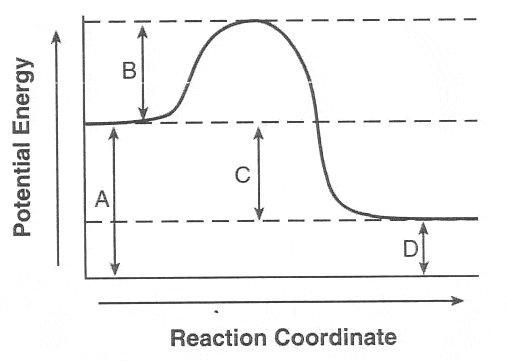
What type of reaction is shown in the picture?
a)
endothermic
b)
exothermic
76.
In an exothermic process, the surroundings are are gaining energy.
a)
True
b)
False
77.

List three factors that affect the rate of a reaction

a)

temperature

b)

concentration

c)

surface area

d)

volume

78.

A temperature increase causes the particles ......

a)

to slow down

b)

move faster

c)

collide higher

d)

in the right order

79.

Why does a higher concentration increase the rate of reaction?

a)

it increases the amount of reactants

b)

it lowers the activation energy

c)

it increases the energy of particle collisions

d)

it increases the frequency of particle collisions

80.

Why does a higher temperature increase the rate of a reaction?

a)

it increases both the frequency and energy of particle collisions

b)

it only increases the frequency of particle collisions

c)

it only increases the energy of particle collisions

d)

it reduces the activation energy of the reaction

81.
What is the rate of reaction?
a)
How fast a reaction is 
b)
How big a reaction is
c)
How loud a reaction is
d)
How much gas a reaction produces
82.
Grinding a seltzer tablet into powder increases the rate of reaction due to increased
a)
concentration
b)
surface area
c)
temperature
d)
reactants
83.

The rate of a reaction is how _____________ a reaction occurs.

a)

Quickly

b)

Easily

c)

Unusually

d)

Differently

84.
More collisions correspond to a: 
a)
Faster reaction rate  
b)
Slower reaction rate
c)
Constant reaction rate 
d)
None of the above
85.
Which factors increase the rate of a reaction.
a)
increasing temperature
b)
increasing concentration
c)
increasing surface area
d)
all of these
86.
To slow down a chemical reaction you will do one of the following:
a)
Place the reactants in hot water
b)
Place the products in ice bath
c)
Place the reactants in a ice bath
d)
Keep stirring the reactants with a stirring rod
87.

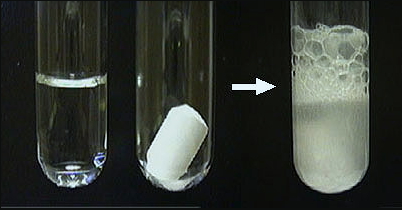
How could we make this reaction happen more quickly?

a)

Decrease the concentration of the acid

b)

crush the chalk to increase the surface area

c)

Put the test tube in an ice bath

88.
The rate of a chemical reaction is NOT affected by which of the following:
a)
temperature
b)
concentration
c)
particle size (surface area)
d)
All of these affect reaction rates
89.
Products will form faster if____________
a)
the particle size of the reactants are larger.
b)
temperature is decreased.
c)
concentration of the reactants are increased.
d)
the reaction is not stirred.
90.
A ______________ is a substance that increases the rate of a reaction without being used up during the reaction. 
a)
catalyst
b)
product
c)
reactant
d)
solute
91.

Adding a catalyst ___________ the activation energy.

a)

Raises

b)

Lowers

c)

Doesn't affect

d)

Inreases

92.

The minimum amount of energy needed for colliding particles to react is called

a)

Chemical Energy

b)

Kinetic Energy

c)

Activation Energy

d)

Potential Energy

93.
What makes an effective collision?
a)
When molecules collide.
b)
When molecules collide with the proper orientation.
c)
When molecules collide with proper orientation and enough kinetic energy.
d)
High Temperature.
94.
Exothermic reactions release heat to the surroundings.
a)
true
b)
false
95.
What type of reaction is this?
a)
Endothermic
b)
Exothermic