
 Worksheets
Earth and Space Fall Final
Total questions: 99
Worksheet time: 50mins
Name
Class
Date
1.
1. The “repeatability” of measurement is known as…
a)
Accuracy
b)
Precision
c)
Significant figures
d)
A theory
2.
2. The metric system is also known as the…
a)
British
b)
English
c)
SI
d)
F.P.S.
3.
3. Scientists Test a Hypothesis by…
a)
Formulating questions
b)
Doing experiments
c)
Designing models
d)
Drawing conclusions
4.
Which SI Prefix means one hundredth (1/100)?
a)
Kilo-
b)
Hecto-
c)
Milli-
d)
centi-
5.
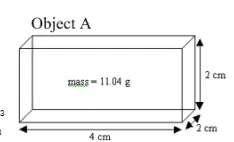
what is the volume of object A?
a)
10 cm3
b)
12 cm3
c)
14 cm3
d)
16 cm3
6.
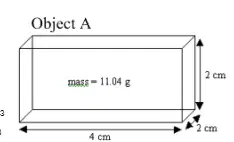
What is the density of object A?
a)
69.0 g/cm3
b)
6.90 g/cm3
c)
0.69 g/cm3
d)
690 g/cm3
7.
The first step in the scientific method is…
a)
Observing
b)
Forming a hypothesis
c)
Experimenting
d)
A baby step
8.
Convert 263.5 cm to hm.
a)
0.2635 hm
b)
0.02635 hm
c)
2.635 hm
d)
26.35 hm
9.
Convert 12 km to hm.
a)
120 hm
b)
1200 hm
c)
1.2 hm
d)
0.12 hm
10.
The value 0.67 kg is equal to….
a)
6.7 g
b)
6700 g
c)
670 g
d)
67 g
11.
The amount of mass in a space is called ____________.
a)
kilogram
b)
squishyness
c)
density
d)
height
12.

What is the volume of the object in graduated cylinder B?
a)
3 mL
b)
5 mL
c)
8 mL
d)
12 mL
13.

What is the density of the object in graduated cylinder B?
a)
1.1 g/cm3
b)
11.3 g/cm3
c)
5.2 g/cm3
d)
52.0 g/cm3
14.
A balance scale is used to measure volume.
a)
True
b)
False
15.
Air molecules are so small they are not considered to be matter.
a)
True
b)
False
16.
A possible answer to why something is happening is called a hypothesis.
a)
True
b)
False
17.
Matter is anything that has mass and occupies space.
a)
True
b)
False
18.
The amount of space an object takes up is called its mass.
a)
True
b)
False
19.
The SI measure for time
a)
liter
b)
meter
c)
second
d)
gram
20.
The SI measure for mass
a)
liter
b)
meter
c)
second
d)
gram
21.
The SI measure for volume
a)
liter
b)
meter
c)
second
d)
gram
22.
The SI measure for length
a)
liter
b)
meter
c)
second
d)
gram
23.
Someone who makes maps is called a cartographer.
a)
True
b)
False
24.
A map projection is a representation of the spherical earth on the flat plane of a map.
a)
True
b)
False
25.
Magnetic north and true north are located in the same place.
a)
True
b)
False
26.
Both latitude and longitude are further divided into smaller units of minutes and seconds.
a)
True
b)
False
27.
Contours closer together mean relatively flat ground.
a)
True
b)
False
28.
The line dividing the Northern and Southern Hemispheres is called the Prime Meridian
a)
True
b)
False
29.
The _________ minute quadrangle is the most common topo map.
a)
60
b)
30
c)
15
d)
7.5
30.
A short way to write 50 degrees, 43 minutes, 22 seconds North latitude is…
a)
50°43'22"N
b)
50'43°22"N
c)
50"43'22°N
d)
50°43"22'N
31.
In latitude and longitude measurements, 1 degree= _____ minutes and 1 minute=______ Seconds
a)
120, 120
b)
60, 60
c)
30,60
d)
15, 30
32.
The map scale for most topographic maps is 1: __________________
a)
2,000
b)
10,000
c)
12,000
d)
24,000
33.
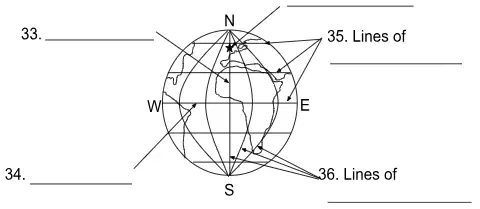
33. Matching Parts of the Globe
a)
Latitude
b)
Prime Meridian
c)
Longitude
d)
Equator
34.
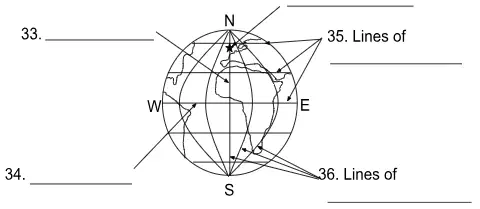
34. Matching Parts of the Globe
a)
Latitude
b)
Prime
c)
Longitude
d)
Equator
35.
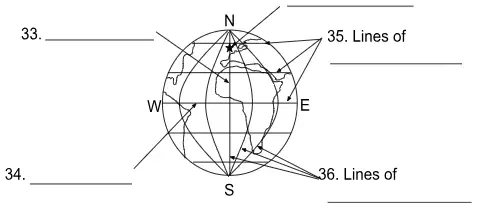
35. Matching Parts of the Globe
a)
Latitude
b)
Prime
c)
Longitude
d)
Equator
36.
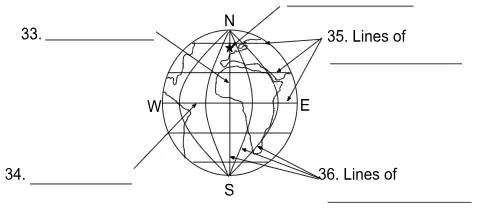
36. Matching Parts of the Globe
a)
Latitude
b)
Prime
c)
Longitude
d)
Equator
37.
All points on a contour line have the same _________________.
a)
elevation
b)
split
c)
same
d)
Hill
e)
Upstream
38.
Every Contour line either meets with itself to form a _________ or goes off the edge of the map. They never stop on the map.
a)
circle
b)
split
c)
same
d)
Hill
e)
Upstream
39.
A closed contour line making a ring shows either a_________ or depression.
a)
Hill
b)
split
c)
same
d)
Upstream
e)
elevation
40.
____________ contours are indicated by small lines pointing down slope.
a)
depression
b)
split
c)
same
d)
Hill
e)
Upstream
41.
Where contour lines are evenly spaced, the slope is the___________.
a)
same
b)
split
c)
Hill
d)
Upstream
e)
elevation
42.
Closely spaced contour lines mean a _________ slope.
a)
steep
b)
split
c)
same
d)
Hill
e)
Upstream
43.
Contour lines far apart mean a _________ slope.
a)
gentle
b)
split
c)
same
d)
Hill
e)
Upstream
44.
Contour lines never “______________”.
a)
split
b)
same
c)
Hill
d)
Upstream
e)
elevation
45.
Contour lines never ___________ each other.
a)
cross over
b)
split
c)
same
d)
Hill
e)
Upstream
46.
In a stream, Contour lines point slightly _____________ where they cross the stream.
a)
Upstream
b)
split
c)
same
d)
Hill
e)
elevation
47.
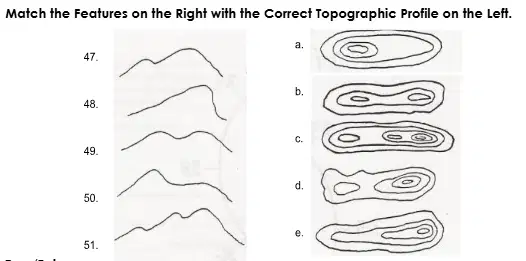
47.
a)
A
b)
B
c)
C
d)
D
e)
E
48.
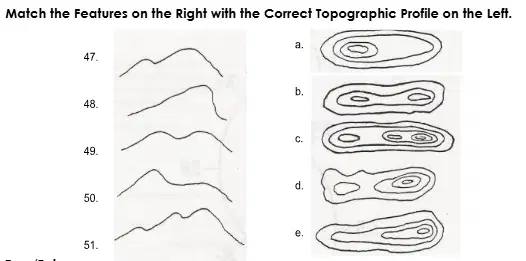
48.
a)
A
b)
B
c)
C
d)
D
e)
E
49.
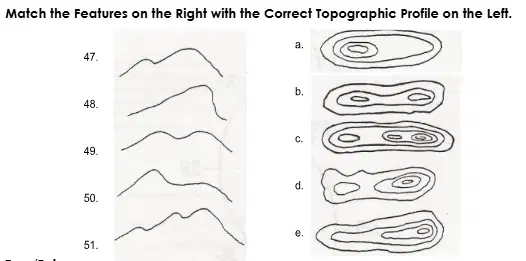
49.
a)
A
b)
B
c)
C
d)
D
e)
E
50.
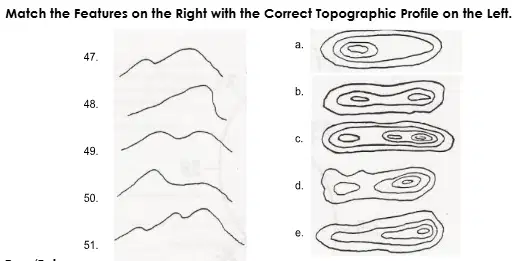
50.
a)
A
b)
B
c)
C
d)
D
e)
E
51.

51.
a)
A
b)
B
c)
C
d)
D
e)
E
52.
The Study of the earth is called biology.
a)
True
b)
False
53.
Baking soda is an acid
a)
True
b)
False
54.
Substances that are neither acids nor bases are said to be neutral.
a)
True
b)
False
55.
On the pH scale, a reading of 14 would indicate a strong acid
a)
True
b)
False
56.
An increase in temperature will usually speed up a chemical reaction.
a)
True
b)
False
57.
Protons are so named because they carry a _____________ electrical charge.
a)
Positive
b)
Negative
c)
neutral
d)
All of the above
58.
Most atoms seek to have ______ electrons in their outermost shell.
a)
5
b)
6
c)
7
d)
8
59.
Electrons in the outermost shell are called _________.
a)
Ions
b)
Unimportant
c)
Valence
d)
Exothermic
60.
Negative ions are called ___________ and positive ions are called __________.
a)
Cations, Anions
b)
Anions, Cations
c)
Polyatomic, Monatomic
d)
Monatomic, Polyatomic
61.
Which chemical reaction releases heat energy?
a)
Exothermic
b)
Endothermic
c)
. Transpothermic
d)
Evapothermic
62.
Which chemical reaction absorbs heat energy
a)
Exothermic
b)
Endothermic
c)
Transpothermic
d)
Evapothermic
63.
To describe the relative strength of an acid or base, chemists use a scale called the _________ scale?
a)
Mohs
b)
Triple-beam balance
c)
pH
d)
bathroom
64.
In a chemical reaction, the original substance is called the reactant, and the new substances produced are known as the __________________.
a)
Results
b)
Products
c)
Difference
d)
None of the above
65.
A type of covalent bond is a ___________.
a)
Triple bond
b)
Single bond
c)
Double bond
d)
All of the above
66.
Increasing the __________________ will usually speed up a chemical reaction.
a)
Concentration
b)
Surface area
c)
Temperature
d)
All of the above
67.
The arrow in a chemical reaction reads____________.
a)
Stop
b)
Yields / Creates
c)
Falling rock
d)
35 mph
68.
An example of sublimation is_______________.
a)
Dry ice
b)
Frost
c)
Both a and b
d)
None of the above
69.
The process of adding electrons or removing electrons from an atom or group of atoms is referred to as _________________.
a)
Ionization
b)
Glaciation
c)
Subtraction
d)
Hibernation
70.
How many of each atom are there in 5NH3
a)
5-N, 5-H
b)
1-N, 5-H
c)
5-N, 3-H
d)
5-N, 15-H
71.
Acids are known for having a ____________ taste.
a)
Sweet
b)
Chocolatey
c)
sour
d)
Rancid
72.
pH = 12
a)
acidic
b)
basic
c)
neutral
73.
pH = 6.5
a)
acidic
b)
basic
c)
neutral
74.
pH = 14
a)
acidic
b)
basic
c)
neutral
75.
pH = 7
a)
acidic
b)
basic
c)
neutral
76.
pH 1.5
a)
acidic
b)
basic
c)
neutral
77.
pH 3.7
a)
acidic
b)
basic
c)
neutral
78.
Minerals must have a definite chemical composition.
a)
true
b)
false
79.
Copper is a precious metal.
a)
true
b)
False
80.
The most distinguishing test to determine the mineral calcite is the acid test.
a)
True
b)
False
81.
Extrusive rocks form from the cooling of underground magma
a)
True
b)
False
82.
Clastic sedimentary rock is named as such because clasts are fragments of other rocks.
a)
True
b)
False
83.
Which of the following is not a rock type?
a)
Igneous
b)
Sedimentary
c)
cubic
d)
metamorphic
84.
Igneous rock forms from…
a)
Weathered rock particles
b)
Evaporation of water
c)
magma
d)
None of the above
85.
Sedimentary rocks are the only rocks that can potentially contain…
a)
Fossils
b)
Minerals
c)
fractures
d)
Faults
86.
Limestone can be metamorphosed into…
a)
Gneiss
b)
Shale
c)
Marble
d)
slate
87.
Which rock type is formed from weathering of other rocks?
a)
Metamorphic rock
b)
Magma
c)
igneous rock
d)
Sedimentary rock
88.
Igneous rocks that have mineral crystals easily seen with the unaided eye formed…
a)
Extrusively
b)
Intrusively
c)
under water
d)
Through compaction
89.

The rock labeled “B” is…
a)
Igneous
b)
Metamorphic
c)
sedimentary
d)
magma
90.

The rock labeled “A” is…
a)
Igneous
b)
Metamorphic
c)
sedimentary
d)
magma
91.
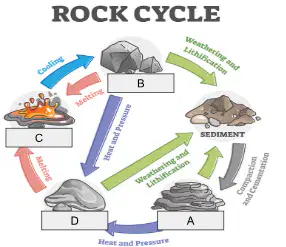
The rock labeled “D” is…
a)
igneous
b)
Metamorphic
c)
sedimentary
d)
Magma
92.
Sulfides are minerals that contain what element?
a)
Silicon
b)
Sulfur
c)
chlorine
d)
hydrogen
93.
All of the following are nonrenewable resources except…
a)
Coal
b)
Trees
c)
uranium
d)
aluminum
94.
_________________ is a renewable resource.
a)
Oxygen
b)
Gravel
c)
Gold
d)
Diamond
95.
A mineral must be…
a)
Inorganic
b)
Crystalline
c)
solid
d)
All of the above
96.
Which of the following is not an igneous rock texture?
a)
Coarse-grained
b)
Fine-grained
c)
smooth
d)
porphyritic
97.
Magma that hardens into light colored rocks is called ____________ magma.
a)
Felsic
b)
Mafic
c)
crystalline
d)
Thin
98.
__________ is an example of organic sedimentary rock.
a)
Coal
b)
Rock gypsum
c)
Sandstone
d)
Shale
99.
The law of _______________ states that the older sedimentary layers are on the bottom and the younger ones are at the top.
a)
Common sense
b)
Superposition
c)
Thermodynamics
d)
gravity
100 %

