wayground logo

Free Printable Worksheets

Font size

S
M
L
XL
Worksheets

6th Summer STEM final 2023

Total questions: 140

Worksheet time: 2hrs 54mins

Name
Class
Date
1.

12 inches = 1 _______________

a)

foot

b)

mile

c)

inch

d)

yard

2.

1 yard = 3 __________

a)

inches

b)

yard

c)

feet

d)

mile

3.

1 yard = 36 ___________

a)

inches

b)

feet

c)

miles

d)

yard

4.

2 feet = __________ inches

a)

24

b)

36

c)

48

d)

60

5.

1 foot _______ 13 inches

a)

>

b)

<

c)

=

6.

2 yards ______ 6 feet

a)

>

b)

<

c)

=

7.

Choose all that would be about an inch.

a)
b)
c)
d)
e)
8.

Choose all that would be about a foot.

a)
b)
c)
d)
e)
9.

Choose all that would be about a yard.

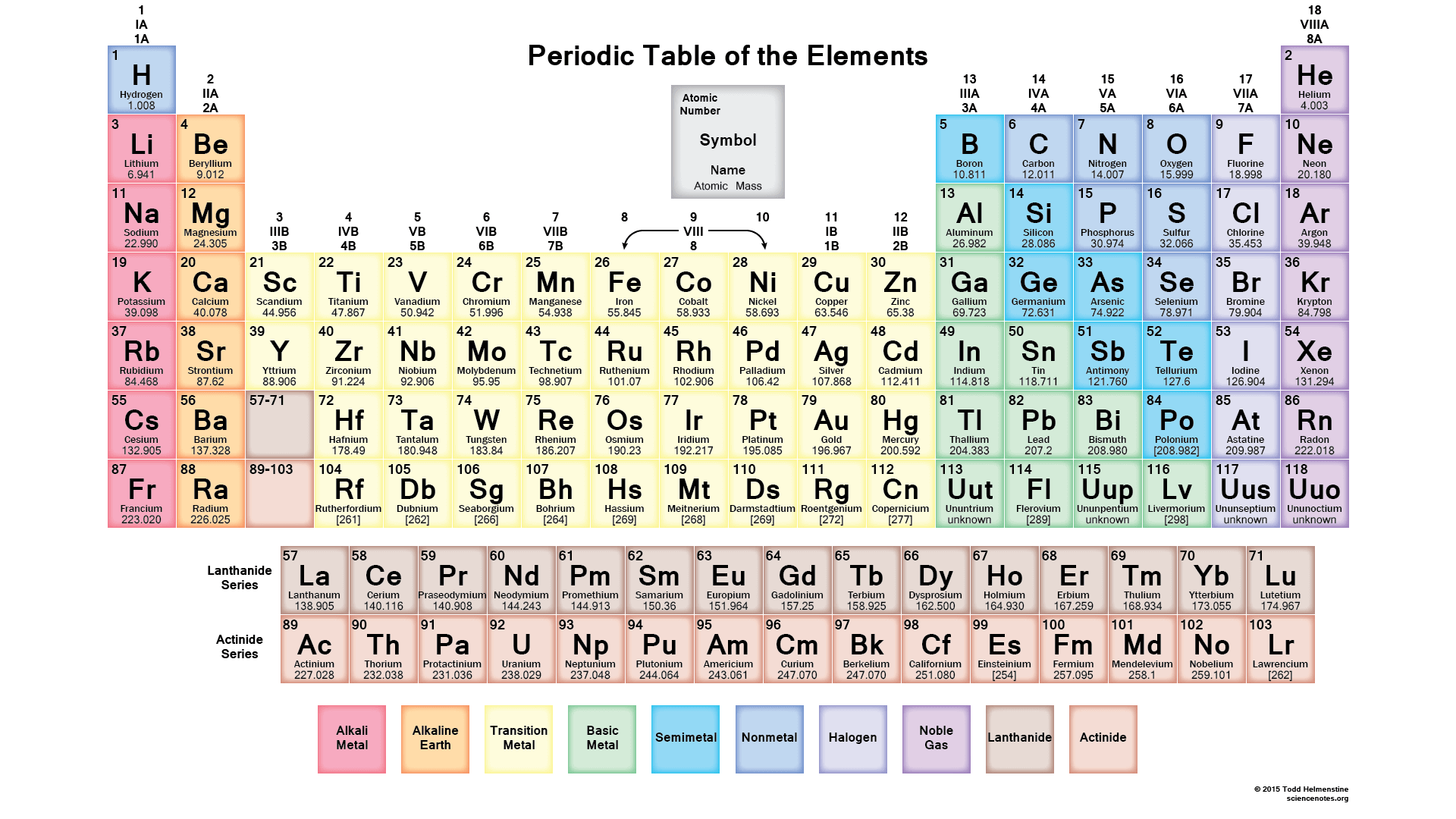
a)
b)
c)
d)
e)
10.
When measuring the thickness of a dime, use which of the following:
a)
mm
b)
mg
c)
nm
d)
cg
11.
When measuring the mass of an elephant it is best to use:
a)
g
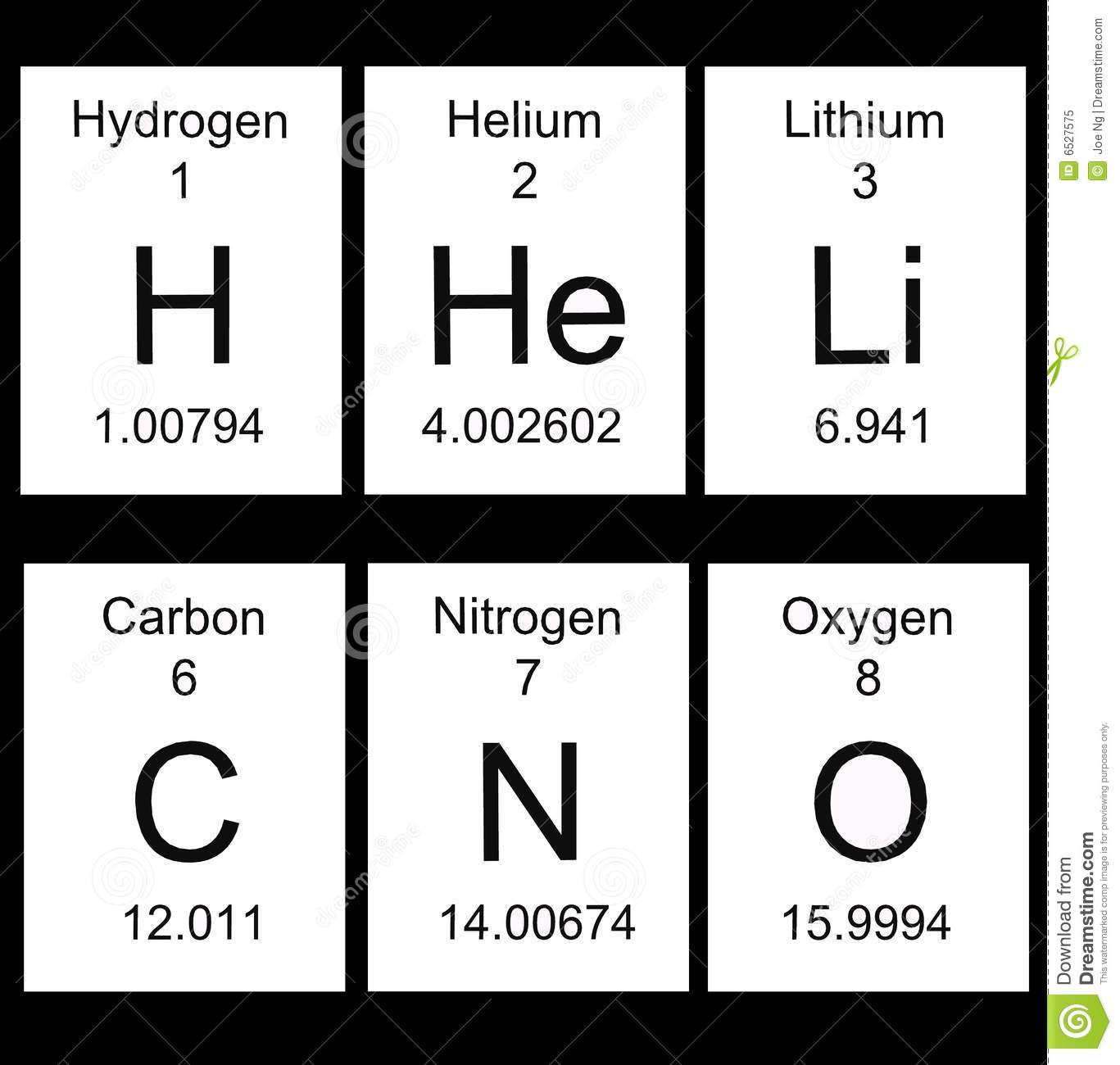
b)
nL
c)
ng
d)
kg
12.
What are the three base units?
a)
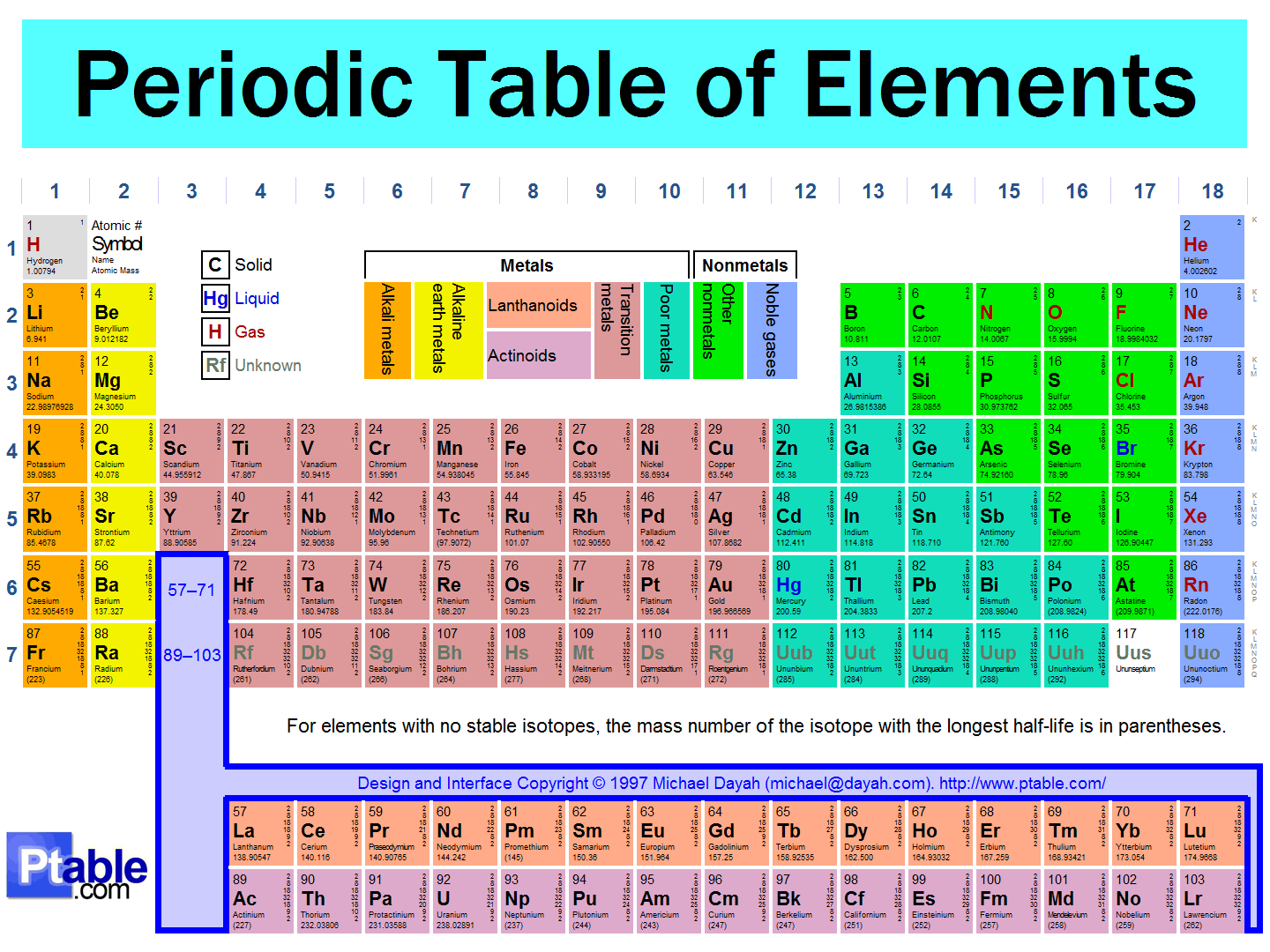
mass,length,grams
b)
meters,length,grams
c)
measuring,liters,games
d)
meters,liters,grams
13.
what is the name for the following?   mL
a)
megaliter
b)
megalift
c)
Meterliter
d)
milliliter
14.
Give the correct symbol:  millimeter
a)
m
b)
M
c)
mm
d)
MM
15.

The distance between New York City and Miami, Florida would be measured in __?__.

a)

kilometers (km)

b)

meters (m)

c)

centimeters (cm)

d)

millimeters (mm)

16.

To measure the length of a Kleenex box you would use __?__.

a)

kilometers (km)

b)

meters (m)

c)

dekameters (dam)

d)

centimeters (cm)

17.

The volume of a glass of orange juice would be measured in __?__.

a)

liters  (L)

b)

cubic meters  (m3)

c)

milliliters  (mL)

d)

kilograms  (kg)

18.

The metric prefix "kilo" means __?__.

a)

one tenth  (0.1)

b)

one thousandth  (0.001)

c)

one hundred  (100)

d)

one thousand  (1,000)

19.

When converting from large unit to a small unit, you should move the decimal to the _____.

a)

right

b)

left

20.

Convert 2 m to mm

a)

200 mm

b)

20 mm

c)

0.002 mm

d)

2000 mm

21.

Convert 298 cm to mm

a)

29.8 mm

b)

2.98 cm

c)

29800 cm

d)

2980 cm

22.
You should never ______ chemicals in the lab. 
a)
taste
b)
touch
c)
smell
d)
all of the above
23.
If you are not sure what to do during a lab activity:
a)
guess
b)
change lab partners
c)
ask a teacher
d)
just sit quietly and do nothing
24.
Keeping your work area neat and clean is important because:
a)
My teacher is a neat-freak
b)
I won't lose my supplies in the clutter.
c)
It keeps the room from looking messy.
d)
It helps prevent accidents.
25.
Disrupting other students in the laboratory with horseplay in the lab is:
a)
helpful.
b)
allowed
c)
dangerous.
d)
the quickest way to do a job.
26.
What is the CORRECT procedure for students to follow if a chemical is spilled?
a)
Stand back and advise the teacher of the spill.
b)
Run screaming out of the room.
c)
Splash large amounts of water onto the spill.
d)
Immediately ask to go to the restroom.
27.
At the end of the lab you see some leftover chemical that looks just like the stuff you were using.  You should:
a)
put the chemical back in the jar it came from.
b)
sweep it into your hand and throw it out.
c)
tell the teacher so you can dispose of it properly.
d)
tell your classmates that your lab partner is really messy.
28.
Helping to clean up the lab or classroom is the job of
a)
older students.
b)
transfer students.
c)
each and every student.
d)
only the teacher.
29.
When in the lab you should wear...
a)
open-toed shoes.
b)
sandals.
c)
closed-toes shoes.
d)
no shoes.
30.
You should report accidents to the teacher __.
a)
after the class is over
b)
immediately 
c)
the following day
d)
never
31.
When should you look over the experiment instructions? 
a)
After starting the lab
b)
When your teacher tells you to
c)
Before starting the lab
d)
It doesn't really matter.  Instructions are silly!
32.
Which of the following are examples of dressing appropriately in the lab?
a)
Pulling long hair back
b)
Leaving long hair down to get in the chemicals. 
c)
Wearing sandals
33.
You have been injured in the laboratory (cut, burn, etc.) The FIRST thing you should do is...
a)
visit the school nurse after class.
b)
see a doctor after school.
c)
tell the science teacher immediately.
d)
apply first aid to yourself.
34.
If you see a science experiment set up in the classroom...
a)
do not touch anything until instructed.
b)
immediately begin working on the lab.
c)
go and check all equipment.
d)
walk around and check each station.
35.
If a lab fire erupts, immediately:
a)
 A. Notify (or tell) your teacher
b)
B. Run and scream
c)
C. Throw water at the fire
d)
 D. Open the windows
36.
What should you do if you break glass in the lab?
a)
Tell the teacher.
b)
Sweep up the glass.
c)
Pick up the glass with your hands.
d)
Ignore it; the teacher will clean it up when she sees it later.
37.
What is this science tool?
a)
sun glasses
b)
safety goggles
c)
hand lenses
d)
beaker
38.
If you do not understand a direction or part of a lab procedure, you should
a)
figure it out as you do the lab
b)
try several methods until something works
c)
skip it and go to the next part
d)
ask your teacher
39.
What safety device is this student missing?
a)
lab coat
b)
hair tie
c)
goggles
d)
all of the above
40.

Archimedes was born in -

a)

Syracuse

b)

Scotland

c)

Italy

d)

Rome

41.

Which is a quote by Archimedes?

a)

"He calculated just as men breather, as eagles sustain themselves in the air."

b)

"Algebra is but written geometry and geometry is but figured algebra."

c)

"Give me a spot where I can stand, and I shall move the earth!"

42.

Sitting in the public bath helped Archimedes discover -

a)

the value of pi.

b)

the laws of buoyancy.

c)

the law of the lever.

43.

Which practical invention was and still is used for water irrigation?

a)

Archimedes Screw

b)

Sand Reckoner

c)

Catapult

44.

Archimedes developed all of the these forms of weaponry EXCEPT:

a)

huge cranes

b)

the catapult

c)

giant reflectors for sun beams

d)

the cannon

45.

What was Archimedes doing when a Roman soldier killed him?

a)

fighting for Greece against the Romans

b)

celebrating the festival of Artemis

c)

working on a geometry problem

46.

What is a push or a pull acting on an object?

a)

force

b)

mass

c)

gravity

47.

A marble on a perfectly flat floor ____________________.

a)

will start bouncing

b)

will not move unless a force acts on it

c)

will roll away

48.

Which of these is an example of a simple machine?

a)

wheel and axle

b)

lever

c)

pulley

d)

All of the above

49.

Calculate the length of the force arm in a lever, if you know that the value of the force is 100 N, the resistance is 200 N and the length of the resistance is 20 cm.

a)

40 N

b)

40 cm

c)

400 cm

d)

400 N

50.

What is a force that pulls objects toward the center of the earth?

a)

force

b)

gravity

c)

inertia

d)

movement

51.

This machine uses wheels and a rope to raise, lower, or move a load

a)

pulley

b)

inclined plane

c)

wheel and axle

d)

lever

52.

This is used to carry loads around easily for long distances with less effort

a)

pulley

b)

inclined plane

c)

wheel and axle

d)

lever

53.

This is any slope or ramp that makes it easier to lift something.

a)

pulley

b)

inclined plane

c)

wheel and axle

d)

lever

54.

This is an inclined plane wrapped in a spiral

a)

screw

b)

inclined plane

c)

wheel and axle

d)

wedge

55.

Match the following

a)

jar lid

1.

screw

b)

window shade

2.

pulley

c)

axe

3.

wedge

d)

stairs

4.

inclined plane

e)

scissors

5.

lever

56.

Find the density of water. Mass = 5 grams

Volume = 5 mL

density=massvolumedensity=\frac{mass}{volume}

57.

Find the density of a substance with a mass of 20 grams and a volume of 10 mL

density=massvolumedensity=\frac{mass}{volume}

58.

Denser objects ​ (a)   . Less dense objects ​ (b)   .

Choose from the below words
sink
float
disappear
levitate
decompose
59.

Calculate the density of an object with 50 grams and a volume of 5 mL.

density=massvolumedensity=\frac{mass}{volume}

60.

​ (a)   is the amount of matter or "stuff" in an object. ​ (b)   is the amount of space an object takes up. ​ (c)   is the measure of how tightly packed particles are in an object

Choose from the below words
Mass
Volume
Density
Velocity
Height
Gravity
Energy
61.

Calculate the density of an object with a mass of 45 grams and a volume of 9 mL.

density=massvolumedensity=\frac{mass}{volume}

62.

Calculate the density of the substance with a mass of 100 grams and a volume of 25 mL.

density=massvolumedensity=\frac{mass}{volume}

63.

Calculate the density of an object with a mass of 100 grams and a volume of 100 mL.

density=massvolumedensity=\frac{mass}{volume}

64.

Define mass

a)

The amount of space an object takes up

b)

The amount of matter in an object

c)

The amount of data in an object

d)

The amount of energy in an object

65.

Define volume

a)

The amount of space an object takes up

b)

The amount of matter in an object

c)

The amount of data in an object

d)

The amount of energy in an object

66.

Define density

a)

How much energy the particles have in an object

b)

How much data the particles have in an object

c)

How much speed the particles an object gathers

d)

How tightly packed the particles are in an object

67.

What is the formula for density?

a)

density=massaccelerationdensity=\frac{mass}{acceleration}

b)

density=massheightdensity=\frac{mass}{height}

c)

density=massvelocitydensity=\frac{mass}{velocity}

d)

density=massvolumedensity=\frac{mass}{volume}

68.

Are the units g/mL and gcm3\frac{g}{cm^3} equal in value for density?

a)

Yes

b)

No

69.
What is the formula for density?
a)

density=mass×volumedensity=mass\times volume

b)

density=massvolumedensity=\frac{mass}{volume}

c)

density=mass+volumedensity=mass+volume

d)

density=massvolumedensity=mass-volume

70.
Jack has a rock. The rock has a mass of 14 g and a volume of 2 cm3. What is the density of the rock?
a)
7 mL
b)
7 g/cm3
c)
28 g/cm3
d)
1/7 g/cm3
71.
Frank has an eraser. It has a mass of 4 g, and a volume of 2 cm3. What is its density?
a)
8 g/cm3
b)
2 g/cm3
c)
1/2 g/cm3
d)
24 g/cm3
72.
Calculate the density of the cube.
a)
2 g/cm3
b)
4 g/cm3
c)
6 g/cm3
d)
8 g/cm3
73.
Calculate the density of the cube.
a)
3 g/cm3
b)
4 g/cm3
c)
2 g/cm3
d)
5 g/cm3
74.
What is the volume of this prism?
a)
18 cubic cm
b)
6 cubic cm
c)
9 cubic cm
75.
To find the volume you:
a)
Divide length x width  x  height 
b)
 length + width  +  height 
c)
 length x width  x  height 
d)
none of the above
76.

Bob has a rectangular prism gift box what it the volume of Bob's gift box?

a)

64in3

b)

60in3

c)

240in3

d)

24in3

77.
What is the volume of this prism?
a)
16 cubic cm
b)
36 cubic cm
c)
144 cubic cm
78.
What is the volume of this rectangular prism?
a)
60 cubic centimeters
b)
15 cubic centimeters
c)
20 cubic centimeters
d)
6 cubic centimeters
79.
Find the volume of the rectangular prism. How many unit cubes would it take to make the rectangular prism?
a)
13 cubic units
b)
13 square units
c)
48 cubic units
d)
24 cubic units
80.
A bar of copper has a mass of 216g and a volume of 24cm3. What is the density of copper?  
a)
9g/cm3
b)
.11g/cm3
c)
5184g/cm3
d)
322mL
81.
What is the density of a plastic ball that has a volume of 6cm3 and a mass of 12g? 
a)
2g/cm3
b)
.5g/cm3
c)
72g/cm3
d)
4mL
82.

Multiplying L x W x H is a way to find the _____ of a regular shape object.

a)

area

b)

volume

c)

weight

d)

length

83.

A student measured 40ml of water using a measuring cup, he then added a rock inside this measuring cup and noticed that the water level is now at 45 ml ? What is the volume of this object ?

a)

40 ml

b)

45 ml

c)

5 ml

d)

Not enough information

84.

Plastic toys and a ping pong ball will sink when placed in water.

a)

True

b)

False

85.

Objects that are more dense will float in water.

a)

True

b)

False

86.

Found in group 17 of the periodic table; highly reactive nonmetals

a)

Alkali Metals

b)

Alkaline Earth Metals

c)

Halogens

d)

Noble Gases

87.
The horizontal row on the periodic table is called a
a)
group
b)
family
c)
period
d)
atomic number
88.
A vertical column is called...
a)
group
b)
tower
c)
period
d)
crew
89.
What is the chemical symbol for Lithium?
a)
H
b)
He
c)
Li
d)
N
90.
Sodium (Na) is found in group 
a)
1
b)
2
c)
3
d)
4
91.
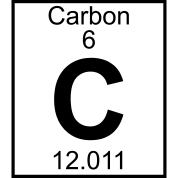
What does 12.011 represent?
a)
atomic mass
b)
atomic number
c)
element name
d)
chemical symbol 
92.

Elements which are shiny, malleable, and good conductors of electricity and heat and found on the left side of the staircase are called

a)

metals

b)

nonmetals

c)

metalloids

d)

noble gases

93.

The last group in the periodic table, contains inert (non-reactive) elements that are called ...

a)

alkali metals

b)

alkaline earth metals

c)

halogens

d)

noble gases

94.

The atoms on the right of the staircase are called

a)

metalloids

b)

non-metals

c)

metals

d)

noble gases

95.

The atoms along the staircase are called

a)

metals

b)

nonmetals

c)

metalloids

d)

noble gases

96.
Two elements chemically bonded form
a)
element
b)
compound
c)
mixture
d)
solutions
97.
How are elements on the periodic table arranged by?
a)
in alphabetic order
b)
simular physical & chemical properties
c)
their symbols
d)
Just simular physical properties
98.
Each column in the periodic table is called a _________ .
a)
period
b)
group
c)
cluster
d)
unit
99.
What element is will have the most similar physical and chemical properties to the element Sulfur (S)?
a)
Carbon (C)
b)
Phosphorous (P)
c)
Oxygen (O)
d)
Neon (Ne
100.
Elements that are arranged in __________ have the most similar physical and chemical properties to each other.
a)
periods
b)
groups
101.
All matter is composed of (contains) at least one element on the periodic table
a)
True
b)
False
102.
Periods on the periodic table are __________.
a)
Horizontal Rows
b)
Vertical Columns
103.
Groups on the periodic table are __________.
a)
Horizontal Rows
b)
Vertical Columns
104.
The Modern Periodic Table of Elements is arranged by
a)
atomic mass
b)
atomic number
c)
valence electrons
d)
number of isotopes
105.
What does the 6 represent?
a)
atomic mass
b)
atomic number
c)
element name
d)
chemical symbol 
106.
What does 12.011 represent?
a)
atomic mass
b)
atomic number
c)
element name
d)
chemical symbol 
107.
What does the C represent?
a)
atomic mass
b)
atomic number
c)
element name
d)
chemical symbol 
108.
These are found on the Periodic Table.
a)
Compounds
b)
Elements
c)
Mixtures
109.

The horizontal (side to side) rows in the Periodic Table are called

a)

groups

b)

families

c)

periods

d)

atomic numbers

110.
Which of the following atomic symbols for bromine is written correctly?
a)
bR
b)
BR
c)
Br
d)
br
111.

Everything on Earth is made from element(s) on the periodic table.

a)

true

b)

false

112.

Groups of elements (the vertical columns) contain elements that are similar to each other.

a)

true

b)

false

113.

Groups of elements (the vertical columns) contain elements that are similar to each other.

a)

true

b)

false

114.

Which color on this image of the periodic table corresponds with the transition metals (metalloids).

a)

bright yellow

b)

gold

c)

teal

d)

light blue

115.

Element symbols must have at least

a)

1 cap. letter

b)

2 cap. letters

c)

2 lower case letters

d)

any letter you want

116.

Which is the biggest group on the periodic table?

a)

metals

b)

nonmetals

c)

metaloids

d)

halogens

117.

Which item on this element square is the chemical symbol?

a)

Copper

b)

29

c)

Cu

d)

63.546

118.

6.09 ÷ 3

a)

2.3

b)

203

c)

18.27

d)

2.03

119.

Subtract: 101234\frac{10}{12}-\frac{3}{4}

a)

712\frac{7}{12}

b)

112\frac{1}{12}

c)

1 1121\ \frac{1}{12}

d)

78\frac{7}{8}

120.

Multiply: 34×12=\frac{3}{4}\times\frac{1}{2}=

a)

616\frac{6}{16}

b)

46\frac{4}{6}

c)

38\frac{3}{8}

d)

34\frac{3}{4}

121.

Christine writes the expression 464^6 . Which is another way to write the same expression using repeated multiplication?

a)

4×64\times6

b)

2424

c)

6×6×6×66\times6\times6\times6

d)

4×4×4×4×4×44\times4\times4\times4\times4\times4

122.

Which of the following is NOT an integer?

a)

-123

b)

42

c)

0

d)

- 0.65

123.

Zero is a ________number

a)

positive

b)

negative

c)

neutral

d)

prime

124.

What is the value of 32×23723^2\times2^3-7^2

a)

22

b)

23

c)

32

d)

66

125.

A deposit of $80

a)

8080

b)

80-80

126.

Evaluate: 12\left|-12\right|

a)

1212

b)

12-12

c)

144144

d)

00

127.

Solve for x: x10=1260\frac{x}{10}=\frac{12}{60}

a)

2

b)

6

c)

120

d)

20

128.

5 is what percent of 25?

a)

5%

b)

20%

c)

4%

d)

25%

129.

Twelve of the twenty students at math club are girls. What percent does that represent?

a)

60%

b)

12%

c)

20%

d)

8%

130.

Jane made six of the ten foul shots she took. What percent of the shots did she not make?

a)

4%

b)

40%

c)

60%

d)

80%

131.

A ratio that compares a number to 100 is a _____________.

a)

Unit Rate

b)

Proportion

c)

Percent

d)

Ratio

132.

A comparison of two or more quantities is called a ___________.

a)

Term

b)

Ratio

c)

Equivalent

d)

Simplest form

133.

Solve: 5x = 60

a)

55

b)

300

c)

12

d)

3

134.

Simplify the following expression:

n+n+nn+n+n

a)

n3n^3

b)

3+n3+n

c)

3n3n

d)

n+n+nn+n+n

135.

What is the inverse operation of addition?

a)

addition

b)

division

c)

multiplication

d)

subtraction

136.

A mathematical statement stating that two expressions are equal is called a(n) __________.

a)

expression

b)

variable

c)

equation

d)

algebra

137.

Twice a number, x

a)

x+2x+2

b)

2x2x

c)

3x3x

d)

x÷2x\div2

138.

Find the volume of a cube with a height of 4 cm.

V = lwh

a)

4 cm34\ cm^3

b)

24 cm324\ cm^3

c)

64 cm364\ cm^3

d)

8 cm38\ cm^3

139.

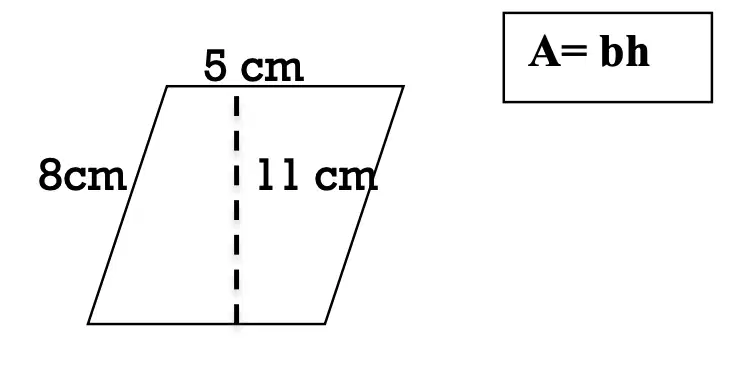
Find the area of the parallelogram.

a)

24 cm224\ cm^2

b)

55 cm255\ cm^2

c)

40 cm240\ cm^2

d)

20 cm220\ cm^2

140.

A square has sides of y centimeters.

Find the perimeter of the square in terms of y.

a)

4y4y

b)

y+4y+4

c)

y×y×y×yy\times y\times y\times y

d)

y4y^4