wayground logo

Free Printable Worksheets

Font size

S
M
L
XL
Worksheets

DEAP Chapter 2 Question Bank

Total questions: 71

Worksheet time: 50mins

Name
Class
Date
1.
compound that releases hydrogen ions in solution
a)
acid
b)
base
c)
buffer
d)
catalyst
e)
enzyme
2.
amount of energy greater than the energy contained in the reactants which must be overcome for a reaction to proceed
a)
potential energy
b)
kinetic energy
c)
chemical energy
d)
activation energy
3.
building block of proteins; characterized by an amino and carboxyl functional groups and a variable side-chain
a)
amino acid
b)
concentration
c)
denaturation
4.
atom with a negative charge
a)
anion
b)
atom
c)
cation
d)
element
5.
smallest unit of an element that retains the unique properties of that element
a)
anion
b)
atom
c)
cation
d)
element
6.
compound that accepts hydrogen ions in solution
a)
acid
b)
base
c)
buffer
d)
catalyst
e)
enzyme
7.
electrical force linking atoms
a)
molecule
b)
isotope
c)
ion
d)
functional group
e)
bond
8.
solution containing a weak acid or a weak base that opposes wide fluctuations in the pH of body fluids
a)
acid
b)
base
c)
buffer
d)
catalyst
e)
enzyme
9.
molecules containing carbon, hydrogen, and oxygen in a 1-2-1 ratio
a)
protein
b)
phospholipid
c)
nucleotide
d)
carbohydrate
e)
lipid
10.
substance that increases the rate of a chemical reaction without itself being changed in the process
a)
acid
b)
base
c)
buffer
d)
catalyst
e)
enzyme
11.
atom with a positive charge
a)
anion
b)
atom
c)
cation
d)
element
12.
form of energy that is absorbed as chemical bonds form and released as they are broken
a)
potential energy
b)
kinetic energy
c)
chemical energy
d)
activation energy
13.
number of particles within a given space
a)
amino acid
b)
concentration
c)
denaturation
14.
chemical bond in which two atoms share electrons
a)
peptide bond
b)
ionic bond
c)
covalent bond
d)
organic compound
e)
inorganic compound
15.
change in the structure of a molecule through physical or chemical means
a)
amino acid
b)
concentration
c)
denaturation
16.
substance that cannot be created or broken down by ordinary chemical means
a)
anion
b)
atom
c)
cation
d)
element
17.
protein or RNA that catalyzes chemical reactions
a)
acid
b)
base
c)
buffer
d)
catalyst
e)
enzyme
18.
group of atoms linked by strong covalent bonds that tends to behave as a distinct unit in chemical reactions with other atoms
a)
molecule
b)
isotope
c)
ion
d)
functional group
e)
bond
19.
substance that does not contain both carbon and hydrogen
a)
peptide bond
b)
ionic bond
c)
covalent bond
d)
organic compound
e)
inorganic compound
20.
atom with an overall positive or negative charge
a)
molecule
b)
isotope
c)
ion
d)
functional group
e)
bond
21.
attraction between an anion and a cation
a)
peptide bond
b)
ionic bond
c)
covalent bond
d)
organic compound
e)
inorganic compound
22.
one of the variations of an element in which the number of neutrons differ from each other
a)
molecule
b)
isotope
c)
ion
d)
functional group
e)
bond
23.
energy that matter possesses because of its motion
a)
potential energy
b)
kinetic energy
c)
chemical energy
d)
activation energy
e)
inorganic compound
24.
class of nonpolar organic compounds built from hydrocarbons that are not soluble in water
a)
protein
b)
phospholipid
c)
nucleotide
d)
carbohydrate
e)
lipid
25.
two or more atoms covalently bonded together
a)
molecule
b)
isotope
c)
ion
d)
functional group
e)
bond
26.
class of organic compounds composed of one or more phosphate groups, a pentose sugar, and a base
a)
protein
b)
phospholipid
c)
nucleotide
d)
carbohydrate
e)
lipid
27.
substance that contains both carbon and hydrogen
a)
peptide bond
b)
ionic bond
c)
covalent bond
d)
organic compound
e)
inorganic compound
28.
covalent bond formed by dehydration synthesis between two amino acids
a)
peptide bond
b)
ionic bond
c)
covalent bond
d)
organic compound
e)
inorganic compound
29.
a lipid compound in which a phosphate group is combined with a diglyceride
a)
protein
b)
phospholipid
c)
nucleotide
d)
carbohydrate
e)
lipid
30.
stored energy matter possesses because of the positioning or structure of its components
a)
potential energy
b)
kinetic energy
c)
chemical energy
d)
activation energy
31.
one or more substances produced by a chemical reaction
a)
suspension
b)
substrate
c)
solution
d)
reactant
e)
product
32.
class of organic compounds that are composed of many amino acids linked together by peptide bonds
a)
protein
b)
phospholipid
c)
nucleotide
d)
carbohydrate
e)
lipid
33.
one or more substances that enter into the reaction
a)
suspension
b)
substrate
c)
solution
d)
reactant
e)
product
34.
homogeneous liquid mixture in which a solute is dissolved into molecules within a solvent
a)
suspension
b)
substrate
c)
solution
d)
reactant
e)
product
35.
reactant in an enzymatic reaction
a)
suspension
b)
substrate
c)
solution
d)
reactant
e)
product
36.
liquid mixture in which particles distributed in the liquid settle out over time
a)
suspension
b)
substrate
c)
solution
d)
reactant
e)
product
37.

If Todd weighs 100 kg, how many kilograms of Nitrogen would you expect his body to contain?

(a)  

38.

If Kyah weighs 50 kg, how many kilograms of Nitrogen would you expect her body to contain?

(a)  

39.

If Todd weighs 100 kg, how many kilograms of Hydrogen would you expect his body to contain?

(a)  

40.

If Kyah weighs 50 kg, how many kilograms of Hydrogen would you expect her body to contain?

(a)  

41.

If Todd weighs 100 kg, how many kilograms of Carbon would you expect his body to contain?

(a)  

42.

If Kyah weighs 50 kg, how many kilograms of Carbon would you expect her body to contain?

(a)  

43.

If Todd weighs 100 kg, how many kilograms of Oxygen would you expect his body to contain?

(a)  

44.

If Kyah weighs 50 kg, how many kilograms of Oxygen would you expect her body to contain?

(a)  

45.

Which type of bond is this?

a)

single non-polar covalent bond

b)

double non-polar covalent bond

c)

ionic bond

d)

polar covalent bond

46.

Which type of bond is this?

a)

single non-polar covalent bond

b)

double non-polar covalent bond

c)

ionic bond

d)

polar covalent bond

47.

Which compound is this? (name, not formula)

(a)  

48.

What is the formula for this compound?

(a)  

49.

What is the formula for this molecule?

(a)  

50.

Which type of bond is this?

a)

single non-polar covalent bond

b)

double non-polar covalent bond

c)

ionic bond

d)

polar covalent bond

51.

Which type of bond is this?

a)

single non-polar covalent bond

b)

double non-polar covalent bond

c)

ionic bond

d)

polar covalent bond

52.

Which molecule is this? (name, not formula)

(a)  

53.

What is the formula for this molecule?

(a)  

54.

Which molecule is this? (name, not formula)

(a)  

55.

What is the formula for this molecule?

(a)  

56.

Label the bonds in this substance.

57.

Which reaction is taking place WITH an enzyme?

58.

Which reaction is taking place WITHOUT an enzyme?

59.

Which chemical process is this?

a)

hydrolysis

b)

dehydration synthesis

c)

chemosynthesis

d)

dissociation

60.

Which chemical process is this?

a)

hydrolysis

b)

dehydration synthesis

c)

chemosynthesis

d)

dissociation

61.

Which chemical process is this?

a)

hydrolysis

b)

dehydration synthesis

c)

chemosynthesis

d)

dissociation

62.

Chyme has a pH of ​ (a)   when it leaves the stomach. It is a​ (b)   .

Choose from the below words
strong acid
weak acid
strong base
weak base
2
6
7.4
63.

Saliva has a pH of ​ (a)   . It is a​ (b)   .

Choose from the below words
weak acid
strong acid
weak base
strong base
6
7.4
2
64.

Blood has a pH of ​ (a)   . It is a ​ (b)   .

Choose from the below words
7.4
weak base
strong base
weak acid
strong acid
2
6
65.

Which kind of biological macromolecule is this?

a)

carbohydrate

b)

lipid

c)

protein

d)

nucleic acid

66.

Which kind of biological macromolecule is this?

a)

carbohydrate

b)

lipid

c)

protein

d)

nucleic acid

67.

Which kind of biological macromolecule is this?

a)

carbohydrate

b)

lipid

c)

protein

d)

nucleic acid

68.

Which kind of biological macromolecule is this?

a)

carbohydrate

b)

lipid

c)

protein

d)

nucleic acid

69.

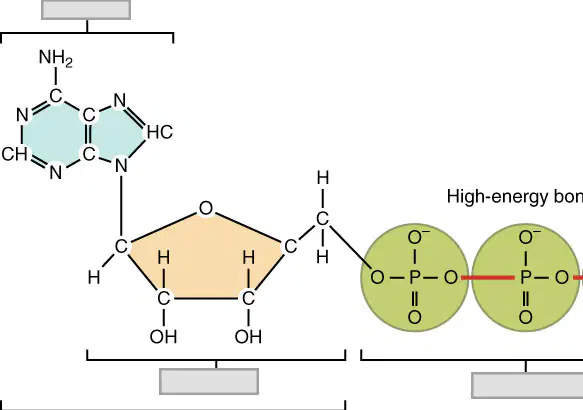
Label the components of ATP.

70.

Which molecule is this?

a)

ATP

b)

ADP

c)

DNA

d)

RNA

71.

Which molecule is this?

a)

ATP

b)

ADP

c)

DNA

d)

RNA