
 Worksheets
Physical Science Review - Chapter 4 Kinematics
Total questions: 60
Worksheet time: 1hrs 26mins
Who was the first scientist who first believed that light matter " desired" to ascend to the heavens and solid matter "desired" to fall towards the ground. This was known as a "Natural" way of looking at science (aka Natural Philosophers)?
Aristotle
Copernicus
Isaac Newton
Albert Einstein
What are the parts of Mechanics you will be studying in this class?
Dynamics
Kinematics
Statics
I don't understand any of this!!!!
Greek Philosophers believed matter would move because:
Forces would push or pull an object.
Its mysterious internal desires.
Why things move
Kinematics
Dynamics
Statics
Mechanics
How things move
Kinematics
Dynamics
Statics
Mechanics
How stationary things react to pushes or pulls
Kinematics
Dynamics
Statics
Mechanics
Who disagreed with the ancient Greek Philosophers and believed that motion could be described mathematically?
Galileo
Aristotle
Select the following areas of mechanics that roller coasters must consider:
Kinematics
Statics
Dynamics
All 3 of the areas of mechanics
A part of the universe that a scientist studies is called a
Surrounding
Point of reference
Frame or reference
System
Early scientists were called
Natural Philosophers
Smart
Earth Philosophers
Physical Philosophers
Suppose a scientists was studying a dump truck, which of the following is NOT part of the system:
The hydraulics of the dump truck
The surface of the road
The tires
The door latch
The stationary location from which we choose to make our observations
Spot of reference
Area of reference
Frame of reference
Point of reference
The geometric space containing the point of reference
Frame of reference
Triangle of reference
Square of reference
Area of reference
Which of the following systems is not accelerating
A car slowing down to a stop
An airplane on the runway speeding up for take off
A boy on a bicycle going 10 mph
A girl swinging on a swing
What does Δt stand for?
Change in temperature
Time interval
Pizza time
Change in torque
Straight line motion must be measured on
A ruler
One specific reference point
Only one reference frame
A coordinate axis
Select all the scalar quantities
300 mL
15 m/s east
8:00 AM
1.7 kg
What two things does a vector need
Direction
A positive scalar magnitude
Temperature
Mass
Motion occurs when a systems ______________ changes during an interval of ________________.
Mass; change
Temperature; time
Time; position
Position; time
The change in an object's position from the initial position to final position.
displacement
distance
Vector quantities have a number, a unit, and a ____________
distance
displacement
direction
velocity
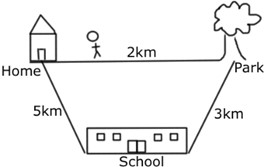
Jerry walked from home to school, then from the school to the park. What is his total distance?
2 km
5 km
8 km
10 km

A common black ant discovers a piece of bread 85 cm east of the entrance to her nest. If the ant carries 10 bits of bread back to her nest on separate trips to carry back its 10 bits of bread, and starts at her nest, what distance did she travel after discovering the bread and bringing it back to her nest?
1550 cm
1600 cm
1650 cm
1700 cm
An archer shoots an arrow into a target 53 m north of his position. What do you call the magnitude of the arrow's displacement? How large is that magnitude?
distance, 53 m
time, 53 m
vector, 53m
quantity, 53 m
What is the formula to calculate acceleration?
a = ΔtΔv
a = ΔvΔt
a = sd
a = ds

time = speed/distance
time = distance/speed
time = speed x distance
time = distance x speed
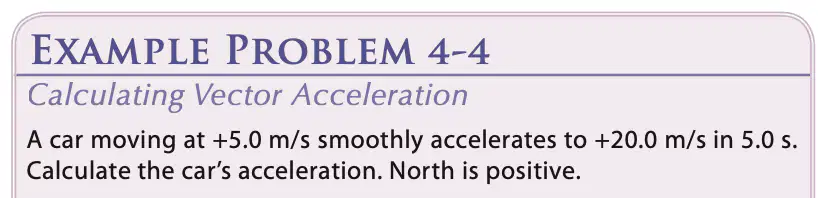
Please use the image to answer the question. Use the techbook to help guide you along with your notes. Show your work and label it example problem 4-4 calculating vector acceleration...
3 s2m north
5 s2m north
− 3 s2m north
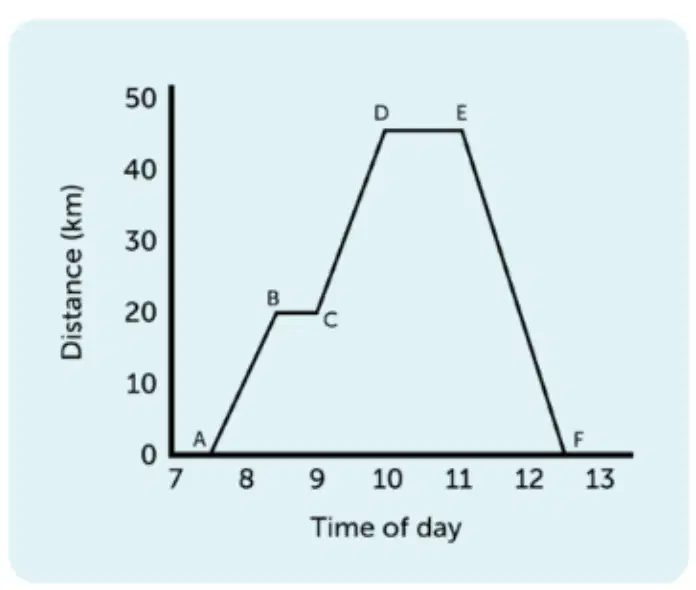
The following graph is tracked by a GoPro GPS system for a Tour de France Bicyclist. What is the distance measured in while he is tracking his trip?
Kilometers
Miles
Meters
Feet
The following graph is tracked by a GoPro GPS system for a Tour de France Bicyclist. What is the time measured in while he is tracking his trip?
hours
days
weeks
months
The following graph is tracked by a GoPro GPS system for a Tour de France Bicyclist. Using the graph, What was his total distance travelled throughout his daily trip?
Distance = 13 kilometers
Distance = 12.5 kilometers
Distance = 90 kilometers
Distance = 100 kilometers
The following graph is tracked by a GoPro GPS system for a Tour de France Bicyclist. Using the graph, How long was his total time travelled throughout his daily trip?
Time = 4 hours
Time = 4.5 hours
Time = 5 hours
Time = 5.5 hours
The following graph is tracked by a GoPro GPS system for a Tour de France Bicyclist. Using the graph, during which time segment(s) did the biker take a break?
Time segment B to C
time segment D to E
during both time segments B to C and D to E
The biker did not take a break
The following graph is tracked by a GoPro GPS system for a Tour de France Bicyclist. Using the graph, what is the cyclists average speed throughout his trip?
speed = 18 km per hour
speed = 22 km per hour
speed = 16 km per hour
speed = 8 km per hour
The following graph is tracked by a GoPro GPS system for a Tour de France Bicyclist. Using the graph, what is the cyclists instantaneous speed from segment c to d?
speed = 25 km per hour
speed = 22 km per hour
speed = 16 km per hour
speed = 8 km per hour
The following graph is tracked by a GoPro GPS system for a Tour de France Bicyclist. Using the graph, what is the cyclists instantaneous speed from segment e to f?
speed = 25 km per hour
speed = 22 km per hour
speed = 45 km per hour
speed = 8 km per hour
The following graph is tracked by a GoPro GPS system for a Tour de France Bicyclist. Using the graph, and the data you collected from the previous questions, when did the cyclist move the fastest?
during segments a and b
during segments b to c
during segments c to d
during segments e to f

