wayground logo

Free Printable Worksheets

Font size

S
M
L
XL
Worksheets

Unit 1 Review

Total questions: 125

Worksheet time: 2hrs 21mins

Name
Class
Date
1.

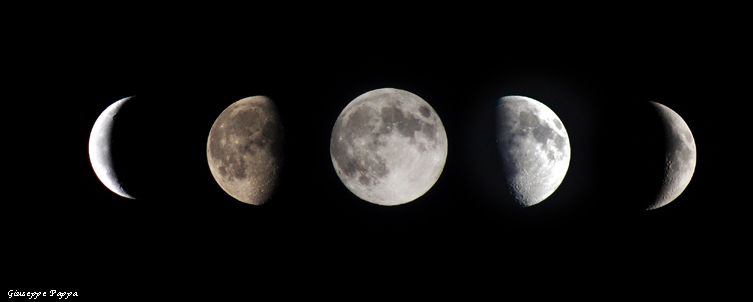
Identify this phase of the moon

a)

new moon

b)

full moon

c)

waxing crescent

d)

third quarter

2.

Identify the phase of the moon that is shown

a)

new moon

b)

first quarter

c)

waning gibbous

d)

third quarter

3.

3. Identify the phase of the moon that is shown

a)

waxing gibbous

b)

full moon

c)

waning gibbous

d)

third quarter

4.

4. Identify the phase of the moon that is shown

a)

new moon

b)

third quarter

c)

waxing crescent

d)

full moon

5.

5. Identify the phase of the moon that is shown

a)

waning gibbous

b)

new moon

c)

third quarter

d)

waxing crescent

6.

6. Identify the phase of the moon that is shown

a)

new moon

b)

blue moon

c)

third quarter

d)

waxing crescent

7.

7. Identify the phase of the moon that is shown

a)

new moon

b)

waxing crescent

c)

full moon

d)

waning crescent

8.

8. Identify the phase of the moon that is shown

a)

new moon

b)

waxing crescent

c)

first quarter

d)

third quarter

9.

Wha type of tide would this arrangement of earth-moon-sun create?

a)

full moon tide

b)

new moon tide

c)

neap tide

d)

spring tide

10.
What type of tides would this arrangement of earth-moon-sun create?
a)
neap tide
b)
spring tide
c)
new moon tide
d)
full moon tide
11.
Tides are caused by
a)
strong winds that blow over ocean waters.
b)
the interaction of Earth, the moon and the sun.
c)
the shifting of the plates on the ocean floor.
d)
variations in the salinity of ocean water
12.
What causes tides?
a)
gravity
b)
wind
c)
spring
d)
neap
13.
If tides alternate from high to low and there are two of each type of tide a day, about how many hours will generally be between each different tide?
a)
2 hours
b)
6 hours
c)
12 hours
d)
24 hours
14.
How many low tides and high tides happen in a day?
a)
1 low tide, 1 high tide
b)
4 low tides, 4 high tides
c)
3 low tides, 3 high tides
d)
2 low tides, 2 high tides
15.
The Moon has a greater influence on Earth tides than the Sun because...
a)
it is smaller than the Sun
b)
it revolves around the Earth
c)
it is closer to the Earth
16.
Differences in the moon's and sun's pull on different sides of the Earth cause _________.
a)
gravity
b)
lunar phases
c)
tides
d)
dabbing
17.
The bulge of water on the side of the Earth closest to the moon produces ___________.
a)
high tide
b)
low tide
c)
neap tide
d)
spring tide
18.
What is a difference between spring and neap tides?
a)
Spring tides occur when the earth and sun are IN LINE with the new or full moon. 
b)
Spring tides occur when moon in 3rd or 1st quarter phases
c)
Spring tides are LOWER than neap tides
d)
Spring tides occur in Spring and neap tides can occur in any season
19.

What is the transfer of heat by circulation of the heated parts of a liquid or gas?

a)

Conduction

b)

Convection

c)

Coriolis Effect

d)

Radiation

20.

What is the transfer of heat by circulation of the heated parts of a liquid or gas?

a)

Conduction

b)

Convection

c)

Coriolis Effect

d)

Radiation

21.

Which best explains how the Earth’s atmosphere is warmed?

a)

Radiation from the sun warms the surface and the atmosphere is heated through conduction and convection.

b)

Radiation from the sun warms the surface and the atmosphere is heated through evaporation and convection.

c)

Convection from the sun warms the surface and the atmosphere is heated through conduction and radiation.

d)

Convection from the sun warms the surface and the atmosphere is heated through evaporation and conduction.

22.

What two processes of heat transfer would cause the water in a pot on the stove to boil?

a)

radiation and convection

b)

conduction and radiation

c)

radiation and evaporation

d)

conduction and convection

23.

What type of energy transfer occurs when two things are in direct contact (touching)?

a)

Condensation

b)

Conduction

c)

Convection

d)

Radiation

24.

Which of the following shows a transfer of energy by means of conduction?

a)

Standing near a warm fire.

b)

Watching a microwave oven cook your food.

c)

Grabbing a metal seat belt buckle after a car has been closed up in the sun all day.

d)

Feeling the breeze that blows over the land during the day and toward the sea later that night.

25.

What is the transfer of heat by the circular movement of molecules?

a)

Condesation

b)

Conduction

c)

Convection

d)

Radiation

26.

To check if an iron is hot, you place your hand near the iron and feel that it is warm without touching it. What type of heat transfer is this?

a)

Condensation

b)

Conduction

c)

Convection

d)

Radiation

27.

When you play outside in the sun too long and receive a sunburn, which type of heat transfer is this?

a)

Conduction

b)

Convection

c)

Evaporation

d)

Radiation

28.

A student must choose three items to demonstrate conduction, convection, and radiation from solar energy. The student quickly chooses water and a metal bowl. Which of the following items should the student choose to complete the experiment?

a)

Rubber ball

b)

food coloring

c)

heat lamp

d)

ice cube

29.

What is the main source of energy that drives all weather patterns?

a)

Sun

b)

Moon

c)

Oceans

d)

Mountains

30.
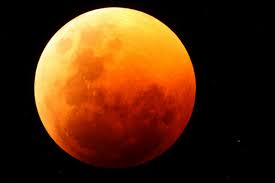
During a lunar eclipse, what color does the moon appear?
a)
Black
b)
Red-orange
c)
Yellow-green
d)
White
31.
A solar eclipse only happens during a ________ moon.
a)
New
b)
Cresent
c)
Gibbous
d)
Full
32.
A lunar eclipse only happens during a ________ moon.
a)
New
b)
Cresent
c)
Gibbous
d)
Full
33.
Where must you be to see a total solar eclipse?
a)
a corona
b)
an orbit
c)
the moon's shadow
d)
the earth's shadow
34.
In order to have an eclipse, the Moon, Sun and Earth have to be?
a)
Below each other
b)
Above each other
c)
In alignment
35.
Which type of eclipse occurs when the Moon comes directly between Earth and the Sun?
a)
Lunar eclipse
b)
Solar eclipse
36.
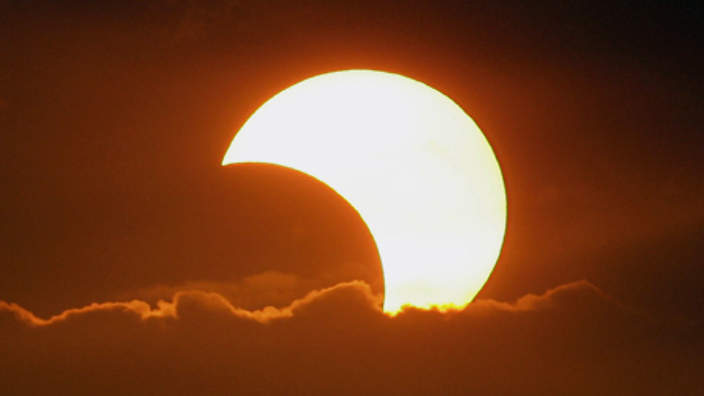
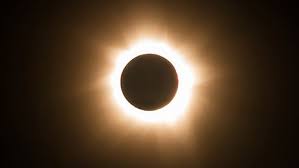
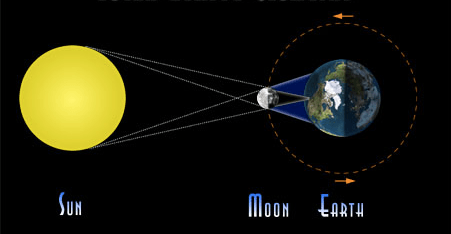
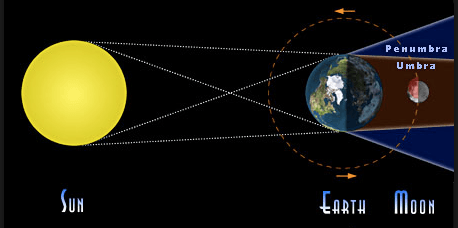
This image is an example of 
a)
Lunar Eclipse
b)
New Moon
c)
Solar Eclipse
d)
Full Moon
37.
This image is an example of
a)
Lunar Eclipse
b)
Full Moon
c)
New Moon
d)
Solar Eclipse
38.
A solar eclipse only occurs during which moon phase?
a)
1st Quarter
b)
New Moon
c)
Full Moon
d)
3rd Quarter
39.
During a solar eclipse...
a)
The sun is blocked by the moon
b)
The Earth is blocked moon
c)
The moon is blocked by the sun
d)
You are blocked
40.
Which of the following is NOT true about a total solar eclipse?
a)
It can be viewed from every spot on earth
b)
It is dangerous to look at without the proper device
c)
When it happens, the moon blocks all of the sun except the corona
d)
You must be within the moon's umbra to see it
41.
Which type of eclipse is shown in this picture?
a)
Solar Eclipse
b)
Orbit
c)
Lunar Eclipse
d)
Total Eclipse
42.
Which type of eclipse is shown in the diagram?
a)
Solar Eclipse
b)
Lunar Eclipse
c)
Total Eclipse
d)
Partial Eclipse
43.
An experiment in which one and ONLY ONE, variable is changed.
a)
variable
b)
coordinate
c)
controlled experiment
d)
standard
44.
The variable that is being tested or changed
a)
independent variable
b)
dependent variable
c)
control variable
45.
Mr. S. sets up an experiment to see how the mass of a ball affects the distance it rolls off a ramp.  Identify the independent variable.
a)
distance traveled by the ball
b)
height of the ramp
c)
mass of the ball
d)
weight of the ball
46.
What step does every scientific experiment begin with?
a)
hypothesis
b)
question/problem
c)
procedures
d)
conclusion
47.
An experiment is performed on plants to see how different liquids affect plant growth. Each plant in the experiment is given a different liquid; water, apple juice, or milk. Each plant has the same amount of soil, sunlight, and listens to the same music. In this investigation, what is the dependent variable?
a)
Type of plant
b)
Water, apple juice, milk
c)
Plant growth
48.
When experimenting with the growth of a plant, a scientist uses three (of the same type of) plants, two different fertilizers, equal light, and equal water. What type of variable is the fertilizer?
a)
Dependent
b)
Independent
c)
Control
d)
Compound
49.
The educated guess you make at the beginning of the scientific method is called the....
a)
variable
b)
conclusion
c)
hypothesis
d)
procedure
50.
The librarians want to know which students are checking out what types of books. They are testing "Which type of book do 7th graders check out most often: fiction or nonfiction?" The number of checked out books is
a)
the independent variable
b)
the dependent variable
c)
a constant variable
d)
a waste of money
51.
The variable that is being measured
a)
independent variable
b)
dependent variable
c)
control variable
52.
the variable that is kept the same to make sure results are caused by the thing being tested
a)
independent variable
b)
dependent variable
c)
control variable
53.
A student is planning an experiment to find out how the height from which he drops a ball affects how high the ball bounces. The dependent variable is the _____.
a)
Diameter of the ball
b)
Force acting on the ball
c)
Height that the ball bounces
d)
Height from which the ball is dropped
54.
An experiment is performed on plants to see how different liquids affect plant growth. Each plant in the experiment is given a different liquid; water, apple juice, or milk. Each plant has the same amount of soil, sunlight, and listens to the same music. In this investigation, what is the dependent variable?
a)
Type of plant
b)
Water, apple juice, milk
c)
Plant growth
55.
Mr. S. normally uses praise as a reward to train his dog.  He wants to know the best way to train his dog, so he sets up an experiment to find out if there is a better way to get his dog to respond to commands. What is his independent variable?
a)
amount of times the dog follows the command
b)
type of reward
c)
 praise
d)
type of dog
56.
A student is planning an experiment to find out how the height from which he drops a ball affects how high the ball bounces. The dependent variable is the _____.
a)
Diameter of the ball
b)
Force acting on the ball
c)
Height that the ball bounces
d)
Height from which the ball is dropped
57.
You use your five sense to find out about the world around you. This is called______.
a)
observations
b)
data
c)
conclusion
d)
scientific method
58.
A series of steps used by scientists to solve a problem or answer a question. 
a)
scientific method
b)
recipe
c)
data collection
d)
metric system
59.
If plants are exposed to sunlight, then they will grow taller.
What part of the scientific method is this an example of?
a)
Procedure
b)
Hypothesis
c)
Question
d)
Results
60.
What is a hypothesis?
a)
an educated guess stating what you believe will be the result of your experiement
b)
a random guess
c)
a statement of the outcome of your experiment
d)
step by step directions for your experiment
61.
Which scientific instrument would best be used to measure a small distance?
a)
Ruler
b)
Stopwatch
c)
Balance
d)
Pipette
62.
Which scientific instrument would best be used for measuring an amount of time?
a)
Ruler
b)
Balance
c)
Stopwatch
d)
Magnifying Glass
63.
The Earth's axis is tilted _____ degrees.
a)
23.5
b)
25.3
c)
30.2
d)
24
64.

The "spinning" motion of Earth like a top is called:

a)

Turning

b)

Revolution

c)

Spinning

d)

Rotation

65.

Rotation of the earth takes (Select 2 answers)

a)

One day

b)

One year

c)

One summer

d)

24 hours

66.

The imaginary line that runs through Earth from the North to South pole is called:

a)

Equator

b)

Axis

c)

South Pole

d)

Line

67.

Earth's axis is tilted at

a)

20 degrees

b)

28.6 degrees

c)

23.5 degrees

d)

26.2 degrees

68.

The imaginary line that runs East to West and separates the Earth into 2 hemispheres is called:

a)

Axis

b)

North pole

c)

Equator

d)

South pole

69.

Rotation of the earth is what causes __________________ on Earth

a)

The seasons

b)

Day and night

c)

The tides

d)

A full moon

70.

As viewed from Earth, most stars appear to move across the sky each night because

a)

stars orbit around Earth

b)

Earth rotates on its axis

c)

stars revolve around the center of the galaxy

d)

Earth revolves around the Sun

71.

Which location on Earth is turned away from the sun?

a)

Location A

b)

Location B

72.

Which location on Earth is facing towards the sun?

a)

Location A

b)

Location B

73.

Which location is experiencing day time?

a)

Location A because it is facing away from the sun

b)

Location B because it is facing the sun

c)

Location A because it is facing the sun

d)

Location B because it is facing away from the sun

74.

Which location is experiencing night time?

a)

Location A because it is facing away from the sun

b)

Location B because it is facing the sun

c)

Location A because it is facing the sun

d)

Location B because it is facing away from the sun

75.

How long do you think it would take for location A to get to where location B is?

a)

24 hours

b)

a year

c)

12 hours

d)

a summer

76.
Planets orbit the Sun in a shape called a(n)
a)
circle
b)
ellipse
c)
focus
d)
perihelion
77.
Planets orbit the Sun in a shape called a(n)
a)
circle
b)
ellipse
c)
focus
d)
perihelion
78.
An ellipse is drawn around two points called
a)
aphelion
b)
perihelion
c)
foci
d)
axis
79.
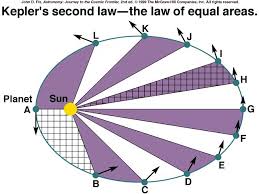
Where is the planet moving faster
a)
Position A to B
b)
Position B to C
c)
Position H to I
d)
Position I to J
80.
What has an eccentricity of zero
a)
a straight line
b)
a large ellipse
c)
a circle
d)
a small ellipse
81.

Kepler's 2nd Law deals with

a)

the shape of the planets' orbits

b)

the area the planet travels

c)

the length of time/period it takes the planet to orbit the sun

82.
A planet moves __________ when it is farthest from the sun.
a)
faster
b)
slower
83.
The farther away a planet is from the sun, the _______ it takes it to orbit the sun once. 
a)
longer
b)
shorter
84.

What does Kepler's 1st Law state?

a)

all planets move in elliptical shaped orbits around the sun

b)

all ellipses have one foci

c)

the area that a planet revolves around the sun is equal

d)

the speed that a planet revolves around the sun changes

85.
A perfect circle has an eccentricity of ______.
a)
0
b)
.99
c)
1
d)
2
86.
The flattest ellipse before it becomes a line will have an eccentricity of _______.
a)
0
b)
.99
c)
1
d)
2
87.
Calculate the eccentricity for the following orbit. 
a)
1.6
b)
0.8
c)
0.6
d)
1.2
88.

What is the formula for eccentricity?

a)

e = d / L

b)

e = L * d

c)

e = L / d

d)

e*d=L

89.

The eccentricity formula is:

a)

change in value/distance

b)

mass/volume

c)

distance between foci/length of major axis

d)

change in value/time

90.
True or false: as you move along the spectrum, radio to gamma waves, the wavelengths decrease in size (get smaller)
a)
true
b)
false
91.
A wave with a large wavelength will have a ______ frequency and _____ energy
a)
high, low
b)
high, high
c)
low, high
d)
low, low
92.
Select the correct order of waves on the EMS from the longest wavelength to the shortest wavelength
a)
Radio, Micro, Infra, Visible, Ultra, X-ray, Gamma
b)
Gamma, X-ray, Ultra, Vis, Infra, Micro, Radio
c)
Vis, Micro, Infra, Ultra, X-ray, Gamma, Radio
d)
Micro, Radio, Vis, Infra, Ultra, X-ray, Gamma
93.
Which has the LONGEST wavelength and, therefore, the lowest frequency/energy
a)
Gamma Rays
b)
Radio Waves
c)
Visible Light
d)
Infrared rays
94.
Which has the SHORTEST wavelength and, therefore, the highest frequency/most energy
a)
Radio waves
b)
Ultraviolet Rays
c)
Gamma Rays
d)
X-rays
95.
Which section of the spectrum is the ONLY one we can see?
a)
X-rays
b)
Visible Light
c)
Gamma Rays
d)
Ultraviolet Rays
96.
How are electromagnetic waves different from other waves? 
a)
They have very short wavelengths 
b)
They transmit energy instead of matter 
c)
They can travel through empty space
d)
They can change direction by reflection 
97.
Which of the following electromagnetic waves has the lowest energy?
a)
gamma ray
b)
infrared wave
c)
visible light wave
d)
microwave
98.
As the frequency of an electromagnetic wave increases, the amount of energy in that wave...
a)
increases.
b)
decreases.
c)
stays the same.
99.
High frequency waves have _________ wavelengths.
a)
varying
b)
long
c)
the same
d)
short
100.
The distance between two crests or two troughs of a wave is called:
a)
frequency
b)
amplitud
c)
wavelength
d)
hertz
101.
How much of the electromagnetic spectrum is visible?
a)
All of it
b)
None of it
c)
Most of it
d)
Only a small part
102.

Quasars are extremely distant celestial bodies. Investigators using a special telescope determined that a certain quasar was emitting waves with a frequency of 1.41 × 10⁹ Hz. An

electromagnetic spectrum is shown.

a)

microwaves

b)

Infrared

c)

Visible Light

d)

Gamma Rays

103.

Which of these is an observation?

a)

The dog is 4 years old.

b)

The dog is wearing a hat.

104.

What is an observation about this picture?

a)

The lady is working on a remote learning day.

b)

This lady has her hair in a bun.

105.
What is an inference? 
a)
Just a random guess
b)
A prediction or logical conclusions about our observations
c)
The same as an observation
d)
deciding if an observation is qualitative or quantitative
106.

Choose 2 inferences about this picture.

a)

Today is the dog's birthday.

b)

There is a candle on the cake.

c)

The dog has a tag on the collar.

d)

The dog will eat the cake.

107.

Observation or Inference: I think the weather is cold.

a)

Observation

b)

Inference

108.

Observation or Inference: I notice the tree by the pond has no leaves on it.

a)

Observation

b)

Inference

109.

Which statement is an observation about this picture?

a)

There are washing machines or dryers in the picture.

b)

The woman is at a laundry mat.

110.

Which two of these can be observations about a gorilla?

a)

The gorilla wants a bigger banana.

b)

The gorilla has 5 fingers on his right hand.

c)

The gorilla is hungry.

d)

The gorilla has dark brown hair.

111.

The cat looks mad. He must be hangry.

a)

Observation

b)

Inference

112.

In qualitative research, we depend mostly on our senses.

a)

True

b)

False

113.

The camptosaurus is going to eat

the stegosaurus

a)

Observation

b)

Inference

114.

Which of these is an observation about this picture?

a)

The blue team is winning.

b)

The blue team is the Golden State Warriors.
115.

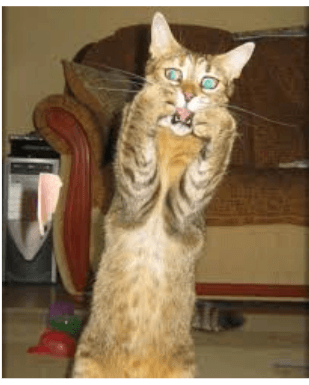
Observation or Inference: The cat is scared.

a)

Observation

b)

Inference

116.

Choose 2 inferences about this picture.

a)

The person is wearing brown shoes.

b)

There are 2 carts showing in the picture.

c)

The person is trying to climb up in the dryer to hide.

d)

The cart is used for hanging and sorting clothes.

117.

Using any of your 5 senses to describe the world around you.

a)

Observation

b)

Inference

c)

Quantitative Observation

d)

Logical Theory

118.

An observation that has to do with adjectives like heavy.

a)

Centimeters

b)

Inference

c)

Qualitative Observation

d)

Quantitative Observation

119.

An observation that has to do with numbers and labels like 3.5 cm.

a)

Observation

b)

Touch, Taste, Sight, Hearing, Smell

c)

Qualitative Observation

d)

Quantitative Observation

120.

Qualitative or Quantitative: There is 300 mL of liquid in this beaker.

a)

Qualitative Observation

b)

Quantitative Observation

121.

The Camptosaurus is leaving

tracks into the ground.

a)

Observation

b)

Inference

122.

Qualitative or Quantitative: I feel rough sand and a strong heat on the back of my neck.

a)

Qualitative Observation

b)

Quantitative Observation

123.

Qualitative or Quantitative: We bought 3.4 pounds of fruit.

a)

Qualitative Observation

b)

Quantitative Observation

124.

Qualitative or Quantitative: I hear a rush of wind, loud yells, and metal banging together.

a)

Qualitative Observation

b)

Quantitative Observation

125.

Qualitative or Quantitative: The green bar is 3.5 centimeters long.

a)

Qualitative Observation

b)

Quantitative Observation