wayground logo

Free Printable Worksheets

Font size

S
M
L
XL
Worksheets

Grade 8 Final Exam Review

Total questions: 100

Worksheet time: 2hrs 14mins

Name
Class
Date
1.

An educated prediction that may solve your problem is called _

a)

hypothesis

b)

observation

c)

data

d)

conclusion

2.

Question that you want to answer is called _

a)

inference

b)

experiment

c)

problem

d)

data

3.

Answers whether or not you supported your hypothesis is a _

a)

problem

b)

observation

c)

data

d)

conclusion

4.

You do this to test your hypothesis.

a)

conclusion

b)

problem

c)

experiment

d)

control

5.

When we test our hypothesis, there are two types of variables. What are they?

a)

Independent and controlled variable

b)

dependent and controlled variable

c)

independent and dependent variable

d)

none of the above

6.

Constants are factors in an experiment that stay the same. True or False?

a)

True

b)

False

7.

An independent variable is?

a)

step-by-step approach to solving problem

b)

a statement that can be tested

c)

variable measured during the experiment

d)

variable changed by the experimenter

8.
Research Question: Does the type of gasoline put in a car effect how fast the car can drive. What is the independent variable?
a)
Type of gasoline
b)
which car the gas is put into
c)
how fast the car can drive
d)
how much gas is put into the car
9.

What is the DEPENDENT variable (effect) in this experiment?


"Does eating breakfast improve test scores?"

a)

eating breakfast or not

b)

the grade you got on the test

c)

what time you get up in the morning

d)

how tasty the breakfast is

10.

You are testing how the amount you water a plant affects its growth. What would be the INDEPENDENT VARIABLE in this experiment.

a)

They type of pot you put the plants in.

b)

The amount you water each plant.

c)

The amount of sunlight the plants get.

d)

The amount the plant grows.

11.

The ONLY thing that the scientist changes on purpose in all of the experimental groups is the

a)

answer

b)

independent variable

c)

dependent variable

d)

hypothesis

12.

In an experiment, the group that IS NOT exposed to any changes made in the variables. The groups that are exposed to change are compared to this one in order to see the differences.

a)

Control group

b)

Experimental group

13.
What does the nucleus of an atom contain?
a)
Electrons and neutrons
b)
Protons and neutrons
c)
Neutrinos and positrons
d)
DNA and RN
14.

The positive particles of an atom are called _____.

a)

electrons

b)

positrons

c)

neutrons

d)

protons

15.
What is the charge of the electron
a)
positive
b)
no charge
c)
negative
d)
neutral
16.
How many Protons are in one atom of Lithium?
a)
3
b)
6
c)
7
d)
6.941
17.

Use the picture to answer. What is the atomic mass of gold?

a)

79

b)

196.967

c)

197

d)

118

18.

If an atom's atomic number is 2 and has a mass of 4, how many neutrons does the atom have?

a)

2

b)

4

c)

6

d)

0

19.

What is a substance made of two or more elements that are chemically combined called?

a)

A. element

b)

B. compound

c)

C. mixture

d)

D. solution

20.

Is salt (NaCI) a compound or an element?

a)

Compound

b)

element

21.

Valence electrons are found

a)

outermost energy level

b)

innermost energy level

c)

some where in the electron cloud

22.

How are ionic bonds formed?

a)

transfer of electrons

b)

sharing of electrons

23.
How many valence electrons do most atoms need to be stable?
a)
1
b)
2
c)
6
d)
8
24.
How many O's are in Al₂(SO₄)₃
a)
4
b)
12
c)
7
d)
24
25.
How are covalent bonds formed?
a)
Sharing of electrons
b)
Transfer of electrons
26.
The parts of a homogeneous mixture are   __________ throughout. 
a)
Same 
b)
Different 
c)
Neutral 
d)
Suspended 
27.
___________ is a combination of substances that can be physically separated. 
a)
Colloid 
b)
Mixture 
c)
Suspension 
d)
Compound 
28.

Mixtures that have parts that are not uniformly mixed together are called...

a)

Homogeneous

b)

Heterogeneous

29.
Evidence of a chemical reactions is anything that shows - 
a)
a new substance has formed
b)
a solid dissolved in a liquid
c)
interaction between 2 gases
d)
a change in the state of matter
30.
If reaction starts with 20g of reactants it should produce 
a)
a total of 40g of products
b)
a total of 10g of products
c)
a total of 80 g of products
d)
a total of 20g of products
31.

Is a phase change such as ice melting a physical or chemical change?

a)

Physical

b)

Chemical

32.

What colour does litmus paper turn when added to an acid?

a)

Blue

b)

Red

c)

Green

d)

Colourless

33.
A pH scale is...
a)
A  corrosive substance that says a substance is an acid.
b)
An indicator that tells if a substance is an acid or base. 
c)
A blue litmus paper.
d)
A red litmus paper.
34.

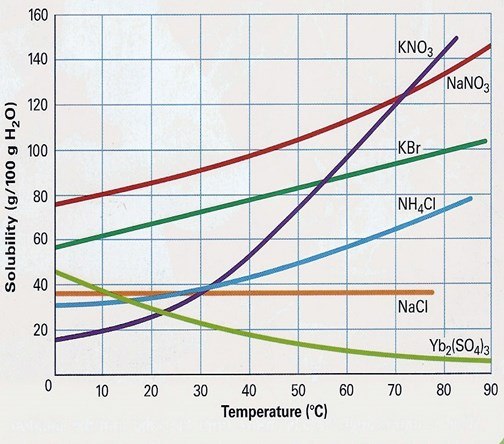
What is the solubility of NaNO3 at 20 C in 100 g of water?

a)

90 g

b)

80 g

c)

40 g

d)

160 g

35.

At 80'C, KBr's solubility is:

a)

100

b)

90

c)

80

d)

0

36.
What is the activation energy?
a)
The energy of the products
b)
The energy of the reactants
c)
The minimum energy needed by the reactants to form the products.
d)
The energy lost in the reaction
37.

In an endothermic reaction, energy is _________.

a)

absorbed

b)

released

38.

Your family uses candles to see when the electricity goes out.

a)

exothermic

b)

endothermic

39.

When heat is released it is an

a)

exothermic reaction

b)

endothermic reaction

c)

both

d)

none

40.

The following tells us the number of molecules that are present in an equation.

a)

coefficient

b)

subscripts

c)

elements

41.

What does the following represent?

a)

coefficient

b)

subscript

c)

elements

42.
Speed=
a)
T/D
b)
D/T
c)
S x T
d)
D x T
43.
Which is an example of VELOCITY?
a)
A dog running at 3 m/s
b)
A deer sprinting at 4 m/s
c)
A migrating bird headed south for the winter at 3 m/s
d)
A person not moving at all
44.
a)
Object not moving
b)
Object accelerating
c)
Object slowing down
d)
Object at a constant speed
45.

This occurs when an object speeds up, slows down, or changes direction.

a)

Speed

b)

Velocity

c)

Acceleration

46.
A ____________ is a push or a pull on an object.
a)
friction
b)
force
c)
magnet
d)
gravity
47.

Which is newtons 3rd law

a)

for every thing there is reaction

b)

for every reaction there is a unusual action

c)

For every reaction there is an equal and opposite reaction

d)

for every reaction there is an good action
48.
Do free falling objects move at constant velocity or do they accelerate?
a)
Falling objects accelerate at -9.8 m/s2
b)
Falling object move at constant velocity
c)
Falling objects accelerate at 100 m/s2
d)
It depends on the mass: heavy objects accelerate, light objects do not
49.
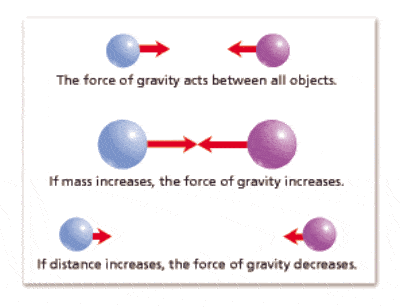
As distance between two objects increase the pull of gravity 
a)
Increases
b)
Decreases
c)
Stays the same
50.
As mass increases, what happens to gravitational force?
a)
increases
b)
decreases
c)
stays the same
d)
i don't know
51.

Friction is a force that acts in an ___________ direction of movement.

a)

similar

b)

opposite

c)

parallel

d)

west

52.
How can friction be reduced?
a)
reduce the force acting between the 2 surfaces
b)
reduce the roughness of the 2 surfaces coming in contact
c)
use wax, grease or oil
d)
all of the above are ways of reducing friction
53.

What is Newton's 3rd Law?

a)

For every action there is an equal and opposite reaction.

b)

Acceleration depends on two variables, the mass of the object and the amount of force.

54.

Force=Mass x Acceleration

a)

Newton's First Law

b)

Newton's Second Law

c)

Newton's Third Law

55.

Which of the following is heterozygous?

a)

MM

b)

Mm

c)

mm

56.

What term denotes the physical expression of a gene?

a)

genotype

b)

phenotype

c)

appearance

d)

homologous

57.

Which of the following would produce a recessive phenotype?

a)

hh

b)

Rr

c)

Ww

d)

BB

58.
T - tall and t = short
In the punnett square below, what belongs in the missing square
a)
tt
b)
Tt
c)
Bb
d)
TT
59.
Dominant alleles are represented by a:
a)
Male gene
b)
lowercase letter
c)
recessive trait
d)
capital letter
60.
What is a gene?
a)
An entire chromosome that  codes for a trait
b)
a piece of clothing
c)
a piece of a DNA on chromosome that codes for a trait
d)
Chemical messengers in your brain that code for a trait
61.

DNA is the code for (a)   life.

62.

Thymine will bond with...

a)

Guanine

b)

Cytosine

c)

Adenine

d)

Uracil

63.

Guanine will bond with...

a)

Thymine

b)

Cytosine

c)

Adenine

d)

Uracil

64.
the process of making a copy of DNA
a)
transcription
b)
double helix
c)
DNA replication
d)
replication fork
65.
The shape of DNA.
a)
double helix
b)
nucleotide
c)
DNA polymerase
d)
single stranded
66.

The process that happens in the nucleus and makes mRNA from DNA is called _

a)
Replication
b)
Transcription
c)
Translation
d)
Protein synthesis
67.

the second step of production of proteins where mRNA is coded to produce a specific protein chain is _

a)

translation

b)

transcription

c)

replication

d)

central dogma

68.

one form of RNA that transports a specific amino acid to a ribosome during protein synthesis

a)

mRNA

b)

tRNA

c)

rRNA

d)

sRNA

69.
Any change in the sequence of DNA is...
a)
transgenic shift
b)
Single Genotype
c)
Monohybrid Trait
d)
Mutation
70.
Mutations are__________
a)
Harmful
b)
Harmful or beneficial
c)
Neutral
d)
Harmful, neutral, or beneficial
71.

What are the two ways mutations can occur?

a)

inherited

b)

abduction

c)

they don't exist

d)

acquired

72.
The process of making changes in the DNA code of a living organism is called 
a)
Selective Breeding
b)
Inbreeding
c)
Genetic Engineering
d)
Di-hybrid Cross
73.
A member of group of genetically identical cells produced from a single cell is called 
a)
Vector
b)
Clone
c)
Hybrid
d)
Genome
74.

It is the transfer of genetic material for the purpose of treating human disease.

a)

chemotherapy

b)

gene therapy

c)

gene transfer

d)

gene editing

75.

_ change the DNA base sequence resulting in a dysfunctional protein.

a)

RNA

b)

Mutations

c)

meiosis

d)

cloning

76.

WHAT DOES MEIOSIS CREATE?

a)

CHROMOSOMES

b)

GAMETES

c)

DNA

d)

TRAITS

77.

The stage of meiosis where crossing over or the exchange of genetic information happens between pairs of chromosomes

a)

Prophase II

b)

Telophase I

c)

Metaphase II

d)

Prophase I

78.

What do we call structures that no longer perform their original function?

a)

Natural Selection

b)

Analogous Structure

c)

Vestigial Structure

d)

Homologous Structure

79.

What do you call a characteristic that allows an organism to survive in an environment?

a)

variation

b)

adaptation

c)

selection

d)

overproduction

80.
This is an ecological relationship in which two or more organisms depend on the same limited resource.
a)
Adaptation
b)
Competition
c)
Evolution
d)
Natural selection
81.

True or False? In Natural selection an animal chooses to adapt in a single generation, and survives.

a)

true

b)

false

82.
A  population of cockroaches was sprayed with an insecticide.  Some cockroaches survived and produced a population of cockroaches that was resistant to this spray.  What can BEST be inferred from this example?
a)
species will adapt no matter what the environment
b)
environment has no effect on the survival of an organism
c)
Individuals with favorable variations survive and reproduce
d)
Insecticides cause mutations that are passed on to the next generation
83.
Analyze the seashell found in the white layer.  Which statement is true of the rock layer that contains this fossil?
a)
It could also contain a fossil from the bottom layer.
b)
It is older than the layers below it.
c)
It is younger than the layers above it.
d)
It is older than the layers above it.
84.

The youngest rock layer is made of what type of rock?

a)

Granite

b)

Sandstone

c)

Limestone

d)

Shale

85.

The fossil record shows that younger rock layers have...

a)

both a greater variety of a life and more complex organisms.

b)

decreasing variety of life and less complex organisms.

c)

decreasing variety of life but more complex organisms.

d)

a greater variety of life but less complex organisms.

86.

Which is used in radioactive dating?

a)

Carbon-14

b)

Index fossils

c)

Hydrochloric acid

d)

Law of superposition

87.
What is Half-life?
a)
The amount of time it takes for some of the nuclei in a sample of the isotope to decay
b)
The amount of time it takes for half the electrons in a sample of the isotope to decay
c)
The amount of time it takes for half the nuclei in a sample of the isotope to decay
d)
the amount of time it takes to double the nuclei in a sample of the isotope to decay
88.
To be considered an index fossil, it had to have lived for a relatively short period of time.
a)
True
b)
False
89.

What is an example of convection currents

a)

Feeling the heat from a bonfire with your friends

b)

Touching a hot curling iron

c)

The movement of air in a circular motion in the atmosphere

90.

What type of breeze is this?

a)

Land Breeze

b)

Sea Breeze

c)

Mountain Breeze

d)

Valley Breeze

91.

What type of breeze is this?

a)

Land Breeze

b)

Sea Breeze

c)

Mountain Breeze

d)

Valley Breeze

92.

______ causes surface currents.

a)

The Coriolis Effect

b)

gravity

c)

density differences

d)

wind

93.
Deep Ocean currents are a result of
a)
Global Wind Patterns
b)
Earth's Rotation
c)
Density
d)
All of the above
94.
What causes ocean currents in the Northern Hemisphere to curve to the right?
a)
Earth's orbit around the Sun
b)
Earth's spinning on its axis
c)
Earth's magnetic field
d)
Earth's force of gravity
95.
What causes day and night?
a)
revolution of Earth
b)
rotation of Earth
c)
orbit of Earth
d)
The moon blocks the Sun
96.

During the winter months of the Northern hemisphere the Earth is ______.

a)

tilted closer toward the Sun

b)

tilted farther away from the Sun

c)

spinning slower than in Summer

d)

spinning faster than in Summer

97.

What causes the seasons?

a)

the rotation of the Earth

b)

the tilt of the Earth

c)

the Earth moving closer or farther from the sun

d)

eclipses

98.
What does this diagram represent?
a)
Solar eclipse
b)
Lunar eclipse
99.
What does this diagram represent?
a)
Solar eclipse
b)
Lunar eclipse
100.

At which position would people on Earth see a New Moon?

a)

A

b)

B

c)

C

d)

D