
 Worksheets
Biology Unit 1 Test Review
Total questions: 177
Worksheet time: 2hrs 19mins
Which of the following is the correct order of organization in living things from most basic (simple) to most complex?
organism, cell, tissue, organ, organ system
organ system, organ, tissue, cell, organism
cell, tissue, organ, organ system, organism
cell, organ, tissue, organism, organ system
A zookeeper notices that that a certain monkey will jump when different volumes of a sound are played. He wonders if the volume of the noise affects how high the monkey jumps. The zookeeper then plays the same noise at different volumes (from very quiet to very loud) and measures how high the monkey jumps each time. What is the independent variable for this experiment?
Height jumped
Volume of sound
no sound
type of sound

Compare the two graphs in Figure X. Which statement below correctly compares the two graphs.
The Independent variable decreases while the dependent variable increase for both graphs.
Graph L and graph M 99% similar.
Graph L has a stronger correlation than graph M.
Both variables change at equal rates.
all are correct
100% of the students got a B or better on the last test. Is this Claim, Evidence, or Reasoning?
Claim
Evidence
Reasoning
Match the following
Two out of three ineligible high school students fail to get enough sleep. This is the ..
evidence
If students are getting less sleep, then they are more likely to be tardy, absent, and inattentive in the morning and less able to learn because sleep is essential for basic school functioning. This is the ___.
reasoning
Sleep is important to do well in school
Claim
Match the following
Iguanas cannot control their temperature by shivering and sweating, instead, they burrow to stay cool and bask on rocks in the sun to stay warm.
homeostasis
Some animals have camouflage, which allows them to hide from predators more easily than organisms that do not have camouflage.
Adapt and evolve over time
A bird consumes a lot of worms every morning.
Requires energy
The head of the sunflower moves along with the sun’s location in the sky
respond to stimuli
As time progresses, a tadpole will lose its tail and grow legs until it is the structure of a frog.
grows and develops
Which correctly identifies the sub-organelle particles of cellular organization?
Atoms, molecules, & macromolecules
Carbon, hydrogen, & oxygen
Protons, neutrons, & electrons
Molecules make up macromolecules.
Match the following
Examples: protein, lipid, carbohydrates
macromolecule
Flower, stomach, brain, stem, roots, etc
organ
All of the beetles living in a garden during the springtime.
population
A group of atoms bonded together.
molecule
A group of cells working together for a common function.
tissue
Amino acid is to protein as
Fat is to lipid.
Sugar is to fat.
Simple sugar is to carbs
Lipids is to fatty acids.
Both animal fats and plant oils are examples of _________and have a monomer called ________.
lipids; amino acids
lipid; fatty acids
proteins; amino acids
proteins; fatty acids
Which statement is true?
Simple sugars are made up of carbohydrates.
Glycerol is made up of fatty acids.
Polymers are made of monomers.
Amino acids are made of protein.
Match the following
Found in the nucleus of eukaryotic cells.
Nucleic Acid
very diverse, many different functions due to various shapes
Protein
the cell membrane made up of phospholipid bilayer
lipid
Built for the Kreb cycle, & the mitochondria’s primary source for making energy by cell respirations.
Carb.
Has an R-group
amino acid
The basic unit of structure and function of living organisms
organ
organ system
cell
tissue
organism
Which organelle would you expect to find in plant cells but not animal cells?
nucleus
chloroplast
cell membrane
phospholipid bilayer
plasma membrane
Which organelle would you expect to find in plant cells but not animal cells?
mitochondria
cell wall
cell membrane
phospholipid bilayer
plasma membrane
A group of similar cells that work together to form the same function is called .......
organ
cell
organ system
organism
tissue


What is a Cell?
The smallest basic unit of structure and function in living things
The smallest basic unit of structure of matter
Groups of similar cells that have a common function
A structure that is composed of different kinds of tissues that perform similar functions
A structure that consists of different organs that work together closely to perform a vital function
Control group
Controlled variable (constant)
Constant (controlled variable)
Control group

What is the DEPENDENT variable (effect) in this experiment?
"Does eating breakfast improve test score?"
eating breakfast or not
the grade you got on the test
what time you get up in the morning
how tasty the breakfast is

"Do tall people jump further than short people?"

"Will fish school more if a predator is present?"
Diego wants to know how drinking milk affects how tall Dora grows. Which is the independent variable?
Drinking milk.
Diego's growth.
Dora's growth.
Chocolate or plain milk.
An experiment is performed on plants to see how different liquids affect plant growth. Each plant in the experiment is given a different liquid. Each plant has the same amount of sunlight, soil and listens to the same music. What is the independent variable?
the type of plant
the type of liquid
the type of music
the amount of liquid
Scientific Question: Does being tardy impact test scores?
What is one of the constant variables?
test scores
the time a student arrives to class
amount of time to complete test
Scientific Question: Will a person fall asleep faster if they listen to music?
What is the manipulated (independent) variable?
music
time to fall asleep
person
Scientific Question: Will a person fall asleep faster if they listen to music?
What is the dependent (responding) variable?
music
time to fall asleep
person

Jamal is trying to perfect his basketball shots. He thinks getting closer to the basketball hoop before throwing the ball will help him score more points. In this situation, what is the manipulated (independent) variable?
How close Jamal gets to the hoop
How high Jamal jumps when he shoots
How many points he scores
How hard he throws the ball
Jamal is trying to perfect his basketball shots. He thinks getting closer to the basketball hoop before throwing the ball will help him score more points. In this situation, what is the dependent (responding) variable?
(p74) Which are pseudo-polymers?
Nucleic Acids
Polysaccharides
Protein
Lipids

(p59) Miller discharges a spark to mimic a lightning bolt in order to make....
amino acids
protein
DNA
all of the above

p87) DNA and RNA are examples of...

p87.) Nucleotides are monomers of
Which of the following correctly illustrates a dipeptide and an amino acid in the optimal position to form a tripeptide?


p77.) What type of macromolecule are enzymes?

Proteins are made of...
C H O
C H O N
C H O N P

p74.) What suffix (word ending) is used in the names of most carbohydrates?
p75.) Which type of macromolecule is a Triacylglycerol (triglyceride) used for long term energy storage?


p75.) What is the molecule illustrated in the figure below?
monounsaturated fatty acid

(p87) This is a picture of a?
DNA Nucleotide
RNA Nucleotide


Polyunsaturated triglyceride
monounsaturated triglyceride
What are the 3 monosaccharides?
Glucose, Sucrose, Lactose
Maltose, Fructose, Galactose
Glucose, Fructose, Galactose
Maltose, Sucrose, Lactose
Which of the following is not one of the four major classes of macromolecules?
Lipids
Carbon
Protein
Carbohydrates
Nucleic Acid

p79.) Which monomer is shown?
lipid
amino acid
nucleic acid
glucose

Which picture(s) correctly depict(s) the structure of its macromolecule?
Only C
B and C
A and B
Only A

The diagram shows three repeating units of a polymer. Which of the following molecular structures make up the repeating units shown in the diagram?
amino acid
nucleotide
triglyceride
monosaccharide
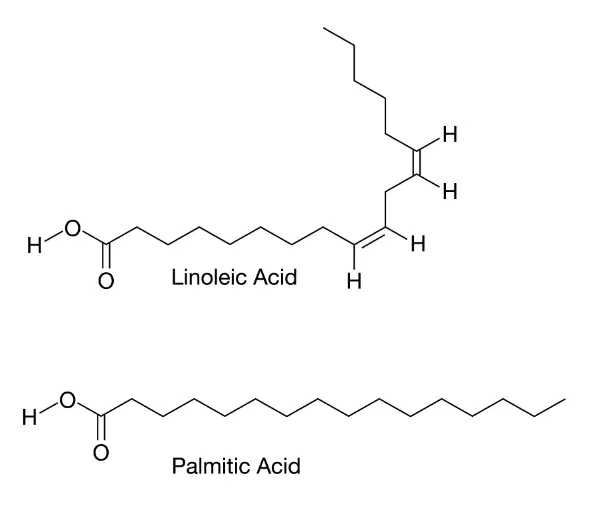
Based on the molecular structures shown in the figure, which molecule is likely to be solid at room temperature?
Linoleic acid, because the absence of carbon-carbon double bonds allows the molecules to pack closely together.
Linoleic acid, because the presence of carbon-carbon double bonds prevents the molecules from packing closely together.
Palmitic acid, because the absence of carbon-carbon double bonds allows the molecules to pack closely together.
Palmitic acid, because the presence of carbon-carbon double bonds prevents the molecules from packing closely together.

p74.) Carbohydrates are made of...
C H O in a 1:2:1 ratio
C H O with very little O
C H O N P
C H O N S

If a cell was deprived of amino acids, which macromolecule would not be able to develop properly?
Carbohydrates
Lipids
Proteins
Nucleic Acids

Which class of organic macromolecules did this sample belong?
Carbohydrates
Lipids
Proteins
Nucleic Acids

What macromolecule is shown?
Nucleic Acids
Lipids
Proteins
Carbohydrates
Nucleic acids are mad up of nucleotide. What is the structure of a nucleotide?
(hint: look for a 5-Carbon Sugar Molecule)


A fat that is solid at room temperature. (ex. Animal fat)
Saturated Fat
Supersaturated Fat
Unsaturated Fat
A fat that is liquid at room temperature because of the kinks in the molecule. (ex. Plant oils)
Supersaturated
Unsaturated
Saturated
Which of these are examples of Lipids?
simple sugars
complex carbohydrates
fats, oils, & waxes
hair, skin, & nails
Monomers of Lipids include
amino acids
monosaccharides
nucleotides
glycerol and fatty acids
Lipids are made of...
CHO
CHON
CHONP
CHONS
Which is an example of a lipid?
candy
olive oil
meat
DNA
Saturated fats are __________ at room temperature.
liquid
solid
Which of these is NOT an example of a carbohydrate?
Dextrose
Thymine
Galactose
Glucose
True or False
Lipids are hydrophobic
True
False
Which of these represents a fatty acid molecule?


saturated fatty acid
no double bonds
monounsaturated fatty acid
1 double bond
polyunsaturated fat
at least 2 double bonds

What is the term for a single subunit of a polymer?
Isomer
Monotope
Isotope
Monomer

What is this molecule called?
triglyceride
phospholipid
glycero-phospholipid
polysaccharide

Which of these fatty acids is a solid at room temperature?
A
B
C
D
Fatty acids are either saturated or unsaturated. When do we say that a fatty acid is saturated?
If its carbon- carbon bonds are triple bonded.
If all carbon- carbon bonds are single bonds.
If the hydrocarbon chain has one or more double bonds.
Cannot be determined
Fatty Acids differ in there chain length and their
protein carriers
Side chains
energy level
degree of saturation
What sugar is found in DNA?
Glucose
Ribose
Deoxyribose
Fructose
(p87) The backbone of DNA is made up of _______ & ________ units.
Nucleic Acids are made of
CHO
CHON
CHONP
CHONS
(p51) Which of the following is LEAST likely to dissolve in water?
p75.) Which of the following is considered fully saturated?


Proteins are made of monomers called ___________p79
Water
Dipeptide


(p6-7) Which of the following statements best describes how organisms such as rabbits obtain the carbon necessary for building biological molecules?
Rabbits eat plants and use energy absorbed from the plants to make carbon atoms from electrons, protons, and neutrons in the air.
Rabbits eat plants and break down plant molecules to obtain carbon and other atoms that they rearrange into new carbon-containing molecules.
Rabbits eat plants and use water absorbed from the plants to hydrolyze
CO2, which the rabbits breathe in from the air and use as a carbon source.
Rabbits eat plants and make carbon-containing molecules by using carbon atoms that the plants absorbed from the soil and stored in the cells of their leaves.
Which type of biological macromolecule is the main component of the plasma membrane?
carbohydrate
lipid
protein
nucleic acid

Define plasma membrane
lipid that helps minimize effects of temperature
only on the outer surface of the plasma membrane and are attached to proteins or lipids; form distinctive cellular markers
flexible boundary of a cell that separates a cell from its surroundings
may extend partway into the plasma membrane, cross the membrane entirely, or be loosely attached to its inside or outside face
1.) They act like gatekeepers, only let certain things in.
2.) Enzyme receptors embedded in the membrane.

when some molecules can cross the membrane while others cannot.
In a lipid bilayer, ___________ fatty acid tails face each other within the bilayer and form a region that excludes water.
A. Hypotonic
B. Hypertonic
C. Hydrophilic
D. Hydrophobic
Phospholipid heads are...
lipophobic
greasy
hydrophobic
This regulates the movement of molecules from one side of the membrane to the other.
cell membrane
equilibrium
passive transport
diffusion


What molecule is pictured?
Integral Protein
Carbohydrate chain
Phospholipid
kittens

This image is an example of a phospholipid. Which part of a phospholipid is HYDROPHOBIC?
the phosphate "head"
the lipid "tails"
This image is an example of a phospholipid. Which part of a phospholipid is HYDROPHILIC?
the phosphate "head"
the lipid "tails"

Where can carbohydrates be found when part of a plasma membrane?
On the outside of the membrane
On the inside of the membrane
Embedded part of the way into the membrane
Embedded the whole way through the membrane
All of the above
Where can PROTEINS be found when part of a plasma membrane?
On the outside of the membrane
On the inside of the membrane
Embedded part of the way into the membrane
Embedded the whole way through the membrane
All of the above
What is the function of cholesterol in a plasma membrane?
To make the membrane flexible
To control the effect of temperature changes
To attract water molecules
To allow nutrients and other essential molecules into the cell
What is the "big idea" of the fluid mosaic model of plasma membranes?
the plasma membrane creates a specialized FLUID that looks like a MOSAIC.
the plasma membrane is a MOSAIC.
the fluid mosaic model is NOT related to the plasma membrane.
a plasma membrane is a MOSAIC of components that move FREELY and FLUIDLY.
What does "hydrophobic" mean?
water loving, associates with water
water fearing, does not associate with water
a world war II submarine
an example would be solutes like sugar or salt
What does "hydrophilic" mean?
water loving, associates with water
water fearing, does not associate with water
a world war II submarine
an example would be solutes like oil or fat
Which are example is hydrophobic in nature.
Oil
Sugar
Salt
Water


Which of the following is NOT a characteristic of the cell membrane?
Forms a protective boundary between the inside and outside of the cell
Controls what enters and leaves the cell
Composed of a double layer of phospholipids
Contains high amounts of cellulose to maintain structure
Semi-permeable membranes...
Allow all materials to pass through freely
Allow some materials to pass through freely, but stops other materials
Stop all materials from passing through
Are rigid to protect the cell from viruses
Amino acids are the building blocks of which macromolecule?
carbohydrate
nucleic acid
lipid
protein
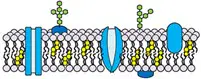
This picture is of a structure found within a cell. This structure also contains cholesterol, proteins, and carbohydrates. What is the lipid structure?
Phospholipid bilayer
Cell Wall
Cytoplasm
polypeptide
Homeostasis
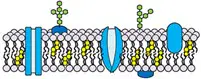
There are multiple phospholipids that, due to their structure, creates a semi-permeable membrane. What is this structure of a phospholipid?
Hydrophobic head, hydrophobic tail
Hydrophobic head, hydrophilic tail
Hydrophilic head, hydrophilic tail
Hydrophilic head, hydrophobic tail
There are multiple phospholipids that, due to their structure, creates a semi-permeable membrane. What is this structure of a phospholipid?
Lipophobic head, Lipophobic tail
Lipophobic head, Lipophilic tail
Lipophilic head, Lipophilic tail
Lipophilic head, Lipophobic tail
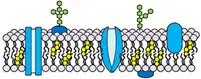
The structure above is an organelle that is semi-permeable and helpful to the cell. What is one main thing this organelle does for the cell?
Helps maintain homeostasis
Does not let anything in
Let’s everything into the cell
Gives the plant cell its structure
This organelle is selectively permeable and lets things in and out of the cell
cell membrane
plasma membrane
cell wall
cytoplasm
chloroplasts
In an experiment, all variables are held constant except for one. Then, experimental results are compared to that one variable. What type of experiment is this?
a variable experiment
a hypothetical experiment
a multifactor experiment
a controlled experiment
Unlike sexual reproduction, asexual reproduction involves
Two cells
Two parents
One parent
One nonliving parent
Inside the human body, the temperature stays at a consistent 98.6 degrees. We are able to keep the temperature the same by sweating or shivering. These processes are necessary for maintaining _____________.
Energy
Homeostasis
Organization
Reproduction
A frog going from the tadpole stage into a tadpole with legs would be an example of which characteristic of life?
Evolution
Reproduction
Grow and development
Response to a stimulus
A plant in the dark struggles because it is not able to create its own food. What characteristic of life is the plant struggling to fulfill?
Made of cells
Respond to a stimulus
Evolution
Requires energy
A scientist wondered “Will crickets chirp more if the temperature is warmer?” If an experiment was designed to gather appropriate data to answer that question, which would best represent the control and experimental groups?
Control group: number of chirps
Experimental group: type of crickets
Control group: warmer temperature
Experimental group: cooler temperature
Control group: room/normal temperature
Experimental group 1: warm temperature
Experimental group 2: hot temperature
Control group: Type of crickets
Experimental group 1: number of chirps
Experimental group 2: type of diet
Which of the following pairs are unrelated?
sugar / carbohydrate
enzyme / protein
polysaccharide / nucleic acid
fat / lipid
Largely made up of phospholipids with some proteins connected and/or embedded. This describes the make-up of which organelle or cell structure?
Cell Wall
Ribosome
Mitochondria
Cell Membrane

What is happening in this diagram?
A molecule is moving through the phospholipid bilayer from low concentration to high.
A molecule is moving through the phospholipid bilayer from high concentration to low.
A molecule is moving through a channel protein from low concentration to high.
A molecule is moving through a channel protein from high concentration to low.

What is depicted in this image?
a cell wall
a cell membrane
a proton
a ribosome
A nucleotide contains a 5-carbon sugar, phosphate group, and a ____________
Nitrogenous base
Hydrogenous base
Carboxyl group
Amine Group

