wayground logo

Free Printable Worksheets

Font size

S
M
L
XL
Worksheets

Test 2 Review

Total questions: 172

Worksheet time: 4hrs 33mins

Name
Class
Date
1.
What is the function of the cilia?
a)
Movement
b)
Eating
c)
Reproduction
d)
Storage for genetic material
2.

What is the function of pseudopodia?

a)

Reproduction

b)

Eating

c)

Movement

d)

Eating and Movement

3.
Is the Paramecium a autotroph or heterotroph?
a)
Autotroph
b)
Heterotroph
4.
What is the eye spot for
a)
Movement
b)
Protection and shape
c)
For finding the most brightly lit places
d)
Anchors flagellum
5.
_ may have chloroplasts, mitochondria, a nucleus & share traits from plants, animals and fungi.
a)
Protists
b)
Bacteria
c)
Archaea
d)
Blood Cells
6.
___ are tiny hairs all over the cell that are used for locomotion.
a)
cilia
b)
flagella
c)
pseudopods
d)
trichocysts
7.
A _____ is a temporary projection of cytoplasm that is used for locomotion.
a)
pseudopod
b)
flagella
c)
cilia
d)
trichocyst
8.
_________ cause poisonous red tides.
a)
dinoflagellates
b)
diatoms
c)
euglena
d)
rhodophyta
9.
These are protists called _____
a)
diatoms
b)
dinoflagellates
c)
green algae
d)
amoeba
10.

This is type of protist called a/an _________

a)

green algae

b)

diatoms

c)

dinoflagellate

d)

euglena

11.
Plant-like protists are called ________
a)
algae
b)
slime molds
c)
protozoa
d)
zooplankton
12.
animal-like protists are called _______
a)
protozoa
b)
algae
c)
slime molds
d)
phytoplankton
13.
fungus-like protists are called _________
a)
algae
b)
slime molds
c)
protozoa
d)
euglena
14.
The _______ organelle allows Euglena to be autotrophic.
a)
chloroplast
b)
mitochondria
c)
cell membrane
d)
trichocyst
15.

How does an amoeba move?

a)

It uses cilia.

b)

It uses a flagellum.

c)

It uses pseudopods.

d)

It cannot move.

16.
The word "pseudopodia" means
a)
small cell
b)
fake eye
c)
false foot
d)
first animal
17.
Identify the organism pictured.
a)
Amoeba
b)
Paramecium
c)
Euglena
d)
Plasmodium
18.

The long, whip-like structure which helps some protists move is called the ______________.

a)

cilia

b)

flagellum

c)

tail

d)

pseudopod

19.
Protist?
a)
Euglena
b)
Paramecium
c)
Amoeba
d)
Volvox
20.
Protist?
a)
Euglena
b)
Paramecium
c)
Amoeba
d)
Stentor
21.
Which of the following is true of ALL protists?
a)
unicellular
b)
eukaryotic
c)
prokaryotic
d)
heterotrophic
22.
This structure allows the euglena to do photosynthesis.
a)
Nucleus
b)
Flagella
c)
Chloroplast
d)
Mitochondria
23.
Flagella, cilia, and psuedopods are all used for what?
a)
Movement
b)
Food capture
c)
Reproduction
d)
Energy creation
24.
What term best describes the environments of protozoa and algae?
a)
Aquatic
b)
Terrestrial
c)
Harsh
25.
What type of organism is shown in the image?
a)
Amoeba
b)
Euglena
c)
Diatom
d)
Paramecium
26.
What type of organism is shown in this image?
a)
Paramecium
b)
Amoeba
c)
Flagellate
d)
Dinoflagellate
27.
There are three main categories of protists:  animal like, plantlike, and _________  like ?
a)
bacteria 
b)
fungus
c)
virus
d)
slime
28.

Slime molds and water molds belong to which class of protists?

a)

Animal like

b)

Plant like

c)

Fungus like

d)

Sporozoans

29.
One of the worst diseases that is caused by a protists (sporozoan) is ?
a)
Tuberculosis
b)
AIDS
c)
Malaria
d)
Bubonic plague
30.
Malaria is carried by ?
a)
Fleas
b)
Flies
c)
Ticks
d)
Mosquitoes  
31.

Most protistans are _________________.

a)

autotrophic

b)

heterotrophic

c)

unicellular

d)

prokaryotic

32.
What do all protists have in common?
a)
Their cells have nuclei
b)
They can make their own food through photosynthesis
c)
They live in saltwater environments
d)
They are multicellular
33.
Which term best describes algae?
a)
Predatory
b)
Consumer
c)
Plant-like
d)
Prokaryotic
34.
An organism that lives on or in a host and causes it harm is called
a)
a host
b)
a parasite
c)
a cell
d)
a virus
35.
Amoeba and Paramecium are all examples of 
a)
animal-like protists
b)
plant-like protists
c)
fungus-like protists 
36.
What is the function of the chloroplast, as seen in the diagram of the euglena?
a)
Photosynthesis
b)
Detects light
c)
Movement
d)
Removes excess water
37.
Protists are...
a)
Multicellular
b)
Unicellular
c)
Some are Multicellular and some are unicellular
38.
Protists are...
a)
Autotrophs
b)
Heterotrophs
c)
Some protists are autotrophs and some are heterotrophs
39.

A protist has a true nucleus, so it is a ...

a)

Prokaryote

b)

Cell

c)

Eukaryote

d)

Atom

40.

A protist that can make its own food is considered to be an...

a)

autotroph

b)

heterotroph

c)

amoeba

d)

mammal

41.

If a protist can't make its own food, it is considered to be a...

a)

autotroph

b)

eukaryote

c)

heterotroph

d)

ciliate

42.

What is the only multi-celled protist called?

a)

amoeba

b)

ovum

c)

algae

d)

autotroph

43.

What are two diseases associated with protist infections?

a)

AIDS & Malaria

b)

Malaria & Sleeping Sickness

c)

Dysentary & HIV

d)

The Common Cold & Allergies

44.
A protist is any eukaryotic organism with cells that is not a/an:
a)
Animal
b)
Plant
c)
Fungus
d)
All Three
45.

a strong, flexible polysaccharide that is found in the cell walls of all fungi and in the exoskeletons of insects and crustaceans.

a)

chitin

b)

fruiting body

c)

hyphase

d)

mycelium

46.

Filaments that are the basic structural units that make up the body of a multicellular fungus are called...

a)

chitin

b)

fruiting body

c)

hyphase

d)

mycelium

47.

Hyphae grow at their tips and branch repeatedly to form a net like mass called...

a)

chitin

b)

fruiting body

c)

hyphase

d)

mycelium

48.

spore-producing fungal reproductive structure

a)

chitin

b)

fruiting body

c)

hyphase

d)

mycelium

49.

cross wall that divides a hypha into cells

a)

septa

b)

haustoria

c)

spore

d)

sporangium

50.

A sac or case in which spores are produced.

a)

septa

b)

haustoria

c)

spore

d)

sporangium

51.

A photosynthetic partner with fungus

a)

basidiocarps

b)

lichen

c)

bioindicator

d)

mycorrhiza

52.

A symbiotic relationship between a specialized fungus and plant roots.

a)

basidiocarps

b)

lichen

c)

bioindicator

d)

mycorrhiza

53.
decomposition is an important role of
a)
protozoans
b)
algae
c)
plants
d)
fungi
54.
fungi have
a)
nucleus and cell wall
b)
nucleus and no cell wall
c)
no nucleus and no cell wall
55.
a mushroom
a)
sac
b)
club
c)
threadlike
d)
imperfect
56.
Ascomycota is......
a)
sac
b)
club
c)
threadlike
d)
imperfect
57.
truffels
a)
sac
b)
club
c)
threadlike
d)
imperfect
58.
reproduces asexually
a)
sac
b)
club
c)
threadlike
d)
imperfect
59.
fungi are
a)
heterotrophic
b)
autotrophic
60.
Fungi get their food by
a)
eating bugs
b)
absorbing sunlight
c)
releasing chemicals that breakdown organic matter and absorb the nutrients
d)
through animal waste and decaying wood
61.
Like bacteria, fungi play an important role in breaking down the 
a)
bodies of bugs
b)
bodies of dead organisms
c)
animal waste
d)
bacteria
62.
__________ are fungi that that produce the gas that makes bread rise.
a)
Mushrooms
b)
Athletes' foot
c)
Blue Cheese
d)
Yeast
63.
An antibiotic made from a species of thread-like fungus.
a)
lichen
b)
mold
c)
penicillin
d)
asprin
64.
Fungi cells walls are made of a material called ____.
a)
cellulose
b)
fibers
c)
hyphae
d)
chitin
65.
A mass of hyphae is called a(n)
a)
spore
b)
mycelium
c)
sporangium
d)
conidiospore
66.
What are some examples of food made by fungi
a)
Bread
b)
Cheese
c)
Mushrooms
d)
All of the above
67.
The top of the mushroom is called the
a)
hyphae
b)
fruiting body
c)
mycelium
68.
Any method of reproducing that create offspring identical to the parent. 
a)
asexual
b)
budding
c)
sexual
d)
sporogenesis
69.

Which one absorbs nutrients from the living cells of another organism (e.g., cordyceps)?

a)

Saprophytic Fungi

b)

Parasitic Fungi

c)

Mutualistic Fungi

70.

Which one feeds on dead organisms; decomposer (e.g., mushroom)?

a)

Saprophytic Fungi

b)

Parasitic Fungi

c)

Mutualistic Fungi

71.
Fungi are 
a)
prokaryotes
b)
eukaryotes
c)
autotrophs
d)
tardigrades
72.
Which of the following is NOT a characteristic of all fungi?
a)
possess cell walls
b)
heterotrophs
c)
perform photosynthesis
d)
eukaryotes
73.
Fungi thrive in ___________ and ___________environments.
a)
warm and moist
b)
cool and dry
c)
oceans and lakes
d)
cold and snowy
74.
Hyphae grow into a food source and release _____________________ which break down the food into smaller pieces for the hyphae to then absorb.
a)
digestive chemicals
b)
photosynthesis
c)
chemosynthesis
d)
budding
75.
Fungi produce millions of ____________________which are lightweight and easily carried through the air or water.
a)
buds
b)
gills
c)
spores
d)
hyphae
76.
The morel is a type of ______________fungi, which produces spores of the same name.
a)
club
b)
zygote
c)
sac
d)
water mold
77.
The button mushroom (you buy them at the grocery store) is a common type of _______________________ fungi.
a)
club
b)
sac
c)
zygote
d)
poisonous
78.
Fungi can be helpful to humans and the environment because they can...
a)
decompose matter
b)
be used to create medicines
c)
can be used to create yummy food
d)
all of the above
79.
The most common harmful fungi exist in parasitic relationships that cause...
a)
crop damage
b)
skin/lung infections
c)
all of the choices
d)
death from poisoning
80.
In lichen, the algae/autotrophic bacteria benefit because...
a)
the fungi give shelter
b)
the fungi give water
c)
all of the choices
d)
the fungi gives minerals by breaking down rock
81.
Which are examples of fungi?
a)
mold
b)
yeast
c)
mushrooms
d)
all of the above
82.
Fungi are like animals because...
a)
they all reproduce sexually.
b)
they get their food from other organisms.
c)
they can move from one place to another.
d)
They are not like animals.
83.
What part of a fungus is used for reproduction?
a)
spores
b)
flagellum
c)
cilia
d)
hyphae
84.
What are some bad effects of fungi?
a)
Athletes Foot
b)
Ringworm
c)
Mushroom's produce deadly poison
d)
All of the above
85.
What vocabulary word describes the breaking off of dead things and recycling it's nutrients through the food chain?
a)
Symbiosis
b)
Decomposing
c)
Budding
d)
Mycelium
86.
All of the following are examples of fungi except one.  Which of the following is NOT a type of fungus?
a)
yeast
b)
mold
c)
mushroom
d)
algae
87.
Which is an example of a disease caused by fungi
a)
Diphtheria
b)
The Common Cold
c)
Strep Throat
d)
Athlete's Foot
88.

The phylum of Fungi that include bread molds

a)

Ascomycota

b)

Basidiomycota

c)

Deuteromycota

d)

Chlamydpmycota

e)

Zygomycota

89.

Which fungus is unicellular?

a)

toadstool

b)

yeast

c)

mushroom

d)

mucor (mould)

90.

Which organelle is NOT present in fungi?

a)

cell membrane

b)

cell wall

c)

nucleus

d)

chloroplasts

91.

An example of a basidiomycyte is...

a)

mold

b)

a mushroom

c)

yeast

d)

algae

92.

An example of a ascomycyte is...

a)

mold

b)

mushroom

c)

yeast

d)

algae

93.

An example of a zygomycyte is ...

a)

mold

b)

mushroom

c)

algae

d)

yeast

94.

Which best describes fungi?

a)

all are eukaryotic, autotrophs with many cells

b)

all are eukaryotic heterotrophs that feed by absorption

c)

all are prokaryotic and made of many cells

d)

All are eukaryotic heterotrophs that feed by ingestion

95.
Spores are tiny structures that are used by Fungi during both sexual and asexual reproduction. What can you infer about how these spores are dispersed (moved from place to the other)?
a)
They are carried by wind, water or animals
b)
The parent fungus moves the spores to another location
c)
The spores must ONLY grow directly beside the parent
96.
Look at the picture. The part of the mushroom that is above ground is known as the:
a)
fruiting body
b)
hyphae
c)
mycellium
97.
To what domain does Kingdom Fungi belong?
a)
Eukarya
b)
Archaea
c)
Bacteria
d)
Fungi
98.
Which letter points to the spore producing structures of a mushroom?
a)
B
b)
A
c)
C
d)
D
99.

What is the process in fungi where two cells together, but the nuclei are still separate?

a)

spore

b)

lignin

c)

karyogamy

d)

plasmogamy

100.

What is the process in fungi that joins two nuclei together

a)

spore

b)

lignin

c)

karyogamy

d)

plasmogamy

101.

The mushroom is an example of the reproductive structure of which type of fungi?

a)

Chytrid

b)

Zygomcete

c)

Basidiomycete

d)

Ascomycete

102.

Which of the following would expect to find on a rotten piece of food?

a)

Microsporidia

b)

Chytrids

c)

Zygomycetes

d)

Basidiomycota

e)

Ascomycota

103.

Which of the following would expect to be eaten by a human?

a)

Microsporidia

b)

Chytrids

c)

Zygomycetes

d)

Basidiomycota

e)

Ascomycota

104.

Which of the following is the most frequently used in production of alcoholic beverages life beer and wine?

a)

Microsporidia

b)

Chytrids

c)

Zygomycetes

d)

Basidiomycota

e)

Ascomycota

105.

Most types of fungi can form a mutualistic relationship with plants. Which of the following describes mutualistic?

a)

Good for plants and fungi

b)

Good for plants and bad for fungi

c)

Good for fungi and bad for plants

d)

Good for fungi and unaffected towards plants

106.

Some Fungi form a parasitic relationship with plants or other animals. What is a parasitic relationship?

a)

Good for plants and fungi

b)

Good for plants and bad for fungi

c)

Good for fungi and bad for plants

d)

Good for fungi and unaffected towards plants

107.
Fungi are like animals because...
a)
they all reproduce sexually.
b)
they get their food from other organisms.
c)
they can move from one place to another.
d)
They are not like animals.
108.
Mycorrhizae are a fungus that have a ______ relationship with a ______.
a)
commenalistic; arthropod
b)
mutualistic; root
c)
mutualistic; tree
d)
parasitistic; animal
109.
Most Fungi are multicellular organisms. This means they are made of:
a)
one cell
b)
more than one cell
c)
no cells
110.

What is an example of a Basidiomyctes Fungus? Hint: You might eat this on a pizza!

a)

mushroom

b)

bread mold

c)

lichen fungus

d)

yeast

111.

What is it called when two fungi (an ascomycete and a basidiomycete) and an algae (or sometimes photosynthetic bacteria) live in a symbiotic relationship?

a)

lichen

b)

mycorrhizae

c)

root nodules

d)

mold

112.

Which group of fungi?

a)

Basidiomycete

b)

Ascomycete

c)

Zygomycete

d)

Lichen

113.

Which group of fungi?

a)

Basidiomycete

b)

Ascomycete

c)

Zygomycete

d)

Lichen

114.

Made of the hyphae

a)

mycellium

b)

spores

c)

prokaryotic

d)

lichen

115.
Fungi are . . . 
a)
Archaeans
b)
Autotrophic
c)
Eukaryotic
d)
Prokaryotic
116.
By which method do most Fungi reproduce?
a)
Fission
b)
Fusion
c)
Asexually and Sexually
d)
Just sexual
117.
A flowering plant with leaves that have parallel veins.
a)
gymnosperms
b)
angiosperms
c)
dicot
d)
monocot
118.
Small grains that contain a plant's male reproductive cells.
a)
stamen
b)
pollen
c)
anther
d)
stigma
119.
The stalks in a flower that produce the male reproductive cells
a)
pistil
b)
stamen
c)
filament
d)
stigma
120.
Small leaf-like structures forming an outer circle at the base of a flower.
a)
petals
b)
sepal
c)
anthers
d)
dicots
121.
The part of the flower on which the pollen grains land.
a)
pistil
b)
stamen
c)
style
d)
stigma
122.
The part of a flower that produces the male reproductive cells.
a)
anther
b)
style
c)
stigma
d)
filament
123.
Their leaves are not veined, and the flower parts are usually in fours or fives.
a)
monocot
b)
dicot
c)
angiosperm
d)
gymnosperm
124.
Brightly colored parts of flowers that attract insects.
a)
petals
b)
pistils
c)
stamen
d)
filaments
125.
The stalk connecting the ovaries and stigmas.
a)
filament
b)
pistil
c)
style
d)
anther
126.
They enclose the egg cells inside the ovaries.
a)
ovules
b)
anther
c)
seeds
d)
angiosperms
127.
The transfer of pollen, containing the sperm cells, to the female part of the flower. 
a)
seed disperal
b)
pollination 
c)
germination
d)
fertilization
128.
This occurs after a tube grows down from the pollen grain through the style to the ovary.
a)
pollination
b)
germination
c)
fertilization
d)
seed dispersal
129.
The haploid stage in the life cycle of plants is called:
a)
Gametophyte 
b)
Xerophytes 
c)
Sporophyte
d)
Gymnosperms
130.
________  bear seeds directly on the surfaces of cones.  
a)
Gametophyte 
b)
Xerophytes 
c)
Sporophyte
d)
Gymnosperms
131.
________  bear seeds inside flowers
a)
Gametophyte 
b)
Xerophytes 
c)
Angiosperms
d)
Gymnosperms
132.
Plants are described as ‘autotrophic’. What does this mean?  
a)
They use carbon dioxide and oxygen to make their own food.
b)
They make their own food from carbon dioxide and sunlight.
c)
They use chloroplasts to convert sugars into energy.
d)
They convert sunlight into chlorophyll and energy
133.
What part of the plant is #1?
a)
flower
b)
stem
c)
root
d)
leaf
134.
What part of the plant is #2?
a)
leaf
b)
flower
c)
stem
d)
root
135.
What part of the plant is #3?
a)
leaf
b)
root
c)
flower
d)
stem
136.
What part of the plant is #4?
a)
leaf
b)
flower
c)
stem
d)
root
137.
Where does the fruit come from? 
a)
Flower
b)
Roots
c)
Leaves
d)
stem
138.

Which part of the plant does photosynthesis?

a)

roots

b)

stem

c)

leaf

d)

flower

139.
What part of the plant soaks up nutrients from the ground?
a)
leaves
b)
stem
c)
roots
d)
flower
140.

Which of these does not have xylem?

a)

conifers

b)

ferns

c)

grasses

d)

mosses

141.

Ferns belong to what group of plants?

a)

bryophytes

b)

angiosperms

c)

gymnosperms

d)

seedless vascular

142.

Which of these are not gymnosperms?

a)

conifers

b)

cycads

c)

horsetails

d)

ginkgos

143.

What are the female parts of a flower called?

a)

anthers

b)

carpels

c)

sepals

d)

stamens

144.

Xylem transports water from the roots to the _________

a)

flowers

b)

bark

c)

leaves

d)

roots

145.

Which of these is diploid?

a)

sporophyte

b)

spores

c)

gametophyte

d)

gametes

146.
Type of root
a)
fibrous root
b)
taproot
147.
What is this?
a)
Xylem
b)
Phloem
148.
Both the xylem and phloem are considered-
a)
Stomata
b)
Leaves
c)
Roots
d)
Vascular tissue
149.
Moves sugar from leaves to roots
a)
Xylem
b)
Phloem
150.
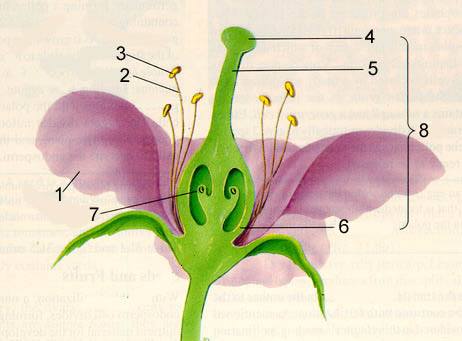
What is #3 pointing to?
a)
stigma
b)
filament
c)
ovary
d)
anther
151.
What is #4 pointing to?
a)
anther
b)
style
c)
stigma
d)
ovary
152.
What is #6 pointing to?
a)
stigma
b)
style
c)
ovary
d)
petal
153.
They enclose the egg cells inside the ovaries.
a)
ovules
b)
anther
c)
seeds
d)
angiosperms
154.
A plant embryo in a case is called a __ 
a)
Seed
b)
Nut
c)
Suitcase
d)
Huh?
155.
The female reproductive part of a flower that produces seeds and consists of an ovary, style and stigma
a)
Carpel
b)
Stamen
c)
Anther
d)
Filament
156.
What does an ovule become when it is pollinated?
a)
a seed
b)
a sprout
c)
a fruit
d)
it stays an ovule
157.
Vascular plants
a)
absorb water right off of the ground.
b)
include mosses and other short plants.
c)
transport water and nutrients up the plant (these plants are tall).
d)
are only found in Puerto Rico.
158.
Nonvascular plants do not have stems and are very short. They get water and nutrients by
a)
absorbing them right from the ground.
b)
eating insects.
c)
growing long stems and transporting through vascualr tissue.
d)
doing phototropism.
159.
What is the name of the vascular tissue that transports water and minerals?
a)
phloem
b)
xylem
c)
angiosperm
d)
gymnosperm
160.
What is the name of the vascular tissue that transports food?
a)
phloem
b)
xylem
c)
angiosperm
d)
gymnosperm
161.
A single deep root like this is known as a
a)
fibrous root.
b)
tap root.
c)
onion tip shoot.
d)
groot root.
162.
Many little roots that are all together like this are called
a)
fibrous roots.
b)
tap roots.
c)
onion tip shoots.
d)
groot roots.
163.
What plants have flowers and fruit?
a)
gymnosperms
b)
angiosperms
c)
pollinators
d)
sprouts
164.

Seedless plants include __________.

a)

mosses, ferns, and horsetails

b)

only nonvascular plants

c)

mosses and gymnosperms

d)

mosses and angiosperms

165.

The dominant part of a fern plant is a _____.

a)

haploid gametophyte

b)

diploid gametophyte

c)

diploid sorus

d)

diploid sporophyte

e)

haploid sporophyte

166.

In the moss life cycle _____ cells within a sporangium undergo _____ to produce _____ spores.

a)

diploid ... meiosis ... haploid

b)

haploid ... mitosis ... haploid

c)

diploid ... mitosis ... diploid

d)

diploid ... mitosis ... haploid

e)

haploid ... meiosis ... haploid

167.

In moss, _____ produce egg.

a)

sporangia

b)

antheridia

c)

embryos

d)

archegonia

168.

In moss, _____ produce sperm.

a)

sporangia

b)

antheridia

c)

embryos

d)

archegonia

169.

Beginning with the germination of a moss spore, what is the sequence of structures that

develop after germination?

1. embryo

2. gametes

3. sporophyte

4. spore

5. gametophyte

a)

4 →1 → 3 → 5 → 2

b)

4 → 3 → 5 → 2 → 1

c)

4 → 5 → 2 → 1 → 3

d)

3 → 4 → 5 → 2 → 1

e)

3 → 1 → 4 → 5 → 2

170.

All gametophytes are _____.

a)

haploid

b)

a myth dreamed up by biology professors to confuse students

c)

diploid

d)

single-celled

e)

female, but not male, reproductive structures

171.

The noticeable part of a moss plant is a _____.

a)

diploid gametophyte

b)

haploid sporophyte

c)

haploid gametophyte

d)

diploid sporophyte

172.

The noticeable part of a liverwort plant is a _____.

a)

diploid gametophyte

b)

haploid sporophyte

c)

haploid gametophyte

d)

diploid sporophyte