wayground logo

Free Printable Worksheets

NEW

Font size

S
M
L
XL
Worksheets

Cell Organelles & Transport

Total questions: 60

Worksheet time: 2hrs 25mins

Name
Class
Date
1.

What is the function of the cell membrane?

a)

To control what comes in and out of the cell

b)

To break down food inside the cell

c)

to not let any material in and out of the cell

d)

to eat the cells food

2.

Which organelle produces the energy a cell needs to carry out its function

a)

Mitochondria

b)

Golgi Bodies

c)

Cytoplasm

d)

Nucleus

3.

Which organelle is found inside the nucleus and produces ribosomes

a)

Nucleolus

b)

Cell Membrane

c)

Lysosome

d)

Golgi Bodies

4.

What is the function of the Vacuoles

a)

Store food, water, and sometimes waste

b)

Receive proteins

c)

Assembles amino acids

d)

Found inside the nucleus

5.

Which organelle receives proteins and materials from the ER, packages them and distributes them

a)

Vacuoles

b)

Golgi Bodies

c)

Nucleus

d)

Chromatin

6.

Which cell contains Chloroplasts?

a)

Animal

b)

Plant

7.

what is the function of ribosomes

a)

to assemble amino acids to create proteins

b)

to pack proteins

c)

to clean proteins

8.

The control center of cell that contains DNA is

a)

the nucleus

b)

ribosomes

c)

mitochondria

9.
Rigid, outermost layer of the plant cell
a)
nucleus
b)
cell membrane
c)
cell wall
d)
cytoplasm
10.
Contains chlorophyll and is where photosynthesis takes place. Found in plant cells only.
a)
mitochondria
b)
chloroplast
c)
vacuole
d)
cytoplasm
11.
jelly-like substance that is located between the cell membrane and the nucleus
a)
mitochondria
b)
chloroplast
c)
vacuole
d)
cytoplasm
12.
I am a protein packaging and shipping machine! Who am I?
a)
vacuole
b)
ribosome
c)
endoplasmic reticulum
d)
golgi apparatus
13.
You might think of me as the trash collector, but recycler is maybe more accurate. What am I?
a)
cytoplasm
b)
lysosome
c)
vacuole
d)
ribosome
14.
What makes the endoplasmic reticulum rough?
a)
Vessicles
b)
Vacuoles
c)
Ribosomes
d)
Chromosomes
15.
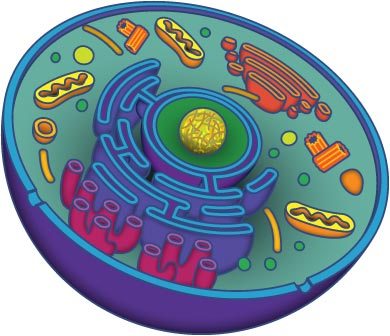
This cell would be classified as a(n) ________________ cell.
a)
prokaryotic
b)
eukaryotic 
c)
plant
d)
virus
16.
The two kinds of cells are Prokaryotes and Eukaryotes. How are they different?
a)
Prokaryotes have a nucleus.
b)
Eukaryotes have a nucleus.
c)
Prokaryotes are plant cells.
d)
There is no difference.
17.
What cell part is NOT found in all cells?
a)
Cell Wall
b)
Cell Membrane
c)
Cytoplasm
d)
Genetic Material
18.
Which of the following is found in eukaryotic cells but NOT prokaryotic cells?
a)
Cell membrane
b)
Mitochondria
c)
Ribosomes
d)
DNA
19.

What means of cellular transport requires energy?

a)
passive
b)
active
c)
facilitated
d)
osmosis
20.
What is the diffusion of water through a selectively permeable membrane?
a)
active transport
b)
osmotic pressure
c)
facilitated diffusion
d)
osmosis
21.
Diffusion is the movement of particles
a)
from low to high concentration
b)
from  high to low concentration
c)
from equilibrium to areas of high concentration
d)
all of the above
22.
The current model of the plasma membrane is called the
a)
hydrophobic layer
b)
transport bilayer
c)
phosphoproteins
d)
fluid mosaic model
23.
What characteristic of the cell membrane allows only certain material to pass through?
a)
selective gating
b)
selective permeability
c)
hydrophilia
d)
selective service
24.
Facilitated diffusion requires
a)
no energy
b)
energy
25.
Placing a cell in an isotonic solution causes the cell to
a)
shrink
b)
swell
c)
stay the same
26.
Placing a cell containing 10% salt  into a solution containing 15% salt will cause the cell to
a)
shrink
b)
 swell
c)
stay the same
27.
Moving from areas of LOW concentration to areas of HIGH concentration is called?
a)
Passive Transport
b)
Active Transport
c)
Diffusion
d)
Osmosis
28.
My cells are Shriveled!    What state are my cells in?
a)
Hypertonic
b)
Hypotonic
c)
Isotonic
d)
Diffusion 
29.
When moving particles AGAINST their concentration gradient, this is called?
a)
Passive Transport
b)
Osmosis
c)
Active Transport
d)
Facilitated Diffusion
30.
If the question asks about Osmosis, I will look for an answer about?
a)
Particles
b)
Salt
c)
Sugar
d)
Water
31.
If the question asks about something being PUMPED, I will look for an answer about?
a)
Passive Transport
b)
Active Transport
c)
Facilitated Diffusion
d)
Osmosis
32.
My cells are swollen!   To fix this, I would want a solution that moves water from a ______ concentration to a ______ concentration of water.
a)
High, Low
b)
Low, High
33.
A solute traveling DOWN its concentration gradient using a protein channel does this by ________ diffusion.
a)
Facilitated
b)
Active
c)
Osmosis
d)
Endocytosis
34.
Which way is the water moving in this cell?
a)
The water level will increase on the right side
b)
The water level will increase on the left side
c)
The water level on both sides will increase
d)
The water level on both sides will decrease
35.
Which way is the water moving in this cell?
a)
Water will move out of the cell
b)
Water will move into the cell
36.
Endocytosis is defined as
a)
the movement of large molecules from the inside of the cell to the outisde of the cell using channel proteins. 
b)
the movement of large molecules from the inside of the cell to the outisde of the cell membrane vesciles. 
c)
 the movement of large molecules from the outside of the cell to the inside of the cell using membrane vesciles.
d)
the movement of large molecules from the outside of the cell to the inside of the cell using channel proteins. 
37.
Exocytosis is the movement of
a)
any type of substance from outside the cell to the inside of the cell. 
b)
very large substances from outside the cell to the inside of the cell. 
c)
any type of substance from inside the cell to the outside.
d)
very large substances from inside the cell to the outside.
38.
Active transport _______ and is the movement of a substance from _____ to _____ concentration
a)
requires energy, high to low
b)
requires no energy, low to high
c)
 requires no energy, high to low
d)
 requires energy, low to high
39.
What type of transport is this?
a)
facilitated diffusion
b)
active transport
c)
diffusion
d)
osmosis
40.
Describes the arrangement of the cell membrane as bendable and made of many parts. 
a)
The Fluid Mosaic Model 
b)
The Major Mobility Model 
c)
The Crazy Cell Model
d)
The Maze Model
41.

"Water Fearing" means

a)

Hydrophobic

b)

Hydrophilic

c)

Hydroelectric

d)

Hydroloric

42.

"Water Loving" means

a)

Hydrophobic

b)

Hydrophilic

c)

Hydroelectric

d)

Hydroloric

43.
A phospholipid has 2 parts. What are they called? 
a)
Hydrophilic Head, Hydrophobic Tail 
b)
Hydrophobic Head, Hydrophilic Tail 
44.

What are the two types of cell transport?

a)

Passive and Active

b)

Active and Facilitated

c)

Passive and Facilitated

d)

None of the above

45.

Which describes a hypotonic environment?

a)

Too much water in the cell will cause the cell to burst - the percentage of water is higher outside the cell than inside the cell

b)

Too little water in the cell will cause the cell to shrink - the percentage of water is lower outside the cell than inside the cell

c)

Concentrations of water are equal inside and outside the cell

46.

Which describes a hypertonic environment?

a)

Too much water in the cell will cause the cell to burst - the percentage of water is higher outside the cell than inside the cell

b)

Too little water in the cell will cause the cell to shrink - the percentage of water is lower outside the cell than inside the cell

c)

Concentrations of water are equal inside and outside the cell

47.

Which describes an isotonic environment?

a)

Too much water in the cell will cause the cell to burst - the percentage of water is higher outside the cell than inside the cell

b)

Too little water in the cell will cause the cell to shrink - the percentage of water is lower outside the cell than inside the cell

c)

Concentrations of water are equal inside and outside the cell

48.
All plants are made of cells.  This was discovered by....
a)
Matthias Schleiden
b)
Rudolf Virchow
c)
Robert Hooke
d)
Aristotle
49.

Who discovered and named cells while looking at cork?

a)

Captain Hook

b)

Robert Hooke

c)

Matthais Schleiden

d)

Rudolf Virchow

50.

All living things are made up of...

a)

cells

b)

tissues

c)

organ

d)

organ systems

51.

Who discovered that all cells come from other living cells and had research that lead to the last major principle of cell theory?

a)

Matthias Schleiden

b)

Theodore Schwann

c)

Robert Hooke

d)

Rudolf Virchow

52.

Who noted that all animals are made of cells and helped write the first two parts of cell theory?

a)

Rudolf Virchow

b)

Anton van Leeuwenhoek

c)

Theodor Schwann

d)

Robert Hooke

53.

This early cell theory scientist looked in a microscope and discovered "animalcules" in the gunk from his teeth and pond water.

a)

Schleiden

b)

Leeowenhoek

c)

Hooke

d)

Virchow

e)

Schwann

54.
If you move the slide left while viewing, in which direction will it appear to move?
a)
right 
b)
left
c)
up 
d)
down
55.
Which part of the microscope controls the amount of light available?
a)

coarse focus

b)
diaphragm
c)
objective lens
d)
revolving nosepiece
56.
Which part lets you turn up the power of magnification, such increasing from 40x to 100x?
a)
coarse adjustment knob
b)
diaphragm
c)
field-of-view
d)
revolving nosepiece
57.

Moves stage up and down for focusing; locates the specimen

a)

Fine Focus Knob

b)

Large Focus Knob

c)

Course Focus Knob

d)

Small Focus Knob

58.
What will be the total magnification if ocular lens is 10X and objective lens is 4X?
a)
4X
b)
40X
c)
10X
d)
100X
59.

Which objective lens should you start on to locate an image?

a)

scanning power

b)

low power

c)

high power

60.
The picture is an example of...
a)
active tranport
b)
passive transport
c)
diffusion
d)
osmosis