wayground logo

Free Printable Worksheets

Font size

S
M
L
XL
Worksheets

Atomic Theory

Total questions: 50

Worksheet time: 52mins

Name
Class
Date
1.

Which part of the atomic theory did Niels Bohr prove?

a)

there are electrons

b)

there is a nucleus

c)

electrons are in energy levels

d)

gold foil experiment

2.

What experiment did JJ Thomson use?

a)

gold foil experiment

b)

cathode ray tube experiment

3.

What determines the identity of the atom?

a)

protons

b)

neutrons

c)

electrons

d)

isotopes

4.

What are atoms with the same number of protons but different numbers of neutrons?

a)

electrons

b)

protons

c)

neutrons

d)

isotopes

5.

What did Rutherford discover about atoms?

a)

An atom is always negatively charged.

b)

An atom is mostly empty space, but has a dense positively charged center(nucleus).

c)

An atom is always positively charged.

d)

All particles will pass straight through gold foil with no change in path.

6.

What is a positively charged particle?

a)

neutron

b)

electron

c)

proton

d)

atom

7.

What is a negatively charged particle?

a)

neutron

b)

electron

c)

proton

d)

atom

8.

What is a particle with no charge?

a)

neutron

b)

electron

c)

proton

d)

atom

9.

Who proposed a model with electrons moving in specific layers?

a)

Dalton

b)

Rutherford

c)

Bohr

d)

Thomson

10.
A tiny but very dense, positively charged portion of the atom that holds most of the atomic mass
a)
Electron Shells
b)
Orbitals
c)
Electron Cloud
d)
Nucleus
11.

Where are electrons located in an atom?

a)
Nucleus
b)
Electron Cloud
c)
Within a Proton
d)
Within a Neutron
12.
What scientist is best known for his "Plum Pudding" model of the atom?
a)
J.J. Thomson
b)
Ernest Rutherford
c)
John Dalton
d)
Democritus
13.
Rutherford's gold foil experiment provided evidence that...
a)
negative and positive charges are spread evenly throughout the atom.
b)
alpha particles have a positive charge.
c)
gold is not a dense as previously thought.
d)
there is a dense positively charged nucleus at the center of an atom.
14.
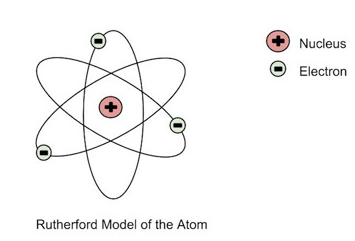
Who came up with the model of an atom pictured?
a)
J.J. Thompson
b)
Ernest Rutherford
c)
Neils Bohr
d)
James Chadwick
15.
He discovered the electron using cathode ray tube experiment.
a)
Joseph Thomson
b)
John Dalton
c)
Ernest Rutherford
d)
Robert Millikan
16.

Which is the correct Lewis Dot Structure of Carbon?

a)
b)
c)
d)
17.

How many valence electrons are shown in this Bohr diagram?

a)

2

b)

3

c)

5

d)

8

18.

This Bohr diagram has only one orbit (shell) with electrons in it. It must come from which period of the Periodic Table?

a)

1

b)

2

c)

3

d)

4

19.
What element is represented in this Bohr Model? 
a)
Carbon
b)
Hydrogen
c)
Aluminum
d)
Lithium
20.

Name this element.

a)

aluminum

b)

silicon

c)

magnesium

d)

phosphorus

e)

boron

21.

The number of protons an element has is its?

a)

Atomic mass

b)

Atomic number

c)

a.m.u

d)

Group

22.

What is the the outermost shell with electrons?

a)

Shells

b)

Isotope

c)

Orbit

d)

Valence

23.

How many electrons can go in the first energy level?

a)

2

b)

8

c)

18

d)

32

24.

How many electrons can go in the Second energy level?

a)

2

b)

8

c)

18

d)

32

25.

How many valence (outer) electrons does an Oxygen atom have?

a)

2

b)

6

c)

8

d)

16

26.

Match the following elements with their correspomding number of valence electrons

a)

1

1.

Hydrogen

b)

2

2.

Magnesium

c)

3

3.

Aluminum

d)

7

4.

Bromine

e)

6

5.

Oxygen

27.

How many valence electrons does Helium Have?

a)

1 Valence electron

b)

2 Valence electron

c)

3 Valence electron

d)

4 Valence electron

e)

5 Valence electron

28.

How many valence electrons does Nitrogen Have?

a)

1 Valence electron

b)

2 Valence electron

c)

3 Valence electron

d)

4 Valence electron

e)

5 Valence electron

29.

How many valence electrons does Magnesium Have?

a)

1 Valence electron

b)

2 Valence electron

c)

3 Valence electron

d)

4 Valence electron

e)

5 Valence electron

30.
This is a correct dot diagram for nitrogen (N)
a)
true
b)
false
31.
This is a correct dot diagram for magnesium (Mg)
a)
true
b)
false
32.

This is a Bohr Diagram of Neon. How many valence electrons does Neon have?

a)

2

b)

4

c)

6

d)

8

33.

Which of these is correct?

a)
b)
c)
34.
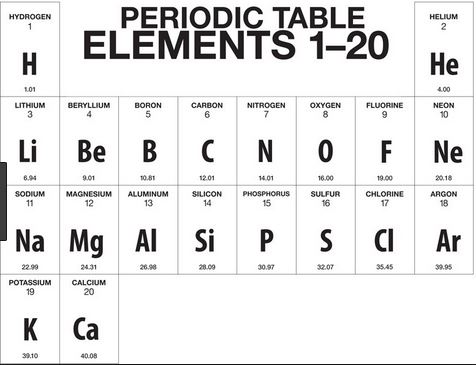
What does the 1.00794 stand for?
a)
Hydrogen
b)
atomic number
c)
atomic mass
d)

mass number

35.

The atomic mass of an element is the ___.

a)

average of the mass number and the atomic number for the element

b)

weighted average of the masses of the isotopes of the element

c)

total mass of the isotopes of the element

d)

total number of subatomic particles in the nucleus

36.
How many neutrons does the isotope of lithium have?
a)
8
b)
3
c)
4
d)
5
37.
How many neutrons does an atom of the isotope Neon-22 have?
a)
12
b)
10
c)
22
d)
20
38.
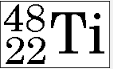
How many protons does this isotope of titanium have?
a)
48
b)
22
c)
26
d)
70
39.
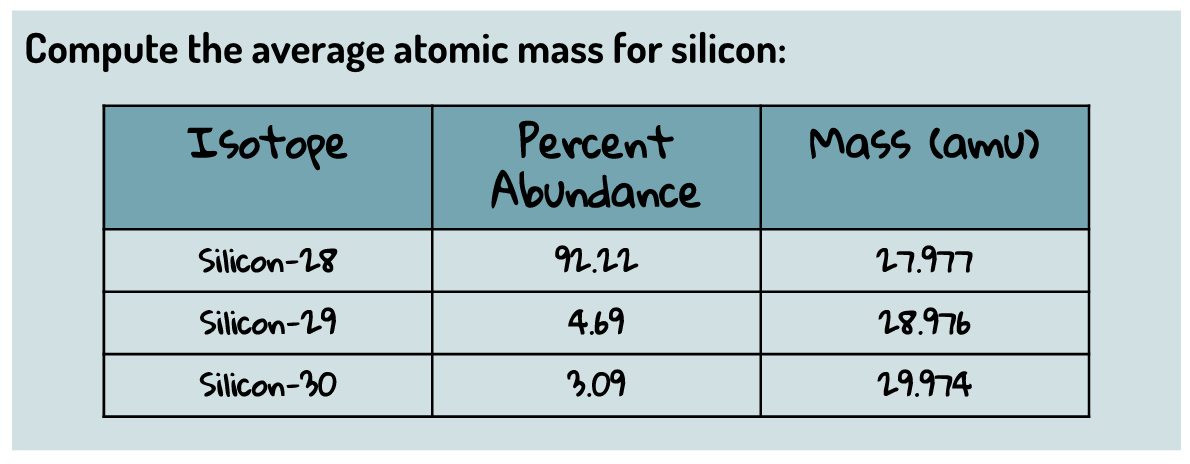
Compute the average atomic mass for silicon:
a)
27.977
b)
28.09
c)
28.976
d)
The average mass cannot be determined from provided information.
40.
An element has three different isotopes. One has a mass of 35.00 amu; another has a mass of 36.00  amu; and another has a mass of 38.00  amu. What is the average atomic mass of this element?
a)
36.33 amu
b)
37.00 amu
c)
12.11 amu
d)
impossible to tell
41.
A neutral atom of Carbon-13 has ________ electrons and _________ neutrons
a)
13, 13
b)
6, 7
c)
7, 7
d)
6, 6
42.
Isotopes are atoms of the same element that have the same number of __________ but different number of __________ . Therefore, isotopes of the same element have different masses. 
a)
protons, neutrons
b)
protons, electrons
c)
neutrons, protons
d)
electrons, protons
43.
An element with 4.35% have a mass of 49.9461 amu, 83.79% have amass of 51.9405 amu, 9.50% have a mass of 52.9407 amu, and 2.36% have a mass of 53.9389amu.
a)
51.99 amu
b)
52.19 amu
c)
53.45 amu
d)
17.33 amu
44.
An element has two naturally occurring isotopes. One is 10.013 amu and is 19.9% abundant. The other is 11.01 amu and is 80.1% abundant. What is the average atomic mass? What element is it?
a)
9.012, Beryllium
b)
12.011, Carbon
c)
6.941, Lithium
d)
10.812, Boron
45.

What is the mass number of a nitrogen atom that has 8 neutrons?

a)

15

b)

14

c)

22

d)

8

46.

What is true about the carbon atom depicted in the image?

a)

This carbon atom has 13 protons

b)

There are 13 subatomic particles in the electron cloud

c)

The mass number of this carbon atom is 13

d)

The atomic number of this carbon atom is 13

47.

What is the mass number of a calcium atom that has 21 neutrons?

a)

20

b)

21

c)

41

d)

40

48.

These three isotopes of carbon have different -

a)

Atomic numbers

b)

Mass numbers

c)

Numbers of protons

d)

Symbols

49.
The number '14' in the name Carbon-14 represents the ______.
a)
mass number
b)
atomic number
c)
number of protons
d)
number of electrons
50.
What is the name of the pictured isotope?
a)
Chlorine-Schmorine
b)
Chlorine-17
c)
Chlorine-35
d)
Chlorine-18