wayground logo

Free Printable Worksheets

Font size

S
M
L
XL
Worksheets

Benchmark 1 review

Total questions: 81

Worksheet time: 1hrs 10mins

Name
Class
Date
1.

A prokaryotic cell is...

a)

Cells that don't contain a nucleus but do contain other membrane-bound organelles.

b)

Cells that contain a nucleus but no other membrane-bound organelles.

c)

Cells that contain a nucleus and other membrane-bound organelles.

d)

Cells that don't contain a nucleus or any other membrane-bound organelles.

2.

A Eukaryotic cell is...

a)

Cell that has no membrane.

b)

Cell with no membrane-bound organelles.

c)

A cell containing a nucleus and other membrane-bound organelles.

d)

A cell containing a nucleus and other nucleus-bound organelle.

3.
Where in the cell does cell respiration occur?
a)
chloroplast 
b)
central vacuole 
c)
mitochondria
d)
cell membrane
4.
This organic molecule is the main component of biological membranes.....
a)
carbohydrates
b)
lipids 
c)
proteins 
d)
nucleic acids
5.
Which of the following is found in plant cells but not in animal cells? 
a)
Cytoplasm
b)
Mitochondria
c)
Cell Wall 
d)
Ribosomes 
6.
Which organelle uses energy from sunlight to make sugar?
a)
mitochondria
b)
nucleus
c)
chloroplasts
d)
vacuoles
7.
What is smallest unit that can perform all the processes necessary for life?
a)
Cell
b)
Nucleus
c)
Organelle
d)
protist
8.
Which type of cell?
a)
Prokaryote
b)
Eukaryote
9.
Plants and animal cells are examples of ___ cells 
a)
prokaryotic cells 
b)
eukaryotic cells 
10.
Which type of cell?
a)
Prokaryote
b)
Eukaryote
11.
When many organ systems work together it can form...
a)
organ
b)
cells
c)
organ system
d)
organism 
12.
A group of tissues that perform a similar function is called_____. (Examples include the heart, lungs or stomach)
a)
cells
b)
tissues
c)
organs
d)
organ system
13.

The DNA structure in a prokaryotic cell is...

a)

double helix

b)

circular

c)

found in the nucleus

14.
A special type of diffusion that involves water only
a)
osmosis
b)
facilitated diffusion
c)
active transport
d)
bulk transport
15.
Which of the following requires ATP
a)
osmosis
b)
diffusion
c)
active transport
d)
facilitated diffusion
16.
Where are proteins made?
a)
Golgi body
b)
Mitoichondria
c)
Chromosomes
d)
Ribosomes
17.
What is diffusion?
a)
when molecules move 
b)
when molecules move from a high concentration to a low.
c)
no movement 
d)
molecules move everywhere
18.
Osmosis is the movement of _____ across a membrane.
a)
food
b)
energy
c)
oxygen
d)
water
19.
Passive transport requires no
a)
concentration gradients
b)
osmosis
c)
motion
d)
energy
20.
The movement of molecules against a concentration gradient
a)
simple diffusion
b)
facilitated diffusion
c)
active transport
d)
osmosis
21.

What is the difference between active and passive transport?

a)

Active transport requires energy, passive transport doesn't.

b)

Active transport molecules move across a cell membrane and passive transport doesn't.

c)

Active transport involves oxygen and water molecules, passive transport does not.
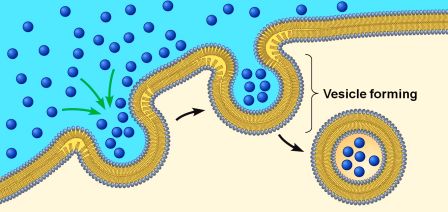
22.
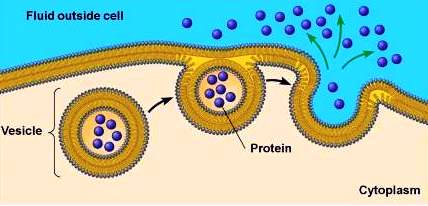
Which form of active transport is being shown?
a)
Facilitated Diffusion
b)
Exocytosis
c)
Endocytosis
d)
Protein Pumps
23.
Which form of active transport is being shown?
a)
Pinocytosis
b)
Endocytosis
c)
Exocytosis
d)
Osmosis
24.

Which of the following is an example of active transport?

a)

osmosis

b)

diffusion

c)

cell communication

d)

sodium potassium pump

25.
Who looked at cork and named the cell?
a)
Robert Hooke
b)
Van Leeuwenhoek
c)
Robert Brown
d)
Francesco Redi
26.
All plants are made of cells.  This was discovered by....
a)
Matthias Schleiden
b)
Rudolf Virchow
c)
Robert Hooke
d)
Aristotle
27.

What is NOT a part of cell theory:

a)

all cells come from existing cells

b)

all cells have a nucleus

c)

all living things are made of cells

d)

cells are basic unit of structure and function in living things
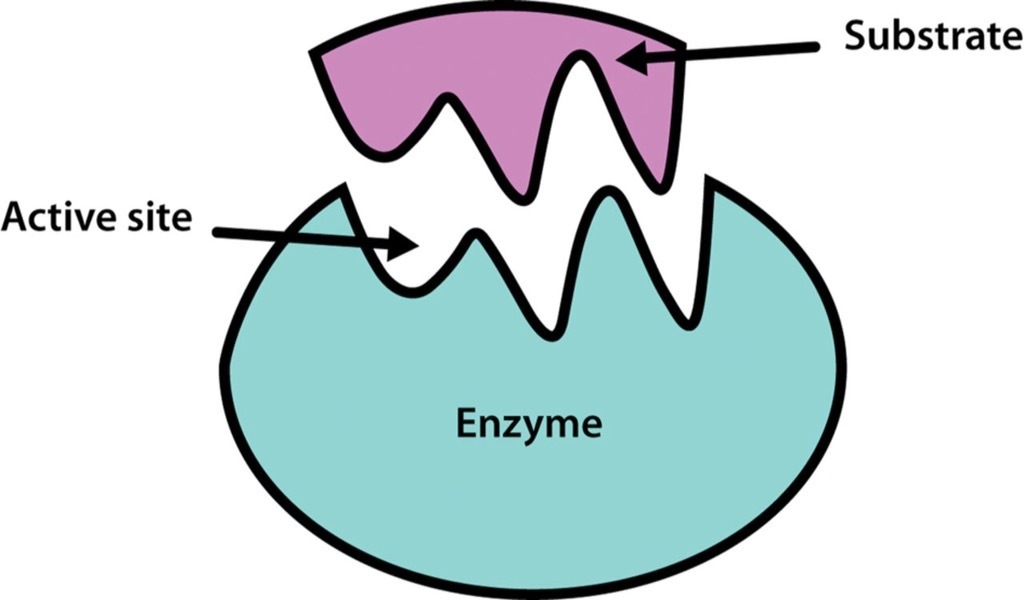
28.
"All animals are made of cells". This fact was discovered by...
a)
Matthias Schleiden
b)
Theodor Schwann
c)
Robert Hooke
d)
Rudolf Virchow
29.
Who said cells come preexisting cells?
a)
Mattias 
b)
Schleiden 
c)
Schwann
d)
Virchow
30.
All polymers are made up of...
a)
monosaccharides
b)
monomers
c)
proteins
d)
None of these
31.
Which biomolecule is responsible for insulation and energy storage?
a)
Protein
b)
Nucleic Acid
c)
Lipid
d)
Carbohydrate
32.
What is the function of nucleic acids?
a)
Stores energy
b)
Stores genetic information
c)
Movement
d)
Physical structure
33.
What biomolecule do enzymes belong to? 
a)
Carbohydrate
b)
Lipid
c)
Nucleic Acid
d)
Protein
34.
Which biomolecule is a main source of quick energy?
a)
Nucleic Acid
b)
Protein
c)
Lipid
d)
Carbohydrate
35.
Which biomolecule is made of nucleotides and contain you DNA?
a)
Carbohydrate
b)
Lipids
c)
Protein
d)
Nucleic Acid
36.
What is the monomer for a protein?
a)
Monosaccharide
b)
Triglyceride
c)
Amino Acid
d)
Nucleotide
37.
Lipids are made up of which of the following?
a)
glycerol and fatty acids tails
b)
glycerol and monolipids
c)
fatty acids and phosolipids
d)
amino acids and nucleotides
38.
What is the monomer of nucleic acids?
a)
Glycerol
b)
Monosaccharides
c)
Amino Acids
d)
Nucleotides
39.
Which biomolecule has sugars and starches?
a)
Lipids
b)
Proteins
c)
Carbohydrates
d)
Nucleic Acid
40.
Enzymes need certain environmental conditions in order to function properly.  What happens when enzymes are heated to a high temperature?
a)
they die
b)
they denature
c)
they change their amino acid sequence
d)
they work better
41.
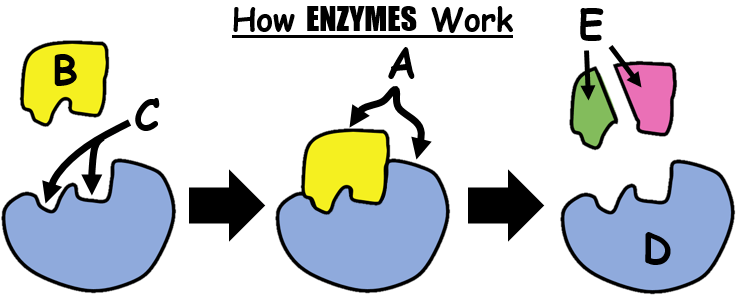
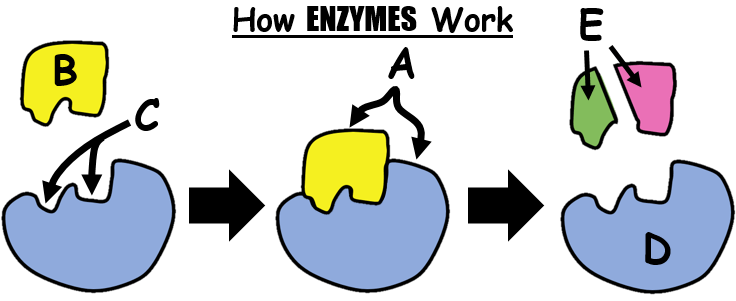
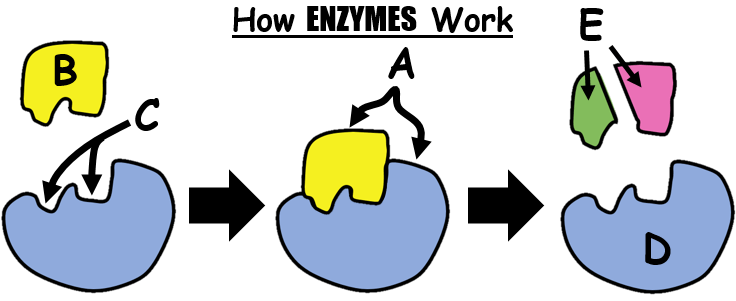
Letter D...
a)
active site
b)
enzyme
c)
substrate
d)
products
42.
Letter B...
a)
active site
b)
enzyme
c)
substrate
d)
products
43.
Letter E...
a)
active site
b)
enzyme
c)
substrate
d)
products
44.
Enzyme A digests proteins in the stomach (environment with a pH of 2).  Enzyme B digests proteins in the small intestine (environment with a pH of 8). Which of the following is NOT true:
a)
Enzyme A would be denatured in the small intestine.
b)
Enzyme A works best in acidic conditions.
c)
Enzyme A can also work in the small intestine.
d)
Enzyme A helps in the hydrolysis of proteins.
45.
Sucrase has an optimum temperature of 37 C and an optimum pH of 6.2. What would happen if the pH changed to 3?
a)
Sucrase would continue to work the same
b)
The reaction sucrase catalyzes would speed up
c)
The reaction sucrase catalyzes would slow down
46.
How does an enzyme's activity change with increasing concentration of substrate?
a)
decreases
b)
stays the same
c)
no change
d)
increases 
47.
Why does enzyme activity decrease when it is in solution that has either a too high or too low pH?
a)
All enzymes only work in neutral solutions
b)
Enzyme activity remains unchanged in different pH's
c)
The shape of the active site changes
d)
The shape of the substrate changes
48.
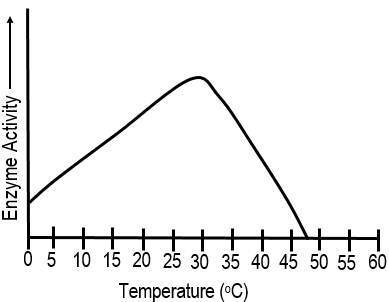
Based on the graph, what would happen to the enzyme activity if the temperature increased from 35oC to 45oC
a)
increase enzyme activity
b)
decrease enzyme activity
c)
no change
49.
Based on the graph, at what temperature would there be the most enzyme activity
a)
25C
b)
30C
c)
35C
d)
40C
50.
what would happen to the rate of enzyme activity if the pH was changed from 8.2 to 7.4
a)
increase activity
b)
decrease activity
c)
no change in enzyme activity
51.
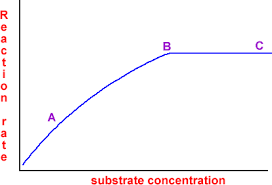
What would happen to the rate of reaction if more substrate added to the solution at point C
a)
increase reaction rate
b)
decrease reaction rate
c)
no change in reaction rate
52.

When you step out into the cold, your body shivers in order to keep its temperature at 98.6F. Which characteristic of life does this represent?

a)

All living things use energy

b)

All living things contain cells

c)

All living things maintain homeostasis

d)

All living things grow

53.

A camel has eyelashes that work to keep the dust and sand out of its eyes. Which characteristic of life does this represent?

a)

All living things adapt to their environment

b)

All living things grow

c)

All living things have cells

d)

All living things use energy

54.
The basic unit of structure and function in the human body is the....
a)
organ
b)
organ system
c)
cell
d)
tissue
55.

Which statement describes ALL living things?

a)

They are composed of one or more cells.

b)

They must reproduce sexually.

c)

They have organ systems to carry out the processes of life.

d)

They are capable of making their own food.

56.

A baby song bird hatches from its egg with both parent songbirds watching. Which characteristic of life does this represent?

a)

All living things reproduce

b)

All living things maintain homeostasis

c)

All living things use energy

d)

All living things grow

57.

The following are all characteristics of life EXCEPT:

a)

made of cell(s)

b)

the ability to move

c)

respond stimuli

d)

reproduce

58.

Which characteristic is shown: A plant switches position and follows the sunlight throughout the day.

a)

Grow and develop

b)

Respond to a stimulus

c)

Acquire and use energy

d)

Reproduce

59.

Which item listed is NOT a characteristic of life?

a)

adjusting to stimuli

b)

getting and using energy

c)

growing and developing

d)

breathing

60.
What was the example of prokaryotes that was referred to in your drawing?
a)
bacteria
b)
fungus
c)
animal cells
d)
protists
61.

Which statement is true?

a)

A virus has a nucleus, but no other organelles.

b)

A virus has a nucleus and ribosomes.

c)

A virus has no organelles, because it has no cells, and it is non-living.

62.

Viruses are considered

a)

Living

b)

Nonliving

63.

A virus consists of:

a)

RNA or DNA and a cell membrane

b)

RNA or DNA and a protein coat

c)

RNA and DNA and a protein coat

d)

proteins, cell membrane, and RNA

64.

What reason do scientists give for saying that viruses are not living organisms?

a)

they cannot reproduce without the aid of a host

b)

they do not metabolize food into energy

c)

they do not have organized cells

d)

all of the above

e)

none of the above

65.

Which results in offspring that are genetically unique and display a combination of traits from each parent?

a)

Sexual

b)

Asexual

c)

Neither

d)

Both

66.

Which type of reproduction results in offspring that are identical to the parent?

a)

Sexual

b)

Asexual

c)

Neither

d)

Both

67.

What type of asexual reproduction is it?

a)

budding

b)

regeneration

c)

sporulation

d)

binary fission

68.

What type of asexual reproduction is it?

a)

vegetative propagation

b)

sporulation

c)

budding

d)

binary fission

69.

What type of asexual reproduction is it?

a)

vegetative propagation

b)

sporulation

c)

budding

d)

binary fission

70.

What type of asexual reproduction is it?

a)

budding

b)

regeneration

c)

sporulation

d)

binary fission

71.

What type of asexual reproduction is it?

a)

budding

b)

regeneration

c)

sporulation

d)

binary fission

72.

What type of asexual reproduction is it?

a)

vegetative propagation

b)

sporulation

c)

budding

d)

binary fission

73.

What is the longest stage of the cell cycle?

a)

Prophase

b)

Metaphase

c)

Interphase

d)

Anaphase

74.

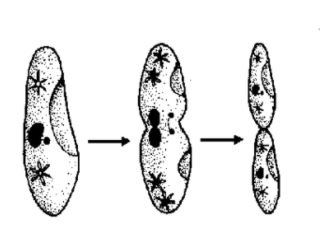
What type of asexual reproduction is illustrated in the diagram?

a)

binary fission

b)

budding

c)

sporulation

d)

regeneration

75.

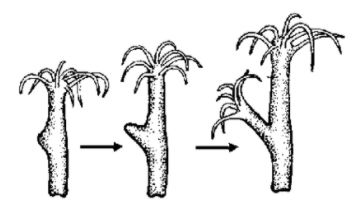
What type of asexual reproduction is illustrated in the diagram?

a)

binary fission

b)

budding

c)

sporulation

d)

regeneration

76.
Stem cells are
a)
cells that grow uncontrollably
b)
undifferentiated and can be any type of cell
c)
never go through cell division
d)
only found in embryos
77.
Which best explains why muscle cells are different from blood cells?
a)
Muscle cells are produced by the brain, but blood cells are produced by the heart. 
b)
Different genes are activated in muscle cells than in blood cells. 
c)
Muscles cells experience different environmental influences than blood cells. 
d)
A mutation occurs during the development of muscle cells but not in blood cells. 
78.
What is cell differentiation?
a)
Process by which cells produce more cells
b)
Process by which cells become specialized
c)
Process by which cells become unspecialized
d)
Process by which cells die
79.
During which part of the cell cycle does the cell divide?
a)
Interphase
b)
Mitosis
c)
S phase
80.
During which part of the cell cycle is DNA copied?
a)
Mitosis
b)
Cytokinesis
c)
S phase
81.

Uncontrolled cell division which usually leads to tumors and disease is called:

a)

Metaphase

b)

Cytokinesis

c)

Cancer

d)

Diabetes