wayground logo

Free Printable Worksheets

Font size

S
M
L
XL
Worksheets

C2W3 - Review

Total questions: 100

Worksheet time: 4hrs 22mins
Name
Class
Date
1.
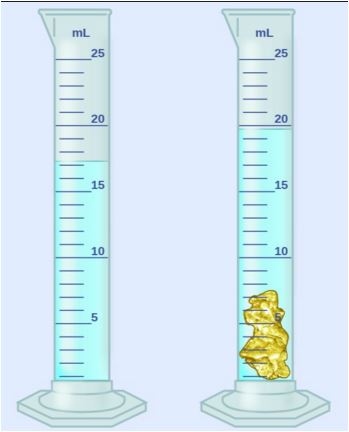
An irregularly shaped piece of gold was lowered into a graduated cylinder holding a volume of water equal to 17 ml. The height of the water rose to 20 ml. If the mass of the gold was 27 g, what was its density?
a)
9 g/mL
b)
10.5 g/mL
c)
6.5 g/mL
d)
8 g/mL
2.
An irregularly shaped stone was lowered into a graduated cylinder holding a volume of water equal to 200 ml. The height of the water rose to 280 ml. If the mass of the stone was 240 g, what was its density?
a)
3 g/mL
b)
4 g/mL
c)
2 g/mL
d)
5 g/mL
3.
An irregularly shaped rock was lowered into a graduated cylinder holding a volume of water equal to 50 ml. The height of the water rose to 75 ml. If the mass of the stone was 250 g, what was its density?
a)
15 g/mL
b)
5 g/mL
c)
10 g/mL
d)
20 g/mL
4.
Calculate the density of the cube.
a)
2 g/cm3
b)
4 g/cm3
c)
6 g/cm3
d)
8 g/cm3
5.
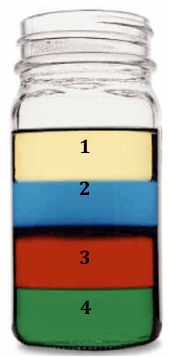
Put the liquids in order from most dense to least dense?
a)
4, 3, 2, 1
b)
1, 2, 3, 4
c)
3, 4, 2, 1, 
d)
4, 3, 1, 2
6.
What is the formula for density?
a)
density = mass x volume
b)
density = mass / volume
c)
density = mass + volume
d)
density = mass - volume
7.
Calculate the density of the cube.
a)
2 g/cm3
b)
4 g/cm3
c)
6 g/cm3
d)
8 g/cm3
8.
Calculate the density of the cube. (Hint: calculate the volume of the cube using V= Bh)
a)
0.33 g/cm3
b)
0.4 g/cm3
c)
0.6 g/cm3
d)
0.5 g/cm3
9.
How much water has been displaced in the image shown?
a)
40 mL
b)
65 mL
c)
20 mL
d)
25 mL
10.

what is the volume of the cube?

a)

123

b)

144

c)

244

d)

150

11.
Which lab tool might you use to measure the volume of a liquid?
a)
electric scale
b)
bunsen burner
c)
test tube
d)
graduated cylinder
12.
What do you call the "dip" in the water of the graduated cylinder that we use to measure the volume of an irregular object?
a)
a measurement dip
b)
menicus
c)
eclipsis
13.
The green jade sample has a volume of
a)
Cannot be determined
b)
10.5 mL
c)
50.0 mL
d)
60.5 mL
14.
How much water has been displaced in the image shown?
a)
80 mL
b)
100 mL
c)
20 mL
d)
60 mL
15.

Why do we use this device

a)

To measure volume of irregular objects

b)

To measure mass of irregular objects

c)

to measure volume of regular objects

d)

to measure....... I don't know

16.
What is the volume for calculating the volume of a REGULAR object?
a)
area X volume X mass
b)
length X width X height
c)
1/2(base X height)
d)
π(r²)
17.
If you start with a water level at 150 mLs in a graduated cylinder & you drop in a stone and the level raises to 157 mLs, what is the volume of the stone?
a)
6 mLs
b)
7 mLs
c)
157 mLs
18.
We start with 50 mL in a graduated cylinder and drop in an object.  The water rises to 64 mL.  What is the volume of this object?
a)
64 mL
b)
64
c)
14 mL
d)
14
19.

What is the volume of the ring?

a)

4 mL

b)

60 mL

c)

64 mL

d)

68 mL

20.

What is the volume of the solid object?

a)

100 mL

b)

125 mL

c)

225 mL

d)

250 mL

21.

What is the volume of the chalk?

a)

9 mL

b)

19 mL

c)

10 mL

d)

20 mL

22.
What is the SCALE of this graduated cylinder?
a)
0.2
b)

1

c)

2

d)
5
23.
Where do we read the level of liquid?
a)
The highest point the liquid touches.
b)
The bottom of the meniscus.
c)
Half way between, we make an educated guess and round it.
d)
Somewhere about there.
24.
What is the volume of the nail?
a)
15 mL
b)
16 mL
c)
1 mL
d)
2 mL
25.
Which is NOT a step for reading a graduated cylinder properly?
a)
Make sure the cylinder sits in the stand vertically.
b)
Be sure to hold it up to eye-level when reading.
c)
Read the water's volume by the bottom of the meniscus.
d)
Know the value of the scale for the sub-graduates.
26.
What is measured with a graduated cylinder?
a)
Passage of time
b)
Distance from one thing to another
c)
Weight of an object
d)
Volume of liquid
27.
What is the volume of the liquid in the cylinder?
a)
9 mL
b)
10 mL
c)
8 mL
d)
6 mL
28.
What is the volume of the liquid in the cylinder?
a)
20.5 mL
b)
25 mL
c)
22 mL
d)
20.4 mL
29.
What is the volume of the water?
a)
25 mL
b)
30 mL
c)
33 mL
d)
35 mL
30.
What is the volume of the liquid in the cylinder?
a)
40.4 mL
b)
44 mL
c)
46 mL
d)
42.5 mL
31.
What is the volume of the water in this graduated cylinder?
a)
16 mL
b)
14 mL
c)
10.6 mL
d)
20.4 mL
32.
What is the scale on this graduated cylinder?
a)
.1 mL per line
b)
.2 mL per line
c)
.5 mL per line
d)
1 mL per line
33.

What is the volume of this object?

a)

3600 ft3

b)

12 ft3

c)

36 ft3

d)

63 ft3

34.

What is the volume of this object?

a)

200 cm3

b)

82 cm3

c)

28 cm3

d)

671 cm3

35.

What is the volume of this object?

a)

80 cm3

b)

150 cm3

c)

8 cm3

d)

75 cm3

36.

Which formula is used to find density?

a)

Density= Mass x Volume

b)

Density = Mass/Volume

c)

Denisty = Volume/Mass

37.

What is the volume of this rectangular prism?

a)

9

b)

6

c)

18

d)

40

38.

The equation (L X W X H) is used to find:

a)

density

b)

volume

c)

mass

39.

An item has a mass of 50g and a volume of 2cm. What is the item's density?

a)

30

b)

25

c)

5

40.

A ring was placed into a beaker of water. What was the initial volume (before the ring was put in)?

a)

64

b)

65

c)

70

41.

A ring was placed into a beaker of water, what was the final volume (after the ring was put in)?

a)

68

b)

69

c)

70

42.

What is the volume of the ring?

a)

64

b)

60

c)

4

43.

Find the denisity of this shape.

a)

5

b)

3

c)

12

44.

Find the volume of this shape.

a)

81

b)

64

c)

512

45.

Find the volume of this rock.

a)

30

b)

100

c)

50

46.
A bar of copper has a mass of 216g and a volume of 24cm3. What is the density of copper?  
a)
9g/cm3
b)
.11g/cm3
c)
5184g/cm3
d)
322mL
47.
What is the density of a plastic ball that has a volume of 6cm3 and a mass of 12g? 
a)
2g/cm3
b)
.5g/cm3
c)
72g/cm3
d)
4mL
48.
Which is NOT a physical change?
a)
Cutting a pizza into equal slices
b)
Ice cubes melting back into liquid water
c)
Baking cupcakes
d)
A chocolate bar melting
49.
Is glass breaking a chemical or phyiscal change?
a)
chemical
b)
physical
50.
A bar of copper has a mass of 216g and a volume of 24cm3. What is the density of copper?  
a)
9g/cm3
b)
.11g/cm3
c)
5184g/cm3
d)
322mL
51.
The volume of a candy bar is 55cm3. The mass of the candy bar is 70g. What is the density of the candy bar? 
a)
2.3g/cm3
b)
.8g/cm3
c)
3850g/cm3
d)
1.3g/cm3
52.
Jack has a rock. The rock has a mass of 14g and a volume of 2cm3. What is the density of the rock?
a)
7 mL
b)
7 g/cm3
c)
28 g/cm3
d)
1/7 g/cm3
53.
Frank has a paper clip. It has a mass of 9g and a volume of 3cm3. What is its density?
a)
3 g/cm3
b)
1/3 g/cm3
c)
27 g/cm3
d)
39 g/cm3
54.
Frank has an eraser. It has a mass of 4g, and a volume of 2cm3. What is its density?
a)
8 g/cm3
b)
2 g/cm3
c)
1/2 g/cm3
d)
24 g/cm3
55.
What is the density of an object that has a mass of 25 g and a volume of 10.0 cm3?
a)
250 g/cm3
b)
25 g/cm3
c)
2.5 g/cm3
d)
0.25 g/cm3
56.
Jill has a gel pen. The gel pen has a mass of 8g and a volume of 2cm3. What is the density of the pen?
a)
4 g/cm3
b)
16 g/cm3
c)
.25 g/cm3
d)
64 g/cm3
57.
A piece of metal has a mass of 35.4 grams and a volume of 6cm3. According to the table what metal is it?
a)
Aluminum
b)
Scandium
c)
Radium
d)
Xenon
58.
A gas has a mass of 5 grams and a volume of 4 L. According to the table what is the gas?
a)
Neon
b)
Nitrogen
c)
Oxygen
d)
Fluorine
59.
Sue found a ring and wanted to know what type of metal it was. She found the mass to be 26.7 grams and the volume to be 3 cm3. What metal is the ring?
a)
Nickel
b)
Silver
c)
Lead
d)
Gold
60.

As part of a classifying elements lab Joe was finding the density of different samples. One sample had a mass of 26.4 and a volume of 12 mL. What element is it?

a)

Sulfur

b)

Carbon

c)

Boron

d)

Krypton

61.

Which equation below is the equation to solve for density?

a)

 D = MVD\ =\ \frac{M}{V}  

b)

 S = DTS\ =\ \frac{D}{T}  

c)

 D = VMD\ =\ \frac{V}{M}  

d)

 S =TDS\ =\frac{T}{D}  

62.
Frank has a paper clip. It has a mass of 9g and a volume of 3cm3. What is its density?
a)
3 g/cm3
b)
1/3 g/cm3
c)
27 g/cm3
d)
39 g/cm3
63.
What is the measuring unit for mass?
a)
centimeter 
b)
millimeter 
c)
grams 
d)
pounds
64.
A crayon has a mass of 10g and volume of 5 mL. What is the density?
a)
30 g/mL
b)
15 g/mL
c)
1 g/mL
d)
2 g/mL
65.
If you have a rectangular object with a length of 5 cm, a width of 7 cm, a height of 9 cm.  What is the volume?
a)
312 cm3
b)
319 cm3
c)
315 cm3
66.
Calculate the Volume
a)
84 cm3
b)
420 cm3
c)
60 cm3
d)
144 cm3
67.
Jack has a rock. The rock has a mass of 14g and a volume of 2cm3. What is the density of the rock?
a)
7 mL
b)
7 g/cm3
c)
28 g/cm3
d)
1/7 g/cm3
68.
Which box has a greater density?  
a)
Box A
b)
Box B
69.
What is the density of water?
a)
0 g/ml
b)
1 g/ml
c)
10 g/ml
d)
100 g/ml
70.
A block has a mass of 54g and a volume of 20cm3.  What is the density of the block?
a)
74 g/cm3
b)
1080 g/cm3
c)
34 g/cm3
d)
2.7 g/cm3
71.
What is the density of a substance that has a mass of 30g and a volume of 6 liters?
a)
24 g/L
b)
5 g/L
c)
36 g/L
d)
180 g/L
72.

Calculate the density of the object below if it has a mass of 3g. (Hint: you need to find the volume.)

a)

60 g/cm3

b)

3 g/cm3

c)

20 g/cm3

d)

0.05 g/cm3

73.

What is the volume?

a)

72 cubic units

b)

27 cubic units

c)

9 cubic units

d)

92 cubic units

74.
Find the volume of the figure.
a)
410 cm3
b)
420 cm3
c)
402 cm3
d)
401 cm3
75.

A bar of copper has a mass of 216g and a volume of 24 cm3. What is the density of copper?

a)

9g/cm3

b)

5184g/cm3

c)

.11g/cm3

d)

322mL

76.
What two types of measurements make up DENSITY
a)
Mass and Volume
b)
Temperature and Mass
c)
Grams and Centimeters
d)
Volume and Weight
77.
What is the density of a plastic ball that has a volume of 6cm3 and a mass of 12g? 
a)
2g/cm3
b)
.5g/cm3
c)
72g/cm3
d)
4mL
78.
Calculate the density of a sugar cube with a mass of  2.9 grams and a length of 1.5 cm, width of 1.5 cm. and height of 1.5 cm.
a)
0.859 g/cc
b)
0.528 g/cc
c)
1.93 g/cc
d)
4.35 gcc
79.
A block of aluminum occupies a volume of 15.0 mL and weighs 40.5 g. What is its density?
a)
2.8g/mL
b)
2.7g/mL
c)
2.66.g/mL
d)
2.5g/mL
80.
Why do ice cubes float in a  glass of water?
a)
the ice cubes are more dense than the water
b)
the water is more dense than the ice cubes
c)
the water is more dense than the glass
d)
the ice is more dense than the glass
81.
Calculate the density of the cube.
a)
2 g/cm3
b)
4 g/cm3
c)
6 g/cm3
d)
8 g/cm3
82.

This is a measurement of the amount of matter in an object or substance.

a)

volume

b)

density

c)

mass

d)

length

83.
Why do some substances float on water?
a)
they are warmer than water
b)
they are cooler than water
c)
they are more dense than water
d)
they are less dense than water
84.

I have two objects with the same volume but different masses. Which object will be more dense?

a)

The object with less weight.

b)

The object with more weight.

c)

The object with more mass.

d)

The object with less mass.

85.

Define the term "volume".

a)

Mass/Volume

b)

Anything that has mass and takes up space

c)

The amount of space an object occupies.

d)

The amount of matter in an object.

86.
____ - to look at (two or more objects) in order to note what makes them similar and/or different.
a)
Physical Property
b)
Property
c)
Compare
d)
Contrast
87.
____ - any characteristic of matter that you can observe without changing the identity of the substances that make it up.
a)
Physical Property
b)
Property
c)
Compare
d)
Contrast
88.
_____ - is an element that is generally shiny.
a)
Metals
b)
Nonmetals
c)
Metalloids
89.
_____ - is an element that is easily pulled into wires or hammered into thin sheets.
a)
Metals
b)
Nonmetals
c)
Metalloids
90.
____ - are elements that have no metallic properties.
a)
Metalloids
b)
Metals
c)
Nonmetals
91.
______ - is an element that has properties of both metals and nonmetals.
a)
Metal
b)
Nonmetal
c)
Metalloid
92.
_____ - describes the ability of metal to reflect light.
a)
Ductility
b)
Luster
c)
Malleability
d)
Conductivity
93.
_____ - how well it allows electricity to move through.
a)
Ductility
b)
Luster
c)
Malleability
d)
Conductivity
94.
_____ - conducts electricity at high temperatures.
a)
Ductility
b)
Semiconductors
c)
Malleability
d)
Conductivity
95.
____ - is the ability of a substance to be hammered or rolled into sheets
a)
Ductility
b)
Semiconductors
c)
Malleability
d)
Conductivity
96.
_____ - is the ability of a substance to be pulled into thin wires.
a)
Ductility
b)
Semiconductors
c)
Malleability
d)
Conductivity
97.
In general, metals are _____. 
a)
poor conductors of heat
b)
brittle
c)
poor conductors of electricity 
d)
good conductors of heat
98.
Shiny
a)
Metal
b)
Nonmetal
99.
Which of these is a property of metals?
a)
It's malleable
b)
It can't conduct electricity
c)
They are used in food
d)
It's very brittle
100.
If a material can easily be drawn into the shape of a wire, it is
a)
Ductile
b)
Magnetic
c)
Malleable
d)
Reactive