
Font size
 Worksheets
Biology Test 2 Review on Chapter 4,5,6
Total questions: 95
Worksheet time: 48mins
Biological catalyst that lower the activation energy
Speeds up a reaction
the random molecular motion
Heat
in what reaction will the reactants contain less free energy than the products
endergonic reaction
what type of energy is the energy that is available in a system to do work?
Free energy
the loss of an electron by a molecule
what law states that
-energy can be converted
-the total amount of energy in the universe is constant and conserved
-energy can be transferred from place to place or transformed in different forms, it cannot be created or destroyed
the first law of thermodynamics
What describes the concept of energy flow?
Bioenergetics
all the chemical reactions that take place within the cell is called
-require energy
-building polymers
-synthesis
anabolic
catabolic
-produce energy
-breaking down polymers
-degradation
Catabolic
Anabolic
What is this?
C6H12O6 + 6O2 -----> 6CO2 + 6H2O
study of energy and energy transfer involving physical matter
what is the term for matter relevant to a particular case of energy transfer
(ex. stove, pot, water)
what is the term for everything outside to that matter?
surroundings
What type of system states that energy can be exchanged with its surrounding (stove top)?
what type of system cannot exchange energy with its surroundings?
the ability to do work
What law states that energy will always be lost as heat as energy transfers?
disorder within a system
energy of motion
energy of position
-aerobic
-takes place in the mitochondria
-produces 2 ATPs, NADH, FADH2
-acetyl-coenzyme A
-aerobic
-takes place in the cristae of the mitochondria
-32-34 ATPs
Electron Transport
What is the process called when energy-depleted elements associated with a proton are accepted by an organic molecule?
fermentation
what is the end product of glycolysis?
stacks of thylakoids are called
6CO2 + 6H2O -----> C6H12O6 + 6O2
makes their own food
uses sunlight and carbon
autotrophs
photoautotrophs
food from other organisms
requires sunlight, carbon dioxide, and water
chloroplast
mesophylls
stacked, disk-shaped structure that contains chlorophyll- pigment responsible for photosynthesis
-thylakoid membrane
-chlorophyll absorbs energy
-releases oxygen
-energy drives both the capture of carbon in carbon dioxide
light-dependent reaction
-give green color
-absorbs wavelength from either end of light spectrum (green is reflected)
Chlorophyll a
-absorbs blue and red
-orange, carotenoids
chlorophyll b
the light-dependent reaction begins in a group of molecules and proteins called
-exit in membranes of thylakoids
packet of energy
two carriers of energy are
ATP and NADPH
reactions of photosynthesis that use the energy stored by the light-dependent reaction to form glucose and other carbohydrate molecules is called
Calvin cycle (dark reaction)
catalyze the fixative reaction
RuBisCo
cell's complete complement of DNA
in prokaryotes, the region in the cell containing the genetic material
how many chromosomes do humans have?
sex cells are
hapoloi
what type of cell is a somatic cell
two matched sets of chromosomes
what letter is used to represent a single set of chromosomes?
what number and letter is used to represent a diploid organism
another word for sex cells is
half the number of chromosomes is called
matched pairs of chromosomes in a diploid organism
-nucleotide segments
-the functional units of chromosomes
what is the name of the location of a gene
different forms of a characteristic is called
traits
The cell grows and DNA is replicated
- Chromosomes are not visible
- chromatin is found in the nucleus
- the nucleus begins to fade from view
- cytokinesis is complete
- the organization phase
- occurs when the cell is preparing to divide
- characterized by non-dividing cells
metaphase
interphase
anaphase
prophase
First gap the cell is accumulating the building blocks of chromosomal DNA. Also first checkpoint, the restriction point- determines if all conditions are favorable for cell division, and checks for damage to genome DNA
- Synthesis phase
- DNA replicates
G2
N
S
G1
Second gap, the cell replenishes its energy stores and synthesizes the proteins necessary for chromosome manipulation (chromosomal replication). 2nd checkpoint- bars the entry to the miotic phase if certain conditions are not met. Ensures that all of the chromosomes have been replicated and that the replicated DNA is not damaged
G2
what are the phases that occur during mitosis
- chromosomes condense and become visible
- Spindle fibers emerge from centrosomes (Spindles are formed)
- Nuclear envelope breaks down
- centrosomes move toward opposite poles
- Nuclear membrane fades from view
- chromatin condenses to form chromosomes
telophase
anaphase
metaphase
prophase
- Chromosomes are lined up in the middle of the cell
- Each sister chromatid is attached to a spindle fiber originating from opposite side
- last phase that chromatids are together
- centromeres split in two
- sister chromatids are moving together
- cytokinesis begins
- centromeres divide and the chromosomes move toward their respective poles
anaphase
interphase
metaphase
prophase
- Chromosomes arrive at opposite poles and begin to decondense
- Nucleolus reappears
- nuclear membrane reappears (forms around the chromosomes)
- cleavage furrow forms
- two new daughter cells are formed
- cytoplasm is being divided
- animal cells begin to pinch in
- chromosomes become invisible
- cell plate is complete
- reverse of prophase
anaphase
telophase
metaphase
prophase
second part of the miotic phase during which cell division is completed by the physical separation of the cytoplasmic into two daughter cells
what are the names for the checkpoints during the phases?
G1, G2, M
occurs near the end of the metaphase stage of mitosis
- known as the spindle checkpoint
- determines if all the sister chromatids are correctly attached to the spindle microtubules
G1
G2
N
M
normal genes are called
proto-oncogenes
oncogenes
genes that cause a cell to become cancerous
genes that code for the negative regulator proteins
tumor suppressor genes
cell division process of prokaryotes
the starting point of replication
what is formed between the nucleoids from the periphery towards the center of the cell
septum
the sister chromatids are moving apart
interphase
prophase
metaphase
anaphase
telophase
the nucleolus begins to fade from view
interphase
prophase
metaphase
anaphase
telophase
a new nuclear membrane is forming around the chromosomes
interphase
prophase
metaphase
anaphase
telophase
the cytoplasm of the cell is being divided
interphase
prophase
metaphase
anaphase
telophase
the chromosomes become invisible
interphase
prophase
metaphase
anaphase
telophase
the chromosomes are located at the equator of the cell
interphase
prophase
metaphase
anaphase
telophase
the nuclear membrane begins to fade from view
interphase
prophase
metaphase
anaphase
telophase
the division (cleavage) furrow appears (for animals)
interphase
prophase
metaphase
anaphase
telophase
the chromosomes are moving towards the poles of the cell
interphase
prophase
metaphase
anaphase
telophase
chromatids line up along the equator
interphase
prophase
metaphase
anaphase
telophase
the spindle is formed
interphase
prophase
metaphase
anaphase
telophase
chromosomes are not visible
interphase
prophase
metaphase
anaphase
telophase
cytokinesis is completed
interphase
prophase
metaphase
anaphase
telophase
the cell plate is completed (for plants)
interphase
prophase
metaphase
anaphase
telophase
chromosomes are replicated
interphase
prophase
metaphase
anaphase
telophase
the reverse of prophase
interphase
prophase
metaphase
anaphase
telophase
the organization phase
interphase
prophase
metaphase
anaphase
telophase
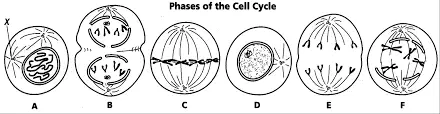
cells A and F show an early stage of the same phase of the cell cycle.
what phase is it?
interphase
metaphase
anaphase
prophase
which cell is in metaphase?
A
B
C
D
E
list the diagrams in order from first to last in the cell cycle
A,B,C,D,E,F
F,E,D,C,B,A
C,B,E,F,A,D
D,A,F,C,E,B
in cell A, what structure is labeled X?
asters
microbes
cytokinesis
centrioles

