Wayground logo

Free Printable Worksheets

Font size

S
M
L
XL
Worksheets

Q1 Benchmark

Total questions: 108

Worksheet time: 2hrs 37mins

Name
Class
Date
1.
Almost Earth’s twin in size and mass, this planet has very thick atmosphere.
a)
Venus
b)
Mars
c)
Mercury
d)
Neptune
2.
The surface of this planet appears red due to rusting iron in the rocks.
a)
Mercury
b)
Mars
c)
Pluto
d)
Venus
3.
Some scientists believe that this dwarf planet is actually a very large comet caught in a permanent orbit.
a)
Eris
b)
Pluto
c)
Mars
d)
Neptune
4.

This cold, blue planet was discovered by a mathematical prediction.

a)

Neptune

b)

Jupiter

c)

Mars

d)

Venus

5.
This is the largest planet in the solar system.
a)
Saturn
b)
Jupiter
c)
Uranus
d)
Venus
6.
This is the smallest planet in the solar system
a)
Mercury
b)
Venus
c)
Earth
d)
Mars
7.
Its largest moon is Titan.
a)
Saturn
b)
Jupiter
c)
Neptune
d)
Uranus
8.
This has an extremely elliptical orbit - 
a)
Pluto
b)
Neptune
c)
Uranus
d)
Saturn
9.
Only planet known to have life
a)
Earth
b)
Mars
c)
Venus
d)
Mercury
10.
The largest known volcano in the solar system, Olympus Mons, is located on this planet.
a)
Venus
b)
Mars
c)
Mercury
d)
Earth
11.
This is the only planet in the solar system with oceans of liquid water.
a)
Mercury
b)
Mars
c)
Venus
d)
Earth
12.
Scientists have been able to find no atmosphere around this planet because it has little gravity and is closest to the sun.
a)
Mars
b)
Venus
c)
Mercury
d)
Earth
13.
This gas giant has a large storm in its atmosphere known as The Red Spot
a)
Jupiter
b)
Saturn
c)
Uranus
d)
Neptune
14.
Most likely due to a massive collision, this planet rotates from top to bottom.
a)
Saturn
b)
Venus
c)
Neptune
d)
Uranus
15.

Which of the following statements is correct?

a)

Pluto was once classified as a dwarf planet, but is now classified as a main planet

b)

Pluto was never classified as a planet

c)

Pluto has always been considered a planet

d)

Pluto was once considered a planet, but no longer is

16.
What is in the center of the Heliocentric Model?
a)
Sun
b)
Comet 
c)
Jupiter
d)
Earth
17.
  What does "geo-" mean?
a)
Earth
b)
sun
c)
Center
18.
This person believed that planets move on small circles that move on larger circles
a)
Ptolemy
b)
Copernicus
c)
Galileo
d)
Aristotle
19.
This person discovered moons on Jupiter, which helped to support the heliocentric theory 
a)
Aristotle
b)
Copernicus
c)
Ptolemy
d)
Galileo
20.
This person developed the heliocentric theory and was considered the founder of modern astronomy.
a)
Aristotle
b)
Copernicus
c)
Ptolemy
d)
Galileo
21.
This person was the first to use a telescope to make observations in the sky -
a)
Aristotle
b)
Ptolemy
c)
Copernicus
d)
Galileo
22.
Which astronomer created laws of gravity and motion? 
a)
Kepler
b)
Copernicus
c)
Brahe 
d)
Newton
23.
What two forces help planets stay in their orbits? 
a)
Gravity and Force
b)
Gravity and Inertia
c)
Doppler effect and Gravity
d)
Inertia and Force 
24.
This astronomer discovered that the orbit of each planet is an ellipse, or an oval shape, and not perfectly circular.
a)
Aristotole
b)
Copernicus
c)
Kepler
d)
Newton
25.
What theory of the Universe did Aristotle believe in? 
a)
Heliocentric theory
b)
Alphamanic theory
c)
Geocentric theory
d)
Vergocentric theory
26.
What shape is an ellipse?  
a)
An oval shape
b)
A round shape
c)
A circle shape 
d)
Sun, moon and Earth lined up shape
27.

Which astronomer figured out that the Earth is a sphere by observing a lunar eclipse?

a)

Newton

b)

Copernicus

c)

Ptolemy

d)

Aristotle

28.
What is in the center of the Heliocentric Model?
a)
Sun
b)
Comet 
c)
Jupiter
d)
Earth
29.
What model does this represent?
a)
Geocentric 
b)
Heliocentric 
30.
  What does "geo-" mean?
a)
Earth
b)
sun
c)
Center
31.
This image shows the:
a)
Geocentric Solar System
b)
Heliocentric Solar System
32.
Galileo used ______ to develop the heliocentric theory.
a)
predictions
b)
the scientific method
c)
theories
d)
guesses
33.
A model of the solar system in which Earth and the other planets revolve around the SUN.
a)
Heliocentric
b)
Geocentric
34.
What does "helios" mean?
a)
Earth
b)
center of
c)
sun
d)
moon
35.
This person was a Greek philosopher who believed the universe centered around the Earth in a perfect circle
a)
Copernicus
b)
Ptolemy
c)
Aristotle
d)
Galileo
36.
This person believed that planets move on small circles that move on larger circles
a)
Ptolemy
b)
Copernicus
c)
Galileo
d)
Aristotle
37.
This person discovered moons on Jupiter, which helped to support the heliocentric theory 
a)
Aristotle
b)
Copernicus
c)
Ptolemy
d)
Galileo
38.
This person was the first to use a telescope to make observations in the sky -
a)
Aristotle
b)
Ptolemy
c)
Copernicus
d)
Galileo
39.
For over 1,000 years, the church supported this theory -
a)
Geocentric
b)
Heliocentric
40.
This person developed the heliocentric theory and was considered the founder of modern astronomy.
a)
Aristotle
b)
Copernicus
c)
Ptolemy
d)
Galileo
41.

The Moon is the Earth´s natural...

a)

celestial body

b)

satellite

c)

comet

42.

What is a natural satellite?

a)

Celestial bodies that orbit an object.

b)

Small celestial bodies that orbit only planets

c)

Celestial bodies formed by ice and dust
43.
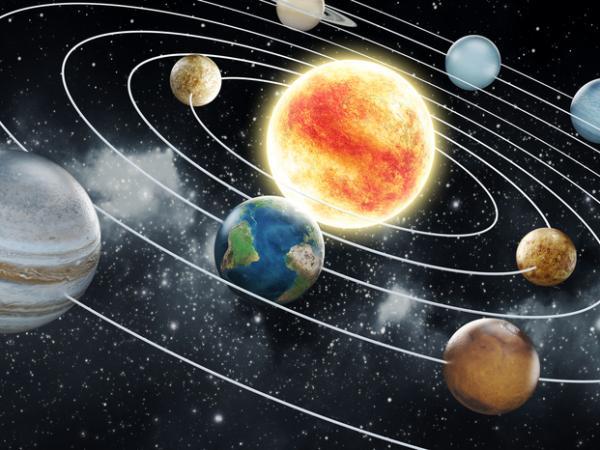
How many planets are there in the Solar System?
a)
eight
b)
three
c)
nine
d)
ten
44.

Galaxies are:

a)

gropus of Asteroids

b)

Groups of planets

c)

Groups of stars, gas and dust.

d)

Group of satellites

45.

Man-made device orbiting around the Earth, Moon or another planet that transmits information or is used for communication

a)

Planet

b)

Artificial satellite

c)

Natural satellite

d)

Star

46.

Between which 2 planets do we find the asteroid belt?

a)

Mercury and Jupiter

b)

Earth and Mars

c)

Mars and Jupiter

d)

Jupiter and Saturn

47.

Planets with the longest revolution are called ______________

a)

Gas Giants

b)

Terrestrial Planets

48.
A celestial body of ice, dust, and rock with an elongated and elliptical orbit.
a)
coma
b)
comet
c)
moon
d)
planet
49.
The gravitationally-curved path of an object around a point in space.
a)
Galilean Moons
b)
Moons of Saturn
c)
Orbital Path
50.
The force that causes objects with mass to attract one another.
a)
Galilean Moons
b)
Moons of Saturn
c)
Orbital Path
d)
gravity
51.
A celestial body that revolves around a planet.
a)
moon
b)
star
c)
comet
d)
meteor
52.
Something that orbits around another object.
a)
satellite
b)
sun
c)
galaxy
53.
Remains of meteoroids that strike the surface of Earth or the Moon.
a)
meteor
b)
meteorites
c)
meteoid
54.
A small object that enters Earth's atmosphere from space and burns due to friction, emitting light.
a)
meteor
b)
meteorites
c)
meteoid
55.
A natural chunk of rock or dust existing outside of Earth’s atmosphere.
a)
meteor
b)
meteorites
c)
meteoid
56.
The region between the inner and outer planets where most asteroids orbit around the Sun.
a)
Asteroid Belt
b)
Solar System
c)
Inner Planet
d)
Outer Planet
57.
Any of the planets Jupiter, Saturn, Uranus, and Neptune, whose orbits lie beyond the asteroid belt.
a)
Asteroid Belt
b)
Solar System
c)
Inner Planet
d)
Outer Planet
58.

...------- emit large amounts of heat and light.

a)

Stars

b)

Galaxies

c)

Planets

59.

The telescope is used to study the ………………..

a)

minerals

b)

celestial bodies.

c)

volcanoes

60.

In addition to the Sun, the solar system includes ……………

a)

eight planets only.

b)

asteroids, meteorites and comets only.

c)

stars and planets.

d)

d. eight planets with the asteroids, meteorites and comets.

61.
There are two types of data. Which type of data involves numbers that are obtained by counting or measuring?
a)
quantitative
b)
qualitative
62.
The part of the experiment that remains the same for the control and experimental group.
a)
constants
b)
control
c)
independent
d)
dependent
63.
Mr. S. sets up an experiment to see how the mass of a ball affects the distance it rolls off a ramp.  Identify the independent variable.
a)
distance traveled by the ball
b)
height of the ramp
c)
mass of the ball
d)
weight of the ball
64.
A student is planning an experiment to find out how the height from which he drops a ball affects how high the ball bounces. The dependent variable is the _____.
a)
Diameter of the ball
b)
Force acting on the ball
c)
Height that the ball bounces
d)
Height from which the ball is dropped
65.
When experimenting with the growth of a plant, a scientist uses three (of the same type of) plants, two different fertilizers, equal light, and equal water. What type of variable is the fertilizer?
a)
Dependent
b)
Independent
c)
Control
d)
Compound
66.
Research Question: Does the type of gasoline put in a car effect how fast the car can drive. What is the independent variable?
a)
Type of gasoline
b)
which car the gas is put into
c)
how fast the car can drive
d)
how much gas is put into the car
67.
Suppose you are looking at how daisies grow in different light sources. What would your control group be?
a)
Blue filtered light
b)
Red filtered light
c)
Green filtered light
d)
Sunglight
68.
The dependent variable is the one
a)
you measure.
b)
you change.
69.
The independent variable is the
a)
one you measure.
b)
one you change.
70.
The control group is the...
a)
group you are testing
b)
"normal" group
71.
A test is set up to test which brand of soda creates the biggest foam explosion when adding a Mentos candy.  Three different sodas were tested. They measured the height of the foam eruption.   What is the dependent variable?
a)
Brand of soda
b)
Number of mentos candies used
c)
Height of foam eruption
d)
Temperature of soda
72.
What step does every scientific experiment begin with?
a)
hypothesis
b)
question/problem
c)
procedures
d)
conclusion
73.
The summary at the end of an experiment that explains the results. 
a)
conclusion
b)
procedures
c)
materials
d)
hypothesis
74.
Qualitative or Quantitative:
The cat has orange fur on his ears. 
a)
Qualitative
b)
Quantitative
75.
A possible explanation to a problem that has not yet been tested. 
a)
data
b)
theory
c)
hypothesis
d)
fact
76.
This scientific variable is graphed on the x-axis. 
a)
Dependent
b)
Control Group
c)
Independent
d)
Constant
77.

Tim and Moby intentionally changed the amount of water to determine if Moby was watering his plant too much. Amount of water is known as this type of variable.

a)

Independent or Manipulated Variable

b)

Independent or Dependent Variable

c)

Dependent or Responding Variable

d)

Controlled Variable

78.

The best question for this experiment is

a)

Do plants need sunlight to grow?

b)

How tall can a plant grow?

c)

How much water is needed for plants to grow the tallest?

d)

Why do plants need water to grow?

79.
This variable in an experiment is the one being deliberately changed by the scientist. 
a)
dependent variable
b)
independent variable
c)
data
d)
control group
80.
A possible explanation to a problem that has not yet been tested. 
a)
data
b)
theory
c)
hypothesis
d)
fact
81.
A series of steps used by scientists to solve a problem or answer a question. 
a)
scientific method
b)
recipe
c)
data collection
d)
metric system
82.
Which variable do you measure?
a)
Independent
b)
Dependent
83.
Mrs. LaRue wants to know which brand of paper towels is the strongest.  In this experiment, what is the DEPENDENT variable? 
a)
Stength 
b)
Brand of paper towel
c)
Environment
d)
Weight
84.
If you increase the amount of spinach you eat, then you will increase the iron in your blood. 
What's the dependent variable?
a)
increase the amount of iron in your blood
b)
spinach you eat
85.
If I study for my scientific method test, then I will have a better test score. What is the dependent variable?
a)
Scientific Method
b)
Studying
c)
Independent variable
d)
Test score
86.
What is the first step in the scientific method?
a)
Make an observation --> Question
b)
Design and conduct an experiment
c)
Make an hypothesis
d)
Share your results
87.
The summary at the end of an experiment that explains the results is... 
a)
conclusion
b)
procedures
c)
materials
d)
responding variable
88.
A testable prediction about a scientific investigation is a(n)
a)
Question
b)
Observation
c)
Hypothesis
d)
Experiment
89.
Information you obtain through your senses, such as touch, sound and sight.
a)
observation
b)
hypothesis
c)
question
d)
conclusion
90.

What is the last step of scientific method?

a)

hypothesis

b)

observe

c)

communicate

d)

question

91.
A series of steps used by scientists to solve a problem or answer a question. 
a)
scientific method
b)
recipe
c)
data collection
d)
metric system
92.

The information you collect while doing your experiment is called

a)

conclusions

b)

data

c)

hypotheses

d)

procedures

93.
The independent variable is the ONE thing you _____.
a)
change on purpose
b)
control or keep constant
c)
measure
94.

How many independent variables should you have in an experiment?

a)

two

b)

as many as possible

c)

four

d)

one

95.

The variable that is being measured or observed is called the _______________. Hint: this is the variable that is the result or effect

a)

independent variable

b)

dependent variable

c)

control variable

96.

What is a constant/control in an experiment?

a)

Things that do not change in a experiment. It's the variable that stays the same. You can have many variables stay the same.

b)

It's the variables that the scientist changes in the experiment

c)

It's the variables that are being measured in an experiment

97.
Will a construction paper air plane fly faster than an airplane made from notebook paper? Choose the best hypothesis.
a)
If I make a paper airplane from notebook paper, then it will fly faster than construction paper.
b)
Yes.
c)
No.
d)
I think the construction paper air plane will fly faster.
98.
The summary at the end of an experiment that explains the results. 
a)
conclusion
b)
procedures
c)
materials
d)
responding variable
99.

If I floss more, then I will have fewer cavities. What is the independent variable?

a)

Number of cavities

b)

Amount of flossing

c)

Type of floss used

d)

Amount of brushing

100.

If I put on a higher factor sunscreen, then I will burn less. What is the dependent variable?

a)

Severity of sunburn

b)

Factor of sunscreen

c)

Time spent in the sun

d)

Weather conditions

101.

Researchers are developing a new fertilizer designed to improve the growth of endangered Hawaiian plants. The fertilizer was applied to one hundred plants in a greenhouse. The temperature, humidity and amount of water were kept constant. Which is best for the researchers to do next?

a)

A compare plants that received fertilizer plants that received none

b)

B begin selling the fertilizer to gardeners living in hot, dry climates

c)

C change the conditions in the greenhouse and retest the fertilizer

d)

D test the fertilizer on plants that are adapted to cooler climates

102.
Mr. S set up an experiment to see how the mass of a ball affects the distance it rolls off a ramp. What is the dependent variable?
a)
Distance traveled by the ball
b)
Height of the ramp
c)
Mass of the ball
103.
Mr. S normally uses praise as a reward to train his dog. He wants to know the best way to train his dog, so he sets up an experiment to find out if there is a better way to get his dog to respond to commands. What is his dependent variable?
a)
Type of reward
b)
Praise
c)
Type of dog
d)
Amount of time the dog follows commands
104.
If I study for my scientific method test, then I will have a better test score. What is the dependent variable?
a)
Scientific Method
b)
Studying
c)
Independent variable
d)
Test score
105.

If I floss more, then I will have fewer cavities. What is the independent variable?

a)

Number of cavities

b)

Amount of flossing

c)

Type of floss used

d)

Amount of brushing

106.

If I put on a higher factor sunscreen, then I will burn less. What is the dependent variable?

a)

Severity of sunburn

b)

Factor of sunscreen

c)

Time spent in the sun

d)

Weather conditions

107.

Does pipe material affect the temperature of flowing water? What is a controlled variable?

a)

Temperature of water

b)

Thickness of pipe

c)

Pipe material

d)

Diameter of pipe

108.

What is the purpose of controlled variables

a)

To control what happens in the investigation

b)

To make the investigation valid

c)

To make the investigation reliable