
 Worksheets
Review: Chemistry Final Exam for 1st Semester 2023-24
Total questions: 127
Worksheet time: 2hrs 7mins
What is a common property of all types of solids?
They have a definite shape and volume
They can conduct electricity
They are malleable
They have low melting and boiling points
Which type of solid has a sea of mobile electrons?
Metallic solids
Ionic solids
Covalent solids
Network solids
Which type of solid can conduct electricity?
Metallic solids
Ionic solids
Covalent solids
Network solids
Which type of solid is malleable?
Metallic solids
Ionic solids
Covalent solids
Network solids
Which type of solid is soluble in water?
Metallic solids
Ionic solids
Covalent solids
Network solids
Which type of solid has a high hardness?
Metallic solids
Ionic solids
Covalent solids
Network solids
Which type of solid has low melting and boiling points?
Metallic solids
Ionic solids
Covalent solids
Network solids
What is the main characteristic of ionic solids?
Positive and negative ions are attracted to each other
They have a sea of mobile electrons
They are held together by attractive forces
Non-metallic atoms are held together by covalent bonds
Do ionic solids conduct electricity as a solid?
Yes
No
Only when dissolved in water
Only when melted into a liquid
Are ionic solids malleable?
Yes
No
It varies
Only when dissolved in water
Are ionic solids soluble in water?
Yes
No
It varies
Only when melted into a liquid
What is the main characteristic of covalent solids?
Positive and negative ions are attracted to each other
They have a sea of mobile electrons
They are held together by attractive forces
Non-metallic atoms are held together by covalent bonds
Do covalent solids conduct electricity?
Yes
No
Only when dissolved in water
Only when melted into a liquid
Are covalent solids malleable?
Yes
No
It varies
Only when dissolved in water
What is the main characteristic of network solids?
Positive and negative ions are attracted to each other
They have a sea of mobile electrons
They are held together by attractive forces
Non-metallic atoms are held together by covalent bonds
Which type of solid is not soluble in water?
Metallic solids
Ionic solids
Covalent solids
Network solids
Do metallic solids conduct electricity as a solid?
Yes
No
Only when dissolved in water
Only when melted into a liquid
What is the main characteristic of ionic compounds?
Positive and negative ions are attracted to each other
They have a sea of mobile electrons
They are held together by attractive forces
Non-metallic atoms are held together by covalent bonds
Do ionic compounds conduct electricity as a solid?
Yes
No
Only when dissolved in water
Only when melted into a liquid
Which type of solid has a sea of mobile electrons?
Metallic solids
Ionic solids
Covalent solids
Network solids
what is a liquid?
a substance that flows freely but is of constant volume
a substance or matter in a state in which it will expand freely
firm and stable in shape
Liquid pressure is because of the forces between the liquid particles and the _________ of the container.
Volume
Mass
Surface
Density
When divers return to the surface of water quickly, the pressure is ________.
Increased
Decreased
Not changing
The pressure in a liquid or gas is measures by a _________.
Viscosity
Pressure Plate
Pressure Gauge
Pressure Counter
The pressure exerted by a liquid
increases with depth.
decreases with depth.
is constant
first increases and then decreases.
The pressure of the water at the bottom of a pond is ___ at the surface of the pond.
either lower or higher
higher than
same
lower than
Which of the following does not affect the pressure beneath the surface of a liquid?
Strength of the gravitational field
Area of the liquid surface
Density of the liquid
Depth of the liquid

The diagrams show, to the same scale, the vertical sections of a set of circular vessels, each containing the same depth of water.
The water exerts the same pressure on the base of each vessel.
The water exerts the greatest pressure on the base of vessel S.
The water exerts the greatest pressure on the base of vessel P.
The water exerts the same force on the base of each vessel.
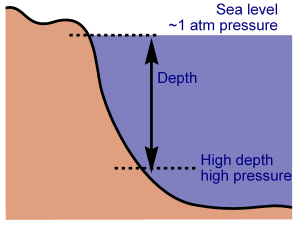
When you increase your depth under water, the water pressure on your body
increases
decreases
stays the same

Diagram shows the design of a dam. Why does the thickness of the dam increase with its depth?
The design of this structure is stronger.
Water pressure increases with depth.
The cost of construction is lower.
Water pressure acts uniformly in all directions.
Which of the following does not affect the pressure beneath the surface of a liquid?
Strength of the gravitational field
Area of the liquid surface
Density of the liquid
Depth of the liquid

The only pure non-water liquid that a person in pre-modern times would run into would be ___
blood
bromine
mercury
liquid fats

Which two elements are liquid at room temperature?
bromine and mercury
bromine and gallium
gallium and rubidium
rubidium and mercury

Which non-toxic brittle metal will melt in the palm of your hand?
francium
mercury
aluminum
gallium

Which moon of Saturn is so cold that methane is liquid on its surface?
Mercury
Iapetus
Dione
Titan

The attractive forces which mediate interactions between molecules are collectively called ___
intermolecular forces
intramolecular forces
gravitational forces
adhesive forces

Using electricity, water can be split into ___
solid and liquid phases
solid and gas phases
hydrogen and oxygen
peroxides of hydrogen

Because gas particles are so far apart, gases have ___
low density and are only slightly compressible
low density and are highly compressible
high density and are only slightly compressible
high density and are highly compressible

Because there's a lot of interaction among the molecules, both liquids and solids are known as ___
bonded states
fluids
cohesive liquids
condensed states

The particles in a solid are very close together, so they have ___
low density and are only slightly compressible
low density and are highly compressible
high density and are only slightly compressible
high density and are highly compressible

The attraction of molecules in a liquid to each other due to intermolecular forces is called ___
cohesion
adhesion
concurrence
uniformity

The tendency of liquids to minimize their surface area due to intermolecular forces is called ___
viscocity
constriction
surface tension
stenosis action

The resistance to flow, seen in liquids like honey and syrup, is called ___
adhesion
capillary action
surface tension
viscosity

Liquid spontaneously rising in a narrow tube due to cohesion and adhesion is called ___
surface tension
meniscus formation
capillary action
condensation flow

The attraction of molecules in a liquid to their container due to intermolecular forces is called ___
cohesion
adhesion
capillary action
viscosity

If the molecules in a liquid are more attracted to the container than each other, they will form ___
an induced dipole
a permanent dipole
a concave meniscus
a convex meniscus

If the molecules in a liquid are more attracted to each other than to the container, they will form ___
a capillary tube
a cohesive sphere
a concave meniscus
a convex meniscus
They can splash. They can squirt. They can bubble and fizz. They come in many different colors. What are they?
Solids
Liquids
Gasses
Liquids have to be kept in a ____________ so they won't spill.
Container
The sky
The ground

Liquids can change their shape.
True
False
What is a solid?
particles that are tightly compacted
particles that are not tightly compacted
what is a liquid?
a substance that flows freely but is of constant volume
a substance or matter in a state in which it will expand freely
firm and stable in shape
3.45 liters of oxygen gas at STP?
2KClO3 (s) --> 2KCl (s) + 3O2 (g)
3.0 L. What is the new volume if the pressure increases to 303.9 kPa?

According to ___________, if you decrease the volume of a container of gas and hold the temperature constant, the pressure of the gas will increase.
Bernoulli's principle
Boyle's Law
Charles's Law
Archimedes' principle

At STP (Standard Temperature 273 K and Pressure 101.3 kPa), a gas has a volume of 3.0 L. What is the new volume if the pressure increases to 303.9 kPa?
9 L
1 L
9 kPa
1 kPa
What is diffusion?
The movement of gas particles from a higher concentration to a lower concentration.
The rate at which gas flows through the air.
An explosion of gases.
The ability of a gas to move from high pressure to a low pressure.

A sample of pure oxygen gas has a volume of 2.00 L at a pressure of 101.3 kPa. What is the new pressure is the volume is decreased to 0.5 L?
203 kPa
101 kPa
25 kPa
405 kPa
What are the values for STP?
0 K and 1 atmosphere
0ºC and 1 atmosphere
32ºF and 1 atmosphere
100ºC and 1 atmosphere

A sample of O2 gas has a volume of 2.0 L, a Temperature of 298 K, and a pressure of 100 kPa. Calculate the number of moles of oxygen. R = 8.314
495,514 moles of oxygen
0.0807 moles of oxygen
5.578 moles of oxygen
12.39 moles of oxygen
What is zero degrees Celsius converted to Kelvin?
100
273
373
212

A 7.00 L sample of argon gas at 420 K exerts a pressure of 625 kPa. If the gas is compressed to 1.25 L and the temperature is lowered to 350 K, what will be its new pressure in kPa?
0.000238 kPa
2916 kPa
4200 kPa
93.0 kPa
Which of the following explains the change in pressure when volume increases?
As the volume increases, the particles slow down, causing less collisions and less pressure.
As the volume increases, the particles speed up, causing more collisions and more pressure.
As the volume increases, the particles have more space to move and collide less with the walls , causing pressure to decrease.
As the volume increases, the particles have more space to move and collide less with the walls , causing pressure to increase.

Calculate the volume that a 0.323-mol sample of a gas will occupy at -8oC and a pressure of 0.900 atm.
R = 0.0821
7.18 L
7.81 L
4.63 L
4.36 L
What is movement of one material through another (higher concentration to lower concentration)?
diffusion
temperature
barometer
pressure

The volume of a gas is increased from 150.0 mL to 350.0 mL when heated. If the original temperature of the gas was 25oC, what is the final temperature?
58 K
176 K
128 K
695 K
What is an instrument used to measure atmospheric pressure?
barometer
thermometer
calorimeter
Kelvin

At STP (Standard Temperature and Pressure), a gas has a volume of 3.0 L. What is the new volume if the pressure increases to 303.9 kPa?
9.0 L
1.0 L
9.0 kPa
1.0 kPa

A sample of Argon gas occupies a volume of 1.8 L at 2.8 atm. What will its volume be at 1.2 atm?
.77 L
1.87 L
3.0 L
4.2 L
R = 8.314 L*kPa/(K * mole)



What variable is held constant in the diagram?
Volume
Moles
Pressure
No constant

What relationship can be interpreted from the diagram?
As volume decreases, pressure decreases
As pressure increases, volume increases
As moles increase, temperature increases
As pressure increases, volume decreases
Can be compressed
Little space between particles
Can be compressed
Lots of space between particles
Cannot be compressed
Lots of space between particles
Can be compressed
Lots of space between particles

[Hint: Space and Heat]

Which metal can be cut using a plasma cutter?
Aluminum
Stainless Steel
Mild Steel
Galvanized Steel
How hot is plasma?
20,000 degrees Fahrenheit
30,000 degrees Fahrenheit
40,000 degrees Fahrenheit
50,000 degrees Fahrenheit
(a) is considered an example of plasma.
What is plasma?
The first state of matter
The second state of matter
The third state of matter
The fourth state of matter
Is it possible for plasma to be hotter than the Sun and the Earth's Core?
No
Yes
Who discovered plasma?
Sir William Crookes
Thomas Francois D'Alibard
Marie Curie
Galen
Is there such a thing as cold plasma?
No, there is only hot plasma that can go over 1000 degrees.
Yes, it is often created using strong electric fields.
No, there is no such thing as a cold or hot plasma. It is only in between due to the atoms making it in between.
Where can plasma be found?
Lightning
Moon
LED light bulbs
Fluorescent lights
Aurora
The negative charge in plasma is usually due to:
Electrons
Neutrons
Protons
In a plasma, the electrons are no longer associated with a particular nucleus.
True
False
What does plasma consist of?
Liquid
Neutrons and proton atoms in the gas
Gas particles
A gas of ions and atoms
In a plasma, the number of positively charged particles is ______ than the number of negatively charged particles.
more
equal
less
Plasma can be created in a laboratory by:
Melting a solid to release gas fumes
Allowing hot gas to roam freely in the laboratory
Heating gas to extremely high temperatures
How hot is plasma?
3000 degrees Fahrenheit and above
3000 degrees Fahrenheit and below

What is the best explanation for the image?
Glass structure
Crystalline structure
Quartz crystalline structure
Silicon dioxide rings

