Wayground logo

Free Printable Worksheets

Font size

S
M
L
XL
Worksheets

CP Chemistry 1st Semester Final Exam

Total questions: 126

Worksheet time: 3hrs 50mins

Name
Class
Date
1.
PBr5
a)
Phosphorus Bromide
b)
Phosphorus Pentabromide
c)
Pentaphosphorus bromide
d)
Phosphorus Bromine
2.
CO
a)
Carbon Oxide
b)
Carbon Oxygen
c)
Dicarbon dioxide
d)
Carbon Monoxide
3.
SeF4
a)
Tetraselenium fluoride
b)
Selenium Fluoride
c)
Selenium tetraflouride
d)
Selenium (IV) Fluoride
4.
P2O5
a)
Phosphorus Oxide
b)
Pentaphosphorus Dioxide
c)
Diphosphorous pentoxide
d)
Phosphoric Oxygen
5.
Disulfur trioxide
a)
S3O2
b)
SO
c)
S2O3
d)
S2O
6.
Phosphorous trichloride
a)
PCl3
b)
P3Cl
c)
P3Cl3
d)
PCL
7.
Bromine monoflouride
a)
Br1F1
b)
BrF
c)
Br2F
d)
BrF2
8.
What region of the periodic table contains atoms that form covalent bonds?
a)
the left side
b)
the middle
c)
the right side
d)
top left
9.
Covalent bonding is typically explained as a bond that forms when
a)
atoms are sharing electrons
b)
atoms are sharing protons
c)
atoms are not sharing anything
d)
atoms are sharing neutrons
10.
Name this compound: P4S5
a)
Tetraphosphide sulfide
b)
Tetraphosphorus pentasulfide
c)
Pentaphosphide tetrasulfur
d)
Pentaphosphorus tetrasulfide
11.
Give the formula for... Dinitrogen trioxide
a)
N(II)O3
b)
N5O6
c)
N3O2
d)
N2O3
12.
What two types of atoms make a covalent bond?
a)
2 Nonmetals
b)
1 Nonmetal and 1 Metal
c)
2 Metals
d)
2 Noble Gases
13.
How are covalent bonds explained?
a)
When one atom takes the other atom's electron
b)
When the atom shares an electron with an another atom
c)
When the two nucleus merge
d)
When the neutrons leave the nucleus
14.
In chemical compounds, covalent bonds form when
a)
the electronegativity difference between two atoms is very large.
b)
electrons are completely transferred between two metals.
c)
pairs of electrons are shared between two nonmetal atoms.
d)
two nonmetal atoms are attracted to each other by opposite charges.
15.
Is carbon considered a metal or a non-metal?
a)
metal
b)
nonmetal
c)
other
16.
Is Hydrogen considered a metal or a non-metal?
a)
Metal
b)
Non-metal
17.
What region of the periodic table contains atoms that form covalent bonds?
a)
the left side
b)
the middle
c)
the right side
d)
top left
18.
Are atoms usually more stable when they are bonded together or when they are apart? 
a)
Bonded Together
b)
Apart
19.

How many bonds does carbon usually make to have a complete valence shell?

a)

1

b)

2

c)

3

d)

4

20.

What is it called if there are three pairs of electrons being shared between 2 atoms?

a)

Triple bond

b)

Bond length

c)

Tribond

d)

Chocolate Mousse

21.
Which of the following is a covalent compound?
a)
LiF - Lithium Fluoride
b)
NH3 - Ammonia
c)
NaBr - Sodium Bromide
d)
CuCl - Copper(I) Chloride
22.

How many electrons are shared in a double bond?

a)

6

b)

2

c)

4

d)

5

23.

When drawing Lewis structures, what do you do if you don't have enough electrons for each atom to have 8?

a)

Place dots until everything has eight

b)

Place dots only around the terminal atoms

c)

Add a multiple bond

d)

Have eight only around the central atom

24.
How many electrons do most atoms need to be stable?
a)
1
b)
2
c)
6
d)
8
25.
Why do Hydrogen and Helium only need two valence electrons?
a)
The first electron shell can only hold two electrons.
b)
They are both metals.
c)
They both begin with H.
d)
They are both gases.
26.

For carbonate ions (CO3 2-), how many resonance structures can be drawn ?

a)

2

b)

3

c)

4

d)

5

27.
For carbonate ions, what is the bond strength between C and O
a)
C-O (single bond)
b)
C=O (double bond)
c)
C≡O (triple bond)
d)
C-O(between single and double bond)
28.

How many resonance structures for NO3- ion?

a)

1

b)

2

c)

3

d)

4

29.

How many resonance structure for SO2 ?

a)

1

b)

2

c)

3

d)

4

30.

How many resonance structures for CH3COO- ion?

a)

1

b)

2

c)

3

d)

4

31.
What will be the compound name of the following chemical formula?
NaCl
a)
Potassium Chloride
b)
Sodium Chloride
c)
Calcium Chloride
d)
Sodium Chlorine
32.
Which is the correct name for CaBr2?
a)
Calcium Bromine
b)
Bromine Calcium
c)
Calcium Bromide
d)
Carbon and Bromine
33.
which types of elements become cations?
a)
nonmetals
b)
all metals
c)
only transition metals
d)
some metals and some metalloids
34.
What is the formula of Sodium oxide?
a)
Na2O
b)
NaO2
c)
Na2O2
d)
Na2O
35.
What is the formula of calcium oxide?
a)
CaO2
b)
CaO
c)
Ca2O
d)
CO
36.
Which of the following is a characteristic property of ionic compounds?
a)
They form hard, brittle crystals with characteristic shapes
b)
They have low melting points
c)
They have low boiling points
d)
They contain no charged particles
37.
In the chemical formula for an ionic compound, which item is written first?
a)
positive ion
b)
negative ion
c)
subscript
d)
the female
38.
Ionic compounds are formed when one or more valence electrons are transferred from _____
a)
a nonmetal atom to a metal atom
b)
a nonmetal atom to a nonmetal atom
c)
a metal atom to a nonmetal atom
d)
a metal atom to a metal atom
39.
Definition: a full shell of eight electrons in the outer energy level of an atom
a)
stable octet
b)
unstable octet
c)
octopus
d)
octagon
40.
Iron III Chromate
a)
Fe2(CrO4)3
b)
Fe3CrO4
c)
Fe2(Cr2O7)3
d)
FeCrO4
41.
Which of these is CoCl4?
a)
cobalt chlorine IV
b)
cobalt chloride
c)
cobalt IV chlorine
d)
cobalt IV chloride
42.
Sr(OH)2
a)
Strontium Hydroxide
b)
Strontium Hydride
c)
Strontium Dihydroxide
d)
Strontium Dioxygen Dihydride
43.
Which of the following is a property of an ionic compound?
a)
high melting point
b)
soft
c)
malleable
d)
liquid at room temperature
44.
What type of bond forms between a metal and a non-metal?
a)
Ionic
b)
Covalent
c)
Metallic
d)
Electronic
45.
Fill in the blank: Ionic compounds have ______ melting points.
a)
low
b)
medium
c)
nonexistent
d)
high
46.
Which type of bond forms between two or more metals?
a)
Ionic
b)
Covalent
c)
Metallic
d)
Ironic
47.
A(n) _________ is an electrically charged atom or group of atoms.
a)
compound
b)
element
c)
solute
d)
ion
48.
Which of the following is an example of an IONIC COMPOUND?
a)
NaCl
b)
H2O
c)
CO2
d)
NO
49.
What charge does a potassium (K) ion have?
a)
+1
b)
-1
c)
+2 
d)
-2
50.
What charge does a bromine (Br) ion have?
a)
-1
b)
-2
c)
-3
d)
-4
51.

Ionic compounds are made of cations and anions.

a)

True

b)

False

52.

Metals form cations.

a)

True

b)

False

53.

Which is a property of ionic compounds?

a)

hard and brittle

b)

ductile

c)

in solids, good conductor of electricity

d)

poor insulators

54.

Which is a property of an ionic compound?

a)

High melting and boiling point

b)

Good electric conductor

c)

Poor insulator

d)

Malleable

55.

What is not a property of metals?

a)

Malleable

b)

ductile

c)

good heat conductor

d)

poor electrical conductor

56.

When a metal can be hammered into thin sheets, it is exhibiting the property of...

a)

malleability

b)

ductility

c)

conductivity

d)

insulation

57.

The electrons that move freely between metal atoms are called...

a)

valence electrons

b)

sea of electrons

c)

electrons in the lowest energy level

d)

metallic electrons

58.

The ability of electrons of metals to move about freely gives rise what property of metals?

a)

electrical conductivity

b)

ductility

c)

good insulating capacity

d)

malleabvility

59.
Why are ions formed?
a)
To make our lives difficult
b)
Because atoms want 8 valence electrons
c)
Because atoms have the same number of protons and electrons
d)
Because atoms gained neutrons
60.
Cations are...
a)
Positive
b)
Negative
c)
Neutral
d)
Purring
61.
Anions are...
a)
Positive
b)
Negative
c)
Neutral
d)
Crying
62.
An atom becomes _________ when it gains electrons.
a)
Positive
b)
Negative
c)
Neutral
d)
Invinsible
63.
An atom becomes _______ when it loses electrons.
a)
Positive
b)
Negative
c)
Neutral
d)
Invinsible
64.
What will nitrogen's charge be as an ion (What is the charge of the nitride ion)?
a)
+3
b)
-3
c)
0
d)
-1
65.
How many total electrons does Mg+2 (a magnesium ion) have?
a)
10
b)
12
c)
14
d)
22
66.
If an element has 3 valence electrons, what charge will its ion most likely have?
a)
+3
b)
+5
c)
-3
d)
-5
67.
What electron configuration matches an oxygen ion?
a)
1s22s22p63s2, 3p64s23d104p5
b)
1s22s22p4
c)
1s22s22p6
d)
1s22s22p63s23p64s23d1
68.

What electron configuration matches a bromine atom?

a)

1s22s22p63s23p64s23d104p5

b)

1s22s22p4

c)

1s22s22p6

d)

1s22s22p63s23p64s23d1

69.

Which ground-state electron configuration belongs to a chloride ion (Cl-)?

a)

1s2 2s2 2p6 3s2 3p5

b)

1s2 2s2 2p6 3s2 3p6

c)

1s2 2s2 2p6 3s2 3p7

70.

Select the ions that are isoelectronic (same number of electrons) with the noble gas, argon? (more than one answer to select).

a)

sulfide ion, S2-

b)

oxide ion, O2-

c)

chloride ion, Cl-

d)

sodium ion, Na+

e)

calcium ion, Ca2+

71.

Which ions have the electron configuration: [Ne] 3s23p6? (More than one answer to select).

a)

Fluoride ion, F-

b)

Chloride ion, Cl-

c)

Potassium ion, K+

d)

Magnesium ion, Mg2+

72.
Which of the following will have a larger radius than Zinc?
a)
Gallium
b)
Aluminum
c)
Magnesium
d)
Strontium
73.
Which of the following will have a higher electronegativity than arsenic (As)?
a)
Carbon (C)
b)
Neon (Ne)
c)
Antimony (Sb)
d)
Germanium (Ge)
74.
As atoms of elements in group 16 are considered in order from top to bottom, the electronegativity of each successive element....
a)
decreases
b)
increases
c)
remains the same
d)
none of the above
75.
Which atom has the largest atomic radius?
a)
potassium
b)
rubidium 
c)
francium
d)
cesium
76.
As you move down the periodic table atoms get bigger.  This is because ____________.
a)
The atoms have more mass.
b)
The atoms have more protons.
c)
The atoms have more energy levels
d)
The atoms have more nuetrons
77.
As you move across the periodic table atoms tend to get smaller because, ______________.
a)
the atoms have more mass.
b)
the atoms have less mass
c)
the atoms have more protons.
d)
the atoms have less electrons.
78.
Atoms that have a high electronegativity, _______________.
a)
give up their electrons more easily.
b)
hold on to their electrons more tightly.
c)
have more electron shells.
79.
Electronegativity is...
a)
how good an atom is at attracting electrons
b)
the ability of an atom to lose electrons
c)
the energy required to remove an electron from a specific atom
d)
how easy it is to make friends. 
80.
The element with the largest electronegativity in the halogens is - 
a)
At
b)
F
c)
Cl
d)
Br
81.
Order the following in increasing atomic radii: 
Ra, Be, Ca, Rb, H
a)
Ra, Be, Rb, H, Ca
b)
Rb, H, Ca, Be, Ra
c)
Ra, Rb, Ca, Be, H
d)
H, Be, Ca, Rb, Ra
82.
Choose the element that is bigger in terms of its atomic size
a)
Al
b)
Al+2
c)
Al+3
83.
Choose the element that is bigger in terms of its atomic size
a)
O
b)
O-1
c)
O-2
84.
Which of the following represents an element?
a)
H2O
b)
H2
c)
NaCl
d)
CaCO3
85.
Which of the following is not a compound?
a)
HCl
b)
Cl
c)
NaCl
d)
CO2
86.
What cannot be broken down into other substances?
a)
Compound
b)
Mixture
c)
Solids
d)
Element
87.
What is made up two or more elements that are chemically combined?
a)
Element
b)
Mixture
c)
Compound
d)
Solids
88.
How many elements are represented in the compound?
Na2CO3
a)
1
b)
2
c)
3
d)
4
89.
A combination of substances that are not chemically combined is called a(n)____________. 
a)
mixture
b)
compound
c)
physical
90.
Mixtures are separated through ___________changes.
a)
mixture
b)
compound
c)
physical
91.
An element is made up of only one kind of _____.
a)
isotope
b)
plastic
c)
atom
d)
metal
92.
In general, metals are _____. 
a)
poor conductors of heat
b)
brittle
c)
poor conductors of electricity 
d)
good conductors of heat
93.
Vertical columns in the periodic table are called _________ of elements and have similar properties. 
a)
groups
b)
periods
94.
The horizontal rows on the periodic table are known as
a)
periods.
b)
atoms.
c)
groups or families.
d)
valence electrons.
95.
made up of one kind of matter and has a definite set of properties
a)
compound          
b)
atom
c)
mixture 
d)
pure substance
96.
A mixture that is uniform and well mixed is _____.
a)
homogeneous
b)
hetergeneous
c)
pure substance
d)
compoud
97.
A combination of particles of one or more substance that are distributed uniformly throughout another substance is a/an
a)
Mixture 
b)
Substance
c)
Solution
98.
How many neutrons does the isotope of lithium have?
a)
8
b)
3
c)
4
d)
5
99.
How many neutrons in C-14?
a)
6
b)
7
c)
14
d)
8
100.
Isotopes are atoms of the same element with different #’s of __________ & therefore different __________.
a)
n0 ;  atomic #’s
b)
p+ ; atomic #’s
c)
e- ; atomic masses
d)
n0 ; atomic masses
101.
How many neutrons does the isotope below have?     89 36Kr
a)
53
b)
36
c)
89
d)
125
102.
What charge does an electron have?
a)
positive
b)
negative
c)
neutral
d)
no charge
103.
What charge does a proton have?
a)
positive
b)
negative
c)
no charge
d)
neutral
104.
Where are protons located in the atom?
a)
orbitals
b)
nucleus
c)
rings
d)
positive
105.
Where are electrons located in the atom?
a)
Nucleus
b)
Shells/orbitals
c)
rings
d)
center
106.
Where are neutrons located in the atom?
a)
shells/orbitals
b)
rings
c)
center
d)
nucleus
107.
How does the size of an electron compare to the size of a proton?
a)
larger
b)
smaller
c)
equal
108.
True or False? Neutrons have a negative charge
a)
True
b)
False
109.
What is the number of protons that the element in this image contain?
a)
14
b)
7
c)
15
d)
18
110.
Which particle does not contribute mass to the atom?
a)
Proton
b)
Neutron
c)
Electron
d)
Nucleus
111.
Most of the mass in an atom is made up of _____________________?
a)
protons and electrons
b)
protons and neutrons
c)
neutrons and electrons
d)
electrons and quarks
112.
24.1% of all the isotopes of a an element have a mass of 75.23 amu, 48.7% have a mass of 74.61 amu, and 27.2% have a mass of 75.20 amu.
What is the average mass of this element?
a)
74.92 amu
b)
24.97 amu
c)
75.01 amu
d)
74.51 amu
113.
Nitrogen has three occurring isotopes: Nitrogen-13, Nitrogen-14, Nitrogen-15. Which isotope is the most abundant?
a)
Nitrogen-13
b)
Nitrogen-14
c)
Nitrogen-15
d)
Based on the information given, it cannot be determined
114.
What is the name of the atom pictured here?
a)
Nitrogen
b)
Nitrogen-15
c)
Nitrogen-7
d)
Nitrogen-8
115.
Which of the following could have 82 neutrons?
a)
W-182
b)
Ta-181
c)
Cs-132
d)
Ba-138
116.
What atom matches this electron configuration?
1s22s22p63s23p64s23d10
a)
Zinc
b)
Copper
c)
Nickel
d)
Germanium
117.
What do you start electron configuration with?
a)
1s2
b)
1d10
c)
1f14
d)
1p6
118.
What is the shorthand electron configuration for Sulfur atom?
a)
[Ar] 3p4
b)
[He] 3s23p4
c)
[Ne] 3s23p4
d)
[Na] 3s23p3
119.

In 1s2, the 1 means

a)

there is 1 electron

b)

the electrons are in the 1st energy level

c)

the shape is circular

d)

there is a -1 charge

120.

In 1s2, the 2 means

a)

there are 2 electrons in this level

b)

it is the 2nd energy level

c)

there is a +2 charge

d)

there is a -2 charge

121.

There are __ energy levels

a)

1

b)

2

c)

7

d)

8

122.
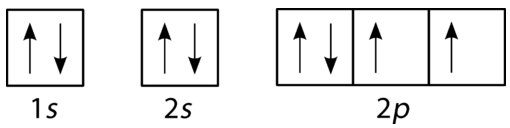
This orbital diagram represents:  
a)
C
b)
B
c)
N
d)
O
123.
This orbital diagram represents:  
a)
C
b)
B
c)
N
d)
O
124.
What is incorrect about this orbital diagram?
a)
Both arrows in the 2p box should be pointing up
b)
There is nothing incorrect with this diagram
c)
In the 2p box there should only be 1 electron in the first 2p box and one in the 2nd 2p box
d)
All the arrows should be pointing up.
125.
The maximum number of electrons that can be placed in an p orbital.  
a)
2
b)
6
c)
10
d)
14
126.
The maximum number of electrons that can be placed in an d  orbital.  
a)
2
b)
6
c)
10
d)
14