
 Worksheets
LT 1 Review
Total questions: 148
Worksheet time: 2hrs 38mins
What is the process by which the Solar System formed?
Nuclear fusion
Volcanic eruption
Chemical reaction
Accretion
What is the force that keeps planets in their orbits around the Sun?
gravity
centrifugal force
friction
magnetism
What are the four inner planets of the Solar System called?
Sun, Moon, Pluto, Jupiter
Saturn, Mars, Uranus, Neptune
Jupiter, Saturn, Uranus, Neptune
Mercury, Venus, Earth, Mars
Which planet is known as the Red Planet?
Venus
Jupiter
Mars
Saturn
What are the two main components of the Big Bang Theory?
Collision of celestial bodies and formation of planets
Creation of time and space
Formation of galaxies and evolution of stars
Expansion of space and formation of matter and energy
What is the name given to the large-scale structures in the universe that contain stars, planets, and other celestial objects?
galaxies
solar systems
constellations
asteroids
According to the Big Bang Theory, how did the universe begin?
The universe began as a singularity and rapidly expanded.
The universe began as a result of a random occurrence.
The universe began as a result of a divine intervention.
The universe began as a result of a cosmic collision.
What causes the phases of the Moon?
Shadows from other objects in the solar system
The Moon's position relative to Earth & The Sun
The shadow of Earth
The rotation of the Moon
What causes an eclipse?
When an object blocks sunlight from reaching another object
When the Sun blocks sunlight from reaching an object
When a dragon eats the sun
When the Earth blocks sunlight from reaching an object
Electromagnetic waves carry energy in the form of _______.
Cells
Atoms
Photons
Molecules

78% of the Earth's atmosphere is ___________ and 21% of the Earth's atmosphere is _____________.
Oxygen, Nitrogen
Nitrogen, Oxygen
Nitrogen, Carbon Dioxide
Oxygen, Carbon Dioxide
As altitude increases, air pressure....
Increases
Decreases
Stays the same
Goes up and down
Why is the ozone layer vital to life on Earth?
Planes fly in the ozone layer
It is made up of oxygen (O2)
It shields the Earth from ultraviolet (UV) rays from the sun
It causes clouds to be created

The greenhouse effect is about
warming the atmosphere because of increased CO2 levels
warming the atmosphere because of decreased CO2 levels
cooing the atmosphere because of increased CO2 levels
cooling the atmosphere because of decreased CO2 levels
The electromagnetic spectrum describe the entire range of light radiation from ___________ to ______________.
ultraviolet, infrared
x-rays, radio waves
gamma rays, radio waves
gamma rays, microwaves

Located CLOSEST to Earth's surface.
Troposphere
Stratosphere
Mesosphere
Thermosphere
All of the above.
Hottest layer, thinnest air.
Troposphere
Stratosphere
Mesosphere
Thermosphere
All of the above.
Is where meteors burn up
Stratosphere
Mesosphere
Exosphere
Troposphere
Latent heat is
the heat absorbed or released at a boiling process during a change of phase
the heat absorbed or released at a constant temperature during a change of phase
the heat absorbed or released at a constant temperature during a change of phase of 1 kg object
the heat absorbed or released by an object to increase or decrease its temperature by 1 degree Celcius
Which of the following best explains why the sand at the beach is hotter than the water?
Sand has a higher specific heat than water.
Sand has a lower specific heat than water.
There is more water than sand at the beach.
There is more sand than water at the beach.

The heat absorbed by melting a solid is known as
latent heat of fusion
latent heat of solid
latent heat of liquid
latent heat of vaporisation
It is the main energy input affected
by latitude, season, cloud cover
Insolation
Reflected solar radiation
Latent heat transfer
Longwave radiation
_______________ is the circular motion that happens when warmer air or liquid — which has faster moving molecules, making it less dense — rises, while the cooler air or liquid drops down.
Insolation
Radiation
Conduction
Convection
Warm currents move away from the equator.
True
False
The proportion of energy that is reflected back to the atmosphere is known as the _____________________.
Albedo
Convection
Conduction
Insolation
Define the term weather.
Average weather conditions over a 30 year period.
Day to day changes in atmospheric conditions.
Average weather conditions over a 20 year period.
Weather relates to temperature & precipitation.
What type of radiation comes from the sun?
Longwave
Shortwave
Surfaces with a high albedo are usually...
Bright / white / light in colour, for example snowy regions.
Dark in colour, for example forests or urban environments.
What is the name given to the process by which some energy is transferred into the soils and rocks?
Conduction
Convection
Radiation
Albedo
How would an overcast sky affect the daytime energy budget?
They would reflect solar radiation and cool the Earth´s surface.
They would neither heat nor cool overall.
They would allow incoming solar radiation to pass through, but absorb some long-wave radiation.
Why is it warmer at night following a cloudy day?
Clouds allow for more short-wave radiation to enter.
Clouds allow for more long-wave radiation to escape to space.
Clouds stop the long-wave radiation escaping to space.
The temperature that determines when water vapor will condensate.
High Temperature
Low Temperature
Saturation
Dew Point
100% humidity
Saturation
Sublimation
Melting
Specific Humidity
When an air mass is forced upwards via a geographic feature, such as a
mountain.
Frontal Wedging
Orographic Lifiting
Convergence
Evaporation
The percentage of water vapor in the air in comparison to the full amount of
water vapor the air can hold.
Relative Humidity
Absolute Humidity
Specific Humidity
Dew Point

Which clouds would be found in the top section of the diagram?
Cirrus
Cumulus
Alto
Stratus
Which clouds would be found in the bottom section of the diagram?
Cirrus
Cumulus
Alto
Stratus
Which clouds would be found in the middle section of the diagram?
Cirrus
Cumulus
Alto
Stratus
__________ is the transfer of energy through space by electromagnetic waves.
aviation
conduction
radiation
convection
What type of solid particles play a role in cloud formation?
extraterrestrial particles
organic particles
dust and salt particles
clay particles
__________ is a measurement of how fast or slow molecules move.
temperature
humidity
heat
dew point
What process by which heat is directly transmitted through a substance when
there is a difference of temperature or between adjoining regions, without
movement of the material?
conduction
convection
insolation
radiation
Which type of EM waves has the shortest wavelength?
radio wave
visible light
gamma ray
ultraviolet
In the visible spectrum, which color has the longest wavelength?
Blue
Yellow
Red
Violet
The movement of water throughout the atmosphere, hydrosphere, lithosphere, and biosphere is known as the
biogeochemical cycle.
hydroflux.
capillary movement.
hydrologic cycle.
The general term that refers to the tendency of a parcel of air to either remain in place or change its initial position is
adiabatic.
stability.
conditional instability.
stasis.
An air parcel is considered unstable when it
either remains as it is, or changes its initial position.
continues to rise until it reaches an altitude at which the surrounding air has a similar temperature.
resists displacement upward.
ceases to ascend.
A cloud is best described as a(n)
suspended raindrops that have not yet fallen under the force of gravity.
aggregated condensation nuclei.
visible aggregation of tiny moisture droplets and ice crystals suspended in the air.
uniform featureless smoke lighter than the force of gravity.
A pocket of air that has specific temperature and humidity characteristics is termed a(n)
packet.
front.
buoy.
parcel.
A thunderstorm is associated with ________ clouds.
cirrostratus
stratocumulus
cumulonimbus
altostratus
Cooling of a surface overnight that chills the air layer directly above that surface may form
an advection fog.
an upslope fog.
an evaporation fog.
a radiation fog.
The primary mechanisms to form precipitation are the
Findeisen and Wegener processes.
collision-coalescence and Bergeron processes.
Bergeron and Wegener processes.
collision-coalescence process only.


Clouds that form very near the ground are called _______________.
smog
haze
fog
dust
a region of air with a changing temperature
What are the two characteristics that describe air masses?
moisture
pressure
speed
temperature

Select the phrase that describes continental air masses.
form over land and are dry
form over water and are dry
form over land and are moist
form over water and are moist

What type of air is associated with a maritime Tropical air mass?
cold and dry
warm and dry
cold and wet
warm and wet

Air masses can NOT move; they are stationary.
TRUE
FALSE

Which type of air mass would form at Point 2 on the MAP?
cT - continental Tropical
cP - continental Polar
cA - continental Arctic
What is wind?
Large scale movement of air caused by differences in air pressure
Large scale movement of CO2 caused by differences in air pressure
Large scale movement of air caused by differences in temperature
Large scale movement of temperature caused by differences in air pressure
Differences in air pressure are caused by...?
Differences in the earths rotation
Differences in temperature
Differences in rainfall
Differences in sea level
Winds move from...
high pressure to low pressure
low pressure to high pressure
Warm air...
sinks
rises
Cold air ...
sinks
rises
Where experiences warm temperatures with clouds and rain?
The equator
The sub-tropical highs
The sub-polar lows
The polar highs
What weather is caused by low pressure?
Clouds and rain
Clear skies
Cool air sinks at the sub-tropical highs, what does this lead to? SELECT TWO
Deserts
Cloudless skies and low rainfall
Tropical rainforests
Clouds and rainfall
What are trade winds?
Surface winds blowing towards the equator
Atmospheric winds
Winds blowing away from the equator
Low pressure winds
Surface winds blowing towards the poles are called ...
westerlies
easterlies
southerlies
northerlies
Objects in the NORTHERN Hemisphere deflect to which direction due to the Coriolis Effect?
Left
Up
Down
Right
Objects in the SOUTHERN Hemisphere deflect to which direction due to the Coriolis Effect?
Left
Up
Down
Right
Pick the TRUE answer in the following about how air masses move:
Air masses move at an estimated 56 km/hr in dry weather and 34 km/hr in cold humid weather.
Prevailing Westerlies are the only type of wind that moves air masses in the continental US.
Prevailing westerlies and jet streams move air masses from east to west in the continental US.
Jet streams and prevailing westerlies work together to move air masses from west to east in the continental US.
When air masses collide or interact with one another, what formation always occurs?
Fronts are formed
High amounts of wind
Thunderstorms form
Extreme weather occurs
Air masses have properties from where they...
were formed
end up
Which type of air mass brings WARM and DRY weather?
Maritime Polar (mP)
Maritime Tropical (mT)
Continental Polar (cP)
Continental Tropical (cT)

Which air mass would be classified as Maritime Polar (mP)?
purple
green
blue
yellow
red
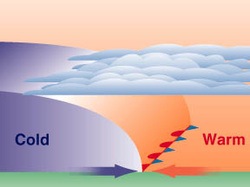
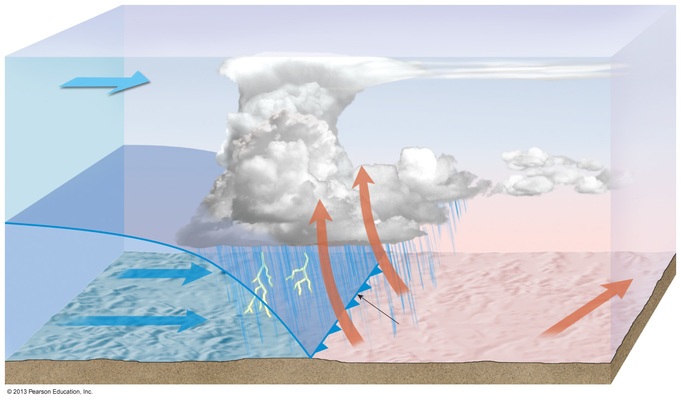
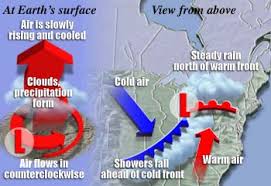
Which cell is located near the equator?
Hadley
Ferrel
Polar
What is the primary characteristic of the Hadley cell?
Cold dense air at the equator sinks.
Warm, moist air near the equator rises.
Cold, moist air sinks
What direction does air move in the polar cell?
North to South
From the poles towards the lower latitudes.
From the equator to the Poles.
What is the main cause of air circulation in Earth's atmosphere?
ocean currents moving from surface to deep ocean
Earth's gravity losing it's pull
energy from the sun heating earth unevenly
Earth's magnetic field stopping

If all 4 locations were at the same latitude, which one would be located inland(surrounded by land)?
A
B
C
D
Without ___, Earth's equator would be much hotter and the poles would be much colder.
clouds
convection cells
precipitation
seasonal changes
The rising and falling in the three convection cells in each hemisphere help to explain...
patterns of wet and dry climates around the globe
the difference between weather and severe weather
the difference between hurricanes and tornadoes
patterns of cold and hot temperatures around the globe
What do you call seasonal changes in the Philippines brought about by the unequal heating of land and water?
ITCZ
monsoons
low pressure
high pressure
Which wind system is characterized by hot and humid weather, frequent heavy rainfall, and a prevailing wind?
trade winds
northeast monsoon (hanging amihan)
southwest monsoon (hanging habagat)
Intertropical Convergence Zone (ITCZ)
Which wind system carries cold and dry wind that affects the Philippines from November to March?
trade winds
northeast monsoon (hanging amihan)
southwest monsoon (hanging habagat)
Intertropical Convergence Zone (ITCZ)
It is a weather disturbance near the equator where the trade winds of the Northern and Southern Hemispheres come together.
trade winds
northeast monsoon (hanging amihan)
southwest monsoon (hanging habagat)
Intertropical Convergence Zone (ITCZ)
For a cyclone to develop it needs a large amount of water vapor. Where does the development of cyclones happen?
above clouds
above the ocean
near the mountain
above the continent
How are tropical cyclones classified?
According to its origin
According to its wind speed
According to the wind system
According to the amount of rainfall
Typhoon signal no. 5 has winds of more than 220 kph and may cause widespread damage to community. This weather disturbance is considered as ____.
tornado
storm surge
Intense rainfall
super typhoon
Which agency is responsible for giving weather reports, updates, and warning signals to the public?
Department of Health
GMA Weather News and Updates
Philippine Atmospheric Geophysical and Astronomical Services Administration
Philippine Atmospherical Geophysical and Astronomical Storm Administration
Which of the following is the sudden rising of the sea level due to the low pressure, high winds, and high waves associated with a hurricane as it makes landfall?
tornado
strong wind
flash flood
storm surge
Which of the following should you do in order to prepare for the coming typhoon?
Don’t travel.
Stay indoors.
Prepare your emergency go-bag.
Keep yourself warm.
Which weather disturbance may bring hail and strong wind for a short period of time?
Monsoon
ITCZ
Thunderstorm
Typhoon
What causes "Habagat?"
When cool, dry air is brought from the land to the seas.
When warm, humid air is brought from the land to the seas.
When cool, dry air is brought from the seas to the lands.
When warm, humid air is brought from the seas to the lands
What causes "Amihan?"
When cool, dry air is brought from the land to the seas.
When warm, humid air is brought from the land to the seas.
When cool, dry air is brought from the seas to the lands.
When warm, humid air is brought from the seas to the lands
The type of climate in the Philippines is based on the rainfall received by a particular place.
True
False
Type II climate is experienced by the places on the eastern side of the Philippines, like Ilocos Sur.
True
False


6. Tropical cyclones rotate ________________ in the northern hemisphere.
Clockwise
Northwest
Northeast
Counter-clockwise

Every year, the Philippines experiences at least how many typhoons?
18
20
25
23
What temperature does the ocean surface have to be in order for a tropical storm to form?
35 degrees
27 degrees
40 degrees
20 degrees
What weather conditions are found in the eye?
Calm and clear
Fastest winds
Heavy rainfall
Low pressure
The area of lowest pressure in a typhoon is...
Farthest from the middle or "eye"
Half way between the eye and the outer edge
At the middle or "eye"
Nowhere; Hurricanes are high pressure systems
What is the name of an apparent deflective force driven by the Earth's spin that gives storms the rotation needed for development?
Corolla force
Borealis force
Vortex force
Coriolis force
Why is water important in the formation of hurricanes?
water produces the winds that move the hurricanes
warm water allows for evaporation which produces the winds to fuel the hurricanes
cold water produces the moisture that creates water vapor and energy to fuel the hurricane
warm water produces the moisture that produces water vapor which in turn releases heat energy to fuel the hurricane
Why do hurricanes form more often at the end of summer?
The ocean water is cooling off and creating more moisture in the air.
The ocean water is cooling off and creating less water vapor in the ocean.
The ocean water is much warmer which fuels the water cycle and creates lower air pressure.
The ocean water is much warmer which fuels an increase in water vapor on the ocean's surface.
How do oceans affect weather patterns?
Ocean water is evaporating, decreasing the temperature and humidity of the surrounding air to form rain and storms.
Ocean water currents transport warm water around the equator and cold water around the poles.
Ocean water is constantly evaporating increasing the humidity and air temperature of the air around it.
Ocean currents transport cold water from the equator throughout the earth.
Why do hurricanes form approximately 8 degrees away from the equator and not closer?
The depth of the oceans at the equator are too deep for heating and forming hurricanes.
The rotation of the earth is too strong to create the needed formation of clouds to start the creation of hurricanes.
The Coriolis Effect is too powerful to form a hurricane.
The rotation force is not strong enough to create the spin of the hurricane
What causes storm clouds to develop?
dry air rising and cooling
humid air rising and cooling
dry air descending and warming
humid air descending and warming
What might cause a thundercloud to start releasing rain?
increase in temperature
decrease in temperature
Place the following events in sequence: A) A tornado touches down; B) An updraft tilts a column of spinning air; C) Cool, dense air begins descending
C,B,A
B,C,A
A,B,C
C,A,B
How are tropical storms in the Northern Hemisphere different from tropical storms in the Southern Hemisphere?
tropical storms cause more rain in the Southerm Hemisphere
the winds spin faster in the southern hemisphere
the winds spin in opposite direction

