Wayground logo

Free Printable Worksheets

Font size

S
M
L
XL
Worksheets

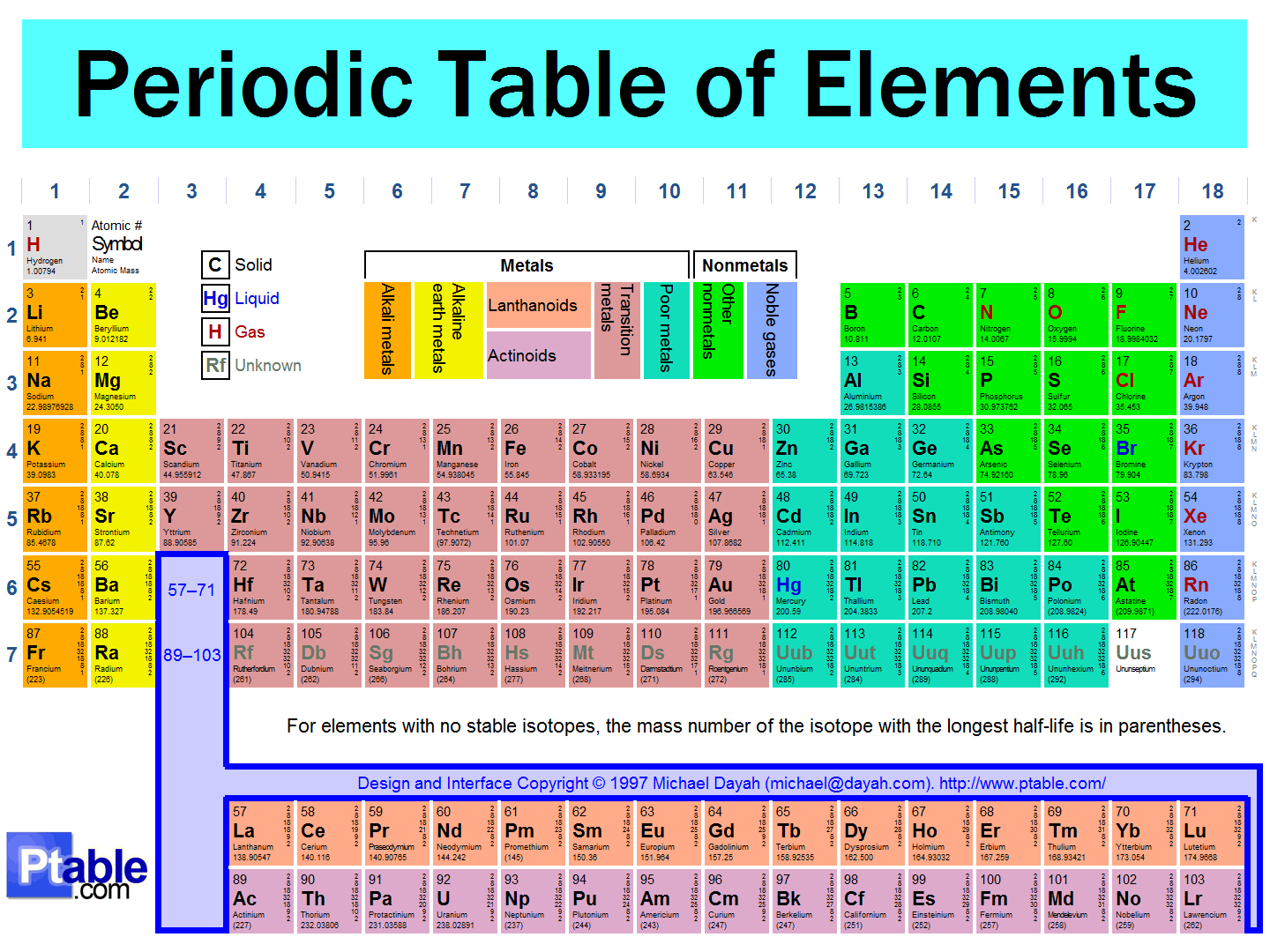
Periodic Table

Total questions: 70

Worksheet time: 1hrs 10mins

Name
Class
Date
1.
In the modern periodic table elements are arranged by:
a)
atomic mass
b)
atomic number
c)
valence electrons
d)
number of isotopes
2.
Each column in the periodic table is called a 
a)
period
b)
group
c)
cluster
d)
unit
3.
The atomic number tells you what?
a)
number of electrons
b)
number of protons
c)
number of neutrons
d)
both electrons and protons in an atom.
4.

Calcium's (Ca) properties are like which of the following?

a)
Barium
b)
Potassium
c)
Cesium
d)
Nitrogen
5.

Beryllium (Be) is in group number______.

a)
Group 2
b)
Group 3
c)
Group 4
d)
Group 7
6.

The period for Bromine (Br) is ___________.

a)
3
b)
2
c)
4
7.
What is the chemical symbol for Lithium?
a)
H
b)
He
c)
Li
d)
N
8.

The number at the bottom of each square on the periodic table is the ...

a)
atomic number
b)
atomic mass
c)
chemical symbol
d)
element name
9.
The horizontal row on the periodic table is called a
a)
group
b)
family
c)
period
d)
atomic number
10.
Which element is found in group 16 period 3?
a)
Sulfur (S)
b)
Selenium (Se)
c)
Chlorine (Cl)
d)
Carbon (C)
11.
Which element is found in period 3 group 2?
a)
Sodium (Na)
b)
Magnesium (Mg)
c)
Yttrium (Y)
d)
Boron (B)
12.
Which element is found  in group 17 period 3?
a)
Chlorine
b)
Flourine
c)
Oxygen
d)
Phosphorous
13.
Which element is found in group 18 period 4?
a)
Neon (Ne)
b)
Chlorine (Cl)
c)
Krypton (Kr)
d)
Xenon (Xe)
14.
Which element is found in group 1 period 2
a)
Lithium
b)
Magnesium
c)
Beryllium
d)
Potassium
15.
Elements which are shiny, conduct electricity and heat are called
a)
metal
b)
nonmetal
c)
metalloid
d)
nonexistent
16.
Which is a halogen?
a)
Helium
b)
Chlorine
c)
Oxygen
d)
Neptune
17.
Which is an alkali metal?
a)
Magnesium
b)
Iron
c)
Sodium
d)
Europium
18.
The atomic number tells you what?
a)
number of electrons
b)
number of protons
c)
number of neutrons
d)
both electrons and protons in an atom.
19.
If an atom had the same properties as fluorine (F), it would probably be located in
a)
period 1.
b)
period 2.
c)
group 2.
d)
group 17.
20.
Atoms with similar properties are most likely located...
a)
in the same period.
b)
in the same group.
c)
in different periods.
d)
to the right and left of each other.
21.
What is the element symbol for boron? 
a)
B
b)
Bo
c)
Bn
d)
W
22.
Each element is unique based on its number of protons, also known as the...
a)
atomic mass
b)
valence number
c)
atomic symbol
d)
atomic number
23.
The atomic number of this pictured element is
a)
28
b)
58.6934
c)
Ni
d)
Nickel
24.

What does the 6 represent?

a)
Atomic mass
b)
atomic number
c)
chemical symbol
d)
element name
25.

What is the group name and number for Neon?

a)
Alkaline Earth Metals 2 or 2A
b)
Noble Gases 18 or 8A
c)
Halogens 17 or 7A
d)
Alkali Metals 1 or 1A
26.

What is the group name and number for flourine?

a)
Transition Metals 3-12
b)
Noble Gases 18 or 8A
c)
Halogens 17 or 7A
d)
Alkali Metals 1 or 1A
27.

What is group name and number for magnesium?

a)
Alkaline Earth Metals 2 or 2A
b)
Noble Gases 18 or 8A
c)
Halogens 17 or 7A
d)
Alkali Metals 1 or 1A
28.
A proton is....
a)
A negatively charged subatomic particle
b)
A positively charged subatomic particle
c)
A neutrally charged subatomic particle
d)
The only subatomic particle located in the nucleus
29.
A neutron has a charge of
a)
+2
b)
No charge
c)
-1
d)
+1
30.
Which elements have the most similar chemical properties?
a)
K and Na
b)
K and Ca
c)
K and Cl
d)
K and S
31.

What is the atomic mass of neon?

a)
10
b)
30
c)
10.18
d)
20.18
32.
Which is a neutron?
a)
A
b)
B
c)
C
33.
Who first developed the Periodic Table?
a)
Mendeleev
b)
Mosely
c)
Mendella
d)
Murphy
34.
What is the formula to solve for the neutron?
a)
Mass + Atomic Number= Neutrons
b)
Mass x Atomic Number = Neutrons
c)
Mass - Atomic Number = Neutrons
d)
Mass + Number of Protons = Neutron
35.
What atom matches this electron configuration?
1s2 2s2 2p6 3s2
a)
Neon
b)
Magnesium
c)
Aluminum
d)
Potassium
36.
Which is the electron configuration for an oxygen atom?
a)
1s22s22p63s23p64s2
b)
1s22s22p4
c)
1s22s22p6
d)
1s22s22p63s23p6
37.
What is the maximum number of electrons that an orbital can have?
a)
1 electron
b)
2 electrons
c)
3 electrons
d)
4 electrons
38.
How many valence electrons are represented here?
a)
7
b)
5
c)
2
d)
8
39.

How many orbital are there in the d sublevel?

a)
1
b)
3
c)
5
d)
7
40.

How many orbitals are there in a p sublevel?

a)
2
b)
1
c)
4
d)
3
41.
How many electrons can the d sublevel hold?
a)
8
b)
10
c)
2
d)
4
42.

What is this element? 
1s22s22p63s23p64s23d104p6

a)
Argon
b)
Krypton
c)
Selenium
d)
Bromide
43.
What atom matches this electron configuration?
[Xe] 6s2 4f14 5d9
a)
Mercury
b)
Gold
c)
Platinum
d)
Thallium
44.
What is the shorthand electron configuration for Sulfur atom?
a)
[Ar] 3p4
b)
[He] 3s23p4
c)
[Ne] 3s23p4
d)
[Na] 3s23p3
45.
How many electrons can the first energy level hold?
a)
1
b)
2
c)
8
d)
0
46.

How many valence electrons does chlorine have?

a)
5
b)
2
c)
7
d)
5
47.
How many valence electrons does phosphorus have?
a)
5
b)
2
c)
8
d)
15
48.

What element has this valence shell configuration?
3s2 3p2

a)
Al
b)
B
c)
Si
d)
Ga
49.
Which element is pictured?
a)
neon
b)
fluorine
c)
magnesium
d)
argon
50.
What noble gas should be used to write the shorthand configuration for Te?
a)
Ar
b)
Kr
c)
Xe
d)
Sb
51.
Identify the element in Period 5 that has 1 valence electron?
a)
Rb
b)
Nb
c)
Ag
d)
Sb
52.
What element in Period 4 has 5 valence electrons?
a)
Zr
b)
As
c)
V
d)
Sb
53.
Which of the following is a p block element?
a)
Ca
b)
Ar
c)
Re
d)
Au
54.
Electron arrangement that uses arrows
a)
Electron configuration
b)
Shorthand configuration
c)
Lewis dot structure
d)
Orbital diagram
55.

Which group of the periodic table is composed of inert (not reactive) gases?

answer choices

a)

alkali metals

b)

alkaline earth metals

c)

halogens

d)

noble gases

56.
What does the 1.00794 stand for?
a)
Hydrogen
b)
atomic number
c)
atomic mass
d)
atomic explosion
57.
The atoms along the staircase are called 
a)
metals
b)
nonmetals
c)
metalloids
d)
noble gases
58.

one or two letters that represent the name of an element

a)

element name

b)

element symbol

c)

atomic number

d)

atomic mass

59.
How did Mendeleev arrange the elements?
a)
alphabetical 
b)
density
c)
melting point
d)
atomic mass
60.
This class of elements are sometimes called "semiconductors."
a)
Metals
b)
Nonmetals
c)
Metalloids
d)
Groups
61.

What is the configuration for Carbon?

a)

1s2 2p2

b)

1s2 2s2 2p2

c)

1s1 1s2 2s2 2p2

62.

1s2 2s2 is which element?

a)

Lithium

b)

Beryllium

c)

Helium

d)

Boron

63.
What atom matches this electron configuration?
1s22s22p63s23p64s23d10
a)
Zinc
b)
Copper
c)
Nickel
d)
Germanium
64.
Which electron configuration belongs to Copper (Cu)?
a)

1s2 2s2 2p6 3s2 3p6 4s2 3d10

b)

1s2 2s2 2p6 3s2 3p6 4s1 3d10

c)

1s2 2s2 2p6 3s2 3p6 4s1 3d9

65.

What is a positive ion called?

a)

anion

b)

cation

c)

isotope

d)

covalent

66.

What is a negative ion called?

a)

anion

b)

cation

c)

covalent

d)

isotope

67.

If an atom loses electrons, the charge will be positive.

a)

true

b)

false

68.
Ions are: 
a)
atoms with a positive or negative charge
b)
atoms with no charge
c)
atoms with ONLY a positive charge
d)
atoms with ONLY a negative charge
69.
An atom becomes _________ when it gains electrons.
a)
Positive
b)
Negative
c)
Neutral
d)
Invinsible
70.

What is a negative ion called?

a)

anion

b)

cation

c)

covalent

d)

isotope